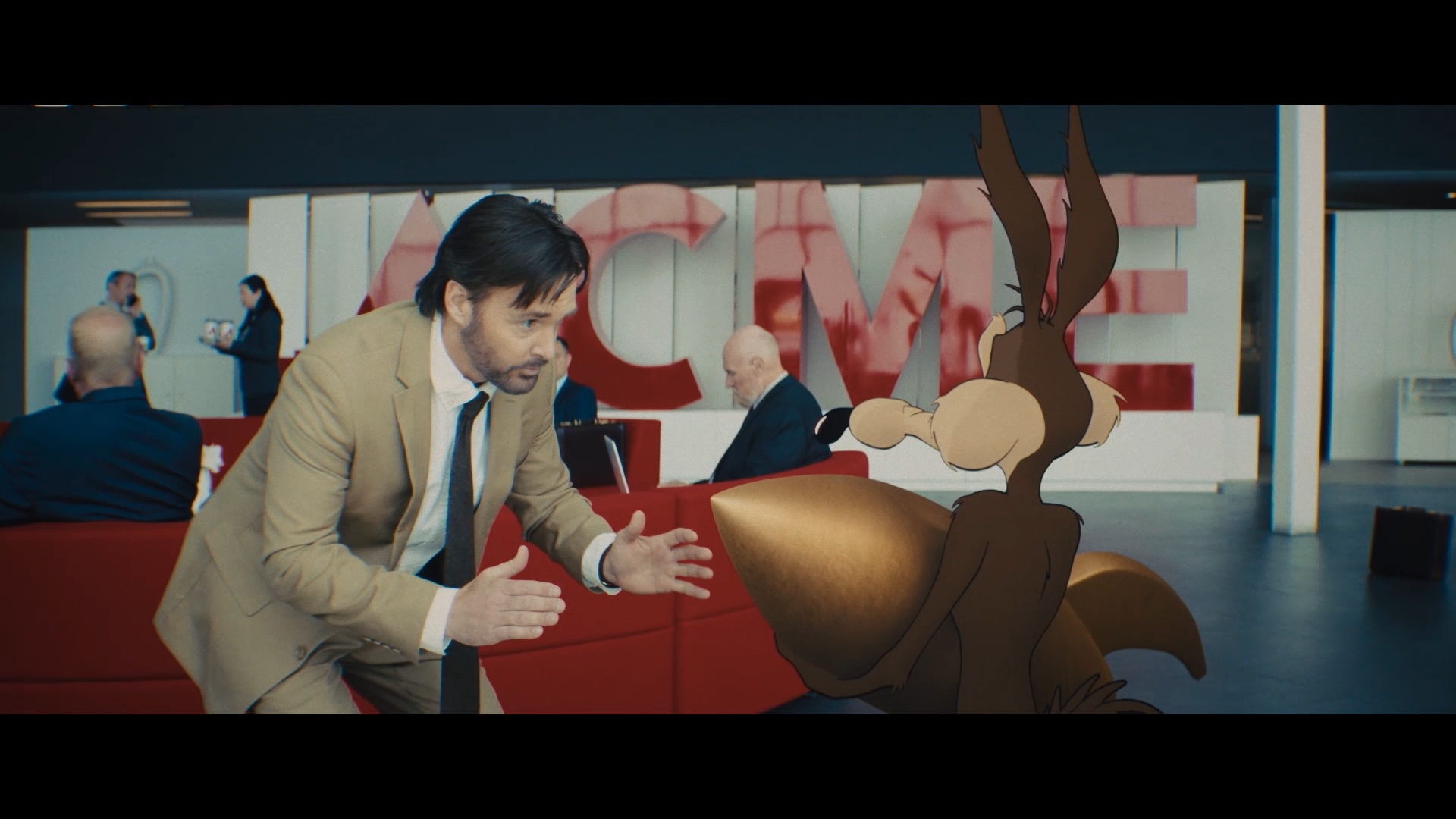
Based on the beloved 1990 New Yorker satirical essay by humorist Ian Frazier, Coyote vs Acme imagines what happens when Wile E. Coyote — the eternally hapless, perpetually-bruised pursuer of the Roadrunner and his next meal — finally snaps. Fed up with decades of catastrophic product failures, exploding rockets, and cliffs that only crumble beneath his feet, Coyote does what any self-respecting cartoon victim would do in the modern age: he hires a lawyer specializing in cartoon defendents and sues Acme Corporation – a faceless corporation of outlandish and often malfunctioning products.
The result is a hybrid live-action/animated legal comedy that blends the anarchic slapstick spirit of classic Looney Tunes with biting contemporary satire — a love letter to animation fans and a biting commentary on corporate accountability, consumer rights, and the absurdity of American litigation culture.
Will Forte stars as the billboard lawyer who takes on Wile E. Coyote’s case alongside Buddy Crane (John Cena) who represents Acme, while an assortment of Looney Tunes characters are rendered in vivid animation that stays faithful to their hand-drawn roots.
The film was directed by Dave Green (Teenage Mutant Ninja Turtles: Out of the Shadows, Earth to Echo) from a screenplay by acclaimed indie screenwriter Samy Burch (May December), whose character-driven instincts brought an unexpected emotional depth to what could have been a purely comedic romp.
Burch and Green shared their thoughts on adapting the original New Yorker article, previous drafts that were shelved, and paying homage to Looney Tunes while creating a comedy that plays well in today’s litigious culture.
What does the ACME Corporation represent?
Dave: Acme is actually part of the vernacular. It’s not just something specific to Looney Tunes. Acme put their name in the phone book so it will be at the top ot the listings.
Samy: From the very beginning from Dave’s pitch, it was always a matter of translating Acme from this ubiquitous, mid-century quaint company that we see in the Looney Tunes to something very recognizable today. It’s a huge, unaccountable corporation today that people are a little more critical of.
Related: Screenwriter Samy Burch On ‘May December’
What did you want to bring to the story of Wile E. Coyote and Acme?
Dave: When I first met this project, I re-read the original Ian Frazier, New Yorker piece, which I thought was incredibly brilliant, raw, funny and smart. It had a real premise at its center, which is if Wile E. Coyote were to sue Acme, would he have a good enough case to win?
I remember first talking to Samy about that piece when we first started discussing this project. It was really funny, first of all, but also it really spoke to the original tonal foundation of what Looney Tunes was when it began. It was it was all of those things in the article.
It was smart, funny and sarcastic all at the same time. One of our shared missions was to give audiences a hybrid live action/ animated film that was able to blend genre in hopefully the same way that Who Framed Roger Rabbit was able to which similarly mixed human actors with animated co-stars.

Samy Burch
There are three credited writers on Coyote vs Acme – Samy Burch, James Gunn & Jeremy Slater. How did that work?
Samy: This version is uniquely me as a very structured piece. There was quite a lot of time between individual writer drafts that went through an arbitration process with the WGA.
WGA arbitration was thematically sound for this movie because I had to write up my case of what I felt I did as a screenwriter. There was an anonymous committee that told us the results.
James Gunn and Jeremy Slater had initially written a treatment and then Jeremy wrote a draft. This was many years before Dave Green was even on the project. So it was definitely a a marathon not a tag team situation. There was no overlapping of drafts.
Dave came on board and then I was hired by him. I think from the beginning, there was a real sense of joy and experimentation of wanting to capture something like that we grew up with as kids that we loved. It’s an interesting mix of goals.
How did you structure the story given that there are so many visuals attached to it with limited dialogue?
Dave: I guess while maintaining the story backbone, it’s easy to run into a sequence of Coyote does this and Acme sells him another faulty product. Samy and I had a chat about what we felt was canon for Wile E. Coyote and what wasn’t. It’s something in our souls. The version of Wile E. that was canon for us was the version where he didn’t talk at and he used signs and mannerisms to communicate.
We also didn’t want to rely too much on those signs as a crutch. We both really liked the challenge of kind of tying one arm behind our backs and having to fence with one hand to have Wile E. Coyote express himself as a silent film, non-verbal character who could still express his wants and goals through body language and expression.
Related: Screenwriter Todd Berger On ‘The Happytime Murders’
How did you navigate the conflict between Acme’s lawyer Buddy Crane (John Cena) and Coyote’s one Kevin Avery (Joe Forte)?
Samy: With Will Forte’s Kevin (a nod to legendary Looney Tunes director Tex Avery) character, it felt really important that there was a lesson to be learned. He was kind of the spiritual person that needed Wile E. Coyote to walk into the door and learn a lesson about resilience. Will does it so beautifully. There’s a lot of sweetness and appeal to him. He’s not a sleazy lawyer guy.
He might be a billboard lawyer, but I don’t think he comes off as someone that’s taking advantage of people. As for John Cena’s Buddy Crane character, I think it’s easy to look at big corporate lawyers with certain tropes. There’s a limitation to the amount of humanity we want to see them with.
I don’t think we get really access to Buddy’s personal life. We maybe see a little bit inside his ego, but not his soul. Buddy’s just doing his job.
Related: Dan Hernandez & Benji Samit Talk Teenage Mutant Ninja Turtles: Mutant Mayhem
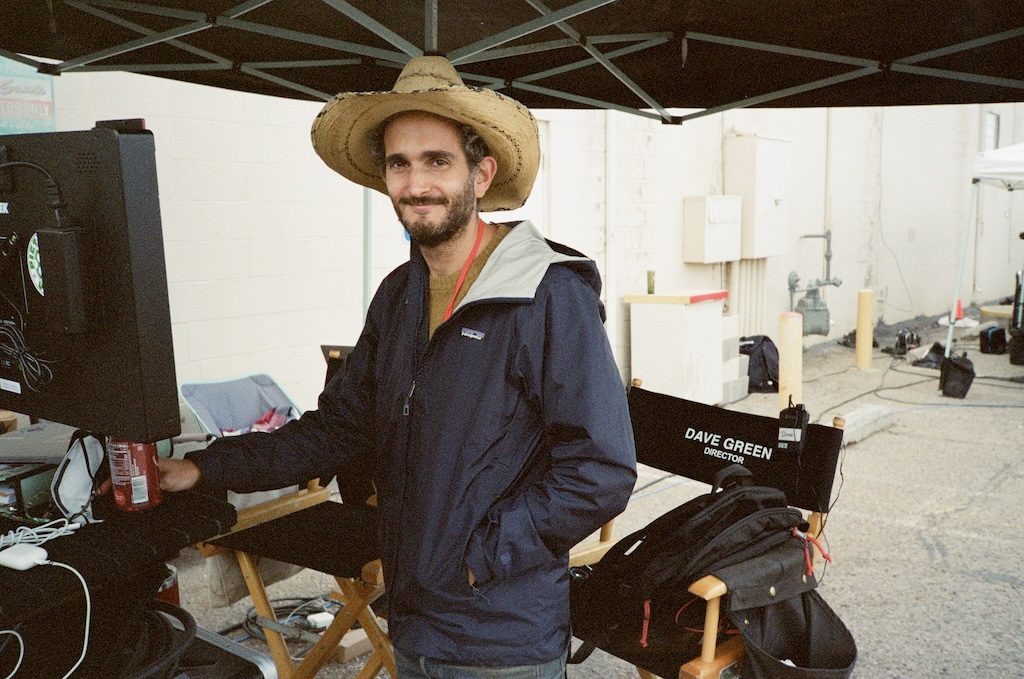
Dave Green. Photo by Karen Kuehn
How did the combination of live action and animation affect the storytelling in Coyote vs Acme?
Dave: From the get-go, we really wanted to set up a world that felt real, or as real as one could be where humans and cartoons are sharing the same universe. We never wanted to design a world where the cartoons lived in a portal or in a separate land. The goal was really to create a version of Albuquerque, New Mexico that felt like having cartoons walk down the street was completely status quo.
We felt it would be funnier that way. What that meant for execution was shooting on location. 95% of the film is shot in Albuquerque, not even on sets; on location or in real environments. I think there are only two sets in the whole film.
It meant giving the cast a counterpart and a proxy that was live and on set. We had a Wile E. Coyote puppet that was built by and puppeteered by Dave Barclay, who is a legendary Henson-trained puppeteer who worked on The Dark Crystal and puppeteered Jabba the Hutt.
He would show up on set and show the actors the first couple takes of what Wile E. Coyote would do, where he would go, and the tempo of him walking across the room and holding up a stick of dynamite. The actors have a fast and easy connection with Dave Barclay and this puppet. They understood it, not only as a way to have a proper eyeline during filming, but also as a scene partner. It really made Wile E. Coyote feel like he was real and present on set.
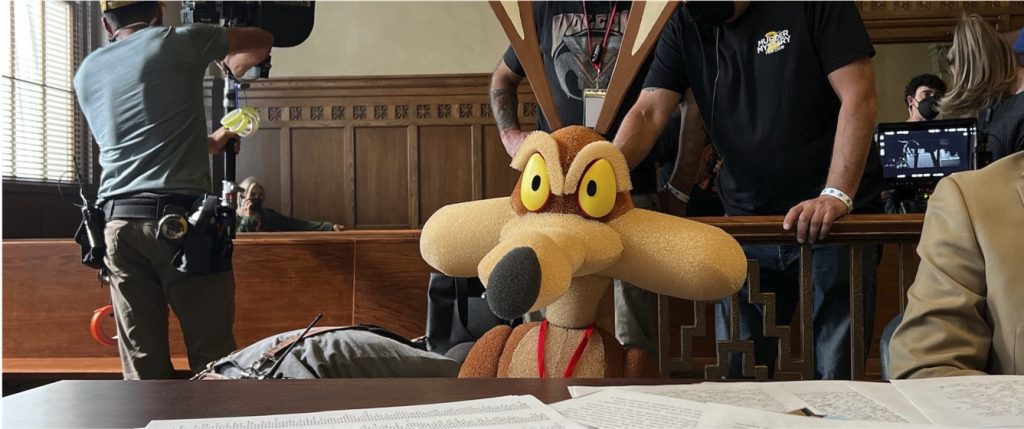
Puppel of Wile E. Coyote on the set of Coyote vs Acme
What did the live action/ animation mix look like in the screenplay?
Samy: Anything animated was in bold.
There was a lot of Wile E.’s intent in the script. It would kind of look like dialogue, but it was often Will Forte”s dialogue. Then it would be followed by an italicized line of description – like Wile E. Coyote makes a face. He was present very much on the page.
As far as the Acme products were concerned, Dave and I were both interested in the characters and the products. We were going into the archives as much as possible for any little reference to the Looney Tunes cartoons. It was almost like having a prop house at your disposal of what and who would work here.
What was amazing was the relationship between Dave and myself. I’m in my house writing alone, turning in pages to Dave, and later talk about them. Then he sent them to animators, from the beginning, at all stages, even while they’re adding gags visually, and they’re being transcribed back into the screenplay.
Dave: I remember Samy putting Wile E. Coyote’s thought processes into the description – anything he wants or feels.
I think one of the strengths of Sammy’s writing overall is that it has such a sparse and minimalist touch that leads to a very beautiful read. If there’s nothing that’s overexplained, it leaves room for cast to interpret. You’re always reading between the lines because nothing is ever spelled out overtly or plainly.
Related: Piece By Piece: Turning LEGO Animation Into A Documentary Biopic About Pharrell Williams.
How did you balance nostalgia and timelessness in Coyote vs. Acme?
Samy: Dave and I are absolutely in the same boat here. I think timelessness is always the goal with any film.
That’s a lofty goal, but I am allergic to any moment that seems too timely. We wouldn’t have cell phones, X or a Miley Cyrus joke or something very timely.
I feel like it’s always going to date you, even if you’re the most modern person in the world. When I look at the movies that I love growing up, the animated and live action family films, you could show them today and stand the test of time.
However, the David vs Goliath battle will always be timeless.
Meep! Meep!