
Chloé Zhao & Maggie O’Farrell Interview: Adapting Hamnet, Grief, and the Real Story of Shakespeare’s Wife

When Maggie O’Farrell’s acclaimed novel Hamnet was published in 2020, it struck a chord with readers and critics alike. Here was a book that stepped behind the literary legend of William Shakespeare and explore the intimate, overlooked world of his family — particularly the short, but meaningful life of his only son, Hamnet. This led to one of his many enduring plays — Hamlet. By focusing on the private aspect rather than the public myth, O’Farrell created a deeply moving portrait of parental love, grief, and the women behind the world’s greatest playwright.
Now, in a captivating film adaptation, Oscar-winning director Chloé Zhao (Nomadland, The Rider) brings her own poetic sensibility to O’Farrell’s literary vision. Both O’Farrell and Zhao share their views on their collaboration to bring this story to the screen.
Maggie, Hamnet takes a fascinating approach to the Hamlet family — it’s the story behind the story. What drew you to focus on Shakespeare’s son, rather than the writing of the play itself?
Maggie O’Farrell: I first heard about the existence of Hamnet, Shakespeare’s only son, when I was a teenager at school and I was studying the play Hamlet. I was really lucky that I had a really brilliant literature teacher and we were studying Hamlet. He just mentioned that Shakespeare had this son who had died aged 11 and that he’d been called Hamnet.
And Shakespeare went on four years or so later to write the play Hamlet. I just was amazed by that story because I think Shakespeare, for all the huge body of his work, we actually don’t know a huge amount about him.
It seemed to me that in that act, it was a hugely significant act. Nobody would name a play after their dead son lightly. It was obviously a very important decision. I’ve always been really heartbroken that not many people know about the existence of Hamnet. And without him, we would not have the play Hamlet — and we probably wouldn’t have Twelfth Night either.

Chloé Zhao
You’ve got two weights on your shoulders. One to honor Maggie’s book and the other to honor one of the greatest playwrights. How did you approach the adaptation?
Chloé Zhao: I have only one loyalty, which is to Maggie’s beautiful book. I actually think me being not British is really helpful. I also didn’t grow up as a deep literature person. I think it’s the same when I made The Rider. I’d only seen two and a half westerns when I made it. I think it’s helpful because I just have to approach Hamnet from the world Maggie created, but also building him with Paul Mescal (who plays William Shakespeare), Jessie Buckley (who portrays Agnes, his wife) and Emily Watson (who plays Mary, William’s mother), and all the other people around him. I just look at him as a human being. I really didn’t feel the weight of Shakespeare at all.
One of the things that struck me about Hamnet is that it needs to stand alone as a family drama rather than as a biography.
Maggie O’Farrell: I never wanted to write a kind of adoration of Shakespeare in the novel. Shakespeare already exists. His plays already exist. And it seemed to me, that what was more interesting, was to address the idea of his life in London. That’s where he wrote and performed his plays. But whenever I read them, it always seemed to me, he was really bonded to Stratford. He sent all his money back to Stratford. Everything he earned in London, he sent back home. And at the end of his career, he retired there.
To write his wife and children out of the picture seemed to be missing an enormously significant element of his life. I wanted to bring those people center stage and say, “I don’t think he did leave his family and forget all about them. And he didn’t hate his wife, as a lot of people try to insinuate.”
Talk about the courtship between Agnes and William and the evolution of their relationship.
Chloé Zhao: It feels like at that time there was a very drastic separation between civilization and nature. So I wondered if there’s something quite primordial in our bodies, when we see the red and the blue, and see them as a masculine and feminine archetype or as nature and civilization.
And I wonder if we have some kind of projection onto that when we look at Agnes and William beyond the chemistry and the dynamic that Maggie created in the book. I wonder if we see parts of ourselves reflected, that could create miracles, but also sometimes are not in harmony. I love when characters can serve archetypal containers and they can go deep from there.

Maggie O’Farrell
Talk about balancing the emotionality of this tragic story with sentimentality.
Maggie O’Farrell: It was never going to be this Hallmark thing, a little tearjerker, but it was a deeply moving tragedy of a family losing their child. I think it was, for me anyway, a reaction to the scholarship around Shakespeare. In those books, Hamnet is lucky if he gets two mentions. He was born and then he died. And always his death in these books and scholarship is wrapped up in statistics about child mortality in the Elizabethan age, which was extremely high.
I actually read a very respected biographer who said, “It’s impossible to know whether or not Shakespeare grieved.” When I read that, I actually wanted to throw this book across the room. Just because mortality was high, it doesn’t make it any less devastating when your child dies. You only have to read the opening act of Hamlet to realise that that whole play is a message from a father in one realm to a child in another. So I suppose, in a way, I was reacting to people downplaying this child’s death. I wanted it to feel upsetting when this child was lost. I wanted to say this child was loved. He was grieved.
Chloé Zhao: The great Francis McDormand once said to the press [about Nomadland], “Chloe sort of walked a razor’s fine line.” It was an edge between sentimentality and emotionality. So I think it depends who is the viewer.
I’m only interested in the present moment. When I’m upset, it is in the present moment, even though I’m in the business of playing with time. But it is in the present moment that the truth exists. When I’m on set, I am loyal to those moments.
During the development process, talk about some of the elements of discovery, that kismet, that magic, that emerged from the merging of film and book, that wasn’t in either of yours’ original thinking.
Maggie O’Farrell: The whole process was really fascinating to me about taking the narrative of a book, which is 350 pages and to stick it down to maybe a 90-page document, which is a film script. It’s very bold. It’s not like a novel at all. A novel has got all this description and interiority.
A film script is functional. What fascinated me, is that it was a bit like the hourglass show. You’ve got this large canvas of a novel and you bring it right down to its sort of pith, in a sense. What was really interesting is watching Chloé build it up again into something different. That’s very poetic.
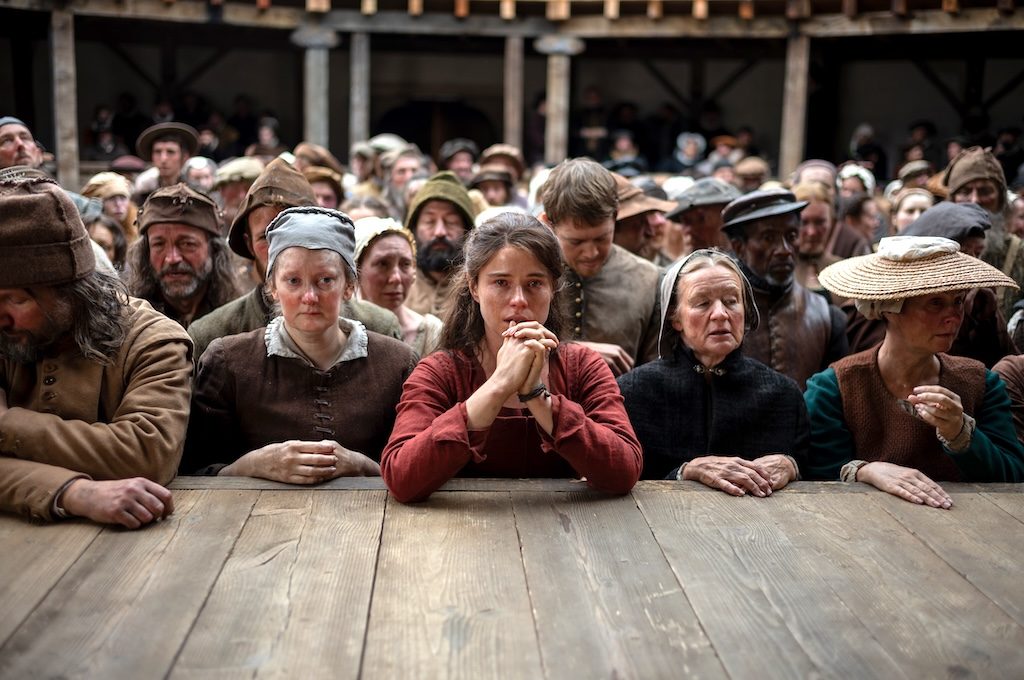
Agnes Shakespeare (Jessie Buckley) Photo by Agata Grzybowska / Focus Features
Discuss crafting the closing scenes as a satisying conclusion to the story.
Chloé Zhao: One of the things I love best about the film are those final closing scenes. There are elements of certain things that are quite telescoped in the book, because in a novel you can put long speeches from Shakespeare. You can’t do that in the film because it feels undigested. I love the way that the film and the script was able to really pull all those threads out of the novel, to expand them, and to actually see the actors and their costumes and the physicality of it all — the exhaustion of performing a play that was probably three, four hours long.
I remember one of the things Maggie asked me to do when we were just about to write those scenes was an essay about where Shakespeare’s biography coincides with the play. I sat there and I was thinking, “This is just like a university.”
Because I don’t have time to read a thousand pages of biographies, I quite enjoyed it. It was amazing because I always say, “When you end your book with the words ‘Remember Me’ and then it goes to blank page.”
What that does to human beings is amazing. The written language is so much older than the cinematic language. It’s not the same to have Paul say, “Remember Me.“It does not evoke the same emotions or imagination in the viewer or the audiences. So we had to write 25 extra pages just to capture that feeling.
During some screenings, people were laughing at the final moment when Mary touched Will’s hand. Think about how crazy that is. She’s not the best audience member at the theater; she’s quite disruptive. I think it’s like a really good eulogy where you’re smiling as you bid someone farewell. I’ve never laughed at a funeral, but I have smiled because of that uplifting feeling.

Join the Discussion!

Browse our Videos for Sale
[woocommerce_products_carousel_all_in_one template="compact.css" all_items="88" show_only="id" products="" ordering="random" categories="115" tags="" show_title="false" show_description="false" allow_shortcodes="false" show_price="false" show_category="false" show_tags="false" show_add_to_cart_button="false" show_more_button="false" show_more_items_button="false" show_featured_image="true" image_source="thumbnail" image_height="100" image_width="100" items_to_show_mobiles="3" items_to_show_tablets="6" items_to_show="6" slide_by="1" margin="0" loop="true" stop_on_hover="true" auto_play="true" auto_play_timeout="1200" auto_play_speed="1600" nav="false" nav_speed="800" dots="false" dots_speed="800" lazy_load="false" mouse_drag="true" mouse_wheel="true" touch_drag="true" easing="linear" auto_height="true"]







You must be logged in to post a comment Login