
Diving into the Depths of “Black Rabbit”: An Interview with Creators Kate Susman and Zach Baylin

Following the success of The Order starring Jude Law and Nicholas Hoult as Bob Mathews, husband and wife team Zach Baylin and Kate Susman turned their attention to television with Black Rabbit. Kate and Zach spoke with Creative Screenwriting Magazine how their earlier collaboration with Jude Law led to their TV series.
How is Black Rabbit a natural extension of The Order?
Kate Susman: The genesis of Black Rabbit from The Order primarily started from just wanting to work with Jude Law again. When Zach was pitching The Order to Jude and director Justin Kurzel, we were in the early stages of thinking about Black Rabbit and pulling the idea together. Zach mentioned it offhandedly to Ben Jackson, who runs Jude’s production company, and Ben suggested that this might be something Jude would be interested in. We continued to meet and tell them the idea.
I don’t think that there are obvious thematic or tonal correlations between The Order and Black Rabbit, except perhaps our shared interest in telling personal stories — stories about characters whose inner lives and troubles manifest in larger-than-life ways. Jude Law who plays Terry Husk in The Order and Jake Friedkin in Black Rabbit certainly fit that bill.

Kate Susman
We were wondering if Jude, known for that gnarled, rusty, haggard look in The Order — could step into this suave, debonair role in Black Rabbit. He’s chameleonic in that way.
Zach Baylin: The Order was something Kate, producer Bryan Haas, and I had been developing for eight or nine years, representing a character study and a throwback to a more 70s crime sensibility — a theme I’ve always been interested in. Black Rabbit fits into that mold to some degree.
Additionally, collaborating with someone like Jude Law and Justin Kurzel was so fruitful. Their input improved the scripts significantly, making us hungry to have that experience again. When we managed to include both of them in this project with Jason Bateman who plays Jake’s brother Vince, it felt fortunate how the timing overlapped.
How did you pitch Black Rabbit to Netflix?
Kate Susman: There were two main drives for the show. Zach and I lived in New York for a long time, and we were fascinated by restaurant culture — not just the food, but how restaurants serve as gathering places and clubhouses for the artistic crowd.
We felt privy to those places because we lived across the street from locations that definitely inspired Black Rabbit, like the Spotted Pig. Additionally, we witnessed how things weren’t as they seemed at those establishments. The nightly theater we observed didn’t match the reality of what was happening during the day, which could be pretty grim and unappealing. We found ourselves intoxicated and intrigued by that world, which we hadn’t really seen depicted on television before.
This mixture of glamorous perception and harsh reality drew us in. The essence of the show lies in its exploration of these environments where the charming surface often hides deeper struggles. Our personal experiences and observations in New York shaped much of Black Rabbit‘s narrative offering a unique perspective that sets it apart within the realm of similar stories.
This exploration of duality within that culture allowed us to craft characters who navigate both the polished façades and the underlying chaos. That complexity became central to our story, in which we dissect behaviors, challenges, and the artistry of life intertwined with restaurant culture.

Zach Bayling (Photo by Kate Susman)
Zach Baylin: The special sauce to any of these things is like a specificity of perspective, since we knew this world very well. This is a much more personal story than I’ve ever written. And I think that’s what we really sold in every stage of the pitch first to Jude Law and to Jason Bateman and then to Netflix. This was a story where we were going to really mine our lives and put it out there.
Can you speak to the main character development of the brothers in Black Rabbit?
Kate Susman: Character development is at the heart of Black Rabbit. Each character grapples with their motivations and desires, which are often at odds with each other. The restaurant setting heightens these conflicts, as the characters’ dreams confront the harsh realities of their lives. It’s a scaffolding and kind of the background for the story about two siblings.
Jake Friedkin, the protagonist, embodies the struggle for self-identity while working in a world that celebrates superficial success. His journey will be one of self-discovery, pushing him to navigate the slippery slopes of what it means to be fulfilled versus what it takes to succeed in an industry that thrives on appearances.
In creation, we want viewers to connect with these characters on a deeper level, understanding their humanity — even when their choices might seem misguided and risky. Each character serves to highlight different aspects of the themes we’re exploring, particularly the cost of aspiration and the shadows lurking behind that ambition.
Discuss the visual storytelling in the series to convey its themes.
Kate Susman: One of our primary goals is to illustrate the contrast between the allure of the restaurant world and the underlying darkness that often lurks beneath its surface. Our visual storytelling will embrace that contradiction, using lighting, color palettes, and camera work to emphasize tone and mood.
We aim to create a richly textured environment where the vibrancy of life in a restaurant contrasts sharply with the emotional undertones of the characters. This stylistic dichotomy will be reflected in how we shoot scenes, from lively dinner service moments to the quieter, more intimate explorations of the characters’ private lives, showcasing the juxtaposition of their public personas versus their inner struggles.
The episodic format provides us with the opportunity to develop arcs that can evolve and play out over time. Each episode will focus on different elements of the characters’ lives, delving into their backgrounds, struggles, and relationships both inside and outside the restaurant. This allows for layered storytelling that can build tension and give viewers a chance to invest in the characters’ journeys.
By structuring the narrative this way, we can explore a variety of themes and issues while providing the space for our characters to grow and change. The episodic nature of Black Rabbit also offers us the flexibility to experiment with pacing and narrative style, allowing for slower, more intimate moments alongside those that are fast-paced and intense, mirroring the rhythm of life in a bustling restaurant.
Going beyond entertainment, we hope this multifaceted approach will facilitate a deeper examination of the broader societal issues reflected in individual stories, revealing how personal experiences are often shaped by culture, class, and the complexities of modern life.
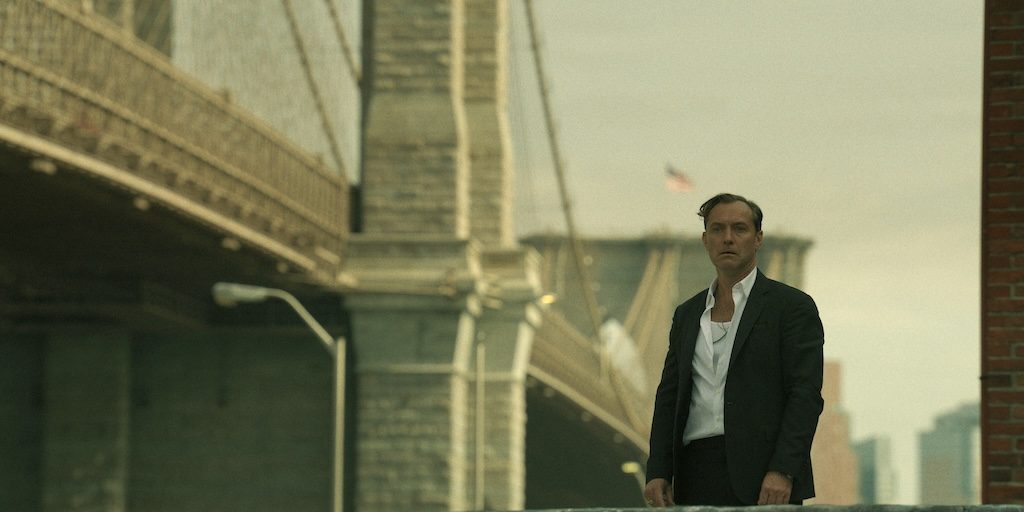
Jake Friedkin (Jude Law) Photo courtesy of Netflix
What’s at the heart of the conflict between brothers Vince and Jake?
Kate Susman: I think the story that we centered it around is the brothers being two sides of the same coin. It’s about two very complex, very different characters, who against all odds, really love each other. They are battling their whole lives with what do they owe each other and how much sacrifice you willing to make for your brother. There’s this this really complicated, really painful and layered history of two brothers.
Zach Baylin: I think a lot of people have relationships, whether they’re familial or friends, where you’re incredibly indebted and tied to, but the further you allow yourself to be pulled into the into their orbit, the more it begins to fracture the larger life you’ve built without them. We were wanted to see how far we could push and test their relationship.
When we introduced Vince at the beginning, he’s going to appear to be the the real screw-up, the one who is an atom bomb in their lives. And then we’re going to spend a little time afterwards, in some ways reversing that dynamic and showing you that Jake, while he puts on the front of someone who has things together, is his own type of atom bomb, but he’s hiding everything.
There is something more honest about Vince because he’s wearing his frailty and his screw ups on his sleeve. That was a very interesting point for the audience who might change who their allegiances and understanding might be with.
How did Jake and Vince’s characters evolve during the development process?
Zach Baylin: Jake became a warmer person than was originally written. Vince became more antagonistic and aggressive than initially on the page. Vince had been a little bit more in retreat and a little bit on the defensive. Jason Bateman, from minute one, perceived the character as indignant in a way and that really changed the way we began to write him. He had so much more confidence than you might necessarily ascribe to that character.
How did you use flashbacks in Black Rabbit?
Zach Baylin: Those are the aspects of the story that Kate and I gravitated towards the most. They were an opportunity to play around in time a little bit and and create mysteries within a relationship, not just in the plot. We were going to be able to expose some of the hinge points of where Jake and Vince’s traumas have come from.
These are all windows into moments where they were on the precipice of success with their band. They were codependent in a positive way. Then there are moments where that opportunity is snuffed out.
Talk about the season finale.
Kate Susman: We always knew this is how we wanted the show to end. We knew that it was a tragedy that ends in one brother making the ultimate sacrifice. But we wanted to feel like there was some hope. I think that there is hope for Jake in the final moments that he is. The weight has been lifted; the anchor has been lifted. Jake’s finally in a place of being able to understand who he is now that the layers have been stripped back off of him. We always liked the idea of when you have some kind of a fall from grace, there is a second chance. Jake has dropped the mask and is more comfortable in his skin.

Join the Discussion!
Related Articles



Browse our Videos for Sale
[woocommerce_products_carousel_all_in_one template="compact.css" all_items="88" show_only="id" products="" ordering="random" categories="115" tags="" show_title="false" show_description="false" allow_shortcodes="false" show_price="false" show_category="false" show_tags="false" show_add_to_cart_button="false" show_more_button="false" show_more_items_button="false" show_featured_image="true" image_source="thumbnail" image_height="100" image_width="100" items_to_show_mobiles="3" items_to_show_tablets="6" items_to_show="6" slide_by="1" margin="0" loop="true" stop_on_hover="true" auto_play="true" auto_play_timeout="1200" auto_play_speed="1600" nav="false" nav_speed="800" dots="false" dots_speed="800" lazy_load="false" mouse_drag="true" mouse_wheel="true" touch_drag="true" easing="linear" auto_height="true"]







You must be logged in to post a comment Login