
From Script to Screen: Lucy Liu, Andrew Corkin, Frank Shyong and Marilyn Wu Talk “Rosemead”

Set in California’s San Gabriel Valley and based on true events, Rosemead follows Irene Chao (Lucy Liu), a terminally ill Chinese immigrant and widow who is desperately trying to secure a future for her teenage son, Joe (Lawrence Shou). As Irene hides her worsening cancer diagnosis from him, she discovers that Joe — who is struggling with schizophrenia — has developed a dangerous obsession with mass shootings.
Faced with a failing medical system, cultural stigmas surrounding mental health, and the realization that she may not be there to guide him once he turns 18 and a legal adult, Irene is forced to contemplate a tragic sacrifice.
This roundtable discussion with actor and producer Lucy Liu, producer Andrew Corkin, executive producer Frank Shyong, and screenwriter Marilyn Fu illustrate the challenges in making a culturally relevant independent film in the modern age.
The LA Times story of 2017 which inspired Rosemead is based on the Hong family on which Irene and Joe Chao are modelled. The article was written by Frank Shyong and has subsequently written additional articles about the subject.
Frank Shyong: This story had existed in the news as a shocking incident of domestic violence in the San Gabriel Valley. They are not as uncommon as you might imagine. A week after my story came out, there was a story of a son who killed his mother in the neighboring community. You keep finding mothers and sons like this.
In the Asian American community, typically the way we like to handle these stories, is to not speak about them. It was a way to remember the event and it was led by people who couldn’t let the record stand as it is, and who wanted to correct that record. Behind a lot of these painful and outrageous incidents, there are people who try to hold on to each other. It’s not an ugly truth, but a beautiful one.
Optioning the L.A. Times article
Producer Andrew Corkin and actor Theo James optioned the story back in 2017, shortly after it was published.
Andrew Corkin: I can’t remember how I first came across the article. But when I read it, it just sat like this pit in my stomach that I could not stop focusing on. Theo and I would explore what we would do in a situation like this.
How do you rectify the actions that took place? What would have been like in that house for these two people? The two of us started talking to people around us, our friends, our family because it was so incredible in terms of this being a true story. It’s tragic, almost like a horror film.
The fact that it was a preventable story is something we were talking about too. Then we got to a place that we realized the only way that we can continue to talk about this and amplify the message that Frank captures in his article, is by turning this into a film. Frank’s article moved us in such a way that we wanted to have larger conversations with the people around the world. This story takes place miles from where we are right now, but the themes are so incredibly universal.
I’m not a parent and Theo wasn’t a parent when we first read this, but this is the story of a mother and her son. It is a story of very complicated love and a mother’s act of love. That was something that really shone through from the beginning.
We’re so glad that the L.A. Times and L.A. Times Studios allowed us to option this article and begin the journey to adapt it. And that leads us to the incredible screenwriter Marilyn Fu, who was the one to take on this story. We knew it was going to be an incredibly difficult tightrope act because of how layered it is.
In the wrong hands, it could be a very black and white story of good or bad, good or evil. It’s such a layered story of love, acceptance, and a lot of difficult themes.
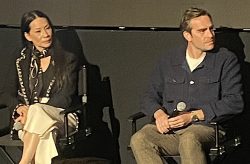
Lucy Liu and Andrew Corkin.
Non-judgment, empathy and understanding of Irene Chao’s drastic choices.
Lucy Liu: I want to take a moment to thank Frank for your bravery and persistence with this story, because I feel like it’s something that might have just passed us by as a headline if you hadn’t really found a way in and given us a glimpse into these people’s world.
My approach in the acting really came from the article, because we’re not making any judgment on Irene. We’re seeing past her final action and looking at her as a person. That is something that I always look for in stories.
I’m looking for humanity and I’m looking for how we step inside the shoes of someone who we think we might have nothing in common with. Those two things aligned when I read the article. Even if we can’t see ourselves doing the same thing, we will have seen her as a real person.
It was always with that in mind, no judgment, we’re just going to get to know Irene and understand her – Lucy Liu
I think it’s very easy to vilify somebody and just see the consequence, and not see it from their side. And I know that for myself, as a child of immigrant parents, you can see the history and track the generational trauma that comes from being placed into a country and then judged based on what you sound and what you look like. With Irene, you can see the joy and the love and the nuance of this relationship that she had with her son.
There’s a fragmentation, an emptiness that people feel like there’s a severe break between how she presents outside of the home. That’s how I grew up as well. Growing up, knowing that at some point I was a translator for my parents, even though I was a child and losing that childhood and losin, that framework of where that line is.
Irene had a displacement, in not only the community of being in America with her language barrier, but she also had a displacement within her own community of being judged for seeing a Western doctor – the rumors, the medicine and the stigma behind mental health in the community
It’s so difficult to understand what people are going through having had lost her husband. Instead of coming together as a community, they judged her and they didn’t surround her with healing.
And then everyone wonders, ‘Oh, my God, look what happened to this person?’
Irene came and acted from a very lonely place. I think that’s the tragedy that she really believed this was her best and only option forward. It’s heartbreaking to me because this is a woman that loved deeply.
Breaking down the dialogue and understanding the fragmentation was also going to be her vulnerability. The audience would feel that she was trying to communicate and she was being direct, but things were slipping through the cracks.
She didn’t quite understand her diagnosis and kept thinking that she would be fine. Irene was a good citizen. She tried to follow and obey what the school was telling her to do with Joe. Go to this mental health therapist. Give him Western medicine. Even at the end, she called the police.
What’s even more heartbreaking is the health care system failed her. She should have had an advocate in those rooms speaking her language and describing to her exactly what’s happening. There’s this scene that Marilyn brought in where Irene speaks to the therapist and says, “Just because you look like me, it doesn’t mean you understand us.” He didn’t speak the language. Even within our own community, there’s that segregation and that sequestering.

Frank Shyong and Marilyn Fu
Balancing Themes of Mental Health in the Writing Process
Marilyn Fu: The screenplay went through a lot of iterations. I think of the screenplay as a living document. When I take my first effort at it, I’m looking at characters, Irene and Joe. At the core of the film, it’s about a mother’s love for her son and a son’s love for his mother. Everything has to echo back to that.
It was always going to end in the motel room. We weren’t ever going to see Irene beyond that because that was her moment. That was what her life had been leading up to very tragically.
Knowing those big pieces starts to frame what the screenplay is going to be. I’m trying to make decisions about how to portray Joe’s schizophrenia. It’s always going to go back to whether this portrayal adds or takes away from this love story between mother and son. Initially, his schizophrenia was much more pronounced outwardly. Eric Lin, our director, asked, “What do we need to strip away so that we can continually focus on the love story?” And by doing that, Joe really internalizes it to make it a universe within himself.
Where does this role fit into Lucy Liu’s career?
Lucy Liu: When you look at the sky, you see the stars; it just seems endless. And sometimes when you go into a different place, like a city, you don’t see as many stars, but they’re still there. This movie and this role has always been there. Maybe the lights have been a little bit too bright. When you shift into a different space, you can see more.
There are so many other possibilities that are out there. You just have to shift your footing to find them. There were very few possibilities and opportunities when I first started in the business over 30 years ago.
Now it’s really exciting to see that this is a not just a role, but an activation. It is not just a discussion point, but a verb. A verb meaning an action of something that is about humanity and about connection.
I think we’ve lost a lot of that, not just from the pandemic, but from technology. So our role is, as people in the arts, is to continue to express and to allow others to feel like they belong and can express themselves. That is the connective thread of why it is important to continue to have art.
Art is not just entertaining, it’s also a form of protest, a form of growth, and a form of protection. And we all deserve to be protected, to be seen, to speak out and feel like we’re doing it together in unity. There’s a safety in that.
There are so many more stars in the sky that we have yet to see. We sometimes have to shift our focus and dim the lights a little bit.
Timing Rosemead’s Release and the State Of Independent Cinema
Andrew Corkin: This was always a story that we knew needed delicate care and couldn’t be rushed. I don’t know if now is the exact right time. I think that this film needs to exist. Even if we had made it eight years ago it still would have been timely.
This story is so necessary right now. The market that it is coming out into is a little bit more dour than it’s ever been for films like this. But this shows the willpower of this incredible orchestra of people that believe and will this film into existence.
It took 16 different investors from all over the world to come together and say, “We believe in what this story is looking to speak into the world and champion.” We had Lucy Liu supporting the film and joining the team at the very beginning. These were the building blocks of the story.
And it was continually saying to people that we meet, whether it was studios, distributors, bigger financing companies and financers to trust us. There is a community. There is a audience for a film like this. Believe in what we’re pitching.
There’s never been an easy time to make independent films. We always accept the fact that no one’s going to do it if we don’t do it. We don’t want this industry to go away. It is being a responsible producer and making sure that we made it at a budget. We’re also responsible enough that if enough people take a chance and watch this film and tell other people about it, then it is actually not the greatest financial risk for these investors.
The people that have supported this film financially signed up for this film with that understanding, and they continue to support it. So, it’s never been easy. That’s not why I got into this business.

Join the Discussion!



Browse our Videos for Sale
[woocommerce_products_carousel_all_in_one template="compact.css" all_items="88" show_only="id" products="" ordering="random" categories="115" tags="" show_title="false" show_description="false" allow_shortcodes="false" show_price="false" show_category="false" show_tags="false" show_add_to_cart_button="false" show_more_button="false" show_more_items_button="false" show_featured_image="true" image_source="thumbnail" image_height="100" image_width="100" items_to_show_mobiles="3" items_to_show_tablets="6" items_to_show="6" slide_by="1" margin="0" loop="true" stop_on_hover="true" auto_play="true" auto_play_timeout="1200" auto_play_speed="1600" nav="false" nav_speed="800" dots="false" dots_speed="800" lazy_load="false" mouse_drag="true" mouse_wheel="true" touch_drag="true" easing="linear" auto_height="true"]






You must be logged in to post a comment Login