
Kate Winslet’s Directorial Debut: Exploring Family, Loss, and Humor in “Goodbye June”

Known for her immersive performances, the much-lauded Kate Winslet as entered the cinematic arena in her directorial debut Goodbye June, starring Helen Mirren, Timothy Spall and Toni Collette. She even reserved a spot for herself as Julia. Notably, the screenplay was written by her son Joe Anders. Winslet shares her thoughts on getting this film together when all the stars aligned.
The premise of the work was inspired by Winslet’s personal experience of death of her mother to ovarian cancer in 2017. Anders wrote the screenplay at the age of 19 when he attended a screenwriting course at the National Film and Television School in Beaconsfield, England. Winslet explains that Anders “was encouraged by a wonderful tutor to write about something that he knew … Whilst it is not autobiographical in any way, [Anders] took the scenario that he had been around when my own mother passed away.”
The Origin of Goodbye June
Honestly, I didn’t plan to do all three roles (actor, director, and producer) initially. The journey started in a rather unexpected way— through my son, Joe Anders. He had always shown an inclination toward creativity, carrying a notebook with him from a young age, and he’d write everything from poetry to monologues. After leaving school, he explored acting and found some initial success. Eventually, he decided to attend screenwriting school. When he completed his program, he approached me and said he had written something that he wanted me to read.
He expressed uncertainty about the quality, worrying it might be “really crap” and even asked if I could lie to him if it was bad! But when I read the script, I was blown away. It instantly struck me that this was a story that needed to be told — a unique narrative that had the potential to resonate with many. I told him that we were going to make this into a film, and he was taken aback, insisting that it was just an assignment. But I assured him that I saw a film in his writing, and he needed to trust himself.
After about a year of development, I found myself deeply invested in the project. I knew I wanted to play the role of Julia, which I ultimately ended up doing. The more I worked on it, the more passionate I became about the story.
Themes of Family and Loss
The narrative centers around family dynamics and the complexities of dealing with impending loss. It’s not merely a story about death; it delves into how families communicate — or fail to communicate — about such sensitive issues. In the film, we see two sisters who haven’t spoken for several years, and they find themselves thrown together to confront the impending loss of their mother, the matriarch of their family.
This theme is particularly poignant because, as we all know, everyone experiences loss at some point. It could be a parent, a sibling, or even a close friend. We’re not particularly skilled at discussing these topics, especially within families where relationships might be strained. I wanted to tackle that head-on.
In a family like the one portrayed in Goodbye June, where open dialogue is absent, the emotional fallout can be severe. The film invites viewers to consider their own familial relationships and how they navigate difficult conversations. It was crucial to me that this story felt relatable — something that viewers could look at and recognize their own experiences in.

Julia (Kate Winslet) and Helen (Toni Colette)
Photo by Kimberley French/ Netflix
Finding Humor In Grief
The fact that my son wrote the story added a profoundly personal layer to the project. His perspective as a young adult informed the narrative in crucial ways. I felt a sense of responsibility, not just to my own artistic vision, but also to honor his storytelling. While the screenplay touches on heavy themes, it’s also laced with humor — something that often emerges in the wake of grief. That blend of heartbreak and comedy made it all the more rich, allowing for a multifaceted exploration of family life.
Watching Goodbye June, I found that the emotional beats resonate deeply, eliciting not only laughter, but also tears. It captures the oscillation between joy and sorrow that often accompanies bereavement. The script is packed with nuances that reflect the complexities of relationships, making it a joy to watch as well as a cathartic experience.
I wanted to illustrate how, even in times of great loss, humorous moments can arise that might seem absurd at first, but reflect the reality of that experience. This script doesn’t shy away from exploring those facets, and it asks the important question: How can we learn to laugh even as we mourn? That balance is something I aimed to capture in the film and in my direction.
Humor enriches the narrative tremendously. Laughter often emerges as a defense mechanism, a way for people to deflect pain briefly. In the film, those moments of humor remind us that it’s okay to find joy even in heartbreaking circumstances. I think audiences appreciate seeing those odd yet relatable moments reflect their own experiences. It resonates deeply and can even provide relief, allowing us to step back and breathe, even as we engage with heavier emotions.
Building the Cast
Each actor brought their unique interpretation to the characters, infusing the film with richness and depth. Andrea Riseborough, in particular who plays Julia’s sistter Molly, has been a longtime collaborator of mine. She read an early draft of the script, which was actually incomplete at the time — my son still had about 20 pages left to write. But even in that unfinished state, she was eager to join us and agreed to play the character of Molly.
There were personal outreaches to many of the actors. While I had previously worked with Andrea, interestingly, I had never met Toni Collette or Johnny Flynn before this project. My son, who had been mingling at various events, managed to speak with Johnny and suggested he might be interested in reading the script. Johnny expressed immediate excitement about joining us. That sense of goodwill was palpable throughout our casting process.
Creating a circle of trust among the cast was of utmost importance to me. It’s essential when tackling intimate themes to foster an environment where actors feel safe to explore their characters fully. Establishing that atmosphere took time, but was well worth the effort.
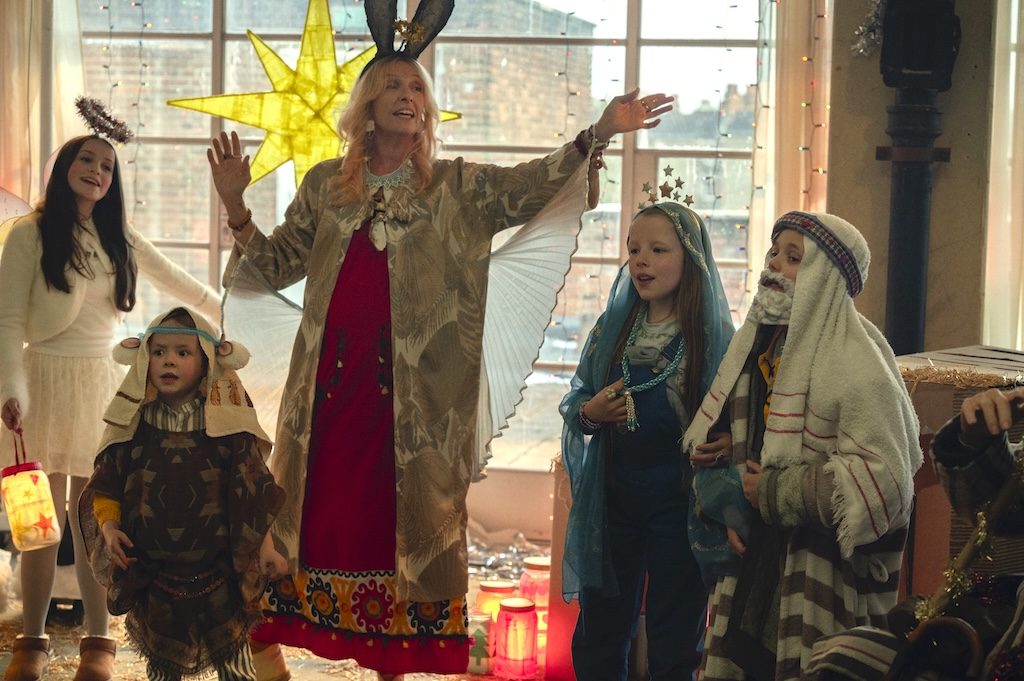
Hele (Toni Collette) Photo by Kimberley French/ Netflix
Creating an Intimate Environment on Set
I wanted to foster a different approach to working on set, particularly given the nature of the story we were telling. I spent a lot of time contemplating how to create an environment that would allow seasoned actors like Helen Mirren and Timothy Spall to be completely real and authentic in their performances.
We made the decision to forgo standard equipment like overhead booms and radio microphones while filming. Instead, we utilized a more intimate setting, allowing the actors to engage freely in the moment without the constraints that traditional filming methods can create. This choice was pivotal in capturing the rawness of their performances.
By altering the on-set environment, I aimed to encourage the actors to dig deeper into their roles. This required vulnerability, especially around themes of grief and family conflict. I think we succeeded in creating authentic connections that allow viewers to feel a part of the story.
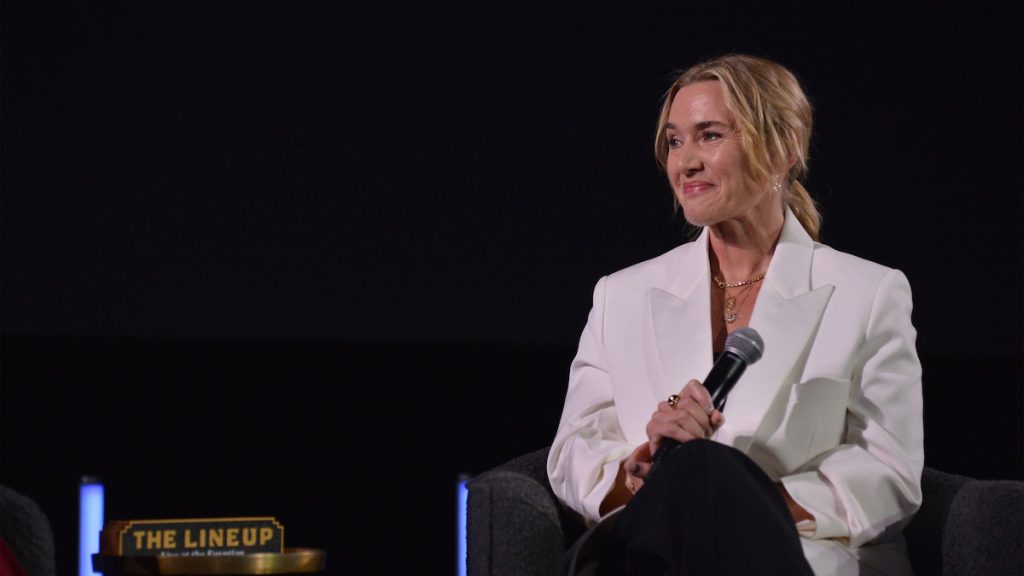
Kate Winslet. Photo courtesy of Netflix
The Journey from Acting to Directing
My experience as an actress was undeniably beneficial. Understanding the intricacies of emotional expression and performance helped me craft a supportive environment for the cast as we navigated the story. I felt confident in communicating with each actor about their characters and making adjustments as needed.
I also drew on my experiences on sets over the years, observing various directors’ methods and approaches. Each director brings something different to the table, and I tried to blend what resonated with me from those experiences into my directorial style.
However, directing also challenged me to step outside my comfort zone. I had to trust my instincts and craft the vision for the film while juggling different roles. Sometimes, I had to let go of being in front of the camera to focus on guiding the story itself. It called for a careful balance between telling the story I wanted to and allowing the actors to bring their interpretations to life.
Final Thoughts
Sharing this personal story with audiences feels like opening up a part of my family’s narrative, which is inherently vulnerable. My hope is that viewers find solace in the film and see reflections of their experiences.
I want the audience to engage with the themes of the film — to contemplate their relationships and perhaps feel inspired to initiate conversations they’ve been putting off. Grief can be an isolating experience, and my hope is that Goodbye June helps people realize they are not alone in their feelings.
I also wish for the audience to embrace all the emotions the film evokes — whether that’s laughter, tears, or a deeper understanding of familial bonds and the complexities they entail. Ultimately, it’s about fostering connection and empathy.
Embarking on this journey has been one of the most fulfilling experiences of my life. It’s not only about the film itself, but also about the relationships that were forged throughout this process, especially with my son. His work has served as a bridge to deeper conversations about family and loss for us both.
I also can’t emphasize enough the power of storytelling — how it helps us process our emotions and confront our truths. I’m grateful for the opportunity to be part of a narrative that honors both the joys and the complexities that come with being human.

Join the Discussion!



Browse our Videos for Sale
[woocommerce_products_carousel_all_in_one template="compact.css" all_items="88" show_only="id" products="" ordering="random" categories="115" tags="" show_title="false" show_description="false" allow_shortcodes="false" show_price="false" show_category="false" show_tags="false" show_add_to_cart_button="false" show_more_button="false" show_more_items_button="false" show_featured_image="true" image_source="thumbnail" image_height="100" image_width="100" items_to_show_mobiles="3" items_to_show_tablets="6" items_to_show="6" slide_by="1" margin="0" loop="true" stop_on_hover="true" auto_play="true" auto_play_timeout="1200" auto_play_speed="1600" nav="false" nav_speed="800" dots="false" dots_speed="800" lazy_load="false" mouse_drag="true" mouse_wheel="true" touch_drag="true" easing="linear" auto_height="true"]







You must be logged in to post a comment Login