
The Masterminds of Alien: Earth: A Deep Dive with Noah Hawley & Creative Team

In the high-stakes sci-fi landscape of 2120, Alien: Earth reimagines the iconic 1979 Alien film by bringing extraterrestrial terror directly to our planet. Created by Noah Hawley for FX, this series explores humanity’s complex relationship with technology through the lens of a deep space research vessel crash that unleashes a Xenomorph in a world controlled by five powerful corporations, Prodigy, Weyland-Yutani, Lynch, Dynamic, and Threshold. In this Corporate Era, cyborgs and synthetics exist alongside humans, but the game is changed when the Founder and CEO of Prodigy Corporation unlocks a new technological advancement: hybrids.
At the center of the narrative is Wendy (Sydney Chandler), a pioneering human-synthetic hybrid who emerges from the Prodigy Corporation’s experimental “Neverland” program, navigating a dangerous world where the lines between human consciousness, artificial intelligence, and alien threat blur dramatically. Set two years before the original 1979 Alien film, the series delves into provocative themes of transhumanism, corporate power, and survival, promising both philosophical depth and heart-stopping horror.
In this roundtable discussion with showrunner Noah Hawley, director Dana Gonzales, editor Regis Kimball & composer Jeff Russo, they discuss the intricacies of adapting this beloved franchise for television.
Adapting the Alien universe into an FX television series
Creator and showrunner Noah Hawley is no stranger to the process of film to TV adaptations. He adapted Fargo into an anthology television series. Now he’s adapted almost three decades of Alien lore into an ongoing television series.
“An Alien movie is a two hour survival story and TV is the opposite,” Hawley says. “You’re spending 10 or 30 or 50 hours with characters who don’t die. So there had to be thematically something more to it than just survival,” The showrunner also indicated a greater confluence between Sigourney Weaver’s character Ripley and the Xenomorph creature in the original movie that translated into Alien Earth. Ian Holm’s character Ash was technology. Ripley was trapped between nature and technology and both are trying to kill her.
Hawley elaborates that Alien Earth represents the current state of the world. It is more than an alien invasion. Where can humanity go from here if we can’t move forward or back? The audience needs to quickly understand how the Alien TV series relates to the original film to establish recognition, grounding, and trust.
“You give the audience what they want out of an Alien movie. You have the military, you have the spaceship, and you take it to Earth. The last part is different, but the same original key elements are there,” Hawley continues.
The TV series (now in its second season) starts with an alien ship crashing into Earth, but it teases out the themes of the core Alien universe – humans playing with God, the evil of corporations, the fear of technology.
It might seem that humanity is doomed on so many fronts, but Noah is hopeful for our survival as a species. “I like our chances, but we’ve got some growing up to do. That’s part of why the idea of children’s minds and adult bodies in this corporate arena, the show is asking the questions, ‘Where are the grown ups? Where are the people who think more about tomorrow than today?'”
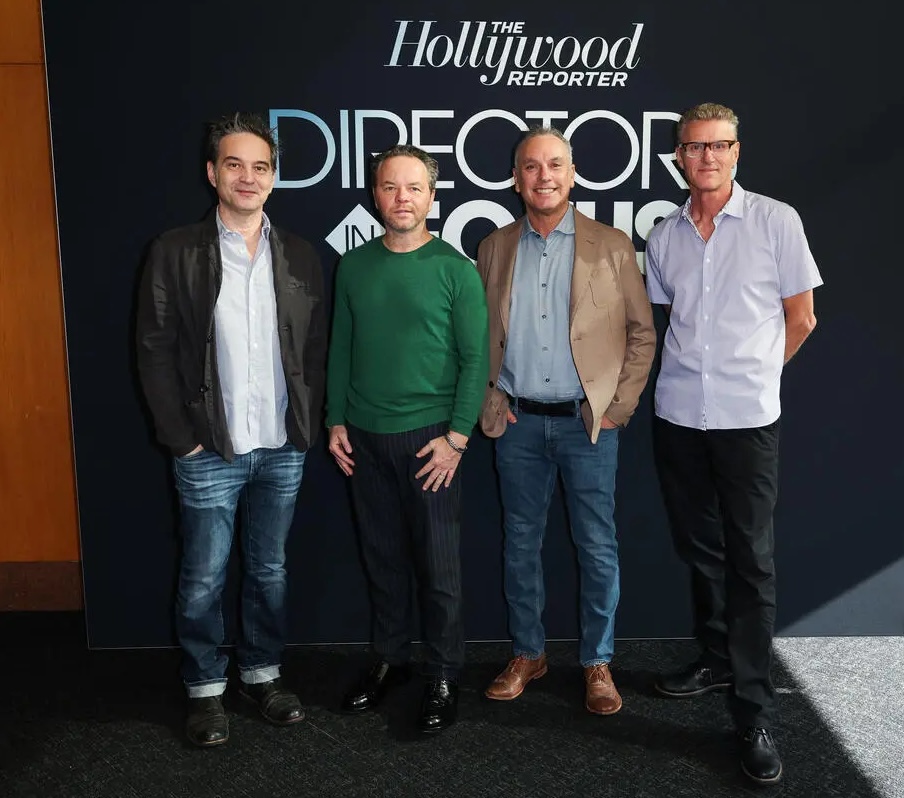
Jeff Russo (Composer), Noah Hawley (Showrunner), Dana Gonzales (Director) & Regis Kimble (Editor)
Beyond Moral Horror
Alien has traditionally been body and creature horror. However, Hawley has infused his series with an element of moral horror – the things characters like Carter Burke (Paul Reiser) do for money.
10 – 12 year old child characters feature heavily in Alien Earth – many as “synthetics.” This is the point where Noah’s story takes over from the original film. “How do you get the audience to be engaged and care for these characters when there’s almost a destructible quality to them; where what happens to them may not matter?”
“You make the danger to them be emotional as well as physical. And because you meet them when they’re children, you see their vulnerability. Because they’re kids, they’re always trying to make the best of bad things and they’re playful. If characters make an audience laugh, if they’re sweet, you invest in them, and you care about what happens to them,” Hawley explains.
Since Alien Earth sought to expand beyond its horror palette, Hawley believes he needs to inject a “Spielberg” quality into it. Audiences see the horror of being trapped in a space ship. The characters see elements of the alien world before the audience sees it.
[More: Fede Alvarez & Rodo Sayagues Takes ‘Alien: Romulus’ Back To Its Survivalist Horror Origins]
Noah Hawley also reached out to Denis Villeneuve (Dune) to offer advice on expanding the scale of the story. “He’s amazing at making you see how small people are compared to spaceships. It is very important that when Joe Hermit (Alex Lawther) comes out of that vehicle and that ship is there, and the engines are firing, you want them to feel that scale, the level of chaos and tragedy that’s going on.” In order to balance the narrative out, the pacing needs to drop slightly during these moments to bring out the emotionality of the dramatic scenes.
“There is an ebb and flow, but emotionally, everything is so grounded and everything is earned. Noah writes these thematic elements into these stories that people can identify with. They’re long scope, there’s meat to these themes. What’s going to happen with humanity? How are we going to survive this? Who’s gonna take over? These are all huge shifts in people’s consciousness; what they’re worried about,” says editor Regis Kimble.
Composer Jeff Russo was a rock guitarist in a previous life. He likens making songs to making films. “My experience writing songs and music for that kind of a narrative exposition are similar in terms of what you’re trying to express emotionally. You’re either trying to express emotionally what the lyric is saying, or you’re trying to express emotionally what you’re seeing on screen. We don’t necessarily need to play music about what you see on screen, but about what all these characters are feeling underneath. We never express anything in music unless we’ve earned that right emotionally in the scene.”

Photo courtesy of FX networks
Taking Science Fiction Seriously
Science fiction television shows sometimes have a hard time being taken seriously by certain people in this town.
“If you look at the billionaires who have created the technology that we’re living with, they were all sci-fi nerds when they were teenagers. The reality that they have created for us was actually created by the science fiction writers and filmmakers of the 60s and 70s. So, we have a responsibility as science fiction writers to create a future that we want to live in because the odds are we’re probably going to end up living in it,” Hawley declares.
In conclusion, Noah Hawley isn’t overly concerned about the sometimes perceived low brow nature of sci-fi. He asserts that audiences will watch something that is meaningful and they can form an emotional connection to.
[More: “Truth Is The Greatest Act Of Patriotism” Noah Hawley Talks ‘Fargo’]

Join the Discussion!



Browse our Videos for Sale
[woocommerce_products_carousel_all_in_one template="compact.css" all_items="88" show_only="id" products="" ordering="random" categories="115" tags="" show_title="false" show_description="false" allow_shortcodes="false" show_price="false" show_category="false" show_tags="false" show_add_to_cart_button="false" show_more_button="false" show_more_items_button="false" show_featured_image="true" image_source="thumbnail" image_height="100" image_width="100" items_to_show_mobiles="3" items_to_show_tablets="6" items_to_show="6" slide_by="1" margin="0" loop="true" stop_on_hover="true" auto_play="true" auto_play_timeout="1200" auto_play_speed="1600" nav="false" nav_speed="800" dots="false" dots_speed="800" lazy_load="false" mouse_drag="true" mouse_wheel="true" touch_drag="true" easing="linear" auto_height="true"]







You must be logged in to post a comment Login