
“Write to the Future of the Show” Seth Meyers and Alex Baze talk ‘Late Night’

When NBC offered Seth Meyers the Late Night desk, one condition was non-negotiable: Alex Baze was coming with him. “Alex was running ‘Update’ at the time and not only running it, but writing the jokes that I was always the most excited to tell,” Meyers recalls. “The idea of doing it without him was just terrifying to me.”
The negotiation with SNL producer Lorne Michaels became a memorable moment in television comedy lore. “I walked in for the purposes of telling him I wanted to bring Baze,” Meyers remembers. “I don’t know if somebody told him or not, but I do remember I walked in and he said, ‘you can’t have Baze.'”
What followed was vintage Michaels. “It’s what is still to this day one of my favorite bits Lorne’s ever done with me,” Meyers laughs. “He started listing off all his least favorite writers and telling me that he thought they would be a really good fit for my voice. And then he relented.”
The arrangement that emerged was uniquely demanding. Baze continued writing for Update while launching Late Night. “I did. For maybe most of the next season, I went in on Saturdays. So I was doing Late Night all week and then ‘Update’ on Saturdays.” Meyers hosted the Emmys that year as well. “I lost 20 pounds that year,” he jokes about the stress.
The Art of Hiring Late Night Writers
With Baze secured, the duo faced the unusual opportunity of hiring twelve writers simultaneously. “The most fun part of hiring writers is that beginning when you have 12 slots at once,” Meyers explains. The approach was deliberately experimental.
“We took a lot of great big swings,” Meyers says of their initial hiring strategy. “It was more about just getting a wide variety of types of writers to see what cooked. We didn’t know what the show was yet.”
Baze expands on this philosophy: “We just tried a variety of kinds of pieces and kinds of jokes and voices. By the time the second wave was there, we’re like, OK, this is the show we have. We need hard punch lines. We need less flights of fancy, maybe. So we’re able to plug in people a little more judiciously.”
The evolution from experimental to targeted hiring proved crucial. “Second wave people are like Matt Goldich and Mike Scollins, who are still heavy hitters on the monologue today,” Meyers notes. “It’s such a unique skill. People can fill up a page with that random joke, which we need every day.”
The metaphor Baze uses reveals his approach to collaboration: “Things got better for me, at least in the writers’ room, when I stopped thinking of it as a restaurant, where I go in and order things, and started thinking of it as a grocery store. I’m like, all right, I’ll see what they have. And, together, we can form a meal from that.”
[More: Molly McNearney & Danny Ricker Discuss The Fast Turnaround World Of “Jimmy Kimmel Live!”]
Finding the Show’s Identity
Like many hosts, Meyers initially tried to distance himself from what audiences knew him for. “The biggest mistake was I want to show everybody I’m more than the ‘Update’ guy,” he admits. “It took us 18 months. We kind of found our way back to the desk, which, of course, at the time we didn’t realize we get points for how inventive that was. And I think, it probably helped that we showed people how bad I was at standing for 18 months.”
“You only figure it out by doing it,” Meyers emphasizes. “You learn pretty quickly what doesn’t work. The problem is it takes you a little bit longer to figure out what does.” This mirrors a universal experience in television.
“Every host goes through this when a show starts. They kind of go on this outward bound trip to try to find this new kind of show or this new way that they are going to do a show. And it’s always kind of a circular journey where you come back and you’re like, ‘Oh, I’m the show. The show is whoever I am and however I see things and do things.’”
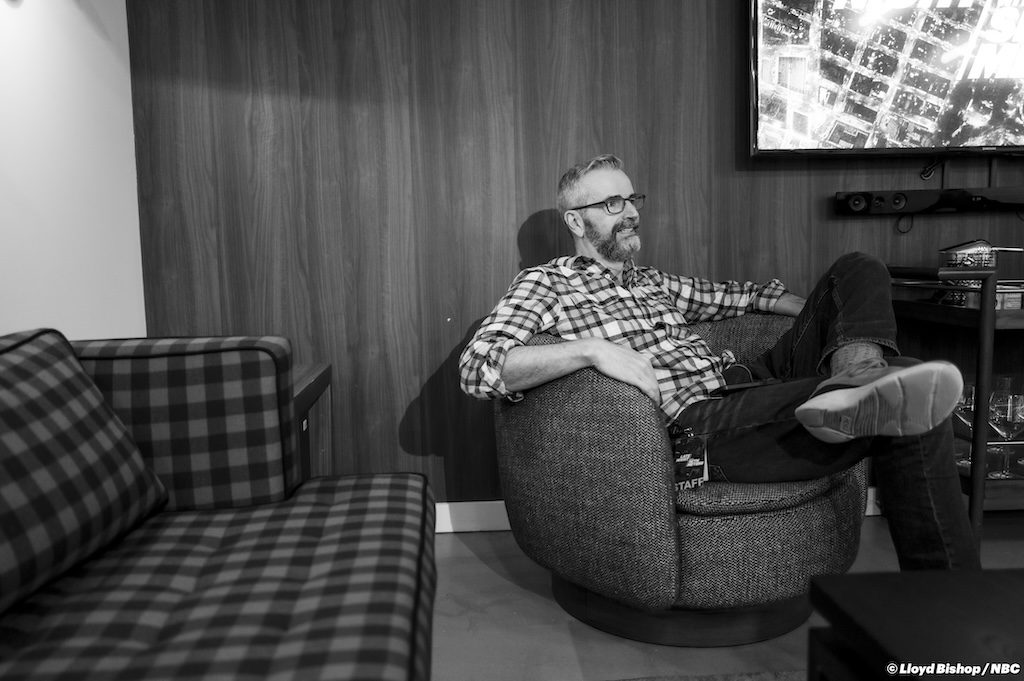
Alex Baze
The daily grind of late-night comedy reveals itself in the numbers. When asked about their joke-to-air ratio, the reality is both impressive and sobering, as the team may write 300 jokes per day. “There’s 12 usable jokes. More than 12 good ones,” Baze explains. “But, I’ll have, you know, too many jokes on one topic, not enough on another topic. But it cooks down to 12 that we can organize in a monologue, and put on TV. And, you know, 8 of them will work really well on a good day.”
The precision required becomes clear in Meyers’ assessment: “The difference between a perfect joke and a joke that gets nothing… not as far apart as people would think. It’s two or three words. It’s, you know, an inversion in the word order.”
The Evolution of A Closer Look
What became one of Late Night‘s signature segments began almost accidentally. “I wrote something about the Greek Debt Crisis. And I think just through the name, Closer Look on it, for lack of anything else,” Meyers recalls. “But then it was so much positive feedback. It was that weird, it was the first thing I felt like we did that you heard about a couple weeks later.”
The segment’s success surprised even its creators. “We would watch The Daily Show and think, ‘Oh, my God, thank God we don’t have to like, write, writing for something like that must be so hard. Thank God we’re not that kind of show.’ And then, all of a sudden, it’s like, ‘Oh, we’re that kind of show.’”
Producer Sal Gentile eventually took over the segment’s development. “It gives Baze and I think both enjoy writing jokes for it, but don’t want to write the first draft,” Meyers admits. “It comes in pretty fully formed. And then we’re just like sanding, sanding and polishing.”
The Big Swing Philosophy
Encouraging risk-taking while maintaining quality requires delicate balance. “We never know what the next big idea is going to be,” Meyers explains. “If you make the mistake of only writing to the kind of things we’re doing today, the show will flatten out.”
The approach extends to their monthly creative meetings. “We have our monthly table where everybody’s job is like bringing a whole new thing. We’re not going to punish somebody for what we would never say, because we want to see a new idea.”
With established segments like the monologue and ‘A Closer Look,’ the remaining airtime becomes precious creative real estate. “With the remaining real estate, the writing staff knows we are incredibly open minded to what we do there,” Meyers notes. “The last thing we want to see at the table read is something political, because we’re so covered on that.”
Both Meyers and Baze approach leadership through craft rather than hierarchy. “Writers know we love writing, and we love good writing,” Meyers explains. “I don’t think Baze or I have ever been credit hogs. And so if you do good work, while we’re, you know, ostensibly supposed to be in charge, like you get the credit for it.”
Baze’s approach centers on service: “I try to just make clear that it’s all service. Writing is service to the show, to the host. Like, if you want to write this, that’s great. But does that help our host do a good show?” He jokes to Meyers that he refers to him as “The Host” during these conversations.
The respect this approach generates becomes evident in their low turnover rate. “We don’t have a ton of turnover,” Meyers notes. “When’s the last time we’ve hired a new writer? It’s like two and a half years, three years.”
The Late Night with Seth Meyers writers’ room stands as a testament to collaborative creativity, where ego takes a backseat to craft, and where the daily challenge of making people laugh is met with both precision and playfulness. For writers entering the field, the lesson is clear: focus on the work, trust the process, and remember that even the most successful shows are built one joke at a time.
[More: The Daily Show Head Writer Dan Amira On Making Political Satire]
Advice for Aspiring Writers:
The conversation reveals key insights for writers hoping to break into late-night television:
- Focus on the Essential: “I can’t go in. I’m not good at going into a room and commanding everyone’s attention and, you know, barking orders or whatever the case may be. But I can say like, here’s the writing. Do like this,” says Baze.
- Quality Over Quantity: Baze never thinks “a joke is better with two or three more words. Take them out. Take them out.”
- Embrace the Learning Process: “You learn pretty quickly what doesn’t work. The problem is it takes you a little bit longer to figure out what does.”
This interview has been condensed. Listen to the full audio version here.

Join the Discussion!



Browse our Videos for Sale
[woocommerce_products_carousel_all_in_one template="compact.css" all_items="88" show_only="id" products="" ordering="random" categories="115" tags="" show_title="false" show_description="false" allow_shortcodes="false" show_price="false" show_category="false" show_tags="false" show_add_to_cart_button="false" show_more_button="false" show_more_items_button="false" show_featured_image="true" image_source="thumbnail" image_height="100" image_width="100" items_to_show_mobiles="3" items_to_show_tablets="6" items_to_show="6" slide_by="1" margin="0" loop="true" stop_on_hover="true" auto_play="true" auto_play_timeout="1200" auto_play_speed="1600" nav="false" nav_speed="800" dots="false" dots_speed="800" lazy_load="false" mouse_drag="true" mouse_wheel="true" touch_drag="true" easing="linear" auto_height="true"]







You must be logged in to post a comment Login