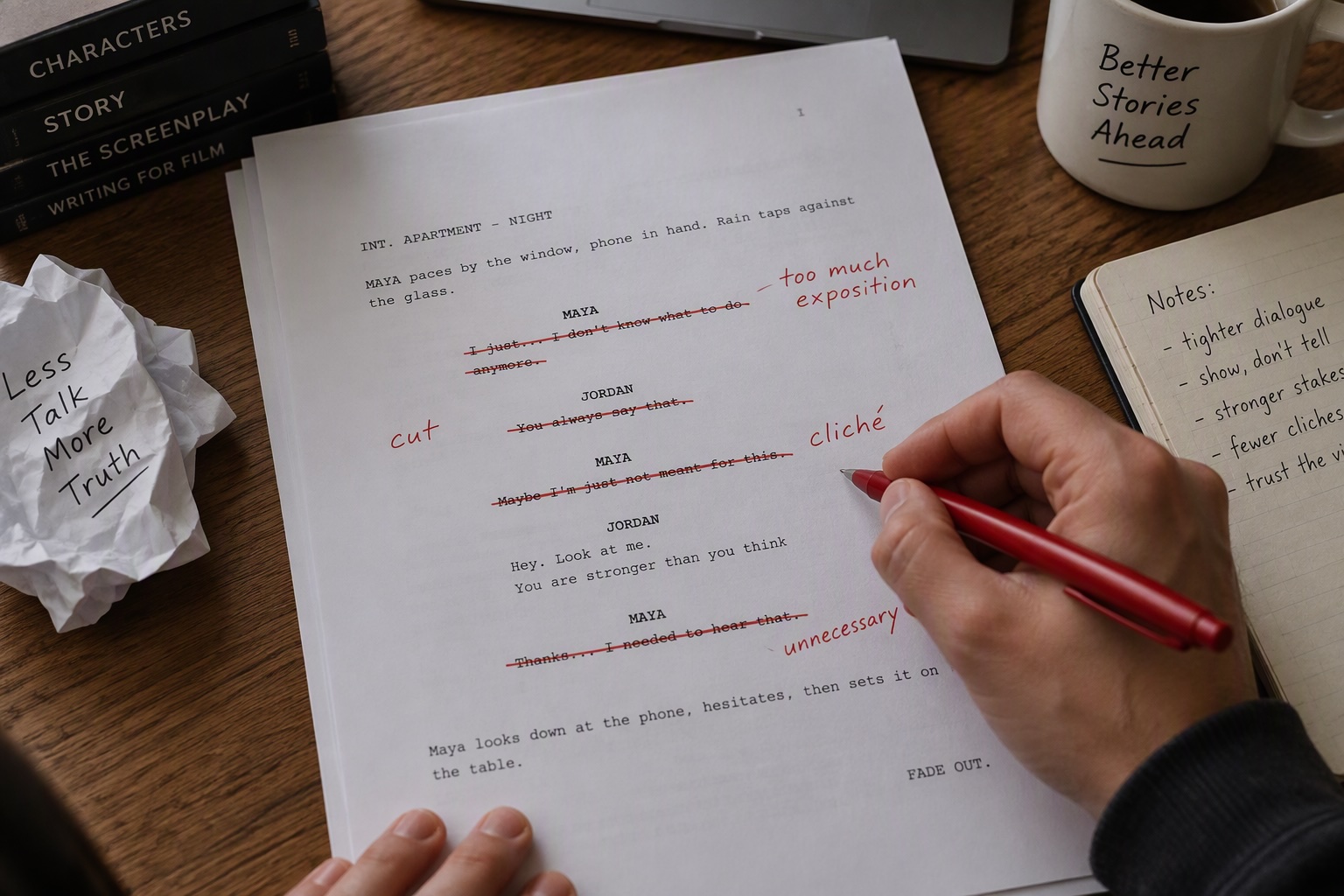
A screenplay can survive a quiet, contemplative scene, a detour or cutaway, or an enthralling freefall. It cannot survive scenes that ask for the audience’s attention without giving the story anything in return. Filler scenes are not defined by their length or volume. They are scenes with no meaningful dramatic, narrative, emotional, or thematic function. They fail to shift what a character wants, what stands in their way, what the audience understands or hopes for, or what is at risk. They hamstring the story despite how well-written they might be.
That distinction matters in a world of effective screenwriting. A script reader is looking for an excuse not to turn the page because the script doesn’t sustain their attention. A scene that delays the story without deepening it weakens momentum.
Filler scenes are not the same as regular scenes that run too long and need to be tightened. In the latter case, you can play Jenga and remove extra greetings, meticulous descriptions of common actions, or any other padding. A character rushing to get to work in the morning doesn’t need every motion described.
Consider the following example of a character named Cherry, running late for work.
Cherry charges out the front door with a croissant in her mouth and a coffee as she slips on a suit jacket. She jumps in her car and screeches off. She types a text. “Be there in ten.”
That’s it. It’s selective in what is described and infers that she’s in a rush without over-complicating. It creates anticipation and potential conflict with what comes next.
Writers often confuse character texture and nuance with narrative inertia. Audiences must
In Chloé Zhao’s Nomadland, extended sequences observe Fern (Frances McDormand) performing mundane tasks. These are not narrative stalls; they communicate alienation, isolation, and economic marginalization.

Nomadland (Frances McDormand) Photo courtesy of Searchlight Pictures
Conversely, an five-minute dialogue exchange in a coffee shop where two detectives repeat facts already established in previous sequences is purely cosmetic and wastes time. It slows momentum without revealing subtext or advancing the central conflict.
If a scene can be trimmed, deleted, moved, or merged, it’s likely a filler scene.
Related: How Pacing, Style & Tone Shape Your Screenplay
How To Identify Filler Scenes
A filler scene is defined as a dramatic unit that could be removed, shortened, or merged without materially changing the logic or pacing of the story.
It may repeat information the audience already knows. It may deliver unnecessary exposition that belongs elsewhere despite it being of general interest. It may feature tangential plot lines. It may exist because the writer needs to reach a target writing page count, bridge two major sequences with a placeholder scene, or postpone a story decision.
It’s not whether the scene is entertaining. A funny or deeply dramatic scene can be filler. A beautifully written tear-jerking scene can also be filler yet still fall flat and upset the story rhythm. A useful definition is this: a scene is filler when its absence won’t be noticed or missed.
That change can take several forms:
- The plot moves into a new position
- A character makes a consequential decision
- The audience learns information that alters interpretation
- A relationship gains or loses pressure
- The stakes rise, narrow, or become more personal
- A thematic idea acquires dramatic weight
- A character’s emotional strategy or mindset changes
A scene can breathe without becoming dead weight if it provides respite after an intense scene. This could be a joke at the wake following a funeral or witty banter after a breathtaking, near-death car chase. These tend to be shorter scenes.
Related: Are Your Screenplay Scenes Excit-ing Or Excite-less?
Why Writers Put Filler Scenes in a Screenplay
Most filler scenes are not inserted because writers are careless. They are often added when the screenwriter has not yet solved the story mechanics.
- The writer does not know the story well enough
- A scene becomes a placeholder for an unanswered structural questions:
- How does the protagonist discover the truth?
- Why does the antagonist wait?
- What causes the relationship to break?
- What happens between the midpoint and the climax?
- How does the character get from one location to another?
Instead of solving the underlying problem, the draft creates an architecture that postpones it. This is particularly common in second acts. The writer knows where the story wants to go, but not the sequence of story beats connecting them. Characters then spend pages researching, arguing, driving, drinking, or explaining on the sidelines creating story flab.
Related: That Scene In Your Screenplay Sucks
The writer is protecting a favorite moment
Writers often fall in love with dialogue, a visual gag, a supporting character, or an atmospheric location. The money shot. The water cooler moment. The scene works in isolation, so cutting it feels like losing part of the movie.
But a screenplay is not a scrapbook of good moments. The question is whether the moment belongs to this story, at this point, in this particular form.
Related: 5 Tools For You To Write Gripping Screenplay Scenes
The writer is inflating the page count
A short draft can create panic. Writers may add transitional scenes, redundant conversations, or forced inorganic complications to make the script appear substantial or make them feel more productive in their writing day.
The writer is over-explaining
Exposition frequently creates filler when characters discuss facts the audience already knows or could reasonably infer. It is redundant much like a joke teller explaining a punchline multiple times. It might also suggest that the screenwriter hasn’t fully locked down their story and buying time.
Related: How To Layer Your Screenplay Scenes
What can screenwriters do?
Exposition Without the Drag
Exposition becomes filler when it reads without resistance or consequence. Stronger exposition creates an obstacle:
- The listener misunderstands or is misled
- The speaker is concealing part of the truth
- The information has a price
- The reveal threatens a relationship
- The audience sees evidence before hearing an explanation
- The information arrives too late to prevent a mistake
Exposition becomes dramatically alive when it is part of a struggle rather than a story delivery system.
Replace explanation with consequence
If the screenplay needs to establish that a character is financially desperate, do not automatically write a conversation about debt or unpaid bills. Show the declined card, the missed payment, the humiliating request for a loan from family, or the uncomfortable choice between two financial obligations.
The strongest exposition often arrives as an action that forces a response. This does not mean dialogue should be stripped of information. It means information should enter through the scene’s existing momentum.
Move the scene
A scene may be useful or more impactful later, but ineffective where it currently appears. A backstory reveal before the audience is ready often drags. The same reveal after a suspicious action can reframe it. Ask whether the audience has earned the information. Timing can convert exposition into suspense.
Rebuild around a turn
If the scene contains a useful idea, but no change in the story dynamics, give the characters incompatible objectives. Let one person seek reassurance while the other seeks permission to leave. Let the protagonist ask a question while secretly testing a lie.
The scene’s subject may remain the same, but its dramatic function changes.
Cut the scene and preserve the payload
Sometimes the best material is a single image, line, or reaction. Extract it. A character’s private realization may work more powerfully as a visual beat between larger scenes than as a full conversation.
The opening of Parasite, written by Bong Joon-ho and Han Jin-won, uses the Kim family’s cramped semi-basement and their search for a usable Wi-Fi signal to establish material conditions through action. The details are funny, specific and tied to how the family navigates its environment. They aren’t a pause to explain poverty; they make the family’s circumstances playable.
Screenwriting rewards compression because the form is built from implication. The audience should not be forced to watch every step of a thought process. It should be invited to participate.
Momentum Is More Than Speed
Eliminating filler does not mean making every scene hyperkinetic. A story needs contrast: silence after violence, reflection after revelation, intimacy amid plot mechanics. The issue is whether the pause has tension and flow.
Don’t ask, “Is this scene slow?”
Ask instead: “What is the audience waiting to discover, fear, or understand?”
If the answer is nothing, the scene is not providing breathing room. It is stopping the story. “What is different by the end of this scene — and why does that difference matter? What is the worst consequence of a character not achieving their objective.”
This matters particularly for television, where episodes often contain several narrative engines operating at once. If a scene belongs to a subplot, that subplot must create knock-on effects elsewhere or reveal or augment something the principal storyline cannot.
Make every scene earn its place.
Perform the Causality Test – Then… And Then….
The cleanest diagnostic for detecting structural bloat comes from South Park creators Trey Parker and Matt Stone: the rule of causality over chronology.
If the connective scenes between your story beats can be summarized as “and then,” you are writing episodic drift with minimal emotional impact.
If your scenes follow and then… therefore… but… they are more likely to show causality, conflict, and consequence.
Elevating Execution Through Script Coverage
Trimming dead weight from your work requires distance that many writers struggle to maintain after months in the weeds. Professional screenwriters rely on objective editorial eyes to pinpoint where momentum drags and pages bloat.
Investing in comprehensive Creative Screenwriting script coverage gives you clear structural feedback from seasoned industry readers. A thorough script analysis helps identify filler scenes, narrative drift, spot scenes that fail the causality test, and sharpen your draft for competitive industry consideration.