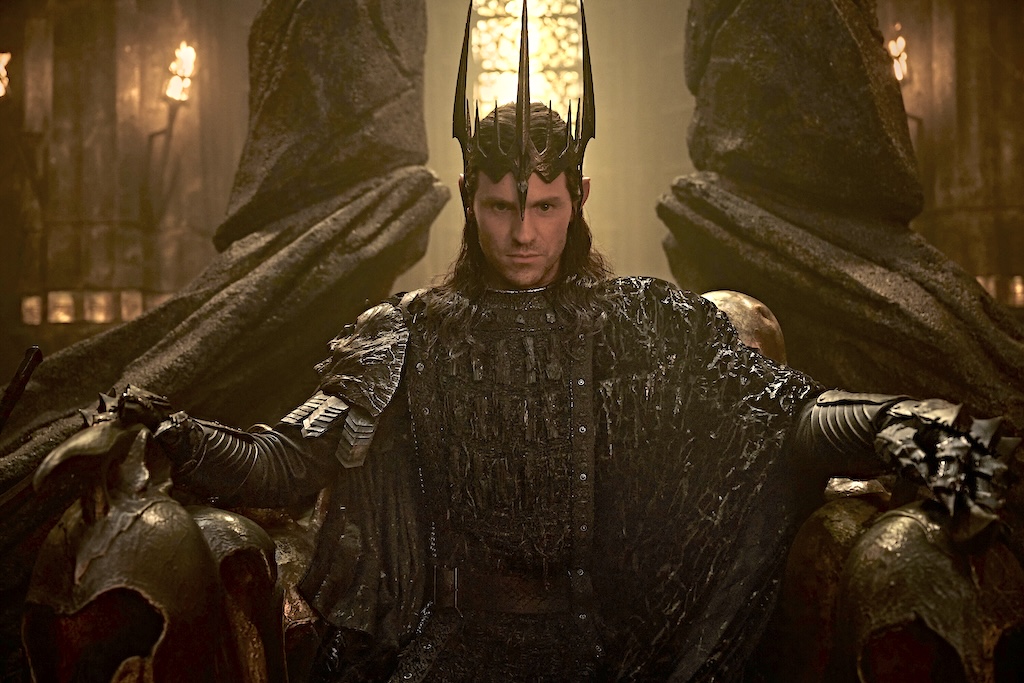
Set thousands of years before the events of J.R.R. Tolkien’s The Lord of the Rings, Prime Video’s The Lord of the Rings: The Rings of Power tracks the monumental history of the Second Age. The epic drama details the deceptive rise of the Dark Lord Sauron, the forging of the legendary Rings of Power, the tragic political fracturing of the island kingdom of Númenor, and the fateful alliances between Elves and Men that defined the geography of Middle-earth.
In Season Three, Middle-earth is at war. Five years have passed since the fall of Eregion. Sauron’s armies have marched across the whole of the world, conquering all in their path. Only a few isolated pockets stand between the Dark Lord and total victory – Khazad-dûm, where the Dwarves are now sealed deep within their mountain halls, and the elven realms of Lindon and Rivendell, which are protected by their Three Rings.
But deep in the land of Mordor, in his newly completed tower of Barad-dûr, the Dark Lord toils day and night, obsessed with harnessing a power that will bring the last of his enemies to their knees: One Ring to rule them all… Now, all the free peoples of Middle-earth – Dwarves, Elves, Men, and Wizards alike – must find a way to come together, in a race against time to prevent Sauron from achieving his goal of utter domination of all life…
The creators of the show J.D.Payne and Patrick McKay spoke with Creative Screenwriting about adapting the world of Tolkien for television.
What makes the fantasy world that Tolkien has created so durable?
J.D.: It’s a spiritual thing. It is able to unite people in a way that gets past ideologies, nationalities, creed, and cultural background. It gets right to the soul.
Tolkien is able to do that in a way that very few other writers were able to. You read Lord of the Rings, and it finds you wherever you are.
Patrick: What is really special about this material is the way that it crosses genres.
Lord of the Rings is epic fantasy, but it contains aspects of high drama. It’s like a history play. It’s a tragedy, but it’s also got this whimsy and song. Sometimes it’s like a horror movie.
There are creatures, but it’s done in this way that almost feels like a classical epic tale. I find that combination to be very potent, really special, and quite unique. There’s only a few properties you can say even aspire to that range of tones, characters, and worlds.
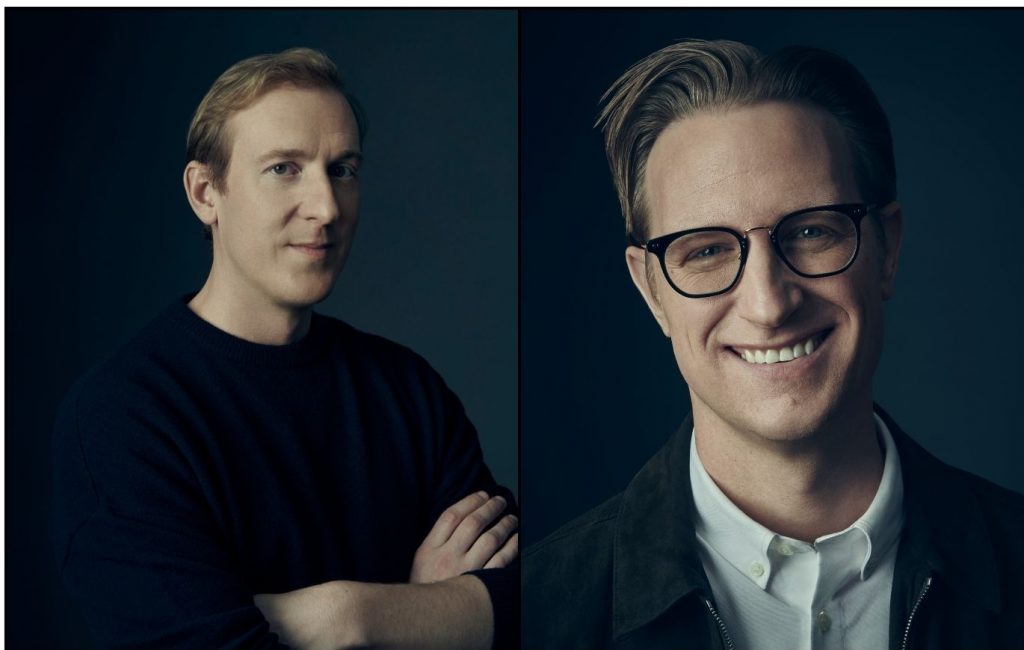
Patrick McKay & JD Payne. Photo by Jason Bell/ Prime Video
J.R.R. Tolkien wrote Lord of the Rings between 1937 and 1949. The Rings of Power is set thousand of years before then. What are both saying to the world today?
J.D.: What’s amazing about Tolkien is that it’s evergreen. It speaks to our world now as much as it spoke to the world of his audience when it was first published. And as much as it will speak to people 50 years from now.
Some of Tolkien’s messages are very simple. They’re about small people doing big things. They’re way above their pay grades.
They’re about people of different backgrounds, without a lot in common, coming together to fight something that’s greater than any of them individually. I think that’s one of the themes that resonates the most today. You can have elves, dwarves, halflings, humans, even orcs come together when they see a threat that is bigger than all of them.
They put aside their differences and they come together to try to make a better world. In a time in which we are so polarized and in which tribalism runs so rampant, Tolkien’s message could not be more applicable.
Patrick: I think that history is the real judge of any creative endeavor. Whether it’s a great record album, a great novel, or a great film.
What makes it lasting and canonical is the way that it continues to feel applicable to one generation after another; one historical period after another. Work that is absolutely beloved, cherished and critically adored during its own lifetime sometimes doesn’t speak to future generations and becomes a period piece.
With a great book like Moby Dick or great recording artists like The Beatles, people discover them again because they’re touching on something timeless and universal. I think The Lord of the Rings and Tolkien’s work absolutely meets and exceeds that standard. I think as adapters of that material, we’re just really lucky to be able to draw from that.
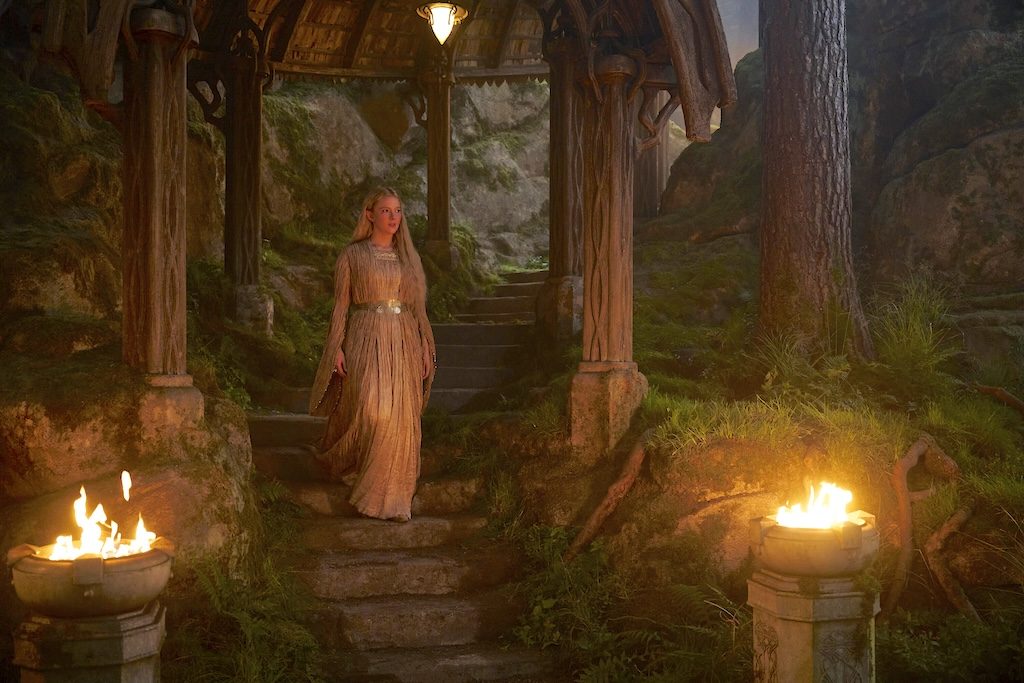
Galadriel (Morfydd Clark) Photo by Ben Rothstein/ Prime Video
Discuss the adaptation process given that the Second Age was mainly referred to in Tolkien’s appendices rather fully developed. How did you balance Tolkien with originality?
Patrick: This era of the mythology that we are adapting is only a framework.
There was a trail of breadcrumbs that we felt compelled to follow. But that meant there’s an enormous amount of imagination that’s involved and answering questions that are present in the text. We had a few ideas of what we felt that a ‘Tolkienian’ epic needed to have.
Our job is to craft something that takes audiences on a journey. This material has a vast audience. So in some ways, from the beginning, we’ve been leaping without a net beneath us. We’re on a tightrope here.
We want to do something that is true to the text and authentic to the feeling you get when you read those books or watch the Peter Jackson films that are so beloved by us and everyone else. But also, you need something that speaks to a mass global audience who have other things they could be watching.
And then trying cut a path that honors both of those things.
There are audiences who love this and would watch anything called Lord of the Rings, and people who’ve maybe never seen Lord of the Rings. That is quite a tightrope. I think that makes it a high bar to clear every day. While we’re working on a script, we want the show to be delightful for a global audience.
That is only going to mean that we’re always demanding more of ourselves.
J.D.: One of the great challenges of the Second Age is that there’s no one singular quest.
In the Third Age, you have Frodo, he’s given the One Ring, and has to go from the Shire to Mount Doom. You can wrap your mind around it in a few moments. In the Second Age, there’s the Forging of the Rings, there’s the War of the Elves and Sauron, there’s the Fall of Numenor, and there’s the Battle of the Last Alliance.
There’s definitely a line that connects them, but it’s not one singular quest in the way that you have in the Third Age. With each of those events, you have characters that Tolkien gives you. You also have certain feelings that surround certain places.
In Season Three of The Rings of Power, you’re going to see Calibor and Galadriel come together, and eventually they found the realm of Lothlorien. What do they do in Lothlorien?
Some of that stuff is, at least in the Second Age, a little more ethereal. You understand what it should feel like, but in terms of what actual incident goes underneath those feelings, those are things where you have to invent a little bit more.
It’s constantly doing this dance back and forth between big canonical events you know are going to happen, characters who you understand where they began and where they end, and a feeling that you have surrounding those characters for those events, for those places.
And then you need to specifically adapt narrative and plot that feels like it fits within those big canonical events, characters and feelings, that Tolkien didn’t necessarily spell out. There’s constantly a trove of amazing treasure that he left you to help as you’re doing that.
So it’s constantly going back and forth between going back to the man and then fleshing it out with your inspiration.
You’re now in the middle of a five season arc. How are you energizing audiences The Rings of Power in each season?
Patrick: Part of this journey has been about coming to an understanding of who the audience is in each season.
Why are people watching TV? What is what is this new era of entertainment we’re in? Where does a property like Lord of the Rings fit into that? I think that’s not necessarily something that you can easily answer, but it is something that you can if you’re an artist. Hopefully you’re creating something for that audience that you have your antenna up for.
I think it’s been very educational for us. We came into this with a love of this material and a vision for what it could be in a streaming space. The journey of the last three seasons has been understanding where to meet audiences in the middle because I think that people had a very particular idea of what they wanted from a Lord of the Rings TV show.
I think we’re getting more in tune with them every season. You’re not just an artist. You’re also an engineer and a master of ceremonies.
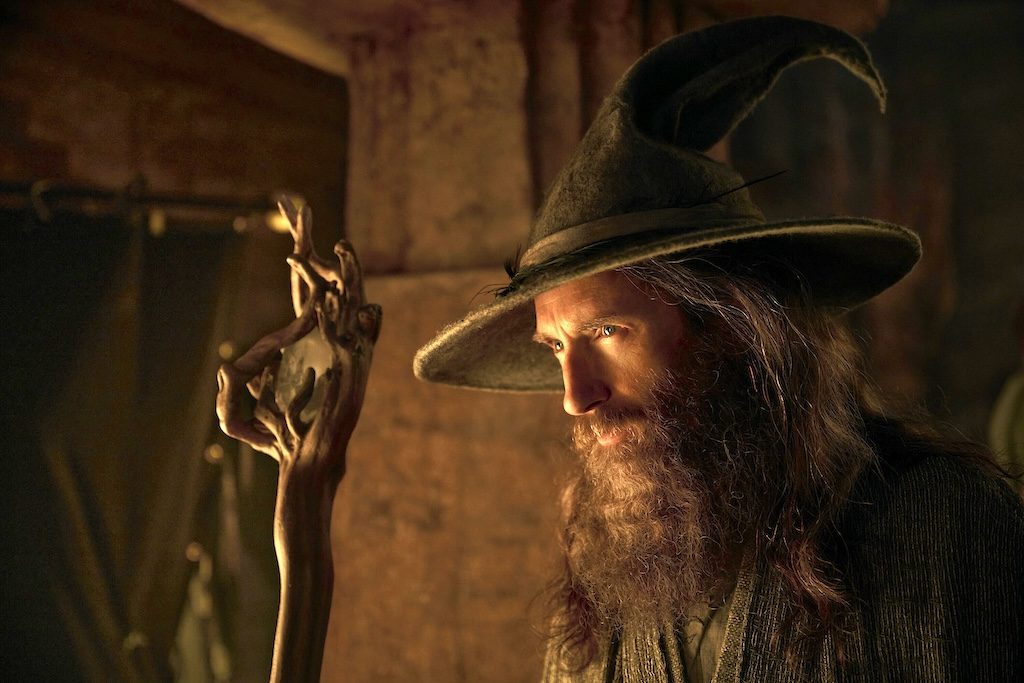
Gandalf (Daniel Weyman) Photo by Ben Rothstein/ Prime Video
How are you navigating the time line over five seasons now that you’re in the middle?
J.D.: In terms of where we are in the story, the midpoint in any story is usually when the ground shifts underneath you. In a lot of ways, the midpoint of the story is the forging of the one ring.
It’s the central act of the Second Age. I think that everything has been building towards that.
In some ways, things get harder from here in terms of the writing of it, because up to this point, we’ve been there’s been a lot of setup. There’s been a lot of bringing characters into the situations. They introduce you to Middle Earth and the Second Age. At this point in the story you can see towards the horizon.
You are figuring out how you’re going to land the plane. There are some characters who won’t make it all the way. Tolkien told us how some of those characters died. Sometimes he didn’t. We have plans for how they exit the story. And there’s still some characters that we’re introducing as well.
Being able to see the entire work in your mind, not just conceptually, in the way that you do when you’re writing a story bible, and being able to look down at the specific episodic level when you’re at this point in the story crafting is really important.
You understand exactly how many hours of storytelling you have left. And every minute of of storytelling with your characters becomes all the more precious.
Given that audiences know how the saga ends, how do you maintain surprise and enthusiasm in The Rings Of Power?
Patrick: We’ve answered a version of this question in the past by talking about how we love Titanic.
You know, the ship’s going to crash and sink. That is giving this energy and riptide underneath the whole story.
I think Francis Ford Coppola was a great writer before he was a great director. He won an Oscar for the script for Apocalypse Now. He was also the writer/ director of The Godfather films and The Conversation.
The number one piece of advice he has for screenwriters is write to the end. Don’t rewrite and obsessively be perfectionistic about the first 30 pages or so.
Once you’re at the end, you now know the target and you can go back and you rewrite your whole script to that target, that landing point.
I think for us as dramatists, knowing where we’re heading, has a similar focusing effect where every part of the story between here and there, we can focus on. How do we make it as delightful and surprising as possible? We know Sauron’s going to make the one ring.
That’s the most famous part of the Lord of the Rings. But then for us, it’s how did he get there?
And before this, he needed this elf craftsman to help him make other rings. So maybe he didn’t know how to do it. All of a sudden, an entire story springs into life. This is a guy who’s aspiring to greatness and power, but maybe not yet able to achieve it.
What does he have to do? How does he have to struggle, change, and overcome that obstacle? That became the whole third season. And then out of that, spring ten other arcs for all your other characters. How do they fit into it? So I think for us as writers, having an ending is the greatest tool possible.
But also as viewers, knowing he’s going to somehow pull the ring off. The journey of him struggling is compelling because you’re waiting to see how it happens. It’s suspenseful rather than surprising, .
J.D.: This is the classic description of the difference between plot and story. Sometimes Tolkien gives us plot and sometimes he gives a story.
We are very fortunate in times where we’re dealing with the appendices, when there’s a list of events, people know that a certain thing is going to fall, but figuring out that a certain kingdom will fall or a certain character will die.
But sometimes Tolkien has not yet spelled out exactly what that will mean to every other character or why exactly the character will die.
So, it’s in finding those spaces between the lines and between the events that there’s room for tons of surprise and for also new meaning the audiences can take away from the Second Age of The Lord of the Rings.
Everyone knows that Sauron forges the one ring. It’s one of the most famous MacGuffins in all of storytelling.
But in this season, we really wanted to unpack what does that mean to Sauron? Why did he forge the one ring? How is it connected to his desire to dominate the other rings? How to dominate the other rings connects to his relationship to Galadriel and characters that we’ve set up deep relationships with over the course of two seasons. What does it mean to Sauron to fail? What does it mean to him to succeed? What parts of himself does he have to give in order to be able to make the ring? Those are all questions that we can go much deeper with than, in some cases, the dates that are in the appendices.
So even though an audience might know what’s going to happen, knowing what it means to our characters is really what makes it a story.
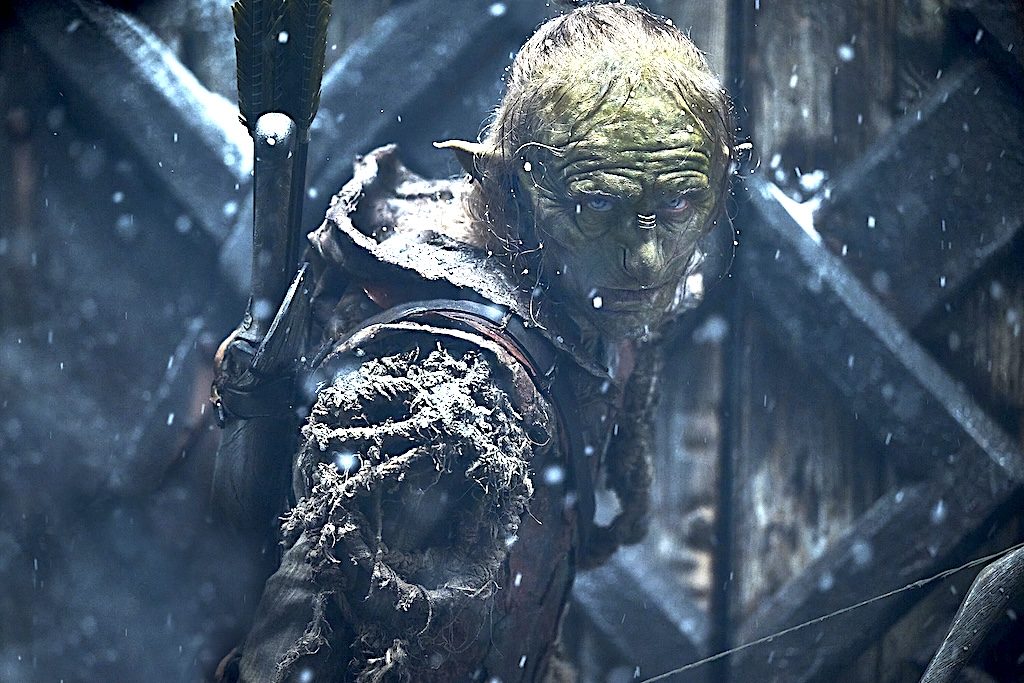
Marnûkh (Adam Young) Photo by Ben Rothstein/ Prime Video
What are the main themes that The Rings of Power is exploring?
J.D.: Patrick and I have talked about this for many years. And for us, theme comes organically and mysteriously out of the book itself.
Tolkien gave us some basic building blocks in terms of themes that this material was always going to circle around. But it’s not like we come at it from the top down and saying how do we shove the theme of X, Y, or Z into this story.
We read and immerse ourselves in that work and constantly think about Tolkien and his themes. Then we go to the page and we find that there are things that start coming out organically and repeat themselves.
Light and darkness has been a big theme.
And a big concern of the Second Age is power because it’s obviously all about the rings of power. What really is power? How does it connect to domination? Who really wields power? What is the greater power? Is it armies, wizards and magic? Or is it friendship, light and beauty? These are questions we return to again and again and again in the show.
They’re are things that come out organically from the scene work and the characters. One of my very favorite movies and arguably the greatest screenplay ever written is Chinatown, Robert Towne’s script. And in Chinatown, there’s a very well-developed motif. It’s a motif of doubling and specifically of false doubling.
If you watch the film and notice the pattern of symbols about false seeing and false sight, it is just so intricately worked out. All of which speak to what the film’s about – the theme.
It was all over the script. It was all over the film. It was teased out at every stage. It was completely subconscious. The mind is mysterious and the creative process is magic.
But if you’re writing to theme or from theme, it tends to feel forced and inauthentic. We try not to think about theme at all. Emotion should feel as authentic as possible and we trust that things like that will weave their way in.
Patrick: Sometimes it’s in that third or fourth draft that you start to not just be an author, but a reader of the work as well. That’s when we start noticing some of the thematic work.
At that point, there’s things you can do to tease up the levels a little bit because you’re starting to see something that feels like it wants to be in there. And it doesn’t feel imposed. It feels organic to the piece.