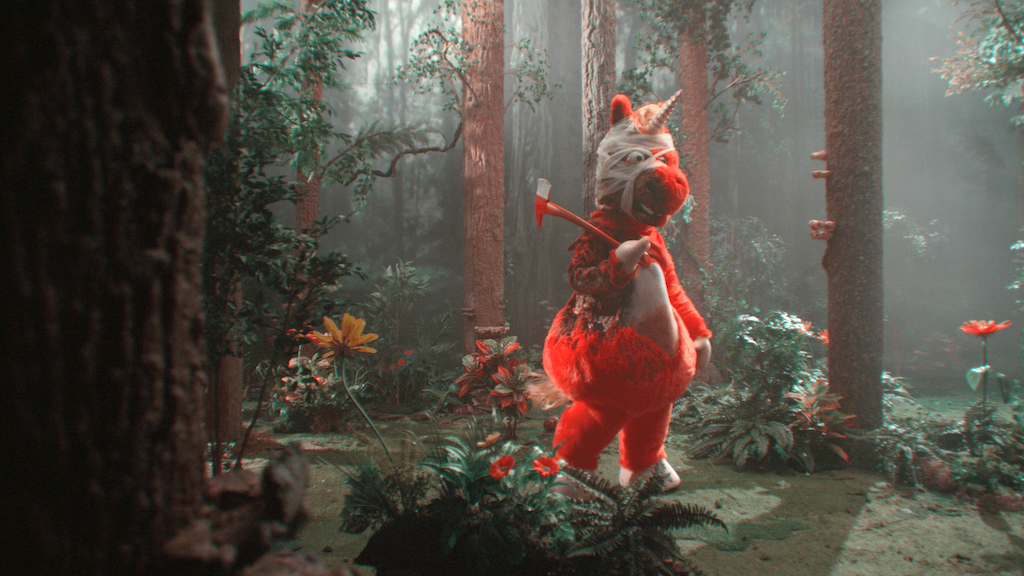
Buddy is a bright orange unicorn and star of a classic children’s television show. How can you not love his soft and cuddly cuteness? He brings life lessons into your living room as a group of happy children sing and dance their way through a joyful 22 minutes. The sets are brightly-painted and vivid. There’s a talking mail box, Strappy, the talking back pack, Couchy the Couch, Worry Well, and Trashy, the bow-tie wielding trash can to spur your children’s imagination. How could this be the premise for a slow-burning psychological horror movie?
Well… initially it isn’t. Dark clouds soon gather in the dark sky.
Josh (Luke Speakman) doesn’t want to attend Buddy’s dance party. Buddy becomes very cross and Josh disappears. He’s swiftly replaced by Hannah in the show while Buddy assures the other children that Josh is traveling to Diamond City. Questions are raised when Freddy (Delaney Quinn) finds Josh’s bloodstained book. She tells Nurse Nancy (Phuong Kubacki) who promises to talk to Buddy, but is swiftly bludgeoned to death. Before she dies, she urges the children to board Charlie The Train and escape to Diamond City.
Buddy is hot on their heels, along with a string of casualties who try to stop him. He has cast a memory-wipe spell on the children so they can’t remember their lives before the Buddy show.
The juxtaposition of the lurid colors, the fake grass and fence, and the fun of dancing stuffed animals with the darkest underbelly of Buddy makes it more jarring and menacing tos audiences. Even more than the brutal slashing scenes.
The horror in Buddy is built from images and characters that scream fun, safety, and comfort and turning those givens on their heads. The movie stars Cristin Milioti, Delaney Quinn, Patton Oswalt, Michael Shannon, with Topher Grace and Keegan-Michael Key (as Buddy).
This corruption of children’s innocence is amplified when Buddy’s true capabilities are drip-fed into the narrative. He can turn kids into amnesiacs and reprogram their memories and their reality itself. Audiences aren’t ever really sure why Buddy behaves like this. We only know he demands military-like obedience. Disobedience ensures disappearance – no questions asked.
Where are the parents in all of this? One of the mothers senses something is off, but is stuck in the real world. Buddy proclaims to the children, “I’ll never leave you?'”
Thematically, Buddy touches on topics of abandonment, isolation, and loneliness. Buddy’s malevolence is only activated when one child, seemingly disconnected from the others, doesn’t want to play. Buddy becomes his stand in bestie – always by his side.
Peeling back more layers, Buddy probes issues of child abuse, missing children, and the social anxieties they evoke.
The film capitalizes heavily on the aesthetics of “uncanny valley horror films.” Buddy’s mannerisms, cadence, and dead-eyed displays of affection sit right on the edge of humans. That uncomfortable forced proximity infuses the primal terror of having your personal sanctuary invaded by someone who genuinely believes they are helping you as your best friend.
Buddy was written and directed by Casper Kelly (Your Pretty Face is Going to Hell, V/H/S Halloween, Yule Log). It was co-written by Emmy-nominated writer Jamie King (World’s Best, Jessica Jones, Impulse).
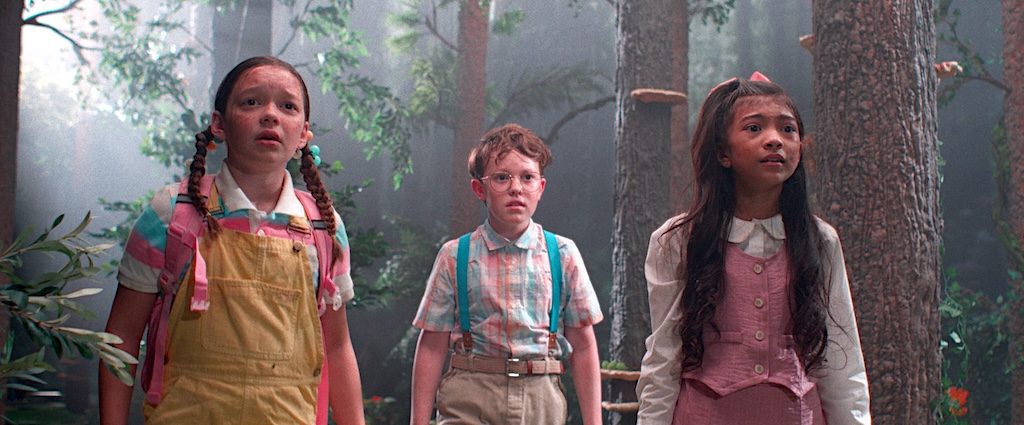
Freddy (Delaney Quinn), Oliver (Tristan Borders), and Hannah (Madison Skyy Polan) Photo courtesy of Roadside Attractions and Saban Films
Why Casper Kelly Chose Buddy
Kelly was approached by producers J. D. Lifshitz, Raphael Margules and Tracy Rosenblum to write a horror version of the kid’s show Barney & Friends.
As a kid, Kelly remembered watching children’s shows and being jealous of the kids that “lived” in that world. It all seemed so happy and exciting. A world where any problem was solved with the help of a loving mentor/ mascot within a tidy 22 minutes.
Upon further reflection my kid self would sense something off. How did the kids know to follow the story? What if they didn’t want to? Why don’t they ever use bad words, or do certain things like normal kids? Is this happy world actually a controlling or indoctrinating one?

Casper Kelly. Photo courtesy of Sundance
Going back to Grimm’s Fairy Tales, there’s an element of propaganda in children’s entertainment. Even well-meaning entertainment is telling us what and how we should think and feel, and setting its agenda.
There’s also a factor of things we loved as children, before we had critical faculties, being repurposed, rebooted, and re-released for our enjoyment.
Buddy is partly a way to help cut through the noisy media landscape, but the effect in a way is also weaponizing our own nostalgia against us. We could no longer enjoy these shows for what they were. Kids can longer just be kids. Everything must be dissected, analyzed and questioned.
Buddy thwarts the childhood wonderment. Everything is tethered to the strict schoolteacher mantra of “Do as you are told.” The kids blithely obeye to avoid a caning.
We went to these shows for entertainment, but also for comfort. This is even more relevant now as we live in a world of screens that we use to anesthetize and insulate us from the harshness of the real world. Parents worry about losing their kids to screens or the dangers that lurk behind them.
I also thought about the purple dinosaur. Beloved, but also hated and mocked in our culture. My kids knew the mean parody songs from their school playground before they knew the show. Why was he hated so much, while Pee Wee Herman, another child show host, was so beloved?
Is it because of his appearance – the pear-shaped body, the short arms, the high perky voice? Does he have that style bullies love to beat up in middle school? Is it because he’s seemingly so perfect, so sincere, always knowing the right thing to say? Mr. Rogers is like that and yet he’s enjoying a bit of a renaissance among Gen Z. What if this kid’s show mascot felt this hatred from kids in the show? What if he internalized it?
How would it make him feel and act? How would he cope with the pressure of having to seem perfect? Many of us have been in situations where we realize the seemingly perfect caregiver/ helper/ authority figure we idolize may not have our best interests at heart, be it a parent, relative, health care system, boss, teacher, friend, or government.
How hard it must be to slowly learn this thing you rely on to teach you and take care of you can’t be trusted. It is as disorienting as a fish finding itself suddenly in poisoned water. Water is the only world it knows. How can it escape?