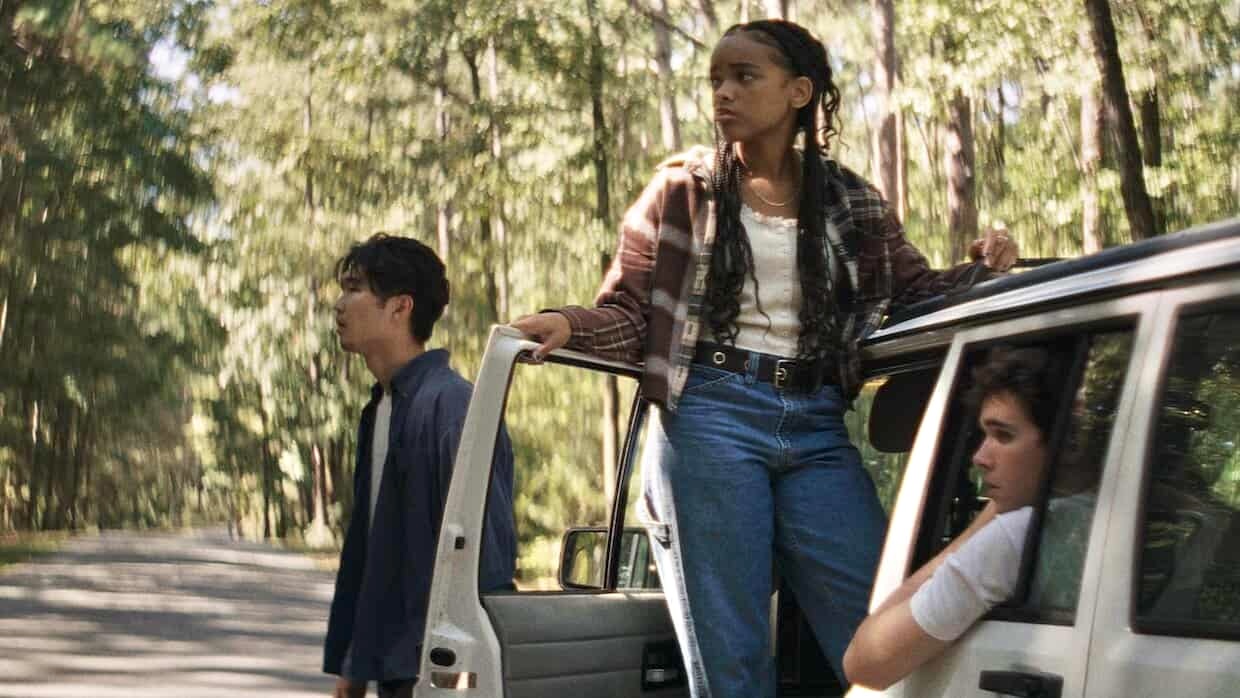
It Ends has been building word-of-mouth in supernatural horror-thriller genre circles. Writer/ director Alexander Ullom’s debut movie traps a group of young adults James, Day, Fisher and Tyler on a road after returning home from a party. It adds new meaning to the “road movie” genre.
What Is It Ends About?
The film’s central premise is succint: a group of friends traveling together becomes trapped on an endless stretch of road in their Jeep, where the rules of normal reality no longer apply. The road may be open, but it is no longer navigable. The characters are physically mobile, but dramatically trapped.
That setup places the movie in a familiar thematic canon of road-bound dread.
The open road, conventionally a symbol of freedom, mobility, individuality, self-discovery, and escape, now becomes a prison. The car, normally a protective private space from external harms becomes a purgatory of sorts. Every mile forward confirms that forward motion is no longer progress. Time is warbled.
Ullom’s premise is rooted less in a traditional monster-movie trope, but in existential, liminal, or cosmic horror. The threat is not simply whether the characters can defeat an antagonist. It is whether they can understand the reasons of their confinement, their relationships, and themsleves. Call it a mobile, extended therapy session.
That premise puts It Ends squarely in the “trapped in a loop” subgenre of horror, but Ullom’s approach leans more psychological than physical. It launches into extended theoretical debates about which animals might win in a fight as a metaphor for the fleeting nature of life and the meaning we impose on it.
What begins as a recognizable lost “friends in a car” scenario becomes a stripped-down nightmare about isolation, distrust, and the visceral terror of being unable to move forward — or turn back.
The film isn’t explicitly interested in explaining its physics or even its full logic. It’s only interested in what happens to people who realize that the normal rules of escape no longer apply to them. Are we stuck? Can we change the path of destiny? Do we keep driving until something happens?
Ullom writes and directs It Ends as a feature film that depends entirely on tight script discipline. Much of the scenery is similar and most action takes place in a driving Jeep. The tension has to come from structure, dialogue, and pacing. In that sense, it plays more like a stage play, free from visual distractions.
Every effective horror film argues with and challenges its own genre points. It Ends borrows recognizable tropes and then complicates them just enough to keep the audience off balance in a menacing sea of uncertainty.
Much of It Ends relies heavily on tonal execution to land. That unseasy dread. The unknowable. Consider movies like Bring Her Back or The Black Phone which suggest an underlying plot while invitinga audience interpretation.
Chamber Films vs Contained Movies and the Craft of Writing Stories Under Pressure

Alexander Ullom
Why a Road Is a Strong Contained-Movie Location
A road is visually simple, but dramatically versatile. It can suggest escape, repetition, danger, liminality, and confrontation. In a low-budget movie, it also offers a writer a practical way to create scope without constantly changing locations.
The key is not merely to strand characters somewhere in a broken down vehicle waiting for help to arrive.. The screenplay must keep changing what “stuck” means in terms of character evolution.
At first, being trapped may be a logistical problem: the characters cannot find an exit an isolated location. Then it becomes a social problem: they disagree about what they saw, where they are, or who is responsible. Finally, it can become a moral problem: survival may require a choice that reveals the worst—or best—in each person.
That escalation is the emotional engine. If the situation remains only “they are still driving,” the concept quickly runs out of gas.
It Ends also manages to keep its horror grounded and practical — headlights, silence, the geography of a car and a dark road doing most of the work. You won’t find any VFX tendrils gobbling up humans here.
Effective Screenplay Endings: 10 Keys to Powerful Conclusions
The Thriller Tropes It Ends Uses
- The Loop Structure
The “can’t escape the road” device has genre fragments running through films like Jeepers Creepers, The Ritual, and more directly, The Endless and Triangle. There is no exit. The loop structure mines what it costs each character and what it reveals about them that a straight-line plot never could.
Ullom uses the loop less as a puzzle box and more as a pressure chamber. The film is less concerned with “how do we get out?” than “what do we become while we’re stuck?” So, ultimately the resolution is more about reflection, self-exploration, and transformation than escape.
- The Closed-System Trap
The road in It Ends operates as a closed system. Paradoxically, even if the landscape appears expansive, its narrative function is confinement.
The audience needs to understand the rules gradually. Too much explanation kills mystery; too little information can make the story feel uncooked. The screenwriter’s job is to reveal enough cause-and-effect for viewers to track the characters’ choices, even if the larger phenomenon remains unknowable.
- The Fracturing Friend Group
A group of friends is not just a convenient ensemble of characters that dwindles. It is a built-in conflict machine.
In effective horror ensembles, each character wants something different from the group. One wants to preserve calm. One demands action. One withholds information. One rejects the situation entirely. One becomes the emotional center. As pressure rises, old resentments become newly relevant.
As the friend group declines, the central question arises regardless of where they are in the loop. Should we accept our fate or should we continue driving?
John Carpenter’s The Thing is the canonical example of paranoia transforming a group dynamic into the primary source of suspense. The creature matters, but the central dramatic question is whether anyone can trust anyone else.
In It Ends, each traveler needs to have a distinct strategy for surviving uncertainty. If every character reacts with equal fear, the scenes flatten. Conflict emerges when fear takes different forms at different timelelines: denial, aggression, humor, control, silence, self-sacrifice, or escape.
- The Unreliable Reality Hook
When a horror movie bends the laws of space or time, writers face a delicate challenge. The audience will suspend their disbelief and accept impossible events, but not meaningless ones.
That is the principle a film like It Ends must honor. Mystery is not the absence of information. Mystery is strategically managed information that is strategically withheld and delivered in measured doses.
In It Ends, unreliability leans into uncertainty and sometimes, ambiguity.
Related: What Exactly Is Cosmic (Lovecraftian) Horror?
Subversion Through Atmosphere
Horror cinema frequently suffers from common, predictable rhythmic beats: the false scare, the sudden audio spike, and the expository sage explaining the curse. Alexander Ullom systematically dismantles these expectations, repurposing familiar narrative devices to catch seasoned genre viewers off balance.
Conventional Jump Scare —> Subverted into —> Protracted Spatial Emotional Pain
Explanatory Mythology —> Subverted into —> Ambiguous Existential Threat
Heroic Final Survivor —> Subverted into —> Psychological Meltdown
Deconstructing the Safe Haven
The domestic space in modern thrillers typically acts as a fortress under siege. Ullom inverts this trope by framing the sanctuary (Jeep) as a tomb long before the outside threat breaches the threshold.
The Refusal of Cathartic Relief
Many commercial screenplays employ comic relief or romantic subplots to release pressure between set pieces. Ullom denies us this respite. Each successive scene tightens the emotional vice, ensuring that the characters — and the audience — are denied emotional pause.
Similar Horror Films for Writers to Study
Writers interested in the formal territory of It Ends should study films that turn limited spaces, unstable realities, and character conflict into escalating suspense.
The Endless (2017): Benson and Moorhead build cosmic horror through recurrence, rules, and emotional history without over-explaining.
Coherence (2013): James Ward Byrkit uses a modest production scale to create a sophisticated thriller with dialogue-driven dread
Triangle (2009): Christopher Smith shows how a time-loop structure can intensify guilt, punishment and character revelation.
Dead End (2003): A direct companion text for the “wrong road” nightmare, using a family drive to create growing unreality.
The Autopsy of Jane Doe (2016): André Øvredal demonstrates how a single location can produce escalating discovery and dread.
Buried (2010): Chris Sparling’s screenplay is a masterclass in sustaining momentum inside an almost impossibly restricted premise.
It Follows (2014) — for slow-building, rule-based horror that never rushes its reveal.
The Invitation (2015): Phil Hay and Matt Manfredi make social unease, withheld information, and character history do the work of action set pieces.
What Makes It Ends Different
Most loop-horror films eventually hand the audience an explanation and a satisfying conclusion — a curse, a scientific accident, a supernatural bargain. It Ends is more nebulant with its revelations, trusting that dread sustained through character is more durable than dread sustained through mythology.
That’s a risk. Ambiguity done poorly reads as a script that didn’t finish its own worldbuilding. Ambiguity done well, reads as confidence. The difference lives entirely in the writing — specifically, in whether the characters’ choices feel motivated even when the surrounding rules don’t get spelled out.
Refining Your Script with Professional Story Analysis
Mastering genre tension requires an objective perspective on pacing, structure, and character mechanics. Navigating the delicate balance between structural economy and emotional chords often demands an external eye trained in industry standards.
For writers developing their own contained horror concepts, the next step is usually the hardest to see clearly on your own: whether the ambiguity in your script reads as intentional or unfinished, and whether your constrained setting is doing enough narrative work. Creative Screenwriting’s script feedback services are built for exactly that kind of diagnostic read — a second set of professional eyes on the specific structural choices that separate a tight horror script from one that just feels sparse.