
The Resident Evil movie franchise has been a horror and action staple since Capcom’s survival/ horror video game debuted in 1996, spawning a massive multimedia empire that includes games, animated features, and a string of live-action films. Known for its zombie outbreaks, shadowy bioweapons conglomerate Umbrella Corporation, and iconic characters, the franchise has grossed over a billion dollars worldwide across its theatrical run — cementing itself as one of the most successful video game adaptation properties in Hollywood history.
Now, a new chapter is unfolding as acclaimed screenwriting talents Zach Cregger (Barbarian, Weapons) and Shay Hatten (John Wick, Ballerina, Army of the Dead) join forces to reimagine the property for a new generation of fans.
In this interview with Creative Screenwriting Magazine, Hatten pulls back the curtain on the collaborative screenwriting process, the challenges of adapting beloved source material, and what makes this Shay Hatten Resident Evil screenplay partnership with Cregger so special. The film stars Austin Abrams as a hapless courier paid extra to deliver a package to Raccoon City during a snow storm while his pregnant girlfriend wants him at home to discuss parenthood.
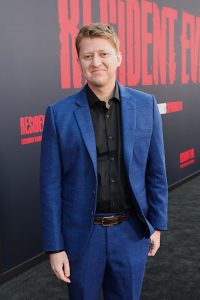
Shay Hatten. Photo by Stewart Cook/ Sony Pictures Via Getty Images)
Discuss how your ultra-violent John Wick background and how it coalesces with Zach Cregger less violent sensibilities.
A lot of my movies in the past have been hyper-violent, over-the-top action movies. But funnily enough, I met Zach for the first time about a decade ago, long before I got thrown into the John Wick world.
We met because I’d written this over-the-top, satirical Stephen King biopic script that he read. It was right at the start of my career. I think he was the third general meeting I ever took.
I was excited to meet him because of his Whitest Kids Who Know videos, which me and my friends were all obsessed with in high school. We met and became good buds. I think that then we were more aligned on the zany, comedic, over-the-top tone in Resident Evil.
And then we both brought it to the John Wick world and went down that path. Zach began the amazing career that has led him here. Getting to work with him again on Resident Evil honestly felt like a full circle.
As much as I love all the hardcore action of the John Wick franchise, it felt nice to get to flex some of those creative muscles that were pushing the tone. It felt like a homecoming in some ways.
Related: Shay Hatten and Michael Finch Discuss “John Wick: Chapter 4
What were some of the ‘blue sky’ conversations you had before you and Zach started writing Resident Evil?
There were a lot of things to consider. Who are the audience? How do we service the hardcore fans? How do we service the gamers? How do we service the people who are not that invested in it? That’s the most daunting question you have to ask when you’re approaching a piece of IP that’s as beloved as this.
How do we please everybody? I think if you start trying to make sure you’re pleasing everybody, you’re almost going to get in a tangle. We said, ‘OK, we’re huge fans of this franchise. We love these video games,’ and went from there.
What would we want to see as the ultimate fans of these games? We tried to answer that. So, the spirit of Resident Evil, as much as it is about the lore from the games, is also about the player experience, which is you’re one person guiding a character. You’re up against it.
Wven if your character in the game has expertise, it is a personal attempt at navigating situations like this. You as the gamer, are not. We just tried to take that spirit and put it into the character in this movie.
Hopefully, the movie represents the feeling of what it’s like to be a fan of these games, trying to stumble through navigating a crazy situation.
Related: Producer Miri Yoon Reveals the Challenges of Making “Weapons”
How did your writing collaboration with Zach Cregger work?
He called me and asked if I’d be interested in working on Resident Evil with him. And I agreed immediately. Zach had the concept that it was going to be ‘run and gun,’ one guy going into Raccoon City, and keeping it in real time.
Then we wrote the entire movie, essentially FaceTiming with each other and talking about pieces of the thing.
Then we would mute ourselves, each take a scene and write it. Then we’d unmute ourselves and read each other’s scenes. So we wrote the whole movie in a virtual room. It really is the most fun I’ve ever had writing anything.
I think it really was that process that I ascribe to the movie having the tone that it does because the writing was always done in these two hour spurts of concentrated energy – let’s keep the fun on, let’s make each other laugh, and pushing ourselves to keep that energy up. Maybe if we had more time to go away on our own and think about things and labor over sequences, some of that fun would have seeped out of the balloon.
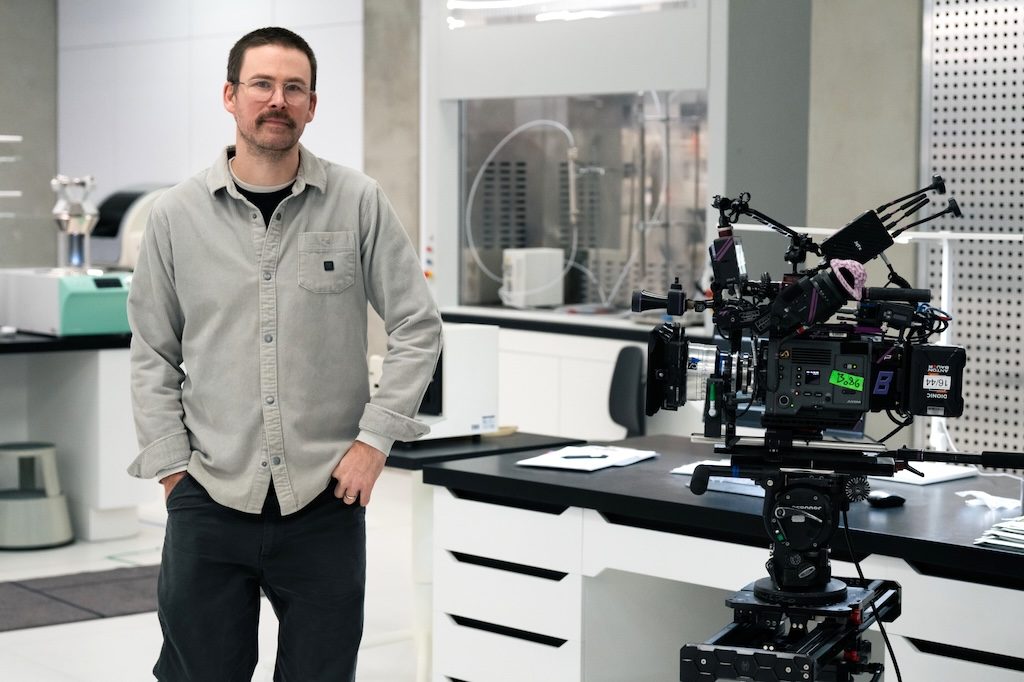
Zach Cregger. Photo courtesy of Sony Pictures
What was your writing North Star to balance survivalism with narrative drama?
Our North Star was just Bryan, essentially.
We really fell in love with writing this character and our North Star became how we keep the focus of the movie on him and keeping his emotional ordeal heightened throughout.
There were drafts where the more we started to bring in other characters throughout the movie. Every time we started to get away from the core of Bryan himself alone with his backup against it, it started to feel like the movie was getting off its course of the pure survival situation for one character.
Related: Zach Cregger’s “Weapons:” Understanding The Symbolism and Character Archetypes
What makes Bryan the ideal hero for Resident Evil?
I see myself in Brian tremendously. There’s more of me in Bryan than there is me in John Wick.
I think he’s the ultimate everyman. He’s not a person cut out for heroism. He’s sympathetic and he’s just trying to make a living in this gig economy. He’s trying to navigate a situation that’s further into adulthood than he knows how to deal with in regards to his girlfriend Michelle’s (Sara Paxton) pregnancy.
Then he gets into this bad situation and realizes, ‘I’m an idiot and everything that I thought was a problem in my life is not a problem now that I’m immersed in a horrifying situation like this, and how do I get out of it?’
It’s almost like his lack of heroism naturally makes him a better conduit for the audience, because I know that he represents what I would be like navigating the situation much more than how a traditional action hero would be navigating it.
Related: A Talk with Zach Cregger on “Barbarian”
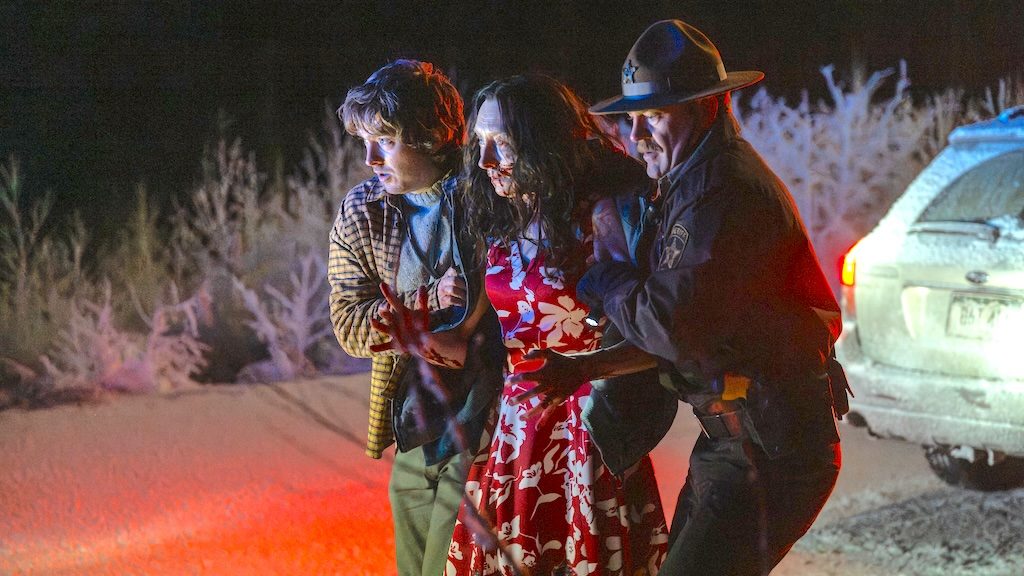
Austin Abrams, Andrea Miltnerova and Johnno Wilson. Photo by Dušan Martinček
Bryan is not bumbling his way through the situation. He has some skills and makes it through to the end.
I think what we wanted for his journey was near the experience that a person playing the Resident Evil games would have. You start out, you have one gun, you don’t really know what you’re doing. And over the course of playing, you slowly get more confidence. So you’re upgrading your arsenal of weaponry and materials as you navigate from point A to point B.
And by the third act, he is navigating some pretty crazy stuff, and doing it adeptly. But at the end of the day, the reason he’s doing all of it is simply because he wants to survive. So, it really is his survival instinct and desire to get home and see his girlfriend that overcomes his natural fear. This gives him the gusto he needs to get through the situation.
That really was what we were trying to go for. It was a guy who’s over his head, realizes what the situation is, and just is doing his best to scramble his way out of it. Never being too competent, but also, not being so incompetent that we don’t want to follow him.
Related: “Be Undisciplined And Write Your Voice” Says ‘John Wick’ Film Producer Basil Iwanyk
Discuss Bryan’s impending fatherhood storyline. Is this a subplot or parallel main plot?
He’s doubting himself as a father, and grappling with the shock of becoming a father.
I definitely think when we set out to write the movie, it probably was more of a B story. That’s his backstory and that’s what drives him into the situation. But we don’t know how much he’s going to be dealing with that thematically as the movie goes on.
But then we kept finding ourselves that this actually mirrors Bryan’s emotional ordeal.
For instance, when he encounters the girl around midway in the movie, when he ends up in the maternity ward of the hospital, all those things speak to his psychological unreadiness to be a father and are reflecting his own situation back to him.
You can read the movie as just a purely crazy survival movie, but also as a metaphor for one guy confronting his unreadiness to be a dad.
The situation he’s going through is psychologically pushing that back in his face. I think there’s enough of it that it’s there, but it doesn’t overwhelm the movie. That’s the balance we’re trying to strike.
Related: Johannes Roberts Talks “Resident Evil: Welcome To Raccoon City”
Was there ever a version where we see his girlfriend Michelle on screen?
No. There was always distance. We always felt like it had to just be Bryan because he’s isolated.
And the more you bring in anybody from his outside world into the situation, the more you’ve got a broken containment of the pure nightmare that he’s in, in Raccoon City. So we really felt like we had to keep the focus extremely narrow.
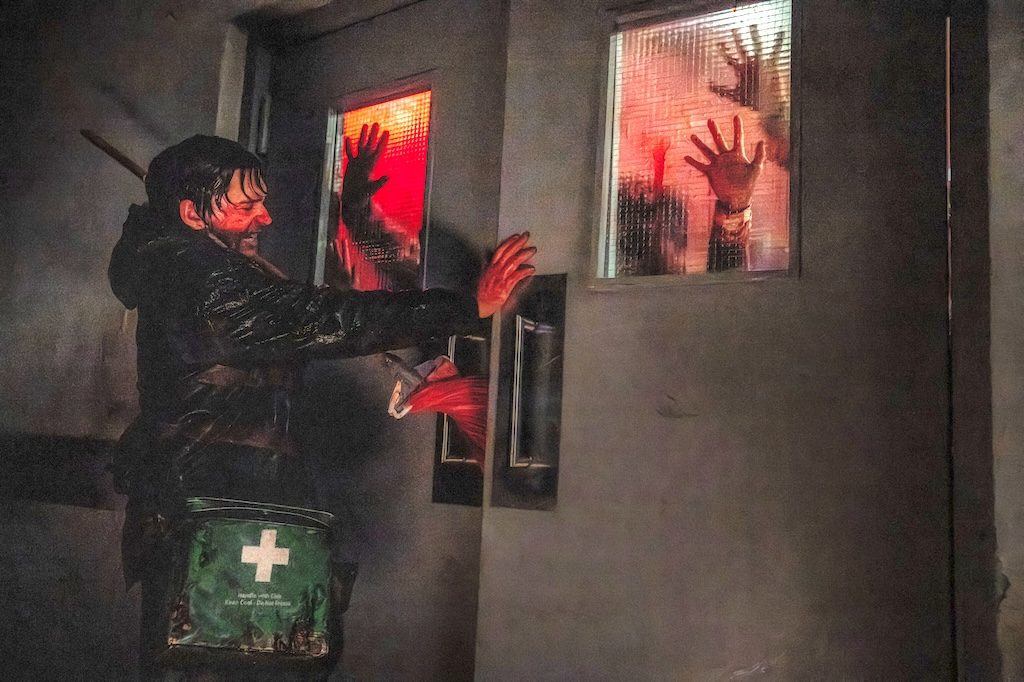
Bryan (Austin Abrams) Photo by Dušan Martinček
Discuss the cheeky nod Bryan makes to the franchise when he calls out, “Video Game?”
That line in particular came straight out of Cregger’s brain, went straight into the script, and now it is in the movie. I remember us crafting that whole sequence and it just came together so beautifully.
Bryan’s in a terrifying situation.
He’s running from the hospital. This monster’s coming for him up the building. The way that we resolved that situation was having the idea that he can do this. So sometimes it truly is a blessing because you don’t have to strain or reach for the line. It’s right there for you.
Talk about the comedic tone of Resident Evil.
Tone is a fascinating question. It’s always the North Star in the writing.
I think partially that’s because there’s a part of me that doesn’t understand what people are talking about when they complain that a movie is oscillating too wildly between different tones. That’s what I’ve always been drawn to. To me, it nails the balance that all of our lives strike – sometimes they’re funny, sometimes they’re sad, sometimes they’re scary.
The tone that feels the most truthful in a movie is like the Sam Raimi tone, where it’s wild and it’s zany, and it’s all over the place. But the emotional reality for the character is played fairly straight, even as the things happening in the movie are getting increasingly crazy.
It really wasn’t even an active decision so much as we were just writing it.
It just felt like the tone that was appropriate for the story. It just kind of came out. Zach Cregger found all these opportunities to push the tone even further and wilder. The thing I’m most proud of in the movie that the tone oscillates between jump scares, grotesquerie, and also moments where you’re kind of endeared; you’re laughing.
Describe the atmosphere of Resident Evil.
I think the thing that I’m most proud of in this movie is the sense of oppressive energy.
Ultimately we wanted to start the movie with a slow sense of creeping dread of something being wrong and start ramping that up and essentially never let off the ramp. It’s just a straight ramp up into absolute madness. I think it really is the key to the movie working because it grips you and it takes you on that ride of lifting you up, up, up, up, up, and then, leaving you at a delirious climax.
Is there a sequence in the movie that speaks the most to you?
I would point to the whole sequence in the middle where Bryan encounters the other scientists and the security guard. They’re in their gauntlet where briefly the buddy movie lets up. I remember us writing that dialogue and being like, ‘It’s so fun to give him somebody to now bounce off of and playing the surprise buddy comedy dynamic for as briefly as we do. But with Austin Abrams and Paul Walter Hauser (the Umbrella scientist), it was really fun to push.
So much of Bryan is the solo ride. That was the one scene where you get to let loose a little bit with the dialogue and continue to navigate the absurdity of the situation, but not escalate the absurdity too hard.
And then put it in a grotesque bow with how we get Bryan back on his own at the end of it.