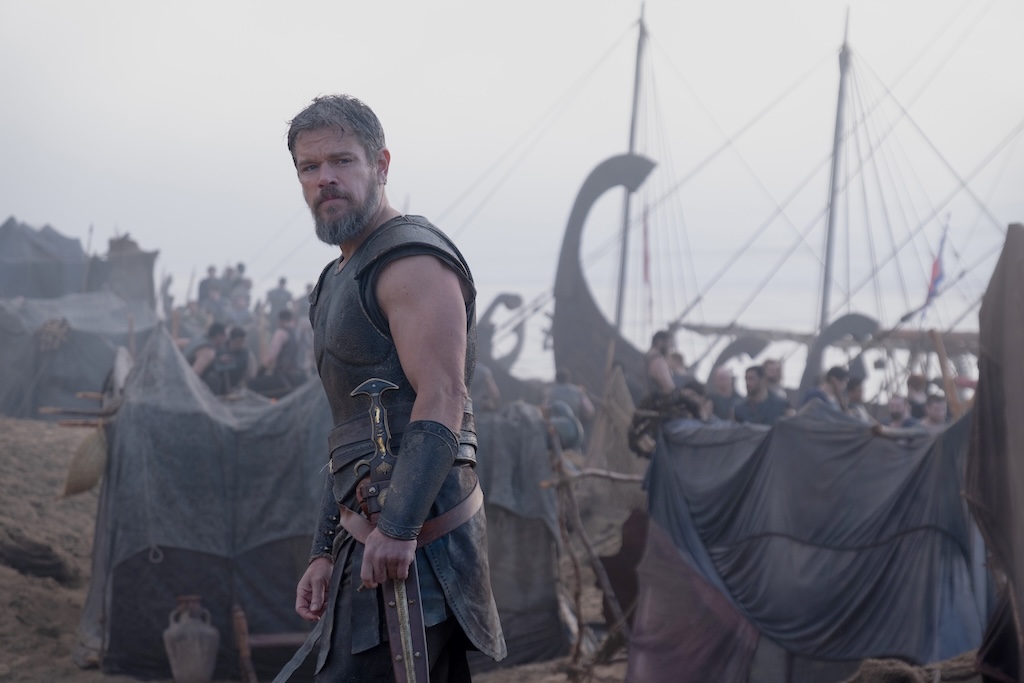
Homer’s The Odyssey, readapted by Christopher Nolan into a glorious film, is one of the original epic adventure stories: a mythic journey following the Greek hero Odysseus as he fights to return home to Ithaca after the Trojan War. Facing monsters, gods, temptations, shipwrecks, and difficult choices, Odysseus must rely on intelligence, resilience, deception, and identity to reunite with his family and reclaim his place in Ithaca.
In this article, we’ll analyze the three main characters – Odysseus (Matt Damon), Penelope (Anne Hathaway) and Telemachus (Tom Holland).
The Odyssey: Deconstructing Odysseus, Penelope, Telemachus
A compelling The Odyssey movie adaptation cannot simpley treat Homer’s characters as mythological archetypes. The epic survives because its central family is built around a recognizable timeless dramatic problem: what happens when war breaks and remakes a man, absence breaks and remakes a marriage, and a child must become an adult without a parent to offer guidance?
For screenwriters, Odysseus, Penelope, and Telemachus offers insights into three interlocking character arcs that converge while preserving their individual terrain. Each occupies a distinct dramatic territory — action, domestic resistance, and coming-of-age — while each reflects, provokes and heals the others’ wounds. Their eventual reunion works, not simply because King Odysseus returns home, but because three people have had to deconstruct and reconstruct their identities and adapt to a new reality.
The Odyssey’s Core Drama Is a Family Under Siege
Homer’s plot is often reduced to an adventure story: a warrior spends ten years trying to return while encountering monsters, gods, temptations, and shipwrecks. That is the external movie. The internal movie is far more demanding.
Odysseus has survived a war, but cannot resume his role as a husband and father. Penelope has preserved a household without becoming passive or emotionally frozen while deflecting a string of suitors. Telemachus has grown up in the shadow of an absent father whose legend is more vivid than the man himself, while also making his own case for the throne.
Those are not three parallel individual stories. They are one interconnected pressure system with various pressure vulnerabilities uniting them.
A successful adaptation should treat Ithaca as more than the destination or the concept of home. It is the crucible where all three storylines clash and resolve. The palace has been occupied by the suitors, but the deeper violation is structural: the home’s rules, inheritance, hospitality, and patriarchal authority have all been corrupted.
That gives the domestic storyline the stakes of a political thriller. The suitors are not merely romantic rivals. They are an occupying force exploiting a leadership vacuum.
The journey sections provide spectacle, but Ithaca supplies the ticking clock. The dam may eventually break as all the forces strain the king’s homeland. This raises two questions regarding Odysseus’ journey. Will Ithaca and his kingdom still exist if or when he returns, and whether or not he deserves it.
More: “The Odyssey” Christopher Nolan Reimagines Homer’s Timeless Epic
The Three-Character Design
The character triad also provides a model for distributing point of view around the central thematic nucleus. The design is a tripod, each leg carrying its own weight to prevent it from falling. Odysseus isn’t a neat main character, while Penelope and Telemachus serve him as supports. Each is a main character in their own right.
Odysseus carries the external conflict: survival, escape, temptation, and the need to impose order on chaos. Not to mention controlling his ruthless tendencies of sacrificing some soldiers while trying to save the majority of them.
Penelope carries the sustained pressure conflict: she cannot leave Ithaca, cannot openly surrender, and cannot safely reveal her full strategy. She is stuck in the belief that her husband will eventually return – albeit after a decade.
Telemachus carries the transformational conflict: he must move from observation to action, from a boy defined by absence to a young man capable of choosing allegiance and risk in order to lead.
Odysseus’ scenes are often built around strategy and tactics. Penelope’s scenes are built around subtext and faith. Telemachus’ scenes are built around decisions that test his evolving manhood.
.
Odysseus: The Trickster-Hero
Odysseus is defined by cunning intelligence, adaptive thought, strategic deception, and the ability to read power in a room and respond in kind.
In Jungian terms, Odysseus is the Trickster-Hero — a figure defined less by physical courage than by cunning, adaptability, and a compulsive need to assert identity through narrative control. He is a man who lies to survive. He disguises himself. He tells stories about himself in the abstract third person. He shapeshifts his identity.
Similar to many Greek mythic heroes, he has ascended to demi-god status. He can consult Athena (Zendaya) for solace and guidance, but ultimately, he is still a human being with flaws and fears. He is the master of his own destiny and makes his own choices.
The gods function as external forces that amplify and accelerate human tendencies. They force introspection in search of greater meaning. Athena doesn’t make Odysseus clever — he already is. She creates conditions that demand his cleverness. Poseidon doesn’t make him proud — he already is. He creates consequences that strip away everything except that pride.
The Trojan Horse is his signature dramatic act. It is not a victory of military force. It is a victory of performance, misdirection, and understanding what an enemy wants to believe. He is part war hero, part con artist, part intelligence operative. But he did breach the gates of Troy.
Ironically, the same quality that saves him also endangers him.
His encounter with Polyphemus is the clearest example. Odysseus initially escapes through brilliant deception, calling himself “Nobody.” Then pride overrides discipline. He reveals his name, allowing the Cyclops (Bill Irwin) to invoke Poseidon’s wrath. The scene exposes a contradiction that an adaptation should not flatten: he wants to be the man who outsmarts the gods and the man whose name is remembered for doing so.
The Absent Center
In dramatics structural terms, Odysseus functions as the absent center — the black hole around whom every other character’s center of gravity bends towards. He drives the plot without being present for most of it.
His wandering episodes — the Cyclops, Circe (Samantha Morton), the Sirens — are not digressions or perfunctory obstacles. They are a systematic testing and reorganising of Odysseus’ identity. Each trial strips away a layer of the warrior-king persona, exposing a more essential, more frightened, more unsure, more human man beneath the shield.
His arc isn’t “will he get home?” It’s “who will he be when he arrives?”
His fatal flaw is hubris — Hamartia, but not the arrogance of lesser heroes. He’s an egotistical man who cannot resist revealing himself, who cannot let a story go untold even when silence would save him.
When he blinds the Cyclops and then shouts his real name across the water, he isn’t being careless. He’s being consistent. He cannot bear to have inflicted suffering anonymously.
The monsters are memorable, but they matter because they test the limits of Odysseus’s weaknesses and mortal sins: curiosity, pride, appetite, control, and the seduction of escape.
The Wounded Strategist
A shallow version of Odysseus is simply clever. A richer version understands that cleverness has consequences and is not fail-safe. His tactics are necessary in a hostile world, but they also make intimacy difficult.
He can return to Ithaca physically while remaining psychologically committed to the habits of war, expeditions, survival and hiding his identity as a beggar. We observe a similar mechanism in Spider-Man: Brand New Day where Peter Parker (Tom Holland) encounters those dearest to him as a stranger. He chooses to maintain his anonymity for as long as possible because he knows that anyone who associates with him becomes endangered.
This is why Odysseus’ reunion with Penelope should not play as an straight reunion scene. He is not merely reclaiming a wife. He is entering a space where intelligence must also dominate an opponent.
David Benioff and D.B. Weiss built much of Game of Thrones around characters who treat information as leverage; George R.R. Martin’s Tyrion Lannister (Peter Dinklage) is a clear descendant of the Odyssean dramaturgist.
Homer’s hero has a more difficult task than simply winning a political power play. He must prove that the man capable of grand deception can still be trusted.
How The Final Season of “Game of Thrones” Torched More Than Just King’s Landing
Penelope: The Domestic Strategist, Not the Waiting Wife
Penelope is often described as faithful, which is accurate but incomplete. Faithfulness is her moral position; intelligence is her dramatic weapon as she functions as the Home Secretary during her husband’s absence to keep the crumbling house intact.
She rules through delay, ambiguity, social performance, and selective disclosure. It is a three-dimension chess game.
Her famous weaving ruse — promising to choose a husband when she completes Laertes’ burial shroud, then undoing the work each night — is not a passive gesture. It is an ongoing act of resistance conducted inside the narrow range of choices available to her.
A weaker version makes Penelope an emblem of devotion: she waits, suffers, and is rewarded for her patience. A stronger one makes her an active political player who understands that overt defiance may get her killed, remove Telemachus’s claim to the throne, or make the household even more vulnerable.
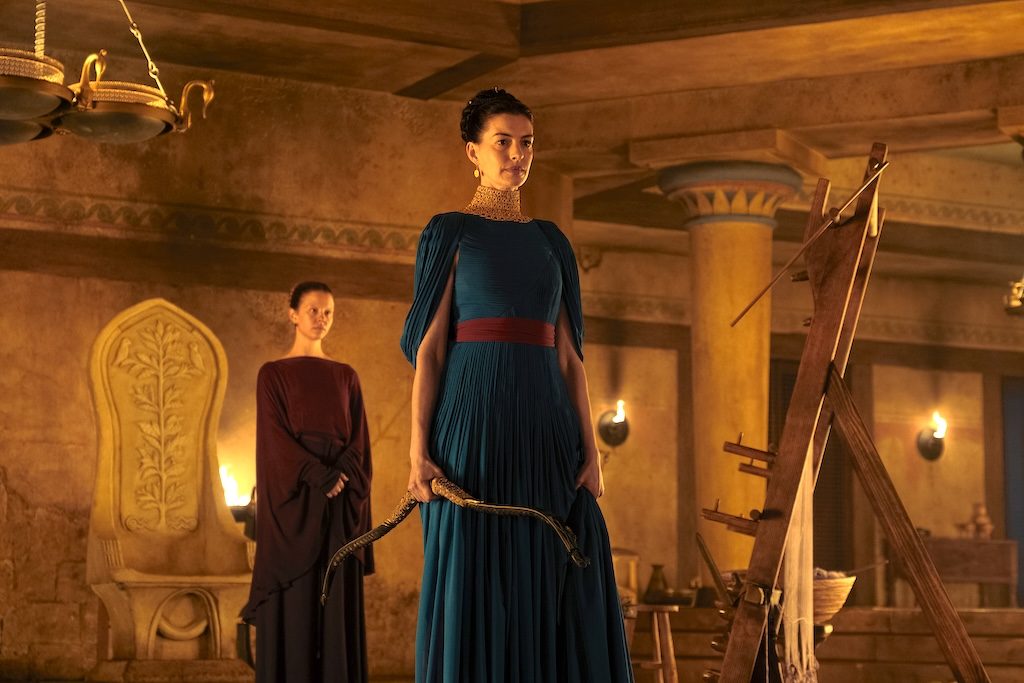
Melantho (Mia Goth) and Penelope i(Anne Hathaway) Photo by Melinda Sue Gordon/ Universal Pictures
Penelope and the Art of Subtext
On the surface, Penelope must entertain suitors, preserve royal decorum, and appear open to remarriage. Underneath, she is buying time, gathering intelligence, and keeping her son alive. It’s a juggling act of survival and subterfuge.
This is a useful tool for writing constrained protagonists. A character does not necessarily need physical freedom to possess agency.
Consider the way Jane Campion writes women navigating restrictive social systems in The Piano and The Power of the Dog. The characters’ strategies are often encoded in gesture, silence, ritual, and what they selectively withhold. Penelope requires a similar approach.
Her final test of Odysseus — referencing their marriage bed, built around a living olive tree — is especially crucial. The returning hero does not authenticate the wife; the wife authenticates the returning hero.
Penelope is the arguably the most tactically sophisticated character in the entire epic. She’s a master strategist. She plays a ten-year long game against more than a hundred armed men who are eating through her estate, and she wins.
She is, in structural terms, the Keeper of the Threshold — the figure who holds the world in stasis until the true hero can return to restore it.
Where Odysseus moves constantly — crossing seas, descending into the underworld, shifting disguises — Penelope is defined by stillness and stability.
What elevates Penelope from clever archetype to fully realized character is what she suppresses. She grieves for a husband she’s not certain is alive, for a youth spent in suspension, for a marriage she can barely remember.
But she cannot grieve openly without surrendering the fiction of hope that keeps her son stable and her suitors guessing.
Telemachus (Tom Holland) Melinda Sue Gordon/ Universal Picture
Telemachus and the Coming-of-Age Story
Telemachus begins The Odyssey as a young man living under humiliation. The suitors consume his household, challenge his authority, and treat him as politically irrelevant – a little boy. His problem is not merely that his father is gone. It is that everyone around him has decided what that absence means.
He is expected to be powerless and ineffective. He is manipulated to convince his mother that his father is not returning and to choose a suitor.
His journey, the Telemachy, is therefore not a side quest. It is the story’s coming-of-age spine. Athena sends him to seek news of his father, but the deeper purpose is to put him among models of kingship, grief, loyalty, and adult male conduct to mentor him. It’s his passage into manhood.
Nestor offers the memory of an older heroic order. Menelaus (Jon Bernthal) presents a king who has returned. but remains scarred by loss and strange knowledge. These encounters teach Telemachus that adulthood is not inherited automatically through bloodline. It is earned through choices, speech, judgment, and risk.
Telemachus was an infant when Odysseus left. He has grown up in a house occupied by men who openly disrespect his absent father’s legacy and consume his inheritance. He is nominally the man of the house. In practice, he has no authority and no model for how to claim it.
His archetype is the Puer — the eternal boy on the verge of becoming. His dramatic function is the succession arc. The story cannot end with Odysseus alone reclaiming his kingdom. The kingdom must have a future with an heir apparent. That future is Telemachus.
What makes Telemachus narratively essential is that his arc mirrors his father’s in structure while inverting it in direction. Odysseus is trying to return to a fixed identity. Telemachus is trying to construct one for the first time.
Athena, disguised as the old family friend Mentor, essentially controls Telemachus’s growth. She tells him what to say, where to go, how to stand in rooms full of powerful men. The divine intervention is mentorship — the transmission of identity from one generation to the next. His apprenticeship.
Telemachus learns to be a king by acting like one before he is one. The behavior precedes the belief.
The recognition scene between Odysseus and Telemachus upon his return — before the final confrontation with the suitors — is one of the epic’s most emotionally loaded moments.
It is private. It is loaded. It comes before the public triumph. It establishes that the personal stakes are settled before the plot resolves. Odysseus doesn’t need to prove himself to his son through violence. The reunion is its own climax, separate from the action climax that follows.
The emotional resolution and the plot resolution are disaggregated. They land in separate scenes. Each gets its full weight and attention.
Writers can look to Michael Corleone’s relationship with his father Vito in The Godfather for a darker version of this character design. Michael’s inheritance is not just power; it is a moral system that remakes and defines him. Telemachus’s arc must avoid that fatalism. He enters his father’s world of violence and strategy, but the story can still ask whether he will inherit its methods without inheriting its isolation.
Similar thematics emerge in the Roy family in Succession. The patriarch searches for a worthy heir and successor and no sibling should assume the throne will automatically be inherited by the eldest son.
Greek Mythology Gives Each Character an Archetype — and a Trap
Archetypes are useful only when they produce friction and emotional conflict. Odysseus, Penelope, and Telemachus each embody a recognizable mythic role.
Odysseus is the returning king, the trickster hero, and the war survivor. His trap is believing mastery over circumstances is the same as mastery over himself – a lesson the gods are constantly teaching him.
Penelope is the faithful wife, the queen under siege, and the keeper of the home. Her trap is that endurance can become a form of self-erasure if the story does not give her a decisive final act.
Telemachus is the fatherless son and heir apparent. His trap is confusing adulthood with aggression or treating violence as the only available proof of manhood.
These archetypes work because they present a debate about identity and destiny. Is a man a king because he kills his rivals? Is a wife loyal because she waits? Is a son grown because he fights beside his father?
The Climax of the Mythic Triangle
When these three character arcs finally converge in the great hall, the dramatic payoff relies entirely on the internal mechanics established in acts one and two. The final showdown is not merely an action sequence; it is a test of recognition, trust, and reintegration. The king cannot simply slaughter the suitors and resume his throne as if twenty years had never passed.
He has been changed by the underworld, the sea, and the lotus-eaters. His wife has been changed by decades of calculated resistance. Their son is no longer a child.
Mastering complex character dynamics in classical adaptations requires a deep understanding of structural beat sheets and thematic resonance. If you want to elevate your feature writing and apply these structural lessons to your own mythic or historical specs, professional script feedback is invaluable. You can refine your plotting and character arcs through the Creative Screenwriting Script Coverage Service, designed to help working writers diagnose structural flaws before taking their material to the marketplace.