
In 2010, The Social Network was released to telegraph the monumental and potentially irreversible impact of social media on the world. It’s mission was noble. It is a way to connect, communicate, and build communities with anyone with an internet connection no matter how spotty.
Almost two decades later, the role of Facebook (now rebranded as Meta) has amplified exponentially due to the unbridled power of its algorithm. Meta has become more sophisticated and more insidious as it harnesses our biases, fears and anxieties. It collects data on its users which it sells to advertisers with pinpoint precision.
Meta manipulates our attention spans and controls our dopamine bursts, encouraging its users to scroll for hours as they unwittingly fall down the rabbit hole of darker echo chambers to link with like-minded people regardless of the facts or non-facts.
Aaron Sorkin brings us The Social Reckoning – a most appropriate title. The platform designed to bring the world together has its day in court.
In a perverse salute to Free Speech, Meta Moguls hail the platform as a Public Square. Users could effectively post any opinion they want, no matter how outlandish, offensive or false, without fear of regulation or retribution for their consequences. Any such regulation would temper the spirit of free speech.
The global behmoth has arrogantly dismissed government regulations as temporary irritants. Meta refers to itself as “post government” in the film. It is the equivalent of powerful players “making a call to their senator” to get things done expeditiously and without fuss.
Many online groups double down with distorted interpretations of laws, often referring to the their opinions as “the absolute truth.”
But wasn’t Facebook supposed to give a voice to the unheard, isolated, and neglected? Isn’t that real democracy?
Therein lies our social media problem. The First Amendment allows for a public forum of various and opposing viewpoints, no matter how unpopular or uncomfortable. It doesn’t allow for psychological harm and deliberate deception.
As Jeff Hortwitz phrases it, “Just because someone has a voice you shouldn’t automatically give them the microphone.”
In 2021, The Wall Street Journal gained access to leaked documents from then Facebook confirming the company was aware of the detrimental effects its platform had on its users in terms of mental and physical health. It relied on flooding the zone with relentless streams of information to confuse and exhaust. These became known as The Facebook Files.
The Social Reckoning tells the captivating story of a Facebook whistle blower Frances Haugen (Mikey Madison) and WSJ journalist Jeff Horwitz (Jeremy Allen White) who set out to uncover Facebook’s tightly-guarded secrets about its manipulative algorithms.
The film not only examines the ramifications of corporate power that could settle the deficits of smaller countries, but the power of technology to be both used and abused if not properly regulated.
Related: Aaron Sorkin On ‘Being The Ricardos’
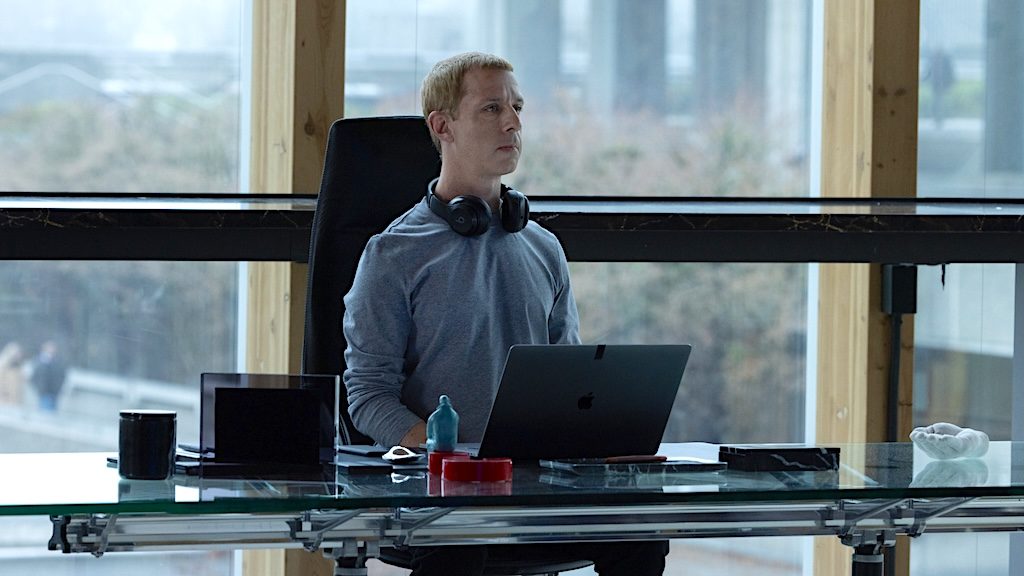
Mark Zuckerberg (Jeremy Strong) Photo courtesy of AOny Pictures
Facebook Goes Off The Guardrails
The stratospheric rise of Facebook and its billionaire CEO Mark Zuckerberg is a tale of daring, hubris, and the messiness of innovation and creation. The Social Network is a story of dreaming big and pushing your ambitions and ego beyond what you thought possible.
The Social Reckoning flips the shiny innovation coin to its drab side as it deals with the chaotic aftermath it has unleashed. From a band of wide-eyed tech nerds looking to connect the planet, its creation became a steady line of crack cocaine with varying purity. It’s well-meaning creation deliberately sowed division, extremism and disinformation to keep its users logged on, angry, and engaged. It wasn’t enough to simply read a post. Users had to comment, react and repost for extra brownie points. The unforeseen consequences for Facebook came with power and serious coinage.
The Social Reckoning explores this insidious power of the algorithm from within a tale of ratcheting momentum set in motion by Sorkin’s trademark complex characters and rapid-fire dialogue. Says Mikey Madison, who took a dive into the tech realm to portray whistleblower Haugen, “It’s an eye-opener to see how algorithms can so easily lead us down a distorted path. The word reckoning in the title really sets the tone.”
Jeremy Allen White, who brings an Everyman quality to in-over-his-head newsman Horwitz, adds, “Like all of Sorkin’s work, The Social Reckoning is smart, funny, tense, and extremely culturally relevant. The focus is on what social media is doing to us all as people.”
For Jeremy Strong, who portrays Mark Zuckerberg, not as the youthful inventor, but a man confronted by the enormity of his power which he will not reliquish, Sorkin was the only person who could unravel this convoluted saga.
“Shakespeare wrote that the role of art is to hold a mirror up to nature and to ‘show the very age and body of the time, its form and pressure.’ Aaron has devoted a large part of his body of work to doing just that, to showing us the form and pressure of our times, and I think this film is his magnum opus,” says Jeremy Strong.
Producer Stuart Besser, a collaborator with Sorkin on every film he has directed to date, joined with producers Todd Black and Peter Rice to bring the script to the screen. “Aaron has created a mesmerizing entertainment out of Facebook’s evolution and our reckoning with social media’s effects. A company that connects three billion people is an amazing thing,” Besser declares. “But it has come to impact everything from children to elections and has come of age without guardrails.”
Related: Aaron Sorkin on Screenwriting

Aaron Sorkin. Photo by Olivier Vigerie/ Sony Pictures VIGERIE_12035.jpg
The Time Of Reckoning
Frances Haugen, a mid level engineer entered the Facebook family with noble intentions and a firm believer of the company’s ideals. Then she faced a morality crossroad when she defies the strict non-disclosure ethos of the social media giant and alerts the Wall Street Journal to The Facebook Files.
The Social Network was about how Facebook was invented. The Social Reckoning is about what social media has become – Aaron Sorkin
The Social Reckoning isn’t merely a long-overdue sequel to a very popular film. It represents a potent moment in time when a corporate titan can make world-changing decisions, affect governments, and democracy itself, via a strategic filtration system which directs posts to users based on their user history. This isn’t a matter of dog chow vendors advertising their gourmet canine delights to dog-loving communities. It’s about shaping how people feel about dogs.
Sorkin notes that “in 2010, Facebook had 500 million users. But today, Facebook has 2.9 billion. It has become something fundamentally different. Over two-thirds of Americans now get their news from Facebook. The problem is that much of what Facebook is sending out into the water supply is simply wrong. Facebook is gushing out mass misinformation, things that outrage and anger you, so that you will keep resharing.”
The Social Reckoning is a meticulously well-researched film and years in the making. The thriller weaves through Congressional hearings, eye-catching news headlines, and Mark Zuckerberg being coached on how to best answer pesky oversight questions, right down to which tie projects the most authority. Don’t worry. Facebook has got everything under control – via low-quality band aids to filter out certain material. The withdrawal of Facebook Kids was hailed as a significant win by activists, but was far from successful in protecting children.
Sorkin sees the subject matter as far beyond politics. “It’s not about red or blue. It’s about a problem we all have together,” he reinforces. His lack of mention of political parties or presidents is intentional.
Facebook In A New Era – Power to the Algorithm & MSI
Despite its ongoing controversies, Facebook’s growth has continued its exponential rise. It has grown so big so fast, laws have lagged behind. It has also drawn increasing scrutiny for data breaches, privacy violations, content manipulation, election interference, and for enabling falsehoods, outrage bait, and abuse to spread across the world.
In 2018, just before Frances Haugen was hired by Facebook, it introduced a new internal ranking system dubbed Meaningful Social Interactions (MSI). MSI prioritized maximum user engagement and resharing posts over the more positive “likes” that previously directed traffic. This led to an uptick in hours spent on the platform.
But it also presaged an explosion of the kinds of speech that tend to draw the most intense human reactions: the lurid, untrue, unjust, outrageous, and enraging. Meanwhile, bots and engagement farmers took advantage of this algorithm to push a wide array of agendas, often with no transparency. Sources and rational analysis of data was rarely fact-checked (it’s current Meta policy to not fact check anything at all).
Sweeping conclusions could fit on a bumper sticker.
All this time, as Facebook’s influence permeated every corner of society in dozens of languages. Sorkin kept tabs on it. He watched closely as the company came under fire from a gumbo of government agencies, including the DOJ, DHS, SEC, FTC, and IRS. But it wasn’t until he read two page-turning books, written by the pair who would become The Social Reckoning’s two lead characters, that cinematic inspiration struck. This was more than an explosive “tell all” exposé of corporate malfeasance. It was bigger than Big Pharma or Big Tobacco.
Aaron Sorkin Gets Involved
Frances Haugen’s The Power of One and Jeff Horwitz’s Broken Code each delved into Facebook’s biggest scandal to date: the uncovering of thousands of secret documents revealing that the company knew about and ignored the dangers of its algorithm.
Haugen and Horwitz collaborated on seventeen ground-breaking reports that exposed such faultlines as: the platform’s major impacts on teen mental health; the MSI algorithm’s bias for angry and sensationalized messages; the bending of platform rules for the most high-profile users; and the use of Facebook in human trafficking and foreign influence operations. The fallout of these investigations continues in 2026.
“When I came across those two books, suddenly there was a very dramatic story,” states Sorkin. “I spent hours with Jeff and Frances, at first unsure of exactly what I was looking for. But as the script’s focus began to take shape, I was able to use my time with them more and more productively, looking for very specific answers to how they took on this investigation.”
“Aaron always starts with a very deep dive into research, trying to understand every single aspect of the world he’s writing about. Only when he has researched his subject to the nth degree does he sit down to write. The research takes longer than the writing because once he gets the core of the story, the writing seems to just happen,” Besser notes.
Sorkin’s instantly recognizable writing, with its familiar whip-saw verbal exchanges, often takes inspiration from factual history.
Historical actions are spun into rapid-fire Shakespearean dramatics, and hyper-real worlds become close mirrors to our own. Likewise, in The Social Reckoning, Sorkin did not aim to precisely recreate the lives of Haugen, Horwitz, or Facebook’s inner circle. Rather, he set out to immerse audiences in the essence of this catalytic moment.
Sorkin’s Frances and Jeff make for an amusingly odd couple: a whip-smart introvert who’d rather live life behind a computer screen handing a tech-challenged, hard-nosed reporter the scoop of a lifetime.
“What interested me most about Frances is that so many people like her found a new lease on life from social media, a place where they could fully be who they are. She knows its potential first-hand,” mentions Sorkin. “ I saw Jeff as a stand-in for the audience, this guy who doesn’t get this world or its language, and is learning what is happening inside it as he goes along.”
The script pits Frances and Jeff as Davids against Facebook’s Goliath, a company that perceives its power to inviolable.
Sorkin gives the thriller structure an elliptical shape. He deftly entwines the perilous investigation with Zuckerberg’s intensive preparations for Congressional hearings and a major political event.
“The movie has a fun structure for the audience,” reflects Sorkin. “The different timelines put you on the edge of your seat and become a puzzle until you see all the connections. Then, in the third act you see Facebook with its hands on the levers and dials of public conversation at a crucial moment.”
While there is little overlapping thematic terrain from The Social Network, Sorkin notes that Zuckerberg has clearly transformed into an unaccountable force. One could argue, an originalist view of free markets’
“In the previous film, you see Mark and his friends ziplining into the pool of a rented house in Palo Alto. You see someone very different in The Social Reckoning. Now Mark exists in a massive glass office, surrounded by security guards, sitting on a bulletproof couch,” Sorkin concludes.