
“The Odyssey” Christopher Nolan Reimagines Homer’s Timeless Epic

Academy Award-winning filmmaker Christopher Nolan returns with one of his most ambitious projects yet: The Odyssey, a sweeping adaptation of Homer’s nearly 3,000-year-old epic poem spanning 12,109 lines across 24 books. The film brings one of Ancient Greek literature’s greatest adventures to the big screen with a modern, yet timeless sensibility.
Despite numerous adaptations across the centuries, Christopher Nolan made his decision for the old to feel new again. The characters speak modern English and infuse an ancient flair into modern sensibilities.
“I made a decision when I was writing the script that I wanted the film to be accessible,” Nolan states. “We wanted an earthy, modern, relatable tone to ground the story.”
Nolan paradoxically leaned into his love of silent cinema to express his iteration of The Odyssey. “Part of the appeal of those spectacles was that these effects were generated practically, with real sets, locations and scores of extras.” Even the visual effects in his film feel like they’re happening in real time.
Leading the cast is Matt Damon as Odysseus, the legendary King of Ithaca, whose decade-long journey home after the Trojan War is filled with gods, monsters, sorcery, temptations, and immense hardships.
Joining him is an all-star ensemble that includes Anne Hathaway as his wife Penelope who has taken the reigns in his absence, Tom Holland as his only son Telemachus, Zendaya as the goddess Athena, Robert Pattinson as Antinous, Charlize Theron as the seductress Calypso, Samantha Morton as the witch Circe, Lupita Nyong’o in dual roles as Helen of Troy and Clytemnestra, Jon Bernthal, John Leguizamo, Himesh Patel, Benny Safdie, Mia Goth, and Elliot Page.
The Odyssey faithfully presents as a road and sea movie (Christopher Nolan can’t anger Poseidon). Along the way, he faces legendary encounters with the Cyclops Polyphemus, the enchantress Circe, the seductive Calypso, deadly Sirens and their songs, and the wrath of the sea god Poseidon.
Related: Christopher Nolan on “Memento”
Meanwhile, Penelope fights to protect her kingdom from ambitious suitors, while Telemachus embarks on his own coming-of-age journey to take the throne and discover the fate of his father.
While Nolan’s film remains faithful to the broad structure of Homer’s classic poem, it is not a page-by-page adaptation. The supporting characters have an expanded role in the movie, while the mythic elements of the original works are presented in a more grounded, realistic way. Notably, Nolan consulted various scholarly interpretations of Homer’s work to broaden its emotional scope.
As an Oscar winner for Dunkirk and Oppenheimer, Nolan was acutely aware of the cinematic expectations he faced in adapting The Odyssey, often considered one of the foundational texts of western civilization by scholars.
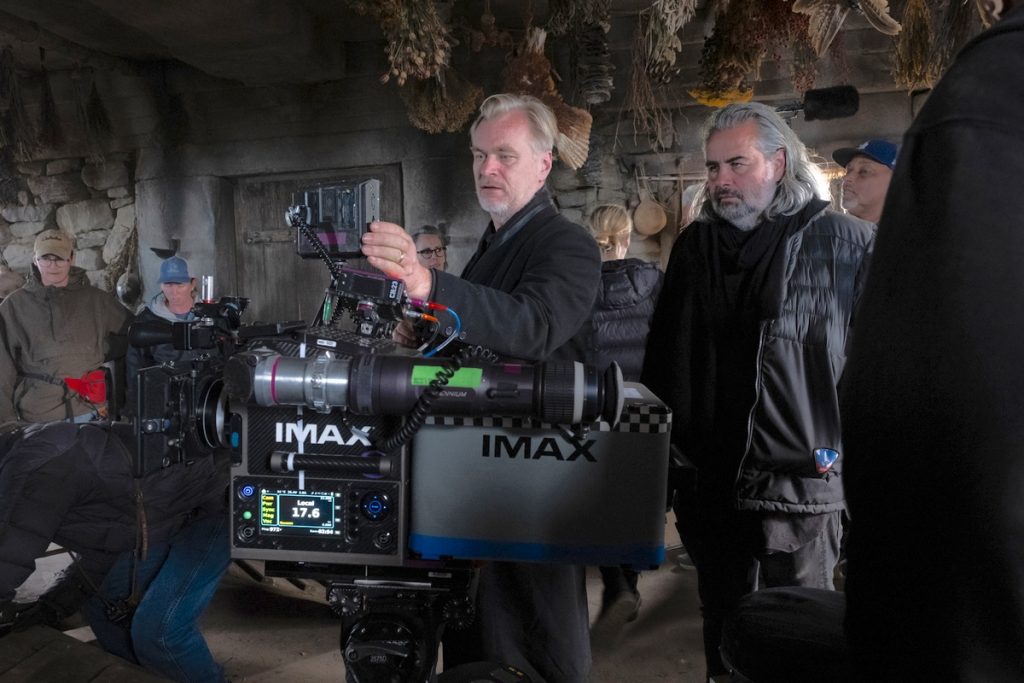
Director Christopher Nolan with Cinematographer Hoyte van Hoytema. Photo by Melinda Sue Gordon/ Universal Pictures
The Literary Structure of Homer’s The Odyssey
The Odyssey is a structurally-complex saga, even by Ancient Greek standards.
The poem is a non-linear narrative with many flashbacks, parallel plots, stories contained within stories, and meta-commentaries about the vicissitudes of life. Christopher Nolan honors these structural elements, but also realizes the need to streamline them for cinema.
Homer’s poem is structured around two central figures: King Odysseus of Ithaca who wins the war for Agamemnon with his iconic Trojan Horse to enter the city, and Telemachus, his now young adult son, who was an infant when his father left for Troy, and uncertain if he will never return.
Nolan maintains this dual track narrative in his film.
As Odysseus embarks on his treacherous homecoming journey his resolve is tested by gods, monsters, storms and tragedy. He even converses with Athena – a telling reminder into the Kings of Ancient Greece being exalted to a demi-god status. However, he is also reminded that he is a human through loss, grief, starvation, and hardships. Hubris is always met with humility.
Telemachus searches for hope that his long-lost father may still alive amid a mounting crisis on Ithaca threatening him and his mother, Penelope. An opportunistic pack of wolfish princes and noblemen have taken residence in the family palace and are pressuring the queen to give up on Odysseus, remarry and crown one of them king.
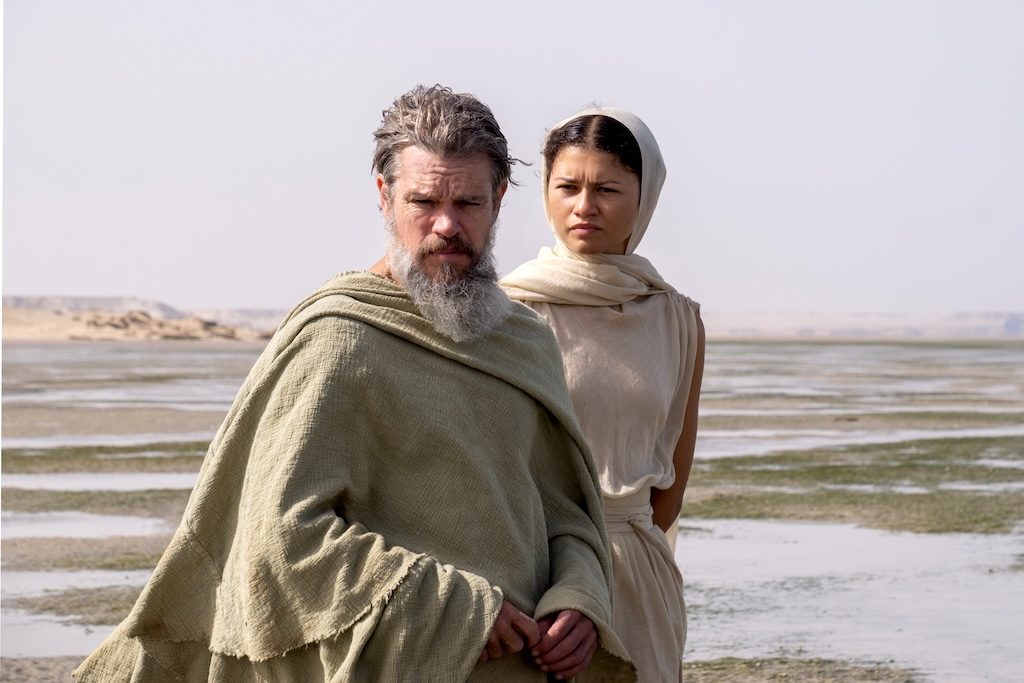
Odysseus (Matt Damon) & Zendaya (Athena) Photo by Melinda Sue Gordon/ Universal Pictures
Related: Charlie Covell Brings A Subversive, Comedic, Modern Spin On Greek Mythology in “Kaos”
The Law Of Zeus
Central to The Odyssey are a pair of interconnected themes expressing ideals and values crucial to the culture of Ancient Greece which are also applicable to the world today.
The first is xenia (guest friendship), the practice of extending generous hospitality, shelter, and food to strangers in need. Also known as “the law of Zeus,” this code of conduct was considered a civic and divine duty, and its violation by host or hosted was considered shameful and impious.
The custom helped Greece cultivate allies and build a network of trade. The second major theme, nostos (homecoming), was understood to be both a literal and metaphorical voyage of return and a spiritual process of rebirth, in which a quest for home and any of its rewards, reuniting with long-lost loved ones, reclaiming lost titles and riches, and forging a more mature, life-giving identity and self-actualization.
The treacherous voyage requires tests and obstacles to reconstruct character and fulfill one’s destiny. It’s near biblical in its scope.
It’s the closing of the circle of life, for Odysseus’ eventual return to Ithaca doesn’t guarantee a long and prosperous life.
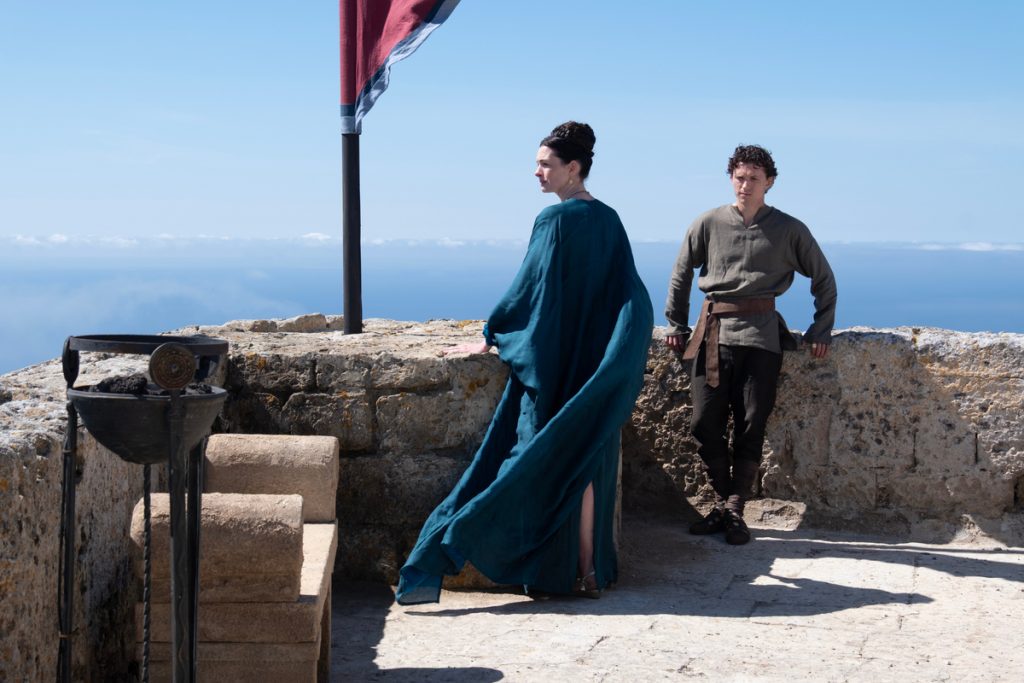
Penelope (Anne Hathaway) and Tom Holland (Telemachus) Photo by Melinda Sue Gordon/ Universal Pictures
Adapting Homer’s Poem
The Odyssey features many mythological and folkloric elements of the poem to make the story more tantalizing. There’s the one-eyed Cyclops, Circe, the witch who turns Odysseus’ soldiers into swines, and Calypso, who seduces him after rescuing him from the sea. These characters are more than props and expanded in Nolan’s epic.
The Trojan Horse has remained an indomitable feature in the contemporary literature.
“Whether it’s the narrative through-line of Odysseus or the singular episodes that make the entirety of the epic, The Odyssey underpins almost all of cinema,” Nolan notes.
Nolan’s previous work on Dunkirk prepared him the she sheer cinematic scale of The Odyssey. But even films like Memento, Oppenheimer, and Inception demonstrate that Nolan can coherently juggle multiple non-linear and parallel storylines with deft and gravity.
His approach to such gigantic storytelling is to break down the story elements into episodic nuggets for the audience to stay on track. There are bloody battles, treacherous sea voyages, mystical moments where Odysseus interacts with the gods, and the tender reunion with Penelope. His thrilling twists and turns provoke pause for reflection, but also illuminate Odysseus’ thirst for egotistical folly of humanity.
Odysseus is cetainly a complicated character. The king is strategic, ingenuous, and morally fluid. He is neither exclusively good nor bad. He meets the moment, sacrifices his men when given no other viable choice, and even has the audacity to defy the gods – specifically the law of Zeus.
He’s mature, wise, cunning, and world-weary. Although revered by his soldiers, he’s constantly reminded that he’s also a mere mortal, especially in the way he relates to Telemachus and Penelope who has been effectively ruling Ithaca in his absence. He realizes, he can’t simply return home and pick up where things left off. He returns disguised as a beggar who served Odysseus in Troy and plans his unveiling.

Join the Discussion!


Browse our Videos for Sale
[woocommerce_products_carousel_all_in_one template="compact.css" all_items="88" show_only="id" products="" ordering="random" categories="115" tags="" show_title="false" show_description="false" allow_shortcodes="false" show_price="false" show_category="false" show_tags="false" show_add_to_cart_button="false" show_more_button="false" show_more_items_button="false" show_featured_image="true" image_source="thumbnail" image_height="100" image_width="100" items_to_show_mobiles="3" items_to_show_tablets="6" items_to_show="6" slide_by="1" margin="0" loop="true" stop_on_hover="true" auto_play="true" auto_play_timeout="1200" auto_play_speed="1600" nav="false" nav_speed="800" dots="false" dots_speed="800" lazy_load="false" mouse_drag="true" mouse_wheel="true" touch_drag="true" easing="linear" auto_height="true"]







You must be logged in to post a comment Login