
DCU’s ‘Lanterns’ Deconstructing the Pilot Episode

When Chris Mundy, Damon Lindelof, and Tom King set out to adapt DC’s cosmic Green Lantern mythology for HBO Max, they bypassed the classic intergalactic battlegrounds favored by many superhero adaptations. Instead, they anchored Lanterns in a grounded, terrestrial detective procedural.
The pilot episodeof Lanterns gets straight to the point. It establishes its core conflict — human detective John Stewart’s (Aaron Pierre) investigation into a murder that implicates the Green Lantern Corps — while weaving in themes of identity, duty, and the weight of legacy.
What makes it work isn’t just the premise. It’s the way the script uses lanterns themselves — not just as glowing props, but as a narrative motif that deepens character and reinforces theme.
By framing Hal Jordan (Kyle Chandler) and John Stewart through the lens of a gritty crime investigation with a supernatural twist, the writers deliver a class in tone, character, and narrative drive.
How to Introduce a Main Characters Without Excessive Exposition
Lanterns solves this common issue by dropping John Stewart into a crime scene before we even know he’s a cop — let alone a future Green Lantern. It’s immersive storytelling where the details are unveiled later.
Stewart arrives at a murder investigation in Nebraska, his flashlight cutting through the dark.
His partner, Hal Jordan, questions why he’s there — he’s not assigned to this case.
The victim is a man with a glowing green ring on his finger.
There is noo long dialogue about Stewart’s past. No voiceover explaining his moral code. Instead, the script allows his actions define him:
He’s methodical, observant, but not by-the-book.
He’s haunted — his eyes linger on the glowing ring, a detail that hints at some deeper knowledge of its significance.
He’s isolated — his partner’s skepticism suggests he’s used to working alone without interference.
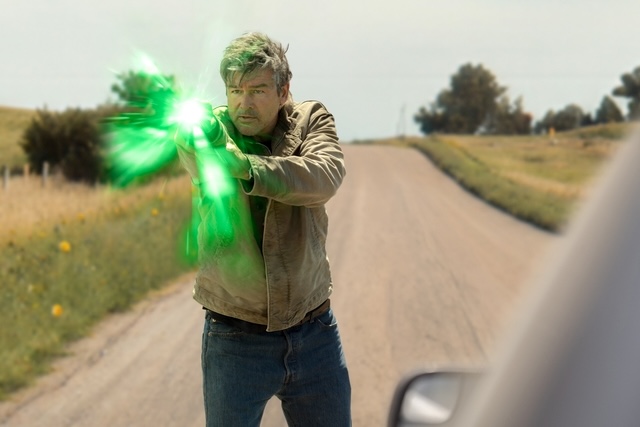
Hal Jordan (Kyle Chandler) Photo by by John Johnson/ HBO Max
Related: Pushing through the membrane of discomfort: Damon Lindelof on The Leftovers
Designing Characters Through Friction
Dynamic pilots thrive on ideological opposition. John Stewart and Hal Jordan’s central partnership uses classic two-hander mechanics with echoes True Detective and The French Connection, contrasting institutional cynicism with rigid moral clarity.
Hal Jordan is introduced not as a brash, fearless test pilot, but as a burnt-out institutional veteran clinging onto active duty past his prime. His world-weariness creates an immediate counterweight to John Stewart, who enters the narrative as an ex-Marine sniper accustomed to chain-of-command logic.
Dialogue informs the subtext of their trauma. Neither character speaks openly about his past. Instead, their professional philosophies do the talking.
Hal and John are not introduced as interchangeable heroes. Their difference is the show’s engine.
Hal is established as a legend, but the word “legend” carries a burden. A veteran officer is useful to a story only if experience has created blind spots as well as competence. If Hal already understands every threat, he has no dramatic function or growth beyond exposition.
John enters as a recruit, which gives the audience a natural point of introduction. He can ask questions, but he should not exist only to ask them. The most effective apprentice characters possess a perspective the master lacks or can’t see.
A mentor-protégé relationship becomes active when both characters are necessary to solve the problem. Hal may recognize patterns John cannot see. John may notice emotional, social, or ethical information Hal dismisses.
Related: HBO’s “Watchmen” Advanced the Classic Comic in a Timely Fashion
Lanterns Builds Its Central Question Around a Contradiction
The pilot’s central dramatic engine is straightforward: Hal Jordan believes a fatal shooting may involve an extraterrestrial threat, while John Stewart is the inexperienced recruit assigned to work with him.
The external investigation asks who committed the crime and what larger force might be responsible. The internal investigation asks whether these two men operate together when one has authority, experience, and emotional damage, while the other has training, but little institutional power?
This dynamic a familiar setup seen in buddy cop movies. Rules pitted against intuition.
That structure recalls the best character-driven procedurals. In True Detective, the case exposes the detectives’ conflicting philosophies. In The X-Files, Mulder and Scully’s disagreement gives each piece of evidence dramatic weight. In Lanterns, the genre conflict is built into the complementary pairing: one character sees the extraordinary everywhere, while the other must determine what deserves belief.
The Lanterns Pilot’s First Question
A pilot does not need to explain an entire universe at once. It needs to establish the question that makes the audience return.
For Lanterns, that question operates on three levels:
What happened at the crime scene?
Why does Hal interpret the event as an extraterrestrial incident?
What does John have to sacrifice to become the kind of officer Hal believes he should be?
This creates three distinct story strands that fuels the story engine.
The audience enters through a recognizable procedural dramatic situation — a murder investigation — and encounters the larger science-fiction mythology through character behavior.
World-Building Is Drama Not Decoration
The series’ most important world-building choice is its collision of scales. The Lanterns are associated with intergalactic law, yet the pilot places them in the American heartland investigating a murder.
That contrast is not merely visual. It creates dramatic and thematic pressure.
A cosmic officer must deal with local law enforcement procedure. A legendary figure must answer to a local sheriff. An institution built around universal order must confront a community whose truth is personal, disputed, and politically inconvenient.
This inflames the moral debate of the series.
Related: HBO’s “Task”: Brad Ingelsby on Writing Tension, Character, and the Art of TV Drama
World-Building Without Expositional Bloat
One of the steepest hurdles in sci-fi and extra-terrestrial adaptations is handling world-building without grinding the plot to a halt. The Lanterns pilot solves this by doling out nuggets of information only when characters need it to survive and the audience needs to follow.
There are no council meetings in high towers, and no lengthy monologues detailing intergalactic history. The broader cosmos is treated as an indifferent employer, distant and bureaucratic.
This minimalist approach respects the audience’s narrative intelligence and allow it to focus on the current story. The script operates under the assumption that viewers understand procedural tropes and will piece the cosmic lore together organically.
Uses character reactions. Stewart’s skepticism mirrors the audience’s. His confusion is our confusion. Drips information. The Lanterns mention the “Corps,” the “Guardians,” and the “Central Power Battery” — but only in passing, as part of the scene’s conflict.
When introducing an expansive universe, reveal your world through its edges with obscured details. Show how its systems affect your characters on the ground and let the wider scope remain a looming mystery to be explored.
Sci-fi and fantasy pilots often stumble when introducing their worlds.
Either they:
Over-explain (endless exposition about alien races, magic systems, or galactic politics), or
Under-explain (leaving the audience confused and disengaged).
Local Setting as Thematic Counterpoint
Nebraska is not simply a location far-removed from outer space. It can represent a culture of buried histories, inherited loyalties, and social surveillance. In a small community, everyone may know part of the truth, while no one possesses the whole story. It is a jig-saw puzzle – the sum of its parts.
That makes the setting a natural partner for a mystery about institutions and secrecy. The cosmic mythology expands the story, but the local environment gives it texture.
A remote town, a police station, a military base, and a family home generate different forms of concealment, discovery, and unveiling.
The Lantern as a Visual Motif: How to Reinforce Theme Without Dialogue
A lantern isn’t just a light source in Lanterns — it’s a symbol. The Lantern is not only a superhero identity; it is a symbol of transmission, responsibility, and succession. Light can expose. It can also interrogate. A focused beam reveals one area while leaving the surrounding darkness intact.
In the pilot, lanterns appear in three key ways:
As a Tool of the Trade – Stewart’s flashlight, the Green Lantern ring’s beam, the crime scene’s flickering streetlights. Light is both a weapon and a guide,
As a Metaphor for Truth – Stewart’s investigation is about uncovering what’s hidden. The lanterns don’t just illuminate — they reveal,
As a Burden – The Green Lantern ring is a source of power, but also responsibility. When Stewart first touches it, the light doesn’t just shine — it burns,
A lantern is a narrative guide for Stewart’s journey: from darkness to light, from ignorance to knowledge, from man to hero – a tale of becoming.
The motif can operate at several levels:
Hal represents an established light source whose confidence may be fading.
John represents an emerging source that has not yet learned how much power it carries.
The investigation turns light into evidence, surveillance, and threat.
Darkness becomes less a symbol of evil than of incomplete knowledge.
Motifs Must Evolve
A recurring image has dramatic value when its meaning changes.
Early in the season, light may signify authority. Hal arrives, identifies the threat, and assumes control. Later, the same image may suggest exposure or vulnerability. A character who once wanted the truth revealed may begin fearing what illumination will cost.
This is how a visual motif deepens theme without requiring dialogue to explain it. The image does not repeat mechanically. It accumulates meaning through changing circumstances.
Screenwriters can build a motif by tracking three questions:
Who controls the image?
What does the image reveal?
Who is harmed by that revelation?
Those questions turn production design into propulsive story structure.
Expand the Mystery, Narrow the Characters
A limited series needs escalation beyond “the case gets bigger.” Expansion should complicate the characters’ personal stakes.
The pilot begins with a murder and a partnership. A season can then widen into institutional history, family relationships, political influence, and the mythology surrounding the Lanterns. But every expansion should return pressure to Hal and John.
A useful season story architecture might operate through successive plot shifts:
The crime appears local.
The evidence suggests an unusual external cause.
The investigation exposes institutional concealment.
The personal histories of the leads become relevant.
The original assumptions about heroism are overturned.
The point is not simply to add twists to keep the audience on its toes. It is to make each revelation reinterpret what came before.
Momentum Comes From Unstable answers
Mystery series lose momentum when answers close the story too cleanly. The better answer changes the question.
If the writers reveal that the killing was not what it first appeared to be, the revelation should create a more dangerous problem. If Hal’s theory is validated, that should not end the conflict; it should force John to confront the consequences of trusting him.
This is an important distinction between plot movement and dramatic momentum. Plot movement is new information that changes the trajectory of the story. Momentum is the pressure created by that information.
A useful episode-ending question is not merely, “What happens next?” It is, “What can the characters no longer pretend is true?”
Let Evidence Change Relationships
New information identifies reversals, decisions, and shifts in power.
The pilot’s investigative scenes can be understood through a simple progression:
A violent event creates the central mystery.
Hal interprets the evidence through his larger professional history.
John is positioned as both observer and subordinate.
Local authorities challenge the Lanterns’ assumptions.
New evidence widens the case beyond a single killing.
The partnership becomes necessary before it becomes comfortable.
Each scene should alter at least one of these conditions:
What the characters know?
How they feel?
What the characters want?
What the characters are willing to do?
Supporting Characters Should Complicate the Case
Kelly Macdonald’s Sheriff Kerry functions as more than a local authority figure. Her presence grounds the investigation in the community where the crime occurred, preventing the narrative from floating away into superhero abstraction.
A sheriff, family member, witness, or local official can easily become functional: deliver information, block access, disappear. The better approach is to give that character an agenda that intersects with the leads’ investigation but does not depend on it.
The local world should resist being used as a backdrop or irritant. It should have its own memory, loyalties, resentments, and explanations.

Sheriff Kerry Kane (Kelly McDonald) Photo by John Johnson/ HBO Max
The Procedural Interrogation Scene
A notable sequence in the pilot’s second act demonstrates how Mundy controls scene dynamics within an interrogation room. Hal and Stewart interview a local county sheriff who knows far more than he is willing to admit about the victim.
Instead of treating the interrogation as an exchange of clues, the writers construct the scene as a three-way dominance contest. Hal relies on street-level leverage, Stewart tracks physiological tells, and the sheriff weaponizes local bureaucracy.
The tension here derives from what remains unsaid. The extraterrestrial element is never addressed directly; it lurks just underneath mundane Midwestern small talk.
Prestige pilots balance big ideas with domestic realities. By grounding the dialogue in local specifics — zoning laws, local corruption, long-standing family rivalries — the writers make the genre elements hit harder when they finally appear.
Related: Subtext – The Beauty Of What’s Left Unsaid (Or Unwritten) In Your Screenplay
Subtext: The Power of the Unsaid
Some of the most powerful moments in Lanterns aren’t in the dialogue — they’re in the absence of it.
In one scene, Stewart sits in his car, staring at the Green Lantern ring. He doesn’t monologue about his fears or doubts. Instead, the script lets the visuals do the work:
The ring glows faintly in the dark.
Stewart’s reflection in the window is fractured, hinting at his internal conflict.
The hum of the city outside contrasts with the silence inside the car.
This is subtext in action. The audience feels Stewart’s turmoil without him having to verbally spell it out.
Use Atmosphere to Build Tension
Atmosphere is not a substitute for structure. It is structure experienced through image, sound, pace, and behavior.
The most effective scenes in a series like Lanterns are likely to be those in which ordinary spaces carry extraordinary implications: a roadside, a station, a quiet home, a dark field. The tension comes from the mismatch between the familiar environment and the possibility that the familiar rules no longer apply.
Writers often over describe atmosphere through ominous dialogue or constant visual darkness. A more controlled approach lets the environment behave normally while the characters interpret it differently.
A fluorescent room can feel threatening if one character knows what the others do not. A sunny landscape can feel sinister if it exposes rather than conceals. Silence can become suspenseful when a character is waiting for an answer no one wants to give.
The pilot’s best scenes use light and shadow to create mood.
The crime scene is lit by flickering streetlights, casting long shadows that obscure the truth.
The Lanterns’ constructs glow with an eerie green light, making them feel both powerful and alien.
Stewart’s apartment is dimly lit, reinforcing his isolation.
The best writers don’t just describe what happens. They describe how it feels.
Atmosphere Must Pay Off
An image, sound, or location introduced for mood should eventually acquire narrative function. A recurring road may become the site of a confrontation. A light source may identify surveillance. A seemingly empty space may reveal who controls access to the truth.
The payoff need not be a twist. It can be emotional. A location that first represents Hal’s authority might later expose his isolation. A place John initially sees as hostile might become the setting where he asserts independence.
Use Pauses as Thematic Plot Points
A pause should not simply indicate seriousness. It should contain a choice.
Does the character answer honestly? Deflect? Test the other person? Leave the room? Look at the evidence again?
When a pause changes the power relationship, it becomes dramatic. This is especially important in investigative scenes, where the most revealing action may be what a character chooses not to say.
Related: You’ve Written Your TV Pilot Episode. What About Episode 2?
The Lantern Pilot’s Final Lesson: How to End an Episode Without Resolving Anything
The Lanterns pilot doesn’t wrap up its central mystery. Instead, it ends with:
Stewart touching the ring, his fate now intertwined with the Corps.
A new threat emerging (a shadowy figure watching from afar).
A promise of bigger stakes (the murder is part of a larger conspiracy).
This is how you end a pilot: with a question, not an answer. The audience should be left wanting more — not because the story is incomplete, but because the characters are still in motion.
Lanterns isn’t just a superhero show, It’s a case study in how to craft a pilot that balances spectacle with substance. For screenwriters, the real takeaway is how to make a story feel immediate, how to make characters feel real, and how to keep an audience leaning forward, episode after episode.

Join the Discussion!



Browse our Videos for Sale
[woocommerce_products_carousel_all_in_one template="compact.css" all_items="88" show_only="id" products="" ordering="random" categories="115" tags="" show_title="false" show_description="false" allow_shortcodes="false" show_price="false" show_category="false" show_tags="false" show_add_to_cart_button="false" show_more_button="false" show_more_items_button="false" show_featured_image="true" image_source="thumbnail" image_height="100" image_width="100" items_to_show_mobiles="3" items_to_show_tablets="6" items_to_show="6" slide_by="1" margin="0" loop="true" stop_on_hover="true" auto_play="true" auto_play_timeout="1200" auto_play_speed="1600" nav="false" nav_speed="800" dots="false" dots_speed="800" lazy_load="false" mouse_drag="true" mouse_wheel="true" touch_drag="true" easing="linear" auto_height="true"]







You must be logged in to post a comment Login