
Inside the Whale: Brian Duffield and Daniel Kraus on Adapting ‘Whalefall’ for the Screen Brian Duffield and Daniel Kraus on Whalefall

When author Daniel Kraus unleashedhis novelWhalefall, he delivered one of the most daring survival concepts in contemporary fiction – set inside the belly of an 80-foot sperm whale. It is now a movie.
The story follows Jay Gardiner (Austin Abrams), an adrift young diver who plunges into the treacherous waters off California’s Monastery Beach on a desperate quest to retrieve the submerged remains of his estranged, deceased father, Mitt (Josh Brolin).
Instead, Jay is caught in the path of a feeding whale and swallowed whole. Trapped inside the creature’s pitch-black, suffocating digestive tract with only an hour of oxygen left in his tank and failing scuba gear, Jay must wage a brutal physical fight for survival while psychologically confronting the generational trauma, unresolved guilt left behind by his father’s ghost as the life lessons Mitt taught him become critical.
Now, Kraus has teamed up with screenwriter Brian Duffield (No One Will Save You, Cocaine Bear) to steer the high-stakes Whalefall movie adaptation for 20th Century Studios and Imagine Entertainment.
Duffield who wrote and directed the survival thriller script faces the ultimate cinematic challenge: translating Jay’s hyper-internal, claustrophobic ordeal into visceral visual storytelling about a strained father/ son relationship.
Daniel Kraus and Brian Duffield spoke with Creative Screenwriting Magazine about their collaboration.
What Is Whalefall Really About?
Daniel: That’s really hard because it really is about two things. It’s about a guy swallowed by a whale and needs to escape. And it’s also about two people having being able to forgive each other. You can’t separate one from the other.
Brian: That’s very much my answer as well.
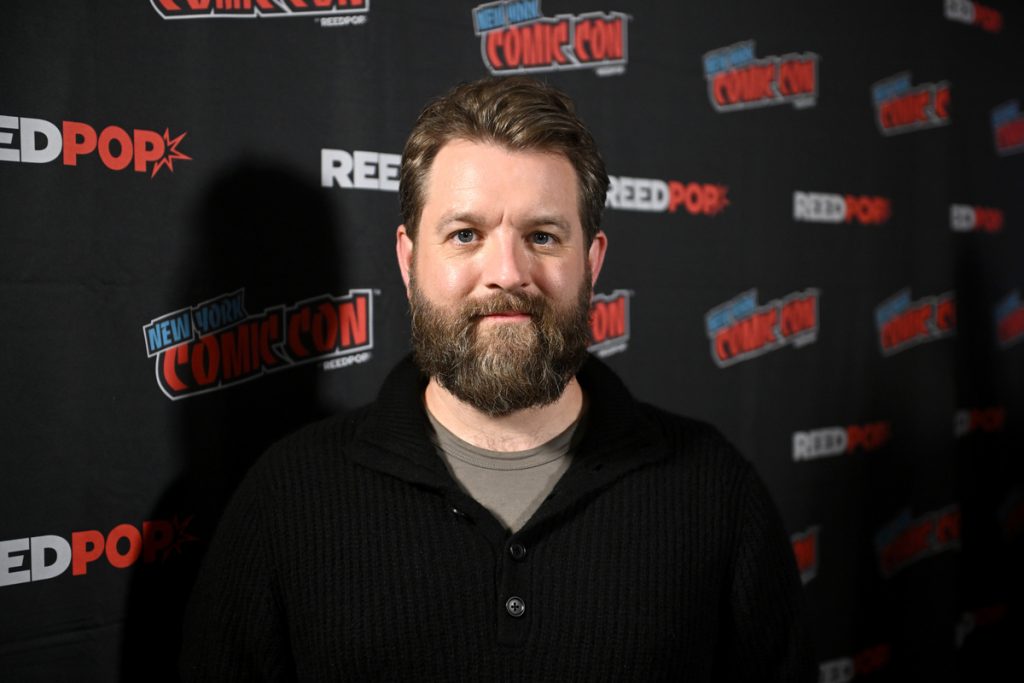
Brian Duffield. Photo by Noam Galai/ Getty Images for Disney
How Would You Describe The Genre Of The Film?
Brian: That comes up a lot. I think it’s much more emotionally driven than a typical horror film. But I also think it can get quite horrific. I think it’s a very unique cocktail of a movie. I think it’s very Daniel Krauss.
I’m less concerned about where in the video store it gets stashed because I feel like putting it under drama undersells maybe how intense it might get physically. And also, I think putting it in horror maybe undersells that it’s very dramatic and earnest.
Daniel: We had this exact same issue with the book. When we were rolling the book out, people would ask all the time, ‘Where do we put this?’ And in bookstores, I see it all over the place. I’ve seen it in science fiction, which I guess is where it’s most accurate. The publishers chose it.
I suppose if forced, I would put it in thriller. But it’s a special kind of thriller.
Discuss Building Out The Layers Of The Story.
Daniel: Because I had to make it scientifically accurate, I had to start there. I had to start with what is possible inside of a whale.
That process took a long time. It took months of scientific discussion. Because if you only have an hour, this is not something I can just sit down and write off. I need to figure out the whole outline before I can begin. The physical journey. What’s even possible.
Once that’s laid out, let’s say, ten points of things are going to happen. Then it’s a matter of taking the central relationship and layering it in. But you can’t do that until you have that physical framework. Before I even figured out all the physical stuff, I knew it was going to be a father-son story.
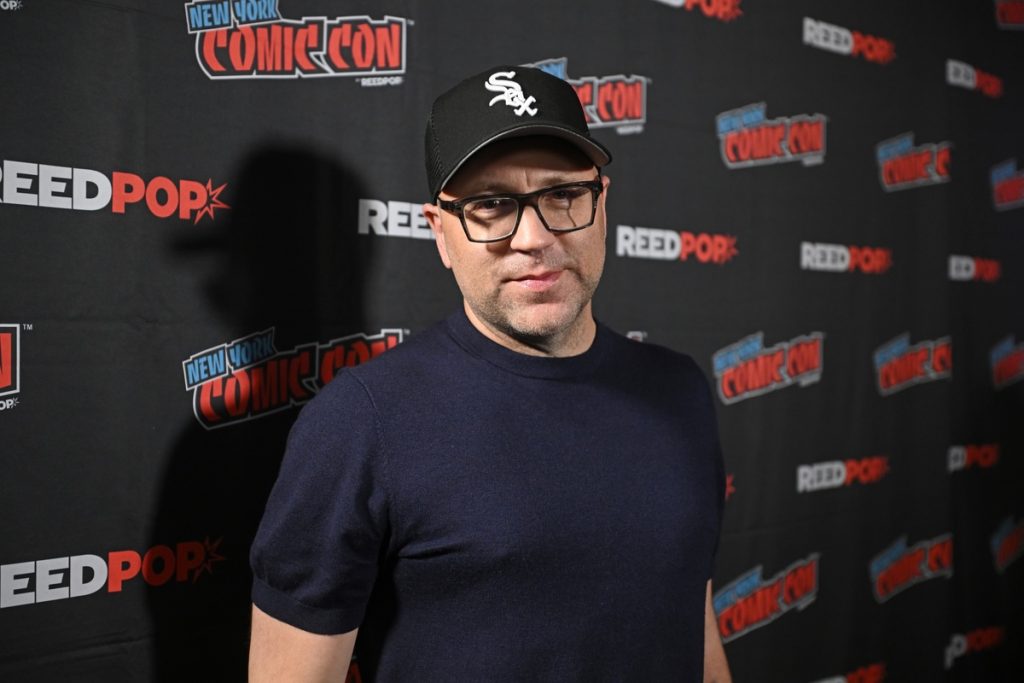
Daniel Kraus. Photo by Noam Galai/ Getty Images for Disney
Talk About The World-building Inside The Whale.
Brian: If we have an 80-85 foot long sperm whale, what space does that gives us to work with?
I’m sure we cheat sometimes, both in bigger and smaller directions. Daniel had done so much research in writing the novel that we piggybacked off of that and then brought in our own researchers; usually people that worked on the novel. That was very helpful. Then it just becomes practically what is possible to do.
I think there’s a lot of benefits in terms of being able to pull it off practically. I think doing this all CGI would have been very difficult. I also think it would lend itself to being more fantastical if it felt like it was a digital space instead of a physical one.
Then it became knowing that we are going to have Austin Abrams inside the whale’s stomachs and our lighting rig inside it.
Each stomach has all these different functions, especially the first stomach in the way it chews its food.
Discuss Your Approach To Adapting The Whalefall Novel.
Daniel: A lot of it is logistical. This is not a setting that anyone understands. And in the book, I have some additional real estate to show what’s happening. And in the film, you can see it.
Uniquely in the screenplay, before it’s a film, you don’t have all that real estate. You have to orient the script reader in an elegant, relatively quick way.
There’s a lot of little tricks we do to direct the attention in the script. There’s times where we will change the justification of text or we’ll have a section where we don’t use periods. And they’re all geared toward clarity in a weird kind of way.
Whenever we had the whale speak, it was justified to the right. We set up a vocabulary of what is possible in the whale and who these characters are. Whether they’re human or a whale, and trying to orient it all in a way that is clean so you can understand what’s going on.
Brian: It’s like parsing what is necessary in a screenplay versus what is necessary for production. I think that’s a very big difference.
The second living document is a Bible of sorts. That is something that we share with everybody.
When you need to know more about how everything works, we have a lot of Google Docs. That had the nitty gritty of it. But for the screenplay, it was mostly what is the bare bones essential that you need to understand.
To understand what Jay himself is interacting with and going through.
How Did You Perceive Space From The Vastness Of The Ocean To The Contraints Of A Whale’s Belly?
Daniel: I thought about that stuff a lot. You get this in movies in space too. You get something that’s really small – like a whale stomach or a space capsule. And then you can jump out to the entire ocean or the entire vastness of outer space. It gets to the heart of what the story is about.
Whalefall is this extremely small personal story about a couple of people. It’s set within this cosmic largeness. And by jumping out large, which both the book and movie do, it makes the human drama feel really small, but in kind of a nice way. It makes it feel like this is powerful and this is big. And this is about us too. But really, we’re specks in this sort of cosmic ether.
Discuss The Unique Use Of Flashbacks.
Brian: I think the two trickiest things in the adaptation were the novel is very internalized in terms of Jay’s inner thoughts. So we had to externalize that. The second biggest thing was how to deploy the flashbacks. The novel has the luxury of having dozens of very small memories and flashbacks in a way that a movie can’t sustain.
We very quickly knew we were essentially using a Slumdog Millionaire structure, where we would have these key moments with Mitt and Jay, that would move back in time, that would reveal his harshness of the character, and then eventually reveal his tenderness.
It was where can we drop those moments that feel like they’re giving the audience a bit of a break sometimes. But then you realize the scenes with Mitt are curdling into something much more despairing. As the movie progresses, the flashbacks and current action become more interlaced.
The characters are directly referencing the flashbacks so they aren’t even flashbacks anymore. They’re taking them over in real time. A big part of it was how to weaponize those in the same way so that you’re understanding why Mitt is working these flashbacks.
Then in the third act, you’re also realizing there were other surprises in those flashbacks that are useful in our culmination.
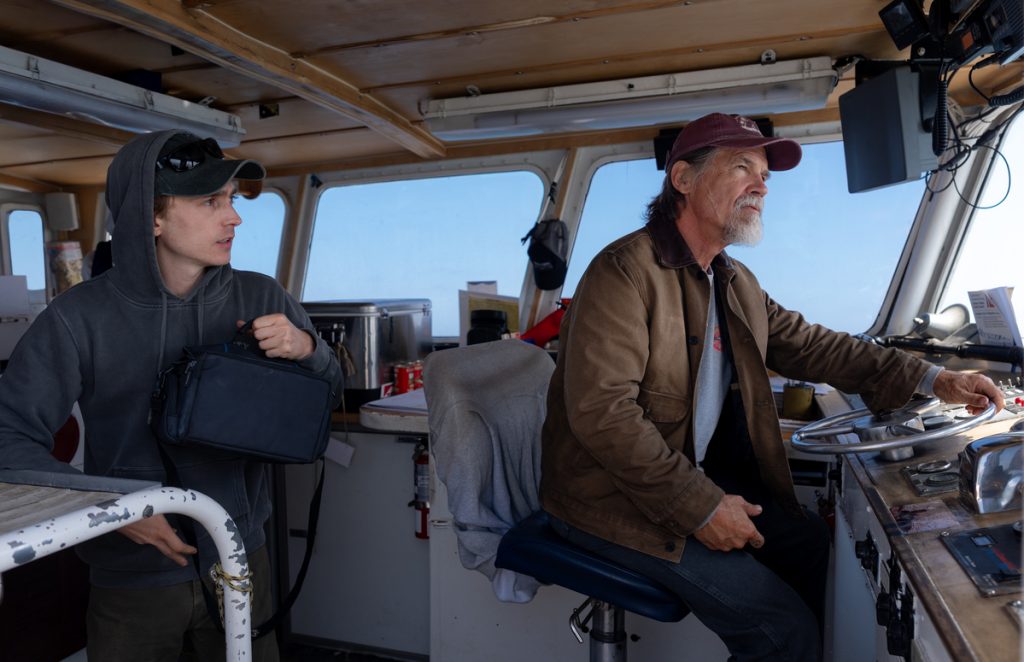
Jay Gardiner (Austin Abrams) and Mitt Gardiner (Josh Brolin) as Mitt Gardiner. Photo courtesy of 20th Century Studios.
Describe the Jay-Mitt Relationship.
Brian: I think it’s an emotionally fraught relationship for sure.
I think Mitt is coming from a real place of fear and fear for his son. He doesn’t quite understand him and doesn’t have the articulation to nurture him in the way that Jay needs to be nurtured. He wants to be a good father, but doesn’t know how.
How Did You Handle The Scenes Which Didn’t Have Much Dialogue?
Daniel: I think in the script there were a few other moments where we had Jay speak to himself. But I think in the shooting and editing, you realize some of that stuff’s not needed.
You realize Austin can communicate this with an expression. Or even if you shot it, once you get into editing, this is becoming clear without having to spell it out. And in the script we do a lot with sounds.
And again, using formatting to emphasize and to remind people that there may be no dialogue here. And if you have a no dialogue scene in a house, it’s probably going to be pretty quiet. What are you going to write in there? But for being inside a whale, there are constant noises.
We would bring up the heartbeat again because you can always hear the heartbeat of a whale. And in the movie, you get so used to it, you don’t really realize it until the whale passes. And then you realize it’s really silent now.
We would constantly bring up the heartbeat noise and we’d bring up noises of the lungs and of blood rushing through the body. There were all these things, that if you use them at the right moments in the script, they can be tension accentuators.
Brian:. I think it was a very sound heavy script because it’s not only about keeping Austin’s character alive. It’s about keeping the whale alive in the script where it’s not like he’s in the room.
It’s trying to always remind the audience or the reader rather, that the whale is this living thing that also has a personality that has to come through in the script. Even in revisions, we were making sure and reminding people that the whale is engaging in the story in a strange way. It’s not a still environment.
Everything it’s doing is constantly alive and moving. That was a big part of the process too. The novel does such a beautiful job of that.
Which Scene Best Captures The Essence Of The Story?
Daniel: It’s the scene in the driveway where it feels inconsequential. [Mitt wants Jay to spend time with him learning boat survival skills, but Jay has made other plans with his friends.]
It’s the whole movie boiled down to a scene. I think it’s the most relatable scene. It’s that feeling where your parent is pulling you one way, and then the person you want to be and the friends you want to hang out with, are pulling you the other way. You feel like you have to make a choice and it feels cruel.
And maybe in the heat of that, both the parent and the child are cruel to each other. It’s such an everyday painful moment that really hits home with me and seems to really hit home with everyone on the crew too.
Brian: I think the one I’ll go with is the Steinbeck scene with Josh and Austin. That starts off as a flashback until Austin takes it over and makes it like a present conversation.
I think there’s something so relatable about your dad loving something and you rejecting it because you don’t want to like the same things that he likes because you’re trying to be your own man. I think there’s the stubbornness on both parties there. And then I just love that it gets to this place where they are able to laugh about the same part of the book. They were so close to being able to connect.
It takes maybe one little step of humility from both of them. If they had done that, something as insignificant as enjoying the same scene in the novel, it could have opened up a whole different world for these two guys.
Daniel: That moment unlocks the resolution between the two of them and that allows Austin to come up with a way to get out of the whale too. I like the mythological side of that. It’s these classic man and fish stories that usually requires the man to humble himself a little bit before the fish will let him go. So even just in the lineage of Jonah, I think there’s something really beautiful about Austin.

Join the Discussion!
Related Articles
 Cracking the Video Game Adaptation: Shay Hatten on Co-Writing the New ‘Resident Evil’ Movie with Zach Cregger
- “Follow Your Inner Compass” Richard Tanne on ‘Chemical Hearts’ & ‘Southside With You’
- Following Its Venice Film Festival Success Austin Stark, Joseph Schuman & Billy Magnussen Blend Spanish Flu, Mystery & Cooking In A Darkly Comedic Film – COUP!



Browse our Videos for Sale
[woocommerce_products_carousel_all_in_one template="compact.css" all_items="88" show_only="id" products="" ordering="random" categories="115" tags="" show_title="false" show_description="false" allow_shortcodes="false" show_price="false" show_category="false" show_tags="false" show_add_to_cart_button="false" show_more_button="false" show_more_items_button="false" show_featured_image="true" image_source="thumbnail" image_height="100" image_width="100" items_to_show_mobiles="3" items_to_show_tablets="6" items_to_show="6" slide_by="1" margin="0" loop="true" stop_on_hover="true" auto_play="true" auto_play_timeout="1200" auto_play_speed="1600" nav="false" nav_speed="800" dots="false" dots_speed="800" lazy_load="false" mouse_drag="true" mouse_wheel="true" touch_drag="true" easing="linear" auto_height="true"]







You must be logged in to post a comment Login