
“Bait” on Prime Video — Riz Ahmed’s Dark Comedy About Balancing Your Private and Public Self

Bait is a six‑episode limited comedy series created by Riz Ahmed that follows his character Shah Latif, a struggling West London actor whose life unravels after he lands an audition for James Bond.
The story unfolds over four intense days and blends film industry satire, dark comedy, and family drama to investigate identity, fame, and cultural expectations. Riz Ahmed also serves as showrunner and leads the ensemble, which includes Guz Khan, Sheeba Chaddha, Ritu Arya, Weruche Opia, with supporting appearances from Rafe Spall and Patrick Stewart.
Riz Ahmed shares his insights on Bait with Creative Screenwriting Magazine.
What was going on in your life that led you tell to this story?
I first had the idea for the show ten years ago when I started to become a bit more well-known. I’d done The Night Of and Rogue One: A Star Wars Story. People in America were really recognizing me and had thoughts and opinions about me.
There was this public version of who I was – whether or not I knew at the time. It was a kind of performance. That was different to my day-to-day, boring reality. I started to find that gap between those two things quite stressful and messy, but also quite funny and interesting.
I realized it’s something that everyone can relate to. Everyone has a public performed version of themselves on social media or at work or on a Zoom call even. And trying to maintain that facade, and keep on that mask, can be increasingly silly, funny and ridiculous as we saw on Zoom calls when people in the pandemic were in serious meetings and then their partner would walk into the room.
I’m interested in that distance between the public and private self. How do we close that gap?
How can we be more authentic in how we relate to everyone? How challenging is that? How realistic? How desirable is it? It was the first idea came out of that big Chewbacca change that was happening in my life about 10 years ago.
Related: Christos Nikou On ‘Fingernails’

Riz Ahmed. Photo by Ludovic Robert
How were multiple ideas whittled down into a single show?
We whittled all of these ideas down over a period of time with the help of my amazing co-show runner Ben Carlin and my writers’ room. We were drawn from lots of different backgrounds. We had novelists, stand-up comedians, and TV writers.
And at its heart, the one idea that was always there was this idea of self-love.
We’re always looking for love in the wrong places, performing for the validation of strangers because we don’t have enough self-love. We’re looking for others to affirm and approve of who we are. That idea was always at the heart of the show.
Of course, that can be quite abstract. We knew we had a story about a character that was trying to please the industry, please mainstream Britain, his very particular community, also his ex, and his family.
But the concept that we landed on that really clarified everything was the James Bond audition.
We knew that if this is a show about a character that is always auditioning for approval, it had to be about an audition. Who would he dream of being? He would obviously dream of being the ultimate symbol of masculinity, Britishness, and success. And that’s James Bond.
Once we landed on the idea of a James Bond audition, we were able to tell the story of performing the version of yourself that you think people want you to be, and seeking approval in that way.
Related: Writer/Director Darius Marder on ‘Sound of Metal’ (Part 1)
How would you describe the genre of Bait?
I would say that something that was a real challenge.
Something we knew we always wanted to try and attempt, and we’re proud of what we managed to do in the writers’ room, is to try and explore all these different genres.
There’s a comedy element to it, but it’s quite a surreal and psychedelic show. It’s also got some spy thriller elements. It’s also got some psychological elements. It’s also a family drama.
One thing that we landed on was this idea that, if the show is about an actor who’s having an identity crisis, then the show needs to be having an identity crisis too, because it’s from his point of view. He’s trying to work out who he is and where he belongs, so he’s seeing his reality through these different genres from one episode to the next
That was something that took a lot of time and work, but we didn’t want to let go of that idea. We wanted to make sure we tried to make something quite kaleidoscopic in that way.
Related: Liz Sarnoff Reveals Inside Secrets of Prime Video’s New Crime Thriller “Scarpetta”
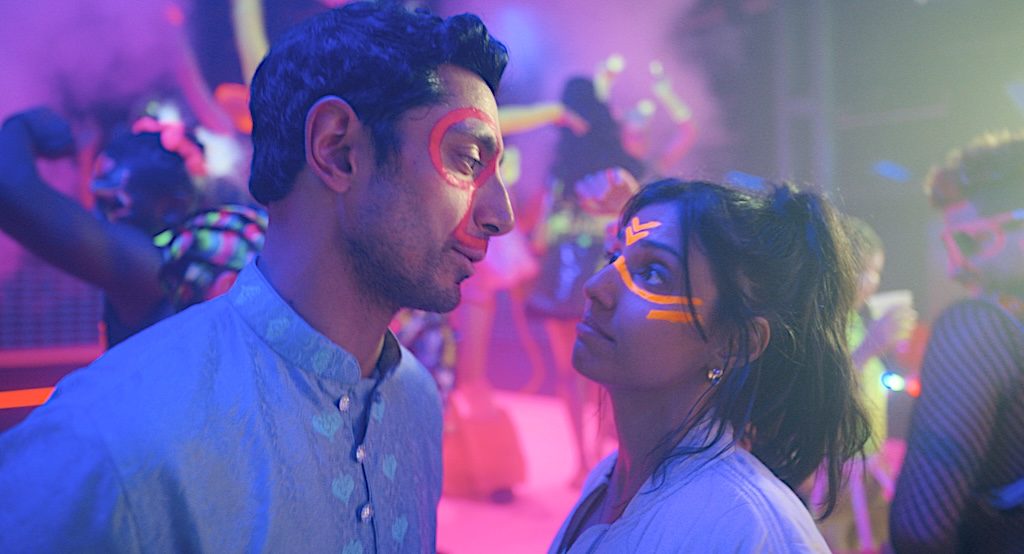
What were some other pop culture references you drew on?
Many pop cultural references drew me in. There were lots of different references. The music was a big thing that kept driving me on. When people would ask what’s the tone of the show, I basically would play them.
It’s 1970s psychedelic Pakistani funk from old Lollywood movies. There’s stuff by Naheed Akhtar and the Tafo Brothers and tracks like Zambo, which in Episode 1, as he’s walking out of the game, self-photographed by Papparazzi. It’s a freewheeling, slightly surreal, unpredictable, very playful mash-up of different sounds, from traditional Indian to acid funk.
It’s synthesizers along with bongos. I think that was a big pop cultural North Star.
In terms of other shows that I was really inspired by, one of them was I May Destroy You. Just how unapologetically personal it was and how it played a lot with structure and genre. It was something that we were also hoping to do. I always enjoy shows like that. I’ve enjoyed the making things that walk a bit of a tightrope in terms of their tone. I really admired how the show really went there. It was really personal.
I wanted to put myself out there in a similar kind of way. Do something that felt quite exposing and felt quite scary because of how personal so many scenes, themes and elements of the show are.
From the sets we built, the house that the family lives in, to the locations we shot, and the old neighborhood I grew up in. I found that inspiring in terms of how authentic it is.
Related: How “Deli Boys” is Redefining TV Comedy and Culture by Leaning Into Stereotypes
What is the main theme that forms the backbone of your story?
I would say that the main theme that forms the backbone of our story is self-love.
This idea of trying to seek approval from other people can really lead you off course rather than trying to grow that self-love from within. That can be hard with society, family, or just anyone. Generally, we’re made to feel like we’re not good enough. We always have to aspire to be a better version of ourselves.
That means that we can all be carrying dissatisfaction or a feeling that we’re not enough. I think that’s very human. I think that’s universal.
I wanted to really explore that. Because if you’re seeking approval from other people you put all your energy on trying to get into the room and have a seat at the table. But often when you have a seat at the table, it actually doesn’t change anything. It can just change you in a way that takes you away from your own true self.
Related: “Two Cultures, Three Languages & A Ton of BS” Mo Amer on Netflix’s ‘Mo
How did you balance the outlandish satire with emotionally-grounded moments?
We felt like none of it would feel outlandish as long as it was grounded in character.
My producing partner Ali Moore always said if you’re worried about tone, think about character. We realised that if it’s rooted in our main character’s emotional experience, we can jump from Bollywood soap opera in Episode 3, to romantic rom-com walk and talk in Episode 4, to a spy thriller in Episode 5.
We just thought it’s about honoring the authenticity of each moment.
Another way in which I think we created a tonal glue between all of this was music. I think that late 70s Pakistani, early 80s Indian cinema music really creates a kind of playful, slightly mischievous sonic backdrop that allows us to go to different places.
Related: “Religion Is Not A Punchline” Ramy Youseff on Hulu’s ‘Ramy’
How did you juggle multiple storylines in a way to keep both yourself and audiences on track?
There were two things we thought about. One was structure – having the compression of time and making sure we’re always driving towards this big audition at the end really helps to create a focal point in terms of where the energy is always pushing towards.
I think the other thing that helped us pull all these different elements together into one, is making sure that it all felt like one journey. It all felt like, at least thematically, you could look at the storyline between Shah and his ex, him and his family, him and this talking pig’s head, him and his rivals for this job. You could do all of that as long as thematically it was all coming from one place.
Shah is looking for love in the wrong places. His failures or attempts to try and find self-love, if we were thematically on track, we actually felt like we could keep these different storylines and relationships, all these plates spinning.
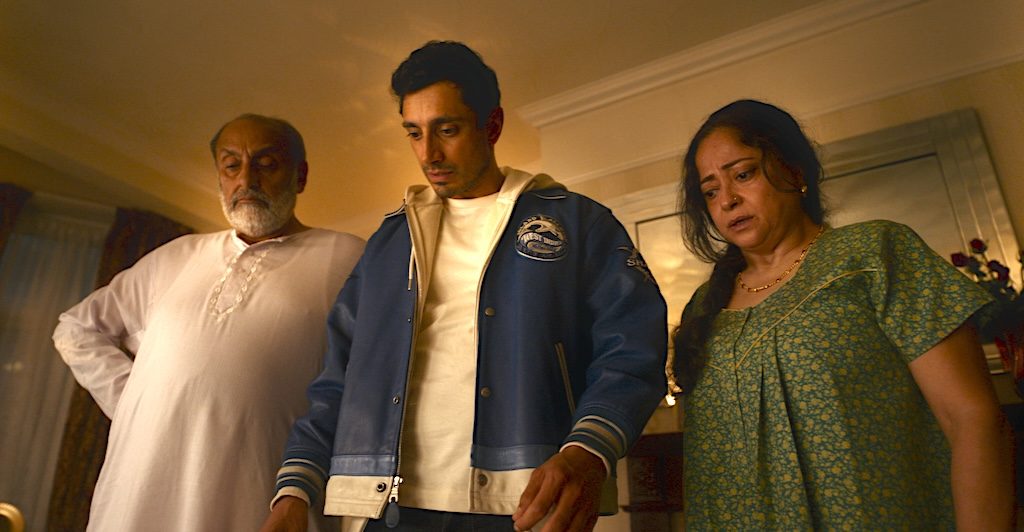
Tahira (Sheeba Chaddha), Shah (Riz Ahmed) & Parvez (Sajid Hasan) Photo courtesy of MGM Prime Video
Related: “Mo” and the Art of Balancing Humor, Heart, and Homeland
How did you balance the emotional tone of Bait?
We wanted to make sure, there’s a comedy, there’s genre elements, particularly the spy thriller element.
To that end, I should say, that’s one of the core concepts we always had from the top. I had this Jordan Peele quote in my mind where he said that being black in America is like being in a horror movie.
I always felt that being brown in the West is like being stuck in a spy thriller. So the genre element was about trying to really speak to the character’s emotional reality. For those harder-hitting moments, it’s interesting because I actually feel like they can land even harder if they come from an unexpected place; if they come from the thick of something that’s comedic and chaotic.
I think the end of Episode 3 is a good example of that. I’m less interested in trying to create an evenness of tone or a balance of tone. I’m really interested in surprising people with where we go tonally.
Related: Minhal Baig Talks ‘Hala’
Is there an episode that speaks the most to you?
I think the episode that speaks to me most, is Episode 3 just because I don’t think we’ve seen that specificity of that community celebrating Eid in that way – paying homage to the genre of those Indian soap operas that so many of us grew up watching and Bollywood films and Tollywood films. I think there’s something about how unapologetic it is in its specificity, how celebratory it is.
We’ve shot in the park behind my parents’ house for the scene where the younger version of my character gets jumped because that’s where I got jumped when I was a kid. We film in the sweet shop near my parents’ house to go and get sweets. That’s where we’d go and get sweets every day on Eid, every year.
It’s very personal. I think also it has the biggest tonal range between going from that kind of larger-than-life, high-end soap opera, Bollywood action movie thing, all the way through to something quite hard-hitting and raw, real, and quite ugly, quite provocative, in terms of where it ends with the character.
In that sense, I feel like we wanted to set out to make something that maybe hadn’t been on TV before. I feel very proud of the whole team in the writers’ room that we pushed to try and make that happen.
What aspects of your writing craft have been sharpened after writing this?
I don’t know if I’d call it a craft because often that’s associated with things like structure and pacing. The crafting for me happens later as you’re editing things down and getting notes.
The part of the writing process that I’ve come out of holding more closely than ever is the emotional honesty of what the characters would do, what this is about for you as a writer, and really honoring that, rather than any idea of what people want, or what you’re supposed to do.
That’s a really big lesson for me. I think that’s no surprise given that’s what the show is about, trying to follow the authenticity of your own instinct.

Join the Discussion!



Browse our Videos for Sale
[woocommerce_products_carousel_all_in_one template="compact.css" all_items="88" show_only="id" products="" ordering="random" categories="115" tags="" show_title="false" show_description="false" allow_shortcodes="false" show_price="false" show_category="false" show_tags="false" show_add_to_cart_button="false" show_more_button="false" show_more_items_button="false" show_featured_image="true" image_source="thumbnail" image_height="100" image_width="100" items_to_show_mobiles="3" items_to_show_tablets="6" items_to_show="6" slide_by="1" margin="0" loop="true" stop_on_hover="true" auto_play="true" auto_play_timeout="1200" auto_play_speed="1600" nav="false" nav_speed="800" dots="false" dots_speed="800" lazy_load="false" mouse_drag="true" mouse_wheel="true" touch_drag="true" easing="linear" auto_height="true"]







You must be logged in to post a comment Login