
From Yellowstone to Marshals. Showrunner Spencer Hudnut on Expanding Taylor Sheridan’s Duttonverse

Serving as a bridge for the franchise, the CBS original drama Marshals marks the first spinoff series Yellowstone universe aka the Dutton-verse. The other series in the canon are 1883 and 1923.
Created and executive produced by Spencer Hudnut (SEAL Team), the neo-Western procedural shifts the franchise into new territory. While universe mastermind Taylor Sheridan remains on board as an executive producer, Hudnut serves as the showrunner, bringing his signature tactical expertise to the rugged landscape of Montana. Seamlessly integrating into the larger Dutton-verse canon, Marshals functions as a continuation of Yellowstone, picking up several years after Dutton ranch’s end and a devastating personal tragedy to follow a newly independent Kayce Dutton (Luke Grimes) trading ranch life for law enforcement. Spencer Hudnut shares his insights on creating a spinoff television series with Creative Screenwriting Magazine.
How do you reference the Yellowstone shows while giving Marshals its own spin and making it a standalone show?
That was really the question that I was struggling with from the outset. You’re coming out of the most popular shows of the last decade, so it would be foolish to completely break away and turn your back on it. But at the same time, we’re stepping into a different platform in CBS/ Paramount+.
Marshals a law enforcement procedural, so it doesn’t have a ton of carryover from the original Yellowstone, but at the same time you have this character Kayce Dutton who has such a rich backstory. So many people were invested in, not only his story, but his family’s story, that it felt like we wanted to continue exploring things from Kayce’s past, but at the same time, populate the show with enough new characters who have their own stories to create their own identity. After he meets Pete “Cal” Calvin (Logan Marshall-Green), a former navy SEAL teammate, Kayce is invited to join the team.
That’s a balancing act as we’re writing Season 2 of Marshals that I’m still trying to figure out.
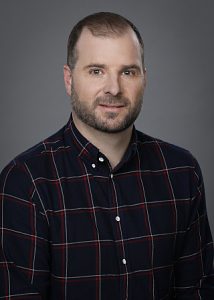
Spencer Hudnut. Photo by Sonja Flemming/ CBS
How would you pitch Marshals as a brand new TV series?
I think it’s in the setting. Being in Montana, being in the West. I think I’d pitch it as a law enforcement team that is run by two Navy SEALs who were using military tactics to combat cuts that law enforcement has faced on the federal state and local level. Needing a unit like this can be the catch all to a wide variety of crimes.
Putting an elite task force like this out in the middle of Montana is really the catch of the show that blends that violence, the old West, and also getting under the hood of what being a first responder does to our men and women who are willing to raise their hands to run into the fire.
Talk about the backstory of Kayce and Cal
They have this deep connection through operating as Navy SEALs together, being on a team that Cal ran, being deployed in Afghanistan, being in war together, which causes such a strong bond.
I had a front row seat to witness my time working on a SEAL team where we had a bunch of special forces operators working on that show. So there is a true and deep connection between them that really gets forged in war. We started hinting early in this season that there was a turning point in that relationship when they were operating together. There was some dark history between them over an incident that we have unpacked over the course of this season, which has allowed them to work through that collective trauma.
Where we really found them this season is that Cal, who has had his own struggles coming out of the military, recognized in Kayce, someone whose struggle was delayed because when he returned to life as a Dutton, he returned to a different battlefield of sorts.
When we pick up Marshals, Kayce has lost so many people in his family, including his wife, and he’s lost his purpose. Cal tries to get him on a new path.
What was Taylor Sheridan’s influence in Marshals?
I was a big fan of his work prior to ever having any thought of actually being in this universe. I was a huge fan of Yellowstone, a huge fan of his films; generally a huge fan of his writing. I feel like his writing has been informing me even before I ever met him or inherited his characters.
What’s interesting about Taylor is that he doesn’t want plot driving story; he wants characters driving story. What was great for us is that CBS really allowed us to tell a non-traditional procedural.
There’s always the engine of a case of the week. Something I’ve taken from Taylor, is, even in the most mundane scenes that are about the case, you want to make sure that each character has something going on underneath the surface while they’re talking about it.
These characters have something that they’re either hiding or that we definitely know that they have some need within that scene. That comes directly from Taylor’s writing style and having the conversations about what kind of show we wanted to have.
Yellowstone is a universe that’s very authentic. What the cowboys are wearing is as authentic as possible. They need to have the right saddle, but at the same time, Taylor’s the master of having something super heightened happen within those moments.
I’m allowing for those moments that only Taylor could seem to have come up with in Yellowstone, where something super outlandish seems to happen, but it feels grounded; it feels connected to character.
Taylor’s been very gracious. He was extremely supportive early on. When I came to him with an early notion of what the show could be, within five minutes of that conversation, he had quickly taken what I had, reshaped and repackaged it, and that very much represents the show that’s airing right now. He has that large creative brain. He was not prescriptive in any way.
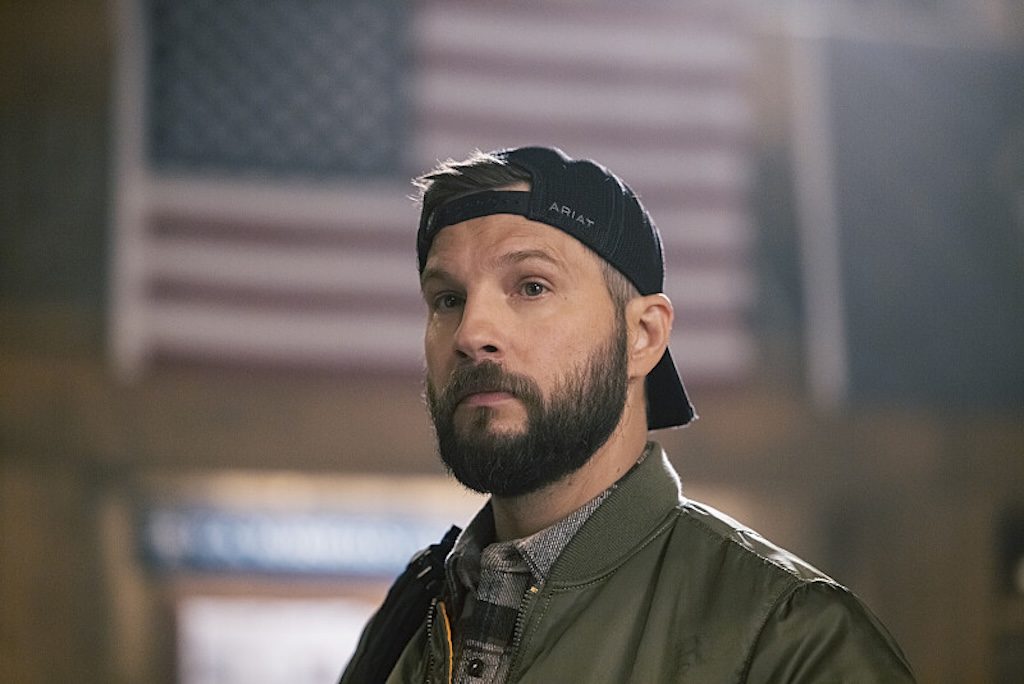
Cal (Logan Marshall-Green) Photo by Fred Hayes/ CBS
When does Taylor Sheridan end and Spencer Hudnut begin in Marshals?
It’s hard to take over multiple characters and inherit an incredible universe. Taylor established such a clear world, and did it in such a massive way that resonated with so many people, it is intimidating. I think early on, I was maybe trying to do a little bit of a Taylor Sheridan cover band in some of these characters. So, it probably took me three or four scripts to realize that I’m doing everyone a disservice by trying to channel Taylor into every moment.
Taylor had told me he wants the show to stand on its own. He wasn’t trying to get me to do the sixth season of Yellowstone. I would say probably about episode four is when I really started to feel that the show was mine.
I think Marshals a blend of the action, but also trying to find these heartfelt moments between the characters, I was really trying to find those emotional connections. Kayce’s beginning the season journey as he’s grappling with his grief for his dead wife Monica. That moment at the end of episode six felt like I’ve found the balance of what this show can be.
My job is to let the show exist in a way that Taylor doesn’t have to worry about it. I’m not running to him with a story crisis, or a question about character, or asking him to help in the scripts, or anything like that.
How did the writers’ room work?
There definitely were conversations about what can we pull from Yellowstone into this universe. What do we think audiences responded to in that show that we could use in Marshals? We spent a lot of time letting as much as possible the characters drive the plot, not the other way around.
We had the same conversation with Broken Rock (Damon Waters) because we were taking on Thomas Rainwater (Gil Birmingham) and Mo (Mo Brings Plenty). We all felt early on, they gave the show another layer. It allowed us to cover things that are real. When you do episodes about missing children from reservations, that’s a real crisis. We have a unique opportunity to continue what Taylor’s done, which is to shine a spotlight on issues like that.
Another thing is asking how we shorthand some of this procedural work. If you watch a typical CBS procedural pilot, people are coming in having figured out how the bomb was put together, where it was bought, things that more hardcore procedurals would spend an act running down. We just cover that in a line of dialogue because we want to get to the character stuff. We want to get to the action.
And pressing upon a bunch of writers who have written a lot of procedurals, there’s a time the procedural story needs to be sound, but also ask how can we cut corners? How can we minimize it so that our characters feel much more front and center than the case does?
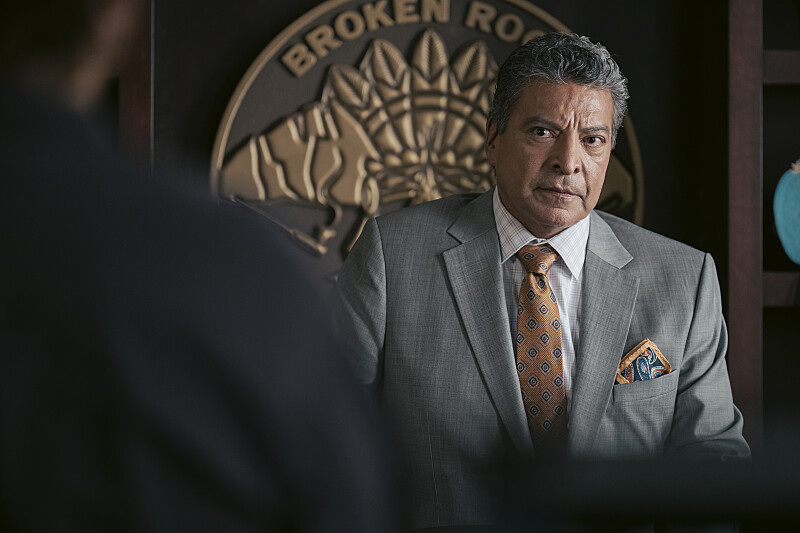
Thomas Rainwater (Gil Birmingham) Photo by Fred Hayes/ CBS
What were some of the lightbulb moments during writing Marshals?
It’s funny because I was going through an outline from the last season just yesterday, and the outline for episode six in the new season. Knowing what episode six became, it’s night and day.
It’s one of the great joys when you’re on set, and you get to see these actors bringing these characters to life. They bring elements to the characters that I never envisioned when I created them.
I think episode 10, which is where our character Belle Skinner (Arielle Kebbel) is confronted with her mother on this prisoner transfer. The more I got to see Arielle work as Belle, I really had this desire to mess her up, to see that character crack, what could get her to actually crack, and being confronted with her past and this deep trauma that she experienced.
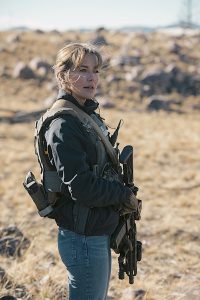
Belle (Arielle Kebbel) Photo by Fred Hayes/ CBS
That was something I wouldn’t have told you was going to happen from the outset. But the goal of a writer is to excite the actors, and then when the actors can do the same thing, you really want to start stepping off the path a little bit to challenge that.
That’s also my experience with Gil Birmingham. Writing his character, Rainwater, was probably the most daunting thing about this entire process. When I met him right before we did our first table read, I watched him turn these words into this incredible performance.
What research did you do for Marshals?
I did a lot of research on U.S. Marshals and what they do. I did a lot of research on the type of crimes being committed out in Montana to try to really keep it grounded and authentic and what’s going on on our northern border.
I did a lot of research into our reservations and our Native American communities and the issues plaguing them. I benefited from having written a show about Navy SEALs for seven years, so I had all that research behind me. I think the most important research is really trying to understand the toll that these jobs take on people, so that part of it can feel grounded.
The truth is, a lot of the things our marshals are running around and doing, aren’t exactly to the letter what a U.S. Marshal does on a day-to-day basis. But the impact of that job on them, trying to get that as authentic as possible is key to me.
I would say to writers, that’s where you can help me the most in terms of the research.
How did you develop most as a screenwriter after this experience?
We’re trying to be a Yellowstone show on a fraction of the budget and shoot in half the time. I’ve become a more efficient writer, or storyteller, in understanding how to tell what feels like a very full story, but with limitations.
I think finding those ways to tell the episode we just talked about, episode 10 – two characters at the back of a bus on set for two days. We didn’t just do a bus crash, we did a bus crash where our characters are confronted with Belle’s mother from her past. We unpacked this dark history of hers and layered in a really emotional story from that. It’s about finding big moments, but a big moment doesn’t need to have huge scale behind it,

Join the Discussion!



Browse our Videos for Sale
[woocommerce_products_carousel_all_in_one template="compact.css" all_items="88" show_only="id" products="" ordering="random" categories="115" tags="" show_title="false" show_description="false" allow_shortcodes="false" show_price="false" show_category="false" show_tags="false" show_add_to_cart_button="false" show_more_button="false" show_more_items_button="false" show_featured_image="true" image_source="thumbnail" image_height="100" image_width="100" items_to_show_mobiles="3" items_to_show_tablets="6" items_to_show="6" slide_by="1" margin="0" loop="true" stop_on_hover="true" auto_play="true" auto_play_timeout="1200" auto_play_speed="1600" nav="false" nav_speed="800" dots="false" dots_speed="800" lazy_load="false" mouse_drag="true" mouse_wheel="true" touch_drag="true" easing="linear" auto_height="true"]







You must be logged in to post a comment Login