
Marty Mauser: The Man Audiences Love To Hate

Who says your main character must be likeable?
Marty Mauser (aka Marty Supreme) is a study in combustible charisma: Timothée Chalamet’s brash, loud, arrogant, volatile, morally compromised character under Josh Safdie’s direction turns an unlikable hustler into a magnetic engine of contradiction, rhythm, and consequence. He’s not an underdog rising above the odds in a worls that dismisses him, or a kid that believes in miracles. He’s not the toad that becomes a prince.
Although Marty Mauser isn’t ideal boyfriend or daddy material, he demonstrates how a deeply flawed protagonist can become intriguing and irresistible to audiences. This phenomenon is beyond relatability or understanding Marty’s humble origins that make him a curious character study.
Conventional screenwriting wisdom suggests main characters should be likeable (unless they’re villains) with a few flaws that they neatly sort out by the end of the movie. Or at least, move in the right direction. We’re all human after all. Marty Mauser dispenses with these conventions. He would hardly make the list of Top 10 characters who should play Santa Claus or you’d love to be stranded on an island with.
While we’re still on the subject of character flaws, he also lies about responsibility, steals, and bulldozes through other people’s lives with a confidence that borders on delusion. We’re still working on Marty’s good points.
What keeps viewers glued to the screen is not sympathy, but fascination with his bombast. Marty’s abolute certainty about himself, even when demonstrably wrong, creates a dramatic promise that the film must resolve. Safdie stages Marty as a force of motion; his flaws are not incidental traits, but the very mechanisms that propel the plot forward and escalate stakes. He makes no excuses for his behavior. He rolls up his sleeves and gets to work. He even submits to a spanking if it will get him closer to his goals.
Marty creates many of his own problems to make his life more difficult than it needs to be. Yet, he is determined to make table tennis a global sport – and crown himself the king. Marty’s is driven by a singular goal – he will be a success. Period. There is no back up plan. At least he’s honest about that.
How Josh Safdie Sculpts Magnetism from Moral Murkiness
Safdie’s filmmaking choices make Marty’s testing behavior weirdly cinematic rather than merely reprehensible. Safdie cast Chalamet precisely because the actor can fuse “boyish vulnerability with aggressive bravado,” allowing audiences to oscillate between contempt and tepid empathy. Mauser’s unhinged bravado is underpinned by his naïve immaturity. He refuses to be jaded by life’s realities. That’s part of his charm.
Safdie has described Marty’s temperament as “lived in” so that his striking arrogance translates as energy on screen rather than flat out villainy.
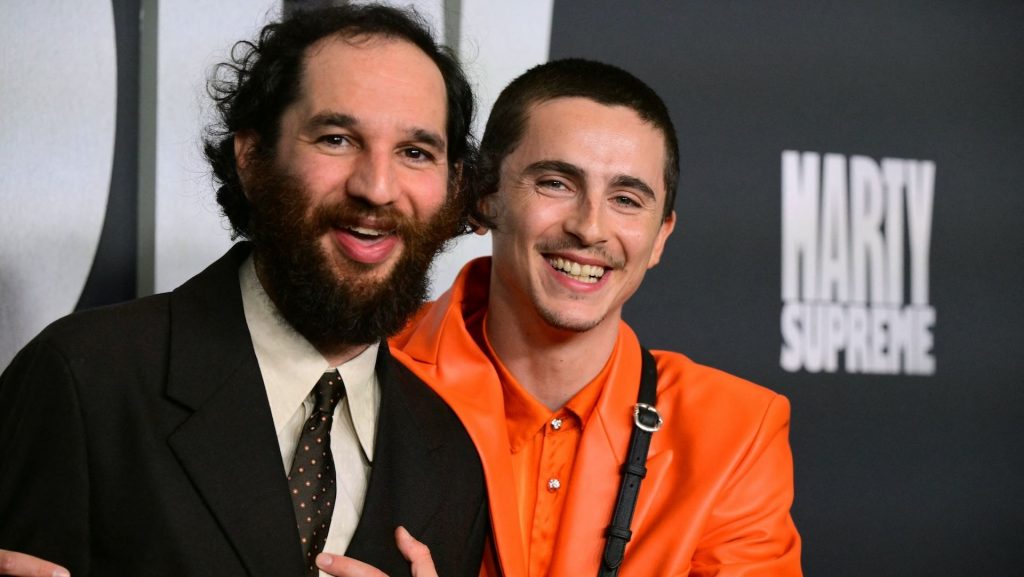
Josh Safdie & Timothée Chalamet
Safdie also leans into “contradiction.” Marty’s swagger is punctured by moments of fear, shame, or fragile hope, which humanize him without excusing his choices. The director’s process lets the audience witness both the spectacle of Marty’s audacity and the escalating consequences that follow. This is part of the allure of the multi-dimensionality of Marty’s character. This culminates in a literal tear-filled finale where Marty lays eyes on his newborn child that he previously denied was his. There may be hope for him yet.
Why Audiences are Drawn to a Character who’s “Not nice?”
There are three main reasons Marty Supreme works.
First, vicarious audacity: viewers enjoy the fantasy of someone who refuses to be small, even if that refusal harms others.
Second, narrative curiosity: Marty’s denials and thefts create moral tension — will he be exposed, punished, or transformed?
Third, performative manic energy: Chalamet’s delivery and Safdie’s staging make Marty’s actions feel immediate and risky, which is inherently compelling. These forces combine so that audiences follow Marty, not because they endorse or even like him, but because they are invested in the outcome of his bold choices.
The Fine Line Between Love and Hate
What makes Marty Mauser such a vivid screen presence isn’t just his flaws — it’s the particular flavor of them. He isn’t a rakish outlaw or a charming con man who steals wallets and hearts in equal measure that we’ve seen on screen many times. He’s not a lovable rogue in any cinematic sense. Marty is abrasive, self‑absorbed, unmovable, unreasonable, and often cruel in ways that don’t offer the usual charm.
Audiences have long embraced flawed protagonists rationalizing their behaviors based on their circumstances, but they usually come with a built‑in release valve codified as a redeeming feature: wit, vulnerability, a code of honor, or at least a glimmer of self‑awareness and goodness. Marty offers none of these compensations. He’s walking the tightrope without a balancing pole to course-correct him.
His irresponsibility isn’t cute— it’s corrosive. His aloofness isn’t buoyed by charisma or charm — it’s exhausting. He wears people down with his constant bullhorning and self-aggrandizing. His hustling isn’t glamorous or inspiring — it’s desperate. And his self‑belief, while admirable in its ferocity and focus, is paired with a near‑total absence of introspection. He barrels forward without contemplation.

Marty Mauser (Timothée Chalamet) Photo courtesy of A24
This is the kind of risky character who can easily alienate viewers if handled without precision. Josh Safdie and Timothée Chalamet understood that from the outset. Their collaboration wasn’t about sanding Marty down around the edges or making him palatable by giving him a shave and a haircut or a suit that fit well; it was about understanding him so completely that the audience would stay engaged even when they recoiled at his antics.
Chalamet approached Marty, not as a collection of bad behaviors, but as a man whose pomposity is a survival mechanism that seeped into his DNA. He trained, researched, and rehearsed until the character’s physicality and psychology fused into something lived‑in. Safdie, built an environment that explained Marty without excusing him. You take him as he is presented, or not at all. The world around him is textured, sweaty, and claustrophobic — an ecosystem that shapes him and constantly pushes back against him. Safdie’s doesn’t ask for sympathy. He shows Marty for what he is – unapologetic.
Together, they found the narrow emotional bandwidth where an unlovable protagonist can still sustain an audience. It’s not about making Marty a misunderstood ragamuffin. It’s about making him legible. The viewer doesn’t need to root for him — they just need to process the internal logic that drives him. That’s the secret to keeping a character like Marty from tipping into pure repulsion. You can’t argue that all Marty needs is a big hug.
The more abrasive your protagonist, the more rigorously you must articulate their emotional architecture. You can’t rely on charm and witty banter to carry the load. You need specificity, contradiction, and consequence. You need a character that reveals flickers of humanity without betraying the character’s core. Blink and you might miss it. And you need a world that reflects and challenges that pioneer character in equal measure.
Marty Mauser will never be a crowd‑pleaser or prom king. He’s not designed for that. Instead he becomes something far more interesting: a character case study in how to push a protagonist to the edge of audience tolerance without losing their attention. It’s a high‑wire act — and for writers willing to take the risk, it’s a masterclass in how to make the unlovable… unforgettable. Even brashness has its beauty.
[More: Marty Supreme: A Dreamer’s Journey Through The Sidestepped World Of Table Tennis]

Join the Discussion!



Browse our Videos for Sale
[woocommerce_products_carousel_all_in_one template="compact.css" all_items="88" show_only="id" products="" ordering="random" categories="115" tags="" show_title="false" show_description="false" allow_shortcodes="false" show_price="false" show_category="false" show_tags="false" show_add_to_cart_button="false" show_more_button="false" show_more_items_button="false" show_featured_image="true" image_source="thumbnail" image_height="100" image_width="100" items_to_show_mobiles="3" items_to_show_tablets="6" items_to_show="6" slide_by="1" margin="0" loop="true" stop_on_hover="true" auto_play="true" auto_play_timeout="1200" auto_play_speed="1600" nav="false" nav_speed="800" dots="false" dots_speed="800" lazy_load="false" mouse_drag="true" mouse_wheel="true" touch_drag="true" easing="linear" auto_height="true"]







You must be logged in to post a comment Login