
Emmy-nominated Writer Mike Makowsky on Creating Netflix’s historical drama “Death By Lightning”

Screenwriter and showrunner Mike Makowsky, known for the true-crime dramedy Bad Education and the dystopian romance I Think We’re Alone Now, is the creator of Netflix’s historical drama limited series Death By Lightning.
Based on Candice Millard’s nonfiction book Destiny of the Republic, the four-part drama dramatizes the stranger-than-fiction true story of James A. Garfield, the reluctant 20th U.S. president, and Charles Guiteau, the unstable admirer who ultimately assassinated him, set against post-Reconstruction political corruption and battles over civil rights and the spoils system.
The series explores leadership, disillusionment, and political violence with a blend of pathos, tragedy and dark humor as it reintroduces largely forgotten historical figures to modern audiences. Death By Lightning boasts an ensemble led by Michael Shannon as Garfield and Matthew Macfadyen as Guiteau, alongside Betty Gilpin as First Lady Lucretia “Crete” Garfield, Nick Offerman as Vice President Chester Arthur, Bradley Whitford as Senator James Blaine, and Shea Whigham as Senator Roscoe Conkling to round out the ensemble.
Makowsky shares his insights into adapting Destiny of the Republic for television. The story begins at his local Barnes and Noble bookstore when he was saddled with a decision to find a book to complete his buy two and get one free purchase.
What attracted you to the story of one of America’s least known President?
I picked up this book, Destiny of the Republic, by Candice Millard Spillard, I read the back cover, and it was like, ‘I’d want to be on Jeopardy one day, maybe I should educate myself, I really don’t know anything about this subject matter.’
The book stayed on my ‘to-read’ pile for about six months, to work up the energy to read the James Garfield book. Eventually I wound up cracking it open and finishing it in one sitting. I was blown away by pretty much all the details of the entire journey.
This structure that Candice crafted, this parallel narrative between the president and the assassin, who were, on the surface, two people who couldn’t have been more different, but shared an eerie number of biographical coincidences.
Related: Julian Fellowes On ‘Downton Abbey: A New Era’ and ‘The Gilded Age’
It became immediately interesting to me to try and tell a story about how one man, James Garfield (Michael Shannon) could fall upward, ostensibly against his will to the presidency of the United States, the highest office in the land, while the other Charles Guiteau (Matthew Macfadyen) desperately courted that same brand of greatness and failed so abjectly over and over again,
Guiteau was rebuffed and rejected to the extent that he is driven mad, and ultimately compelled to kill President James Garfield who he had previously worshipped and campaigned for. It felt like the stuff of great drama, and I was so surprised that I had never really heard the story before.
I found myself laughing a lot while I was reading the book, often at very inappropriate intervals, Then had to like take a step back and question why I was laughing at serious matters.
A lot of times I was jumping back and forth to Google and Wikipedia, to fact check this historian in Kansas (Millard), because I couldn’t believe that all the details were actually true. It was an incredibly joyous reading experience, which is all too rare for me. As soon as I finished the book, I became convinced that I needed to try and adapt it.

Mike Makowsky. Photo by Jana Williamson
How does this story speak to the state of politics today?
I think there are a lot of eerie parallels to the recent state; the political violence that has gripped our national politics, and the factionalism. There was a lot about it that immediately felt almost more relevant to our current era than it did in the 1880s.
The themes of mental illness and how we treat it within our society, and the American dream; who gets to achieve it, who doesn’t. There’s just so much to play with. And also JamesGarfield as a politician and what he represented, what he stood for; he was the most progressive politician ever elected to the presidency up to that point.
The way that he was nominated was fascinating. He got up on the stage in Chicago at the Republican party’s convention in 1880 to give the nominating speech for an entirely different candidate. His name wasn’t even on the ballot. And though beautiful, he presented such a strong vision for the future of his country, while also accounting for the complexities and thorniness of the past, someone stood up in the rafters and shouted, ‘We want Garfield.’
And before he knew it, before the convention was over, he had been nominated against his will. This is a set piece that is such an indelible proposition for any screenwriter. It is definitely unprecedented in the history of our country; this reluctant leader,
You see politicians today, and I feel you have to have a certain amount of ego and audacity to be able to step up on a debate stage and declare that you alone can fix the problems of this country. That ego and that self-serving, blatant ambition that comes from running for president is inescapable, no matter what side of the aisle you’re on. There’s still so much cynicism and distrust of politicians.
For once there was a man who showed up not with that end in mind. I think he had greatness within him, but had that designation, that ambition thrust upon him, even as he tried to reject it. That felt like a very interesting arc for a politician that I had never seen before, and I immediately endeared to him.
He was known as a very gifted orator. It was his great strength. It was why John Sherman, the spoiler candidate who tapped him to give the speech on his behalf. Garfield’s speeches on the house floor really moved people.
He may have not exhibited an overt ambition to the presidency, but there was that latent capacity within him as his wife Crete (Betty Gipin) points out at various times through the series.
Garfield wanted to be known. He wanted to be remembered. He cared very deeply about his legacy and his public perception. The tragic irony here is that he’s one of our least remembered presidents because he only served for 119 days before getting shot in the back.
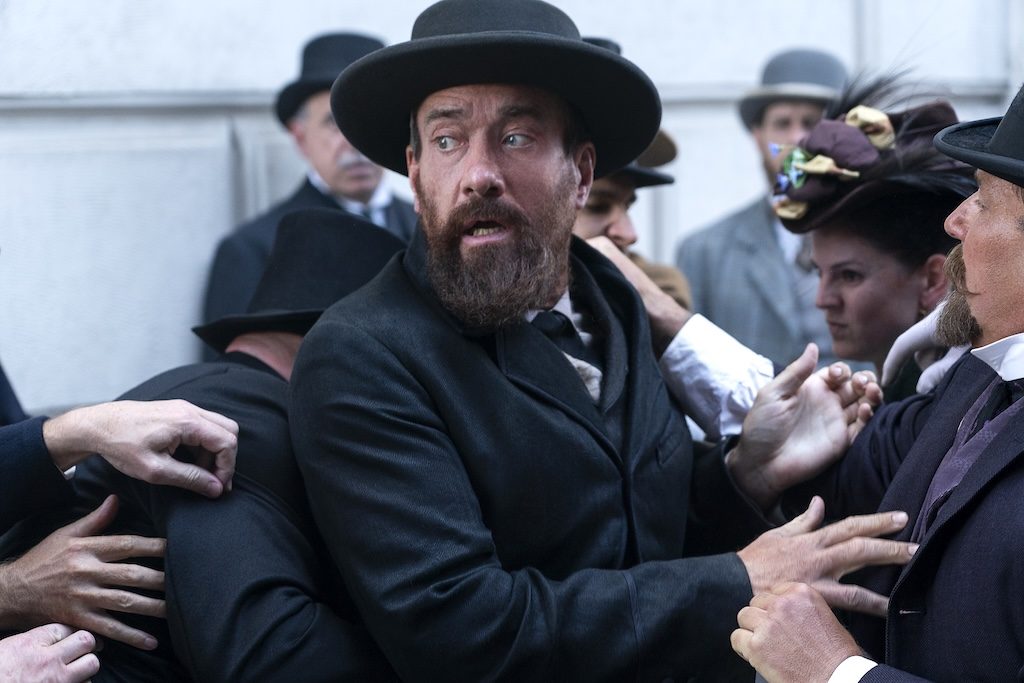
Charles Guiteau (Mathew Macfadyen) Photo by Larry Horricks/ Netflix
Related: Monica Beletsky Explores The “Manhunt” After Abraham Lincoln’s Assassination
Tell us more about Charles Guiteau.
When I was thinking about Garfield and Guiteau in contrast to one another, there are a million ways that those two guys are different, But I think what governs them both is essentially the same.
It’s that desire to be acknowledged, that desire to matter.
In Guiteau’s case, he had fallen in and out of many different career paths over the years. He had escaped debtors prisons and sanitaria. But he always believed that he was destined for something greater than what the rest of the world’s reflected back at him.
He craved doing something that would have some greater impact. And society just kept telling him, ‘no.’ His very few loved ones kept telling him no. He was someone who was born into poverty and had no reason to expect that he would succeed save for the fact that he was an American, and in America, that upward mobility is an actual possibility in a way that it might not be in other places of the world.
He felt that he could transcend his station, and in Garfield’s, improbable rise from poverty to fame, he saw a poster boy for his own ambition. He didn’t get his own shoes until he was five years old.
Guiteau saw a person worthy of lionization.
Garfield was the last person to be born in a log cabin. He was working as a canal boy on the Ohio river as a young teenager. He wasn’t someone that I think anyone ever thought would stand a chance, and yet he’s somehow ended up becoming president.
And to someone like Guiteau to hear that story, it became very important to get as close as possible to Garfield to help ensure that he became president. He campaigned for Garfield, however ineffectively. It became his personal mission to ensure that a man like Garfield find his way into the Oval Office. And once he did, he expected that he would be rewarded for being the director of it.
Related: “Who’s The President?” ‘The Good Fight’ Is A Perfect Spinoff In An Alternate Reality
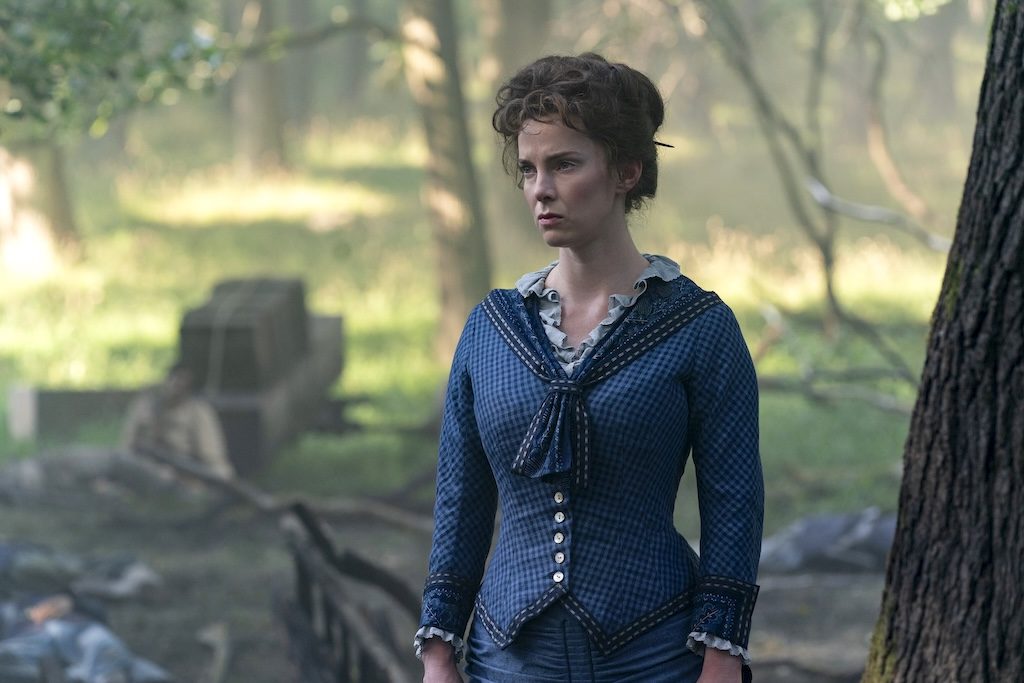
Crete Garfield (Betty Gilpin) Photo by Larry Horricks/ Netflix
Discuss the gruesome opening scenes of the series.
It was set in 1969 in the museum holding Guiteau’s brain in a Mason jar.
As soon as I finished reading the book, I wanted the show to open in the same way.
I never necessarily had the ambition to adapt a historical period, obscure, a bit of esoterica.
I read a story that I thought was riveting, but it was never my intention to make a straight docudrama that just presented the facts as a documentarian would. I wanted to signal to people and the average Netflix viewer probably doesn’t think that they’re going to care about James Garfield or necessarily want to watch a four hour miniseries about him.
You need to surprise them and subvert their expectations for minute by signaling that this is not a dusty period piece that you might expect when you first hear about James Garfield.
I had to be able to start the show in 1969 and hearing the real story of how this brain was rediscovered upon the demolition of a government archive building on the National Mall in 1969. And how, even less than a hundred years later, you see the brain of Charles Guiteau.
That event had fallen so completely out of the public consciousness by that point that it ended up being a really fun and unexpected way to open the show. It is a great way to introduce my central thesis about legacy; that these two people were coming into each other’s lives, both destined to not matter in the way that they so desperately crave.
Related: Alex Gregory and Peter Huyck Stop The Leaks in ‘White House Plumbers’
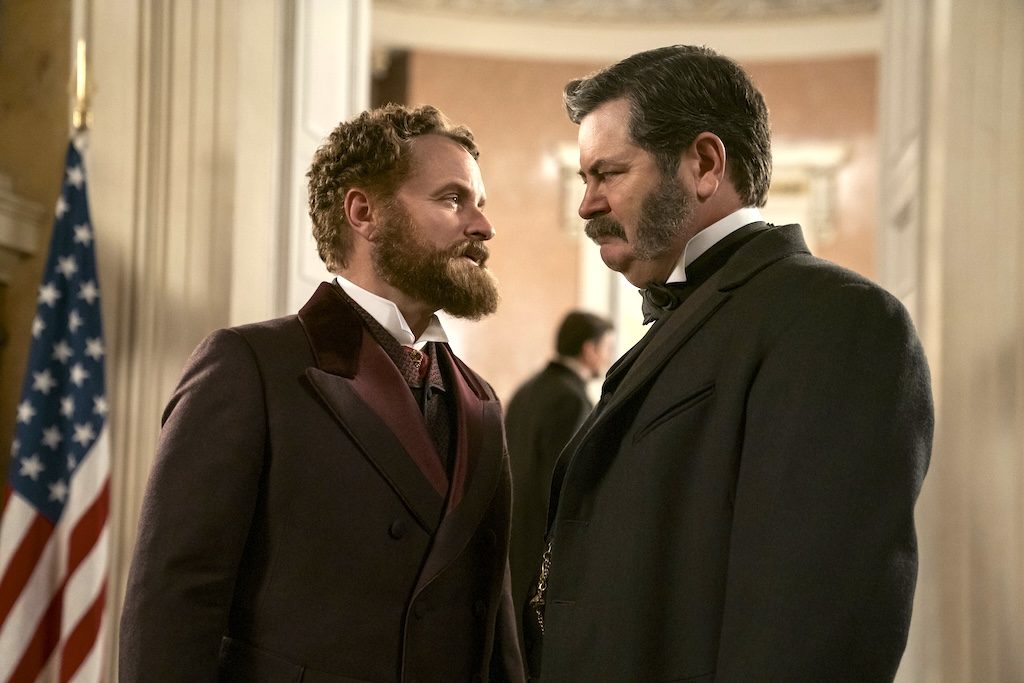
Roscoe Conkling (Shea Whigham) & Chester A. Arthur (Nick Offerman) Photo by Larry Horricks/ Netflix
What were the main points of departure of the series from the book?
I’m really proud of the historical accuracy of the series. At certain points you have to condense the timeline or combine events or combine characters in order to move through the story quicker.
There is no historical record of Lucretia Garfield visiting the prison the night before Guiteau was set to be executed, but it felt like an important scene to write and give voice to her own perspective in a way that the historical record had fallen almost totally silent on.
I would argue that probably the biggest liberties that I took were less based in the historical fact and more in tone.
I wasn’t my ambition to tell a docudrama. I wanted to make something that I felt would have resonance to our current moment in the way that we receive stories. At certain points, I dispensed with period anachronism in favor of maybe a slightly more modern, and at times, more profane parlance.
I hope that audiences have as much fun watching it as I did writing it because the story is insane, absurd, tragic and beautiful. And denying any of those elements, especially when you hear about characters like Chester Arthur (Nick Offerman) or Roscoe Conkling (Shea Wigham) or Charles Guiteau being kicked out of America’s first and only sex cult.
You can leave those ideas on the table or you can allow yourself to have some fun with them and take people by surprise in a way that they might not normally expect from a historical drama series.
Related: “Love Story”: A Deep Dive into John F. Kennedy Jr and Carolyn Bessette’s Lives.

Join the Discussion!



Browse our Videos for Sale
[woocommerce_products_carousel_all_in_one template="compact.css" all_items="88" show_only="id" products="" ordering="random" categories="115" tags="" show_title="false" show_description="false" allow_shortcodes="false" show_price="false" show_category="false" show_tags="false" show_add_to_cart_button="false" show_more_button="false" show_more_items_button="false" show_featured_image="true" image_source="thumbnail" image_height="100" image_width="100" items_to_show_mobiles="3" items_to_show_tablets="6" items_to_show="6" slide_by="1" margin="0" loop="true" stop_on_hover="true" auto_play="true" auto_play_timeout="1200" auto_play_speed="1600" nav="false" nav_speed="800" dots="false" dots_speed="800" lazy_load="false" mouse_drag="true" mouse_wheel="true" touch_drag="true" easing="linear" auto_height="true"]







You must be logged in to post a comment Login