
“One Needs A Head and The Other Needs A Body” Richard Gadd Talks Broken Masculinity in ‘Half Man’

Richard Gadd is a Scottish writer, actor, and comedian from Fife who transitioned from stand-up into dark, deeply personal TV drama. He began his career exploring his own trauma through stand up comedy before shifting to television writing. Baby Reindeer was a massive success that captivated global audiences with its gritty, honest writing. It quickly became one of the most-watched Netflix shows of all time. He described its success as “hysteria” and it triggered a cultural zeitgeist that cements him as one of television’s most exciting voices.
Anticipated Follow-Up to Baby Reindeer
Gadd’s new series, Half Man, is an HBO drama set in 1980s Scotland, centered on two boys who become brothers when their mothers fall in love.
Gadd stars as Ruben Pallister, an explosive and physically imposing man, alongside Jamie Bell as Niall Kennedy, his quiet and sensitive step brother. The series explores their complicated, unbreakable bond over 30 years.
Ruben and Niall appear to be polar opposites, but their tumultuous relationship is nebulous in that they often alternate between being the agressor and agressee. Half Man plays as a stream of consciousness trampolining between time periods – like flipping through the pages of a book, reading a few pages, and flipping again backwards and forwards. It is a narrative that demands to be patiently experienced, as it snakes its way though Ruben and Niall’s lives.
Thematically, Half Man is a kaleidoscope of unbridled testosterone-fuelled emotions that must be tamed and understood – guilt, anger, grief, fear, love, confusion, confession, repression, expression, frustration, intimacy, and all its trggers. The boys often feel lost, adrift, isolated, different – yet somehow, they find solace in each other between fist fights.
Richard Gadd spoke with Creative Screenwriting Magazine about Half Man.
Half Man: Creating an Impactful Title
Gadd refused to evangelize the precise meaning of Half Man, declaring it would diminish the viewer’s interpretation of the show.
We suggest some basics. Ruben and Niall complement each other, they provoke each other, they are part of one brotherhood entity that makes them whole. On some levels, they signify the dark and light sides of the same coin – but which side is which is constantly flipping. To excavate deeper, each brother is missing something spiritually. They haven’t reached full maturity, potential, or destiny.
“I think that’s a beautiful interpretation,” fawns Gadd, while purposely avoiding his explanation of the title.
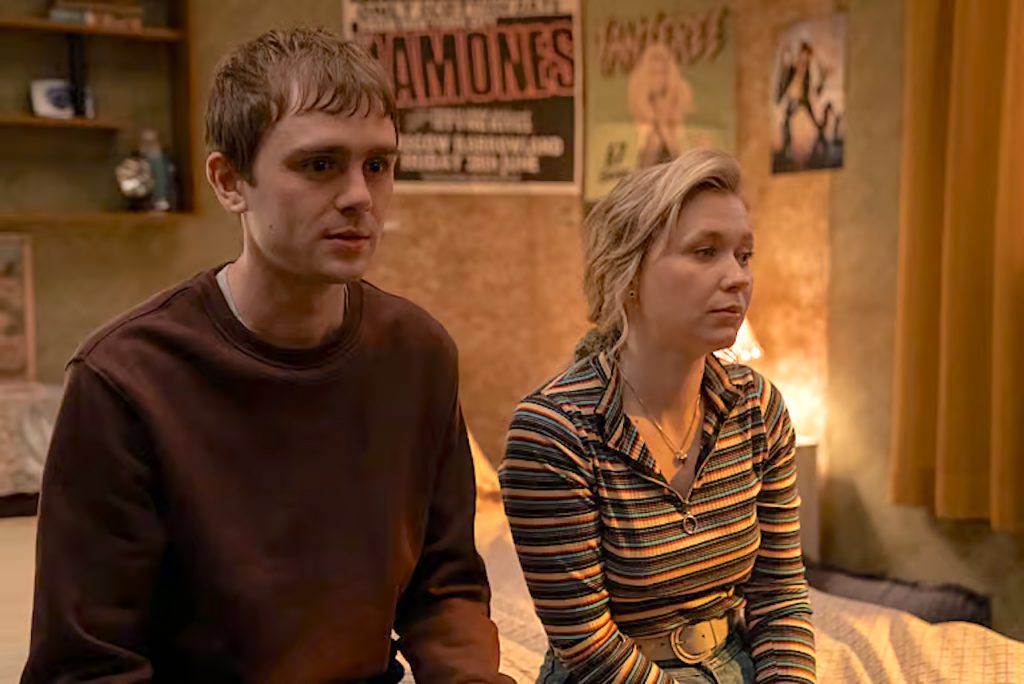
Niall (Mitchell Robinson) and Joanna (Julie Cullen)
Starting With A Thematic Intention
Half Man is by no means a half show. It has multiple stories told across multiple time lines to keep viewers invested. Arguably, there might be several shows packed into one. Richard distills this loose episode structure into the central premise of his show and his creative intention for Ruben and Niall.
“I started by thinking wouldn’t it be interesting to take two broken men in their adult lives and flashback to them as kids? Go to our less accepting times as a UK society, and see them soak up all the prejudices and learn behavior which got them to the point of where they are as adults,” Gadd explains. It’s a provocation and dissection of broken down masculinity.
“We meet Niall and Ruben at these crossroads in their lives,” Richard adds.
Jumping Through Time Lines and Stories
Half Man transports each episode in a metaphorical time machine. It’s a form of controlled freefall for Richard. He doesn’t explain it, which makes for more compelling storytelling. It’s deliberately disorienting so audiences are questioning where they are, what’s happening, and the lay of land. Gadd sees it as a technique to draw people in.
“I wanted to give a historical account of these brothers’ lives. I wanted to leap through the eras and show their toxic bond mutate over several years,”
“I thought the best way of doing that was to leap forward in time and create a situation where the audience are having to fill in the gaps between the episodes.” Gadd cites an example when Ruben crashes Niall’s wedding with a violent outburst. Then the story is catapulted to the start of the wedding.
In many respects, Gadd sees these seemingly random time jumps as a unique way to control exposition of multiple story lines in six episodes at once. It’s almost six films packed into one series. Every time the audience watches an episode, they have to recontextualize and recalibrate before watching the next.
This was a technique to meet these characters at the intersectional points where they’re most destructive.
Ruben and Niall – Decoding Brotherhood and Masculinity
The complicated texture of Ruben and Niall’s toxic relationship is deepened because they are half brothers at war with their own masculinity.
“One means more to the other brother. Masculinity clearly means a lot to Niall because he’s never had it in his life. He doesn’t feel it. He wants to feel strong like Ruben does. Ruben has a hole in his life from his childhood that he didn’t fulfill.”
“It was a very dysfunctional childhood, so brotherhood means a lot more to Ruben. The idea of having a stable family dynamic and a stable home is foreign. Their different needs intersect in very complicated ways,” he continues.
“But ultimately, I don’t think they’re joined particularly by masculinity or brotherhood, as much as they are joined by kind of inability to express one’s feelings for the other.”
Ruben is a volatile contradiction. A ball of uncontrollable rage that he can only express by violently lashing out. This fire is often wrapped in sweetness and kindness. He helps his financially-burdened brother with cash he borrows from his credit card – in an episode after he’s beaten the living daylights out of him.
Niall is living in the shadows. He’s figuring out his identity, while concealing what he has already figured out from the world.
Writing Three-Dimensional Characters
“Whenever I write a character, to try and dig into, I make them three-dimensional. If you take a character like Ruben, and he’s nothing but rage incarnate, it would make it a little bit tiresome,” states Richard.
“But also, it’s interesting to show somebody with a lot of empathy, and a weird way of showing love and acceptance, who’s also capable of a switch. Ultimately Ruben, rather than being a kind of monster, I think he is a product of trauma.” He heals it by showing Niall “odd love.”
“When Ruben loses his temper, he disappears from the world. He almost doesn’t know what he’s doing. If you peel away all the damage, all the layers, and all these things that have gone on in Ruben’s life, what he wants in his heart is a kind of stability. It’s a love that he’s never had.”
This desire runs Ruben’s life. “He insists to Niall, ‘We’re family.’ He’s forcing something onto a situation slightly prematurely because he needs stability.”
“The interesting thing about Niall is how far his repression goes. Something that’s always amazed me, particularly in myself or in other people is the human capacity to repress itself can be very huge so we live in a sphere of denial. We’ve all seen people rewrite the history of because they can’t accept the fact that they were the one that messed it up.”
Niall projects the chaos and recklessness in his life “because other people are the perfect excuse to not face himself.”
What Do Niall and Ruben Need From Each Other?
Niall and Ruben are hardly a case of yin and yang. They complement each other like ill-fitting jigsaw pieces.
The character Celeste (Philippine Velge) accurately describes them. “‘You’re very different, you two. One needs a head and the other needs a body.’ I think it really goes to the heart of their struggle in a lot of ways.”
“Niall wishes to have a physical presence that means he can command a room so that people won’t look down at him, and he won’t project his own fears onto others. Ruben wants the intelligence and stability that earns the approval of others.”
“Niall gives Ruben a certain intellectual quality that makes people give him value from a socially-optical point of view. And so, what they need from one another is the physical component that they’re missing from themselves.”
Final Words on Screenwriting From Richard Gadd
A recurring theme in Gadd’s work is dealing with the aftermath of abuse. “My DNA is kind of in there. Ruben and Niall are fictional. But in a lot of ways, all writing is autobiographical. It’s somebody’s view on the world.”
Richard relates to the struggles of both characters, but not to the extremities they exhibit in Half Man.
Ultimately, Half Man is a family drama. Niall, despite growing up with queer mothers, “it actually doesn’t allow him to lead to a sense of acceptance.” Ironically, it causes the opposite. Gadd uses this dynamic to demonstrate how home life can sow the seeds of prejudice leading to his internalization.
[More: Jessica Gunning Deconstructs Martha Scott and Donny Dunn In “Baby Reindeer”]

Join the Discussion!



Browse our Videos for Sale
[woocommerce_products_carousel_all_in_one template="compact.css" all_items="88" show_only="id" products="" ordering="random" categories="115" tags="" show_title="false" show_description="false" allow_shortcodes="false" show_price="false" show_category="false" show_tags="false" show_add_to_cart_button="false" show_more_button="false" show_more_items_button="false" show_featured_image="true" image_source="thumbnail" image_height="100" image_width="100" items_to_show_mobiles="3" items_to_show_tablets="6" items_to_show="6" slide_by="1" margin="0" loop="true" stop_on_hover="true" auto_play="true" auto_play_timeout="1200" auto_play_speed="1600" nav="false" nav_speed="800" dots="false" dots_speed="800" lazy_load="false" mouse_drag="true" mouse_wheel="true" touch_drag="true" easing="linear" auto_height="true"]







You must be logged in to post a comment Login