
Short Drama Platforms: Who’s Building the New Frontier and What Screenwriters Need to Know

The landscape of serialized storytelling has undergone a seismic shift. For working screenwriters, the traditional 30 or 60-minute pilot or a 90+-minute feature are no longer the only games in town. A new gold rush is happening on smartphones, driven by bite-sized episodic short drama content. And script writers should position themselves accordingly.
These narratives demand compressed plotting, relentless pacing, and engineered cliffhangers at the end of every single minute. Major studios and apps are pouring millions into this space, creating a massive demand for writers who understand how to utilize structure for maximum audience retention.
What Exactly Is Short Drama?
Before mapping the short form ecosystem, it needs a clear definition — because “short drama” gets used loosely and often incorrectly.
A short drama, is a serialized narrative broken into episodes that run between 30 seconds and 5 minutes, designed specifically for vertical (9:16) mobile viewing.
Each episode typically ends on a hard cliffhanger. What will happen next? The genre is sometimes called microdrama or vertical drama and the structural architecture contains high stakes, fast escalation, emotionally manipulative in the best pulp storytelling tradition.
Episodes typically run between one and two minutes, with entire seasons spanning 50 to 100 episodes. The plot-driven narrative arc mimics traditional soap operas, melodramas, and thrillers, but stripped of most exposition. They lean heavily into high-concept romance tropes like billionaire alphas, hidden identities, and ultimate revenge fantasies.
The format originated in China, where platforms like Kuaishou and Douyin (TikTok’s domestic counterpart) proved the model at massive scale. Western adaptations began arriving around 2022 and accelerated sharply after that.
The Microdrama Business Model: How These Platforms Actually Make Money
Understanding the vertical drama revenue model is essential for writers.
Most short drama platforms operate on one of three main structures:
- Coin/token unlocking — Viewers watch the first several episodes free, then purchase in-app currency to unlock subsequent episodes. This is the dominant model used by ReelShort, DramaBox, and GoodShort. It incentivizes aggressive cliffhanger structure at every episode break — which is a direct brief to the writer.
- Subscription — Monthly access to a content library. NetShort and some tiers of DramaBox use hybrid models that layer subscription over coin systems.
- Ad-supported free viewing — Platforms like VibeShort (Story Reel) and FlickReels have experimented with ad-revenue sharing models, making content freely accessible while monetizing through impressions.
The implication for writers is clear: on a coin-unlock platform, episode three has to sell episode four.
Alternatively, users watch the first ten to fifteen episodes for free. As the addictive emotional investment peaks — usually right before a massive confrontation or revelation — the paywall drops. Viewers must watch ads or purchase coins to unlock the next episode.
This pay-per-view model changes the structural math for the writer. Every single episode — often just 150 to 200 words of script — must end on a gripping hook. If viewer retention drops between episode 12 and 13, the monetization funnel breaks.
Related: Vertical Dramas: An Emerging Trend in the Entertainment Industry
The Major Players: A Platform-by-Platform Breakdown
The large short drama ecosystem is consolidating rapidly, but the field remains fragmented enough so that multiple platforms still acquire content.
Operated by Crazy Maple Studio (a subsidiary of Chinese tech company Youdao), DramaBox is arguably the most recognizable brand in the Western short drama space. It runs a coin-unlock model, releases multiple titles weekly, and has invested in original English-language production. Writers working in romance, paranormal romance, and ‘Cinderella-arc’ narratives may find a home here.
ReelShort, owned by Chinese company COL Group, was among the first platforms to localize Chinese short drama scripts for American audiences. It has since moved into original English-language development and is one of the more writer-accessible platforms in terms of open submission pipelines. The platform consistently ranks among the top-grossing entertainment apps.
Positioned slightly more toward a hybrid subscription model, NetShort has been expanding its content catalog and is worth monitoring for writers interested in formats that blend short drama with longer serialized arcs.
DramaWave has positioned itself as a competitor in the romance and thriller verticals, with a content strategy that mirrors DramaBox, but with more aggressive promotion of dubbed and adapted content. It’s less established in original English-language production, but is acquiring actively.
This platform — which has operated under both names depending on market and iteration — has experimented with creator-forward models and ad-supported free viewing. It’s one to watch for writers interested in formats that don’t require navigating coin-unlock economics as a primary audience relationship.
GoodShort
GoodShort has cultivated a catalog that leans into feel-good romance and family drama — lighter in tone than some competitors. The coin-unlock model applies, but the content brief here skews toward emotionally satisfying arcs over pure shock-value cliffhangers.
ShortMax
ShortMax entered the market with backing and infrastructure from Bigo Technology, a subsidiary of JOYY Inc. It has moved quickly to establish an original content slate and is one of the better-funded new entrants in the space.
FlickReels, JoyReels, andMoboReels
These three platforms operate in a similar tier — smaller catalogs, still-developing content pipelines, but actively seeking material. For writers looking to build credits in the format, these mid-tier platforms can be an entry point. The creative risk tolerance tends to be higher at this level, and the turnaround from pitch to production can be significantly faster than major players.
iDrama
iDrama has focused on leveraging existing Chinese short drama IP for Western markets through dubbing and localization. For writers, this matters less as an original content pipeline and more as evidence of how rapidly the format is being adapted across cultural contexts.
Stardust TV
A newer entrant that has positioned itself around a slightly more curated content approach. Worth monitoring for writers who find the mass-market tone of coin-unlock drama at odds with their sensibility. Stardust TV has gestured toward elevated genre storytelling.
Vigloo
Vigloo has been building a catalog with an eye toward romance and drama in the African and African diaspora market — a strategic differentiation from the dominant U.S./ Chinese content pipelines. For writers with storytelling rooted in those communities, this is a viable access point.
MyDrama
MyDrama operates more as a content aggregator with streaming functionality, carrying Asian drama content including Korean and Chinese originals alongside short drama content. It’s a hybrid platform rather than a pure short drama play.
CandyJar TV
CandyJar has positioned itself toward female-skewing romance content — similar to the DramaBox audience but with a brand identity built around that demographic more explicitly. The content brief here is narrow but consistent.
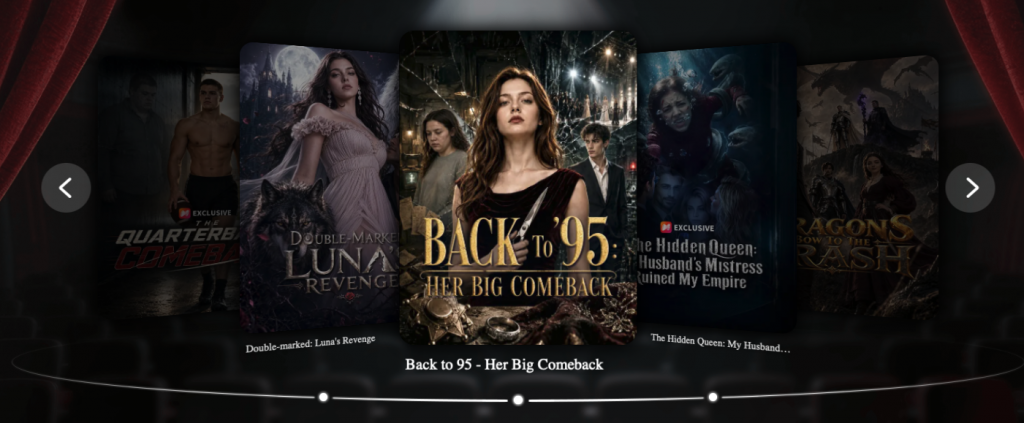
A collection of vertical dramas on Netshort
Emerging Verical Drama Platforms and What’s Coming
The second wave of short drama platforms is already forming, and several trends are worth tracking.
Snap’s investment in vertical drama through Snapchat Originals has been inconsistent, but the infrastructure is there and the audience overlap with short drama demographics is significant.
YouTube Shorts as an indirect competitor deserves attention — several creators have begun producing serialized short drama content natively on YouTube, monetizing through AdSense and channel memberships rather than app-based coin systems.
Wattpad Webtoon pivot into short drama production represents a fascinating content pipeline — adapting existing IP from the platform’s fiction library into vertical drama format. Writers with existing Wattpad properties should be aware this conversion is already happening with or without author involvement in some cases.
Amazon’s experimentation with short-form content through its Creator program and rumored interest in vertical drama from internal development discussions suggests a major-platform entry may not be far off.
Additionally, regional players in South Korea, Nigeria, and Southeast Asia are developing indigenous short drama platforms that may have Western expansion ambitions within the next 24 months.

YouTube shorts
What Makes Each Platform Distinct: A Writer’s-Eye View
The content briefs across these platforms are more differentiated than they first appear. Genre skew matters enormously when positioning a project or pitching an idea.
Romance dominates everywhere, but the type of romance varies. DramaBox leans toward billionaire-alpha-hero narratives. GoodShort favors found-family and second-chance romance. CandyJar TV wants emotionally cathartic female-perspective arcs.
Thriller and paranormal content is a growth category. ReelShort and ShotMax have both commissioned paranormal romance and supernatural thriller content — werewolf and vampire narratives that would feel at home in the peak Twilight era are performing well in this format.
The pacing brief is non-negotiable. Every platform, regardless of content skew, requires the same structural discipline: a hook in the first ten seconds of episode one, an act of escalation every 90 seconds within episodes, and a hard cliffhanger that cannot be resolved without watching the next episode.
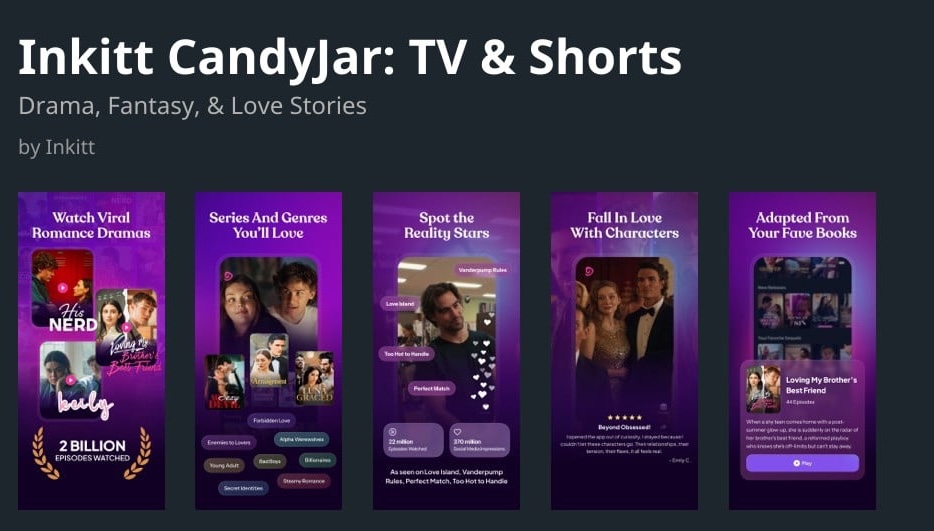
CandyJar TV
What Screenwriters Should Know About the Form
The best short drama writers understand story compression without flattening emotion. A scene still needs progression, but it cannot afford ornamental buildup or reflection.
1. Open with conflict, not atmosphere. A short drama does not have room for mood without pressure points. The opening beat should declare the fracture immediately: a betrayal, a secret, a public humiliation, a threat, a romantic reversal.
2. Build each scene around a reveal. Every scene should either expose information, complicate allegiance, or force an uncomfortable choice. If a scene only confirms what the audience already knows, it is dead weight.
3. Treat reversals as the engine. The format thrives on turns. A character who seems powerless becomes dangerous. A lover is revealed to be an heir. A workplace rival is also the ex. The audience keeps watching because the story keeps reclassifying what it thought was true.
4. Make dialogue functional. Short drama dialogue is rarely about subtext alone. It has to carry plot, declare stakes, and sharpen character in a very small amount of time. The writing can still be stylish, but it cannot be indulgent.
Related: How To Make A Vertical Drama
How to Write a Vertical Drama Script
The Opportunity for Screenwriters
This format needs writers more than it currently knows. The early wave of Western short drama content has been marked by rushed adaptation from Chinese source material, with varying results in terms of tonal coherence and cultural translation.
Writers who understand both pulp storytelling mechanics — the craft of Elmore Leonard, the structural ruthlessness of a prime-time soap, the genre commitment of a Harlequin novel — and the technical requirements of vertical production are genuinely rare.
Most platforms are actively acquiring pitches. Some, including ReelShort and DramaBox, have open submission policies. ShortMax has been reaching out through agents and managers. Mid-tier platforms like FlickReels and JoyReels are more accessible directly.
The format rewards writers who have studied serialized structure, understand act breaks at the micro level, and can sustain emotional escalation across 50 to 100 episodes without losing narrative coherence. That’s a specific skill set, and it’s learnable.
For writers serious about building expertise in the microdrama format, understanding how serialized structure functions at the episode level is the technical foundation everything else builds on rapid turnaround schedules, often shooting an entire 80-episode season in a matter of weeks. They need reliable, fast-turnaround writers who understand how to outline a sprawling 10,000-word arc without losing momentum.
While budgets per episode are modest compared to streaming prestige TV, the volume of production creates steady, lucrative employment. Furthermore, rights ownership and backend structures vary greatly by platform, requiring writers to negotiate terms carefully.
The best career strategy is not to chase every app. It is to develop a sample that demonstrates control of the form:
- A concise series bible
- A clear premise and audience promise
- A season arc with escalation
- Three to five sample episodes
- Character descriptions built around wants and reversals
- A production-aware approach to locations and cast
- A rights position that distinguishes original material from assignment work
Writers should study the platforms, but avoid treating them as interchangeable. Read their current catalogues, track their ad campaigns, identify recurring genres and verify who is actually producing the work. The market changes quickly, and a platform list is only useful when paired with current research.
Short drama rewards writers who can think commercially without abandoning character. Its most durable lesson is structural: every scene must earn the next scene, and every episode must change the value of continuing.

Join the Discussion!



Browse our Videos for Sale
[woocommerce_products_carousel_all_in_one template="compact.css" all_items="88" show_only="id" products="" ordering="random" categories="115" tags="" show_title="false" show_description="false" allow_shortcodes="false" show_price="false" show_category="false" show_tags="false" show_add_to_cart_button="false" show_more_button="false" show_more_items_button="false" show_featured_image="true" image_source="thumbnail" image_height="100" image_width="100" items_to_show_mobiles="3" items_to_show_tablets="6" items_to_show="6" slide_by="1" margin="0" loop="true" stop_on_hover="true" auto_play="true" auto_play_timeout="1200" auto_play_speed="1600" nav="false" nav_speed="800" dots="false" dots_speed="800" lazy_load="false" mouse_drag="true" mouse_wheel="true" touch_drag="true" easing="linear" auto_height="true"]







You must be logged in to post a comment Login