
Ted Humphrey on Crafting The Lincoln Lawyer Season 4: A Crime Show from the Other Side of the Law

Netflix’s The Lincoln Lawyer follows defense attorney Mickey Haller (Manuel Garcia-Rulfo) as he navigates Los Angeles’ tumultuous criminal justice system which often seems tilted against the average citizen, defending clients while grappling with the moral and personal stakes of his work. Adapted from Michael Connelly’s bestselling novels, the series has stretched across four seasons, evolving from a story of redemption in season one to high-stakes personal and professional battles in season four. Each season balances courtroom tension, character-driven drama, and a garnish of dark humor, making it a popular crime series. The series was created by Ted Humphrey and David E. Kelley. Ted shares his insights about the success of the show and what writers can learn from it.
With so many crime shows on TV, what sets The Lincoln Lawyer apart?
At its core, the show is built around a defense lawyer, which is something we haven’t seen as much of in recent years. It’s a crime show, or a show about the criminal justice system and its ups and downs. But it’s very much told from the opposite perspective of the defense attorney.
In many ways, we’re an anti–cop show — not in the sense that we dislike cops, but in that cops or the system are not Mickey Haller’s best friends. He has a lot of critical things to say about them. Even though there are interesting cop characters on the show, the point of view is fundamentally different. We’re examining the legal system from the defense side, and audiences seem to really enjoy being placed in those shoes.
What aspects of the show speaks to the current moment?
Michael Connelly’s books are very much rooted in the present day in which they’re written — who’s president, and major events like COVID. We don’t lean into that as directly in other television, because it can quickly feel dated. You want the show to feel fresh and relevant even years later.
At the same time, we do try to bring in contemporary cultural and societal elements. For example, in season two, the book focused on the mortgage crisis of 2008. We reworked that into issues of gentrification in East Los Angeles and celebrity chef culture, which felt more timely now.
More broadly, the show puts you in the shoes of a defense attorney facing the awesome power of the state. One person versus that power is always a David and Goliath story. That’s timeless. I think it resonates especially now because many people feel increasingly powerless in the face of large societal and political forces beyond their control. That feeling is cyclical. You can see it in the paranoid thrillers of the 1970s, like Three Days of the Condor or The Parallax View. In some ways, The Lincoln Lawyer sits in that tradition.

Ted Humphrey & Mickey Haller (Manuel Garcia-Rulfo) Photo by Lara Solanki/ Netflix
Looking specifically at Season Four, what thematic or societal concerns shaped the writers’ room?
We approached season four on a much more personal level. To me, personal stories are universal. For example, there’s a scene where Mickey meets with his daughter Hayley (Krista Warner) and ex-wife Maggie (Neve Campbell) in prison and is reduced to being called by a number. That moment came from a real experience of my colleague Dylan Rodriguez, who had to visit her father in prison. It’s deeply dehumanizing, and that’s something that transcends any specific moment in time.
[More: Ted Humphrey on Writing Career, Craft, and Longevity in Film and Television]
We don’t feel the need to chase today’s headlines, because those quickly become dated. Instead, we focus on experiences and emotions that are enduring.

Hayley Haller (Krista Warner) Photo courtesy of Netflix
Over the four seasons, how have the relationships between Mickey, Lorna, and Cisco evolved?
That evolution is really at the heart of the show. Season one is Mickey’s redemption story — a man who’s been knocked down very low and is fighting his way back. It’s about who he is, or who he thought he was. Season two is about him flying too close to the sun and getting knocked down again. Season three brings the ghosts of his past back into his life. In season four, all the enemies he’s made are arrayed against him in the most personal and emotional way possible.
Along the way, he’s been fighting for other people’s freedom. Now he’s fighting for his own. That puts him in a very different place and sets up interesting possibilities moving forward, where he has to question who he is and whether his understanding of himself is complete.
Lorna’s (Becki Newton) journey has been equally important. She starts as an assistant and paralegal, but we slowly uncover her backstory — why she didn’t finish law school, what held her back — and then watch her overcome that and step into her own as a lawyer. She’s constantly proving she’s more than people initially assume.
Cisco (Angus Sampson) has evolved from a loner with a sketchy past into someone who’s part of both a professional and personal team. Being married to Lorna complicates things. What she asks him to do professionally as an investigator can clash with what that means personally, and vice versa. That tension is rich territory for storytelling.
I’d also highlight Lorna’s relationship with Maggie. It starts off frosty and intimidating, as you might expect between two ex-wives of the same man, but over time it develops into a professional partnership and even a budding friendship. That’s been one of the most interesting relationships to explore.
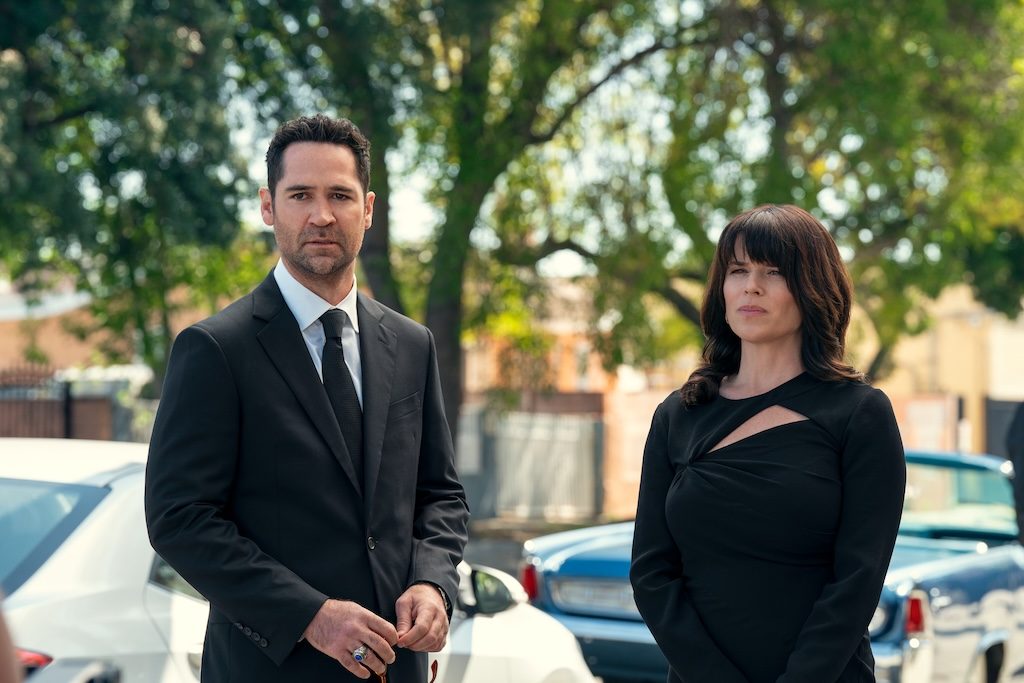
Mickey Haller (Manuel Garcia-Rulfo) and Maggie McPherson (Neve Campbell) Photo by Lara Solanki/ Netflix
Describe the balance between high stakes tension with humor.
That tonal mix is very intentional, and I’m glad when it works. The tone is inspired by classic California noir, especially Chinatown and The Long Goodbye. There’s a lot of humor in those films, even amid the darkness. Elliot Gould’s (Davd “Legal” Siegel) presence on our show adds a meta quality, given his role in that film with the cat.
Our humor may be a bit more direct than the very dry, sardonic humor of those movies, but it’s always balanced with darkness. There’s an Elmore Leonard or Tarantino quality there.
There’s a sequence in the book where Mickey has to go to Arizona to meet this prisoner who has some information for him. It’s kind of dicey, because he’s got to get the judge to approve him, because he’s not supposed to leave the state.
He’s got an ankle monitor on, and in the book he he does that, and then he just flies home, But we invented this whole kind of ticking clock sequence where the ankle monitor is running low on battery power, and he’s got a job to do, So there were opportunities to infuse a lot of humor into that, but also at the same time, it’s very tense, and edge of your seat suspense. It’s that melding of those two elements that I think is really most important.
That balance — letting humor heighten tension rather than release it completely — is key to the fabric of the show.
[More: Man Finding His Way Back” Ted Humphrey Talks ‘The Lincoln Lawyer’]

Join the Discussion!
Related Articles



Browse our Videos for Sale
[woocommerce_products_carousel_all_in_one template="compact.css" all_items="88" show_only="id" products="" ordering="random" categories="115" tags="" show_title="false" show_description="false" allow_shortcodes="false" show_price="false" show_category="false" show_tags="false" show_add_to_cart_button="false" show_more_button="false" show_more_items_button="false" show_featured_image="true" image_source="thumbnail" image_height="100" image_width="100" items_to_show_mobiles="3" items_to_show_tablets="6" items_to_show="6" slide_by="1" margin="0" loop="true" stop_on_hover="true" auto_play="true" auto_play_timeout="1200" auto_play_speed="1600" nav="false" nav_speed="800" dots="false" dots_speed="800" lazy_load="false" mouse_drag="true" mouse_wheel="true" touch_drag="true" easing="linear" auto_height="true"]







You must be logged in to post a comment Login