No One’s Normal. It Just Looks That Way from Across the Street
For television writers, balancing absurdity with devastating pathos is television’s hardest high-wire act — and few walk it quite like Steven Conrad (Patriot and Perpetual Grace, LTD, The Pursuit of Happyness and The Secret Life of Walter Mitty). In HBO’s dark comedy limited series DTF: St. Louis, Conrad turns his gaze on middle-aged malaise and unfulfilled longing wrapped up in a murder mystery.
The seven-episode series charts a darkly comic love triangle between three consenting adults whose desperate bid to energize their married lives spirals out of control, resulting in one of them winding up dead.
In this interview with Creative Screenwriting Magazine, Conrad pulls back the curtain on breaking the traditional limited series structure, developing flawed characters, and how screenwriters can inject genuine melancholy into uncomfortable comedy.
How did you initially pitch the series to HBO?
I mentioned to HBO that I’d like to try to work inside a noir genre. Let’s see what we might contribute to that genre.
I read an article in New Yorker called My Dentist’s Murder Trial: Adultery, False Identities and a Lethal Situation by James Lasden. It was a way for us to start talking about what the characters might be like, what their plights might be, where the tension could come from, and what the mystery might evolve into over the course of seven episodes of DTF.
I knew the ending before we even pitched the show because I thought I knew what the greatest sets of conflict were. I knew that they were personal to a character I was very hungry to write about, Floyd Smernitch (David Harbour).
Unlocking your inhibitions in middle age is probably really dangerous. I guess somewhere inside of that would be the easiest foothold for what the show says and does. I want to talk about the three main characters.

Steven Conrad
How did you decide the professions of Carol Love-Smernitch (Linda Cardellini) is a secretary and football umpire on weekends, Floyd is a sign language interpreter, and Clark Forrester (Jason Bateman) is a TV weatherman.
I knew that middle age was going to have something to say in the show, contending with that phase of life. Our professions, when we get to a certain age, can overwhelm your life.
By the time you’re 50, you have a real sense of what you have to devote to it and what rewards it grants you. It is a comprehensive relationship with your job, the frustrations, and the satisfactions.
I wanted each character each to have a different set of frustrations in relation to their occupation. Carol works as a pool secretary for the accounting department at Purina. She’s got a lot of responsibilities. She’s underpaid and she’s hit the ceiling for her pedigree.
Clark is overpaid doing a profession that he doesn’t see the value in. You don’t depend on your weatherman anymore to tell you what the weather is going to be like. He’s just a person on screen that is part of the news team. Feeling friendly toward him is probably more important than depending on him for meteorology. His job doesn’t give him satisfactions beyond the paycheck. There’s a hole there for him.
Floyd has chosen a profession in sign language which has a tremendous emotional return, but is also seriously underpaid, This has created the real plight and the greatest source of tension in Floyd’s life. He isn’t able to contribute to the upkeep of this family enough so that everybody’s heads can stay above water.
The surprise of this special education quotient in their life, making sure that Carol’s son and Floyd’s stepson Richard (Arlan Ruf ) has created bills in the tens of thousands that the family just can’t handle. There’s no such thing as getting a raise in his job, cornering market, or inventing an app.
He’s hit the ceiling. I think one of the mistaken conclusions that Floyd draws is that he isn’t enough. And he wasn’t satisfactory for his family.
The jobs seem to be important, but when so little else defines you, your job does. It can contribute to creating a picture of frustrations and dreams.
Dreams can become real anchors to people at a certain age. They can hold you, instead of pushing you toward these sexual fantasies of Clark’s. He’s got time on his hands, so he can picture them.
Related: Steve Conrad Interview: Writing The Secret Life of Walter Mitty

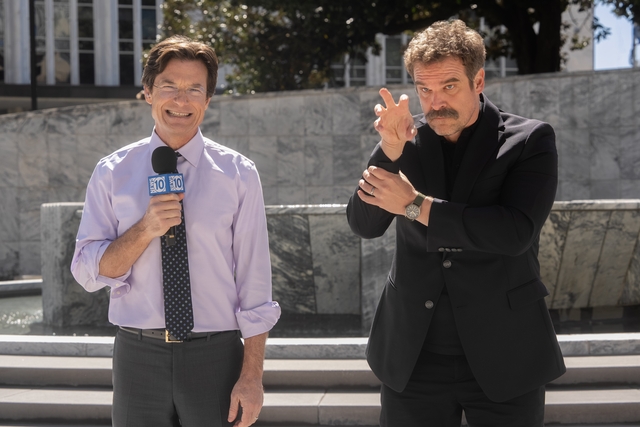
Clark Forrest (Jason Bateman) and Carol Love-Smernitch (Linda Cardellini) Photo by Tina Rowden/ HBO
How did you navigate the parallel, non-linear storylines – the DTF app and the detective story?
I understand that at some point, there was going to be an imperative dovetail of those things. I knew that was ultimately where the proving ground was for the story. Does it add up?
One of the pressures of episodic TV is that there’ll come a moment when you really do have to show your cards. The idea of provoking questions is over. After the investment of seven hours, you feel like this can be a comprehensive ending to that endurance feat.
I made sure that I had confidence in that before I even started to write. I knew what the centerfold was going to represent to Floyd.
I had a sense of how I could use it to take Detective Donoghue Homer’s investigation (Richard Jenkins) in the wrong direction. I knew that it also was going to be a source of real heartache for Floyd. And that the scratching out of the face in the centrefold picture dawned on me very early as an act of self-erasure.
I understood how a good cop could draw the wrong conclusion from the clues when you’re laying out suspense when you’re dealing with mysteries. His colleague Jodie Plumb (Joy Sunday) put all the pieces together.
The audience is there too. They underwent everything the detectives did. It would be the most satisfying trip for the audience to have this come together the same way it comes together for Detective Homer. The audience didn’t know anything before he did.
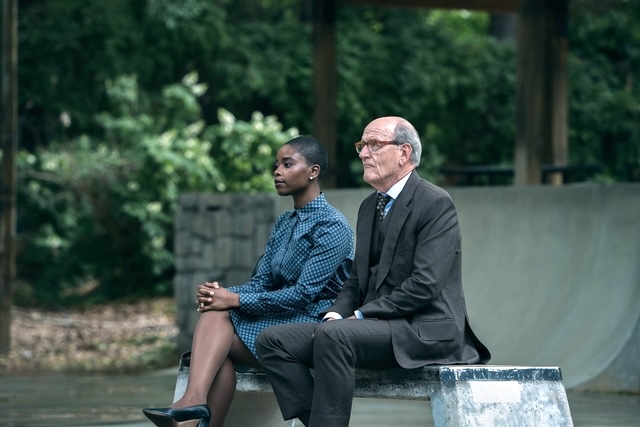
Jodie Plumb (Joy Sunday) and Donoghue Homer (Richard Jenkins) Photo by Tina Rowden/ HBO
Why does Floyd keep going back to the centrefold photo of himself?
The guy in the centerfold (a much younger Floyd) has got an athletic body.
He’s young, he’s virile, but he doesn’t feel like that right now. This is a story about aging, regret, and midlife confusion. He also has few people around like Clark who can say, “I love you, and I think you should feel good about yourself.”
Clark draws Floyd to the pool house, probably only to be able to say to him, “I prefer the 47-year-old Floyd to this 24-year-old Floyd. You make me feel safe and good, and you should love yourself the way that I love you.”
I don’t think that the trouble comes from us losing control of our bodies. I think the trouble comes from us losing some say over who we share our lives with.
The inevitability of this thing can be shared, understood, smiled over, quieted, and ultimately accepted. Floyd’s wife Carol can’t do this for him anymore.
He has frustrated her life so entirely that sex has gone from their marriage. It’s not where he will find some sense of positivity. Clark tried to give that to him.
One of the heroic things that I think Clark does is to recognize that this person’s hurting this way.
Clark’s having an affair with Floyd’s wife, and he’s complicated his friend’s life too. He’s cognizant of this hurt and this pain that Floyd’s carrying around. And probably, in a calmer summer, he could have done something about it if he had more time, if things were a little simpler.
Related: Celeste Hughey Talks “The’ Burbs” In A Candid Interview
How did you approach the specific offbeat genre and tone of DTF: St. Louis?
My experience with making episodic TV has been two seasons of a show for Amazon called Patriot.
There is also one season of a show for EPIX called Perpetual Grace LTD. This was my fourth year of making live-action television.
It should have dawned on me very early on, but it didn’t until Perpetual Grace LTD. When you’re making television, you’re really making three distinct pieces of finished work. You’re making an episode, you’re making a season, and you’re making a series. They have different demands in relation to the filmmakers and the audience.
I wanted to make sure that our audience felt a very specific feeling of satisfaction from the completion of an episode. This became important to me when we were making Patriot. We found along the way that we would aim for some moment in Patriot to stretch the bandwidth of tone into, not the comic exactly, and not exactly the frivolous either, but some lightness that the genre wasn’t accustomed to.
The scenes were often comedic, but often they were creative attempts to put something inside a genre that was unexpected.
I wouldn’t call an episode complete until we moved the plot forward, deepened some of the sets of tension that existed, created a little uncertainty, and then provided the audience with one of those elements.
That is our toolkit now. I find it really elemental to make sure that we can connect to the audience where they get something that isn’t on the channel next door or on the other app. There’s something inside our shows that is distinctive. Often it turns out to be the absurd.
I think it probably had to do with watching all the Monty Python episodes with my dad. It just got into the DNA for me. And that is what clever is.
The absurd is where I try to find a grace note inside of something. If it were music, it would be the dissonant note that allows you to come back to the major chord and makes it feel like home again because you went a little outside. Floyd and the pommel horse routine he does at the skate park is a good example.
The fourth wall rap song is something that I wouldn’t have done my first year making TV, but I had the confidence that it could work in DTF St. Louis.
If we were making a movie and I knew we only had to connect to an audience for two hours, I don’t know that that ever would have happened.

Richard Smernitch (Alran Huf). Photo by Photo by Tina Rowden/ HBO
Why does the song Let The Sunshine In from the musical Hair feature so prominently in the series?
It’s the tagline of Jason Bateman’s character’s weatherman promotion. To Clark, it might feel trite. Detective Homer teases him about it.
In the second episode, he says, “It’s kind of hard to let the sunshine in on a day like today while he’s in jail.” He’s demeaning Clark because it’s a silly thing to have tagged this guy’s profession with.
It ended up meaning if we go back to the pool house and this attempt to infuse Floyd with something good, some transmission from the world to say, ‘You’re beautiful, you’re valuable. I love you.’
Then it became that sad refrain which we recall in the finale. Almost almost sounding like a prayer too.
Can we please let the sunshine in to keep something terrible from happening? It doesn’t feel like that until the end. It had this evolution when I discovered the different iterations of the performances.
I realized that song had the capacity to feel two different ways. This would be a good thing to hang our narrative on because our narrative does that shift.