
In this reimagining of the Kryptonian heroine, Supergirl follows Kara Zor‑El on a galaxy‑spanning, revenge‑filled adventure that blends family drama and friendship with high‑stakes interstellar action. Written by Ana Nogueira (The Vampire Diaries) and directed by Craig Gillespie (Cruella, I, Tonya), the film adapts the sharper Mad Max tone and moral complexity of Supergirl: Woman of Tomorrow into a movie that positions Kara as a more jaded, antiheroic cousin of Kal-El (Superman) than a reckless party girl.
Milly Alcock leads the cast as Kara, joined by Matthias Schoenaerts (Krem), Eve Ridley (Ruthye Marye Knoll), David Krumholtz (Zor‑El), Emily Beecham (Alura), with David Corenswet appearing as Clark Kent/ Superman and Jason Momoa in the role of Lobo.
While the story centers on Kara’s personal loss of home and family, her bond with Krypto the dog, and a ruthless quest for justice that forces her to confront what heroism truly means in a fractured galaxy.
The film is produced by James Gunn and Peter Safran as part of DC Studios’ Chapter One: Gods and Monsters, making Supergirl the second theatrical entry in the newly relaunched DCU canon after Superman in 2025. It intentionally reframes Kara’s origin and tone to coexist with the studio’s broader plan for interconnected character arcs and future crossover installments.
Supergirl/ Kara is a rebellious teenager who wants to redefine heroism and question what fixing the world really means. She is headstrong, worldly-wise, and often reckless. Yet she is singular and pure in her mission. You should strive to do good, but you need to mete out tough justice at times.
Producer Peter Safran wanted a film that was anchored to Superman, but felt unique and autonomous at the same time. Screenwriter Ana Nogueira took over the reins to put her stamp on Supergirl after James Gunn wrote the early drafts.
The natural bridge between the two superheroes is Krypto to keep them connected.
Related: How James Gunn Changed Superman for a New Generation

Supergirl (Milly Alcock), director Craig Gillespie & screenwriter Ana Nogueira. Photo courtesy of Warner Bros. Pictures.
Craig Gillespie on bringing Supergirl to life
Milly Alcock brings a strength and vulnerability to Supergirl. “She is very rough around the edges and unapologetic. And it’s funny for sure, but it’s not the comedy that we’re necessarily used to in superhero films,” Gillespie says.
Supergirl/ Kara is uncompromising in her quest for inter-planetary justice, but also very grounded. This is a coming of age story watching Ms. Zor El step into her power and identity.
In mythological fashion, she reluctantly meets Ruthye (Eva Ridley) who forces Kara to confront her own traumas. It’s time for Kara to become self accountable, take responsibility for her life, and become a woman of her word. Being a party girl is an escape for things she doesn’t want to deal with.
Like many coming of age stories, Supergirl is struggling to find her place in the world while existing in Superman’s shadow. “She wants to be her own person and figure out what her rules are, which aren’t necessarily in the line with how Superman sees things,” the director adds.
Kara and Ruthye share many tender moments as they build their tenuous friendship between moments of high action.
“When she gets to talk about her backstory, she does it in such a beautifully delicate way, because she’s carrying a very guarded person as a character,” Gillespie continues.
These heartfelt moments extend into Kara’s relationship with her father Zor-El (David Krumholtz) and her mother Alura Zoe-El (Emily Beecham) to tease out the family dynamics.
“They were just such powerful emotional scenes. It was very tricky in a way, to strike that balance of emotion and restraint.”
Related: The Evolution of Superman: From Lee Sholem to Richard Donner to Zack Snyder and James Gunn
The Difference Between Clark and Kara
Supergirl has many similar attributes as her cousin Clark. After all, they’re family. She can fly, she has laser vision, and she’s great with hand-to-hand combat.
Friction develops between the two when Clark starts to impose his morality onto her. Although they are blood relatives, their upbringings were wildly different leading to conflict.
“Clark has his adopted family and is very much rooted in that upbringing. Everything was idyllic and he was nurtured. Kara saw a lot of hardship. She came from a very loving family, but around her there was a lot of chaos,” Gillepsie says.
Supergirl has a red planet/ yellow planet problem. She needs to be on a yellow planet to retain her superpowers. Otherwise, she just a regular human. Notably, her cavalier attitude is the same in both scenarios.
Related: Superman: James Gunn’s Writing Process Explained
Besties: Kara and Ruthye
“They’re a classic duo in that they’re reluctantly put together with the same mission. Kara, is singularly focused on what she wants to do, and Ruthye is a distraction that eventually wears her down and warms her up,” Gillespie notes.
Ruthye is Kara’s de facto big sister who takes her under her wing to calm and nurture her.
Kara is a product of her environment and constantly wears her hardened armor around Ruthye how wants to be her friend and disarm her. She’s there for three days and then she’s done. But Ruthye displays the patience of a saint and gets under Kara’s skin.
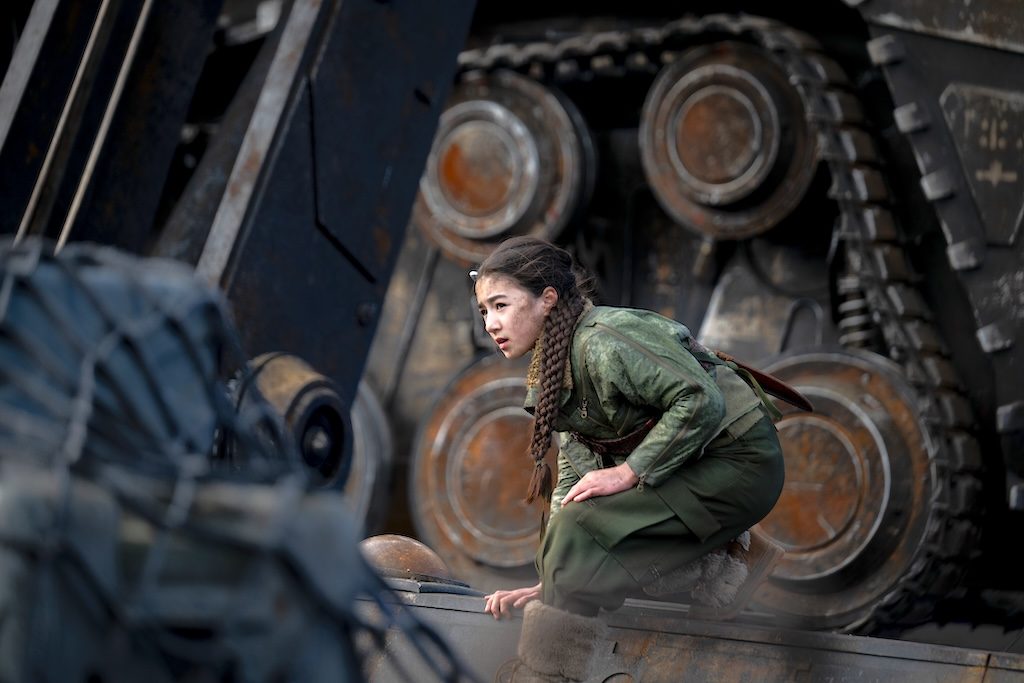
Ruthye (Eve Ridley) Photo by Parisa Taghizadeh/ Warner Bros. Pictures
Screenwriter Ana Nogueira on adaping the comic to the screen
Ana considers Tom King’s graphic novel Supergirl: Woman of Tomorrow, the perfect starting point for Supergirl.
“This version of the character was, to me, the only version of her that made sense. From that moment I knew that we had a shared understanding of who Kara is,” Ana states.
Nogueira believes that all big genre movies can be distilled into “simple, relatable human stories.” But a superhuman movie can make “the
human story come alive even more, that slight distance from the reality. That separation allows me to see myself better.”
You can never truly write what you know – especially with superheroes. However, you can write shared relatable, emotional experiences.
“We were not thinking, let’s make Kara tough just to be tough; it’s more like, how could she be anything but this after what she’s gone through losing her family, losing her planet, losing everything she’s ever known?” Ana continues. We understand where Kara where her behavior comes from.
Then Kara arrives on Earth and is expected to conform to everything that her cousin Kal-El is, especially when everything on Earth is all so foreign to her. She brings all of this into her Supergirl persona because she can’t be anything other than her true self.
Kara and Supergirl relish playing in their own messiness. Part of constructing Supergirl’s character was not to assume that the audience has read all the Supergirl comics. “So, we had to make sure we established her for them, giving her a starting point that makes it super clear what we love about her,” Nogueira concludes.
Related: “Write From A Global Consciousness” Advises D.C. Comics Filmmaker Geoff Johns