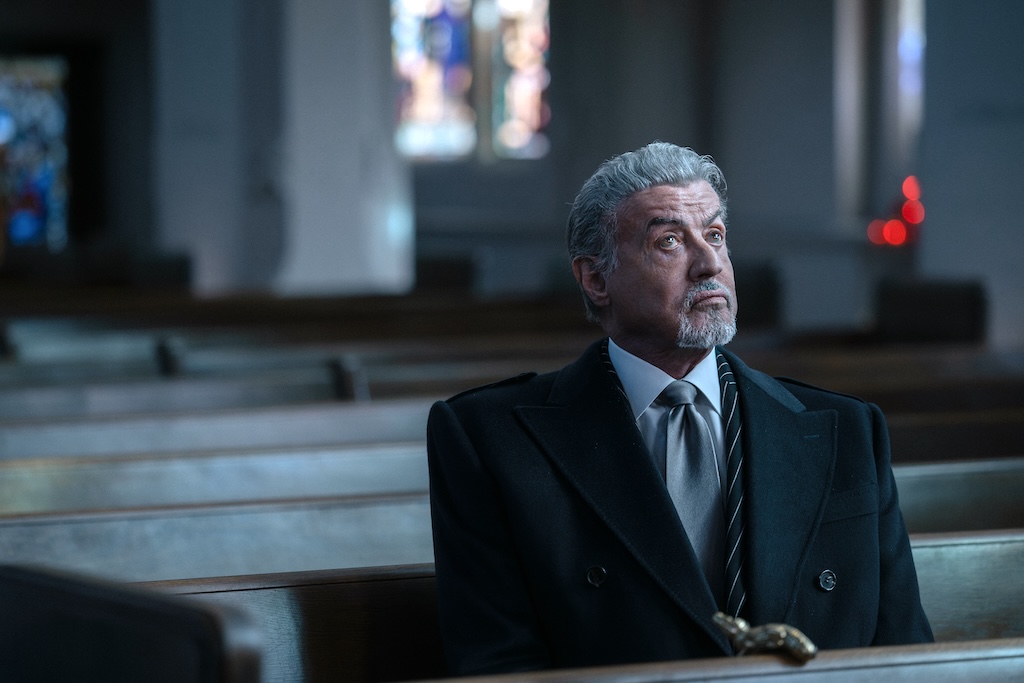
Tulsa King follows Dwight “The General” Manfredi, a New York mafia capo who is released after 25 years in prison and sent to Tulsa, Oklahoma, to build a criminal empire for his boss. Created by Taylor Sheridan and Terence Winter, the Paramount+ drama blends gangster-story conventions with the fish-out-of-water comedy of an aging mobster navigating an unfamiliar world to secure his place in hostile territory.
Sylvester Stallone leads the cast as Dwight, alongside Martin Starr as Bodhi, Jay Will as Tyson, Garrett Hedlund as Mitch, Vincent Piazza as Vince, and Annabella Sciorra as Joanne. Season 4 also features returning cast members including Frank Grillo, Neal McDonough and Dana Delany, with Gretchen Mol joining as a series regular.
Beneath the violence and bravado, Tulsa King explores loyalty, legacy, and the difficulty of reinventing oneself late in life. Dwight’s struggle to balance old-school codes opf conduct with new relationships and a changing landscape gives the series its emotional core, raising questions about redemption, identity, and whether a man can prepare an exit strategy from a criminal empire.
In Season Four, Dwight (Stallone) fights to legitimize his empire and protect his crew as corrupt politicians, dangerous new enemies, and a crushing personal loss hit from every direction. And that’s just in the first episode.
However, every hard-won gain comes with even harder truths: about loyalty, leadership and the cost of ambition. Each move drags Dwight deeper into the street instincts he left behind in New York – turning Tulsa into a battleground and Dwight into the one threat no one can afford to underestimate.
Terence Winter shares his thoughts on writing Tulsa King with Creative Screenwriting.
You’ve established a venerable reputation in the crime genre with The Wolf of Wall Street, The Sopranos, and Boardwalk Empire. What makes Tulsa King stand out as a crime series?
One of the things that interested me in doing Tulsa King was that it wasn’t set in New York, Chicago, Detroit or any of the places that you traditionally think of for traditional mob stories.
The idea of taking a gangster and dropping him into the middle of nowhere such as Tulsa, and how that would work defies the typical tropes of the genre. You’re not going to see Dwight eating in an Italian restaurant in Tulsa. You’re not going to see a lot of other guys in leather jackets or the things that you expect. You’re going to see what the traditional tropes of a Western. You’ll see people on horses, cowboy hats and cowboy boots.
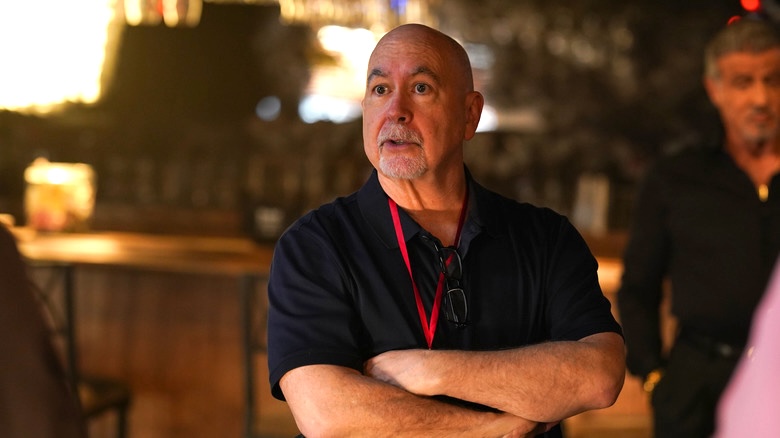
Terence Winter. Photo by Brian Douglas/ Paramount+
What aspects of your previous films and television series did you bring into Tulsa King?
I brought over an understanding of how mobsters work, how they talk, the infrastructure, and how the mob families operate in terms of their hierarchy.
What made Tulsa King different and fun was that Dwight was trying to impose those New York rules and that hierarchy on people who had no idea what he’s talking about. He was trying to build this family from the ground up with people who have not come from that world.
I also brought over some of the cast members that I’ve worked with on Boardwalk Empire.
That doesn’t really go to the writing of it, but they are people who I knew who could play those characters – New York mobsters that could be very authentic and give the show a credible feel.
Beyond that, I just really wanted Dwight to be authentic to who his character was, regardless of where he was. He’s in Tulsa, but he’s still going to behave like a New York mob boss.
Did you know much about Oklahoma before working on the series?
No. The first thing I did when I got the job was go to Tulsa for four days I stayed at the Mayo Hotel, which was featured on the show. Then I just walked around and met local people.
I stumbled on that little acoustical anomaly, the center of the universe, which is a real thing in Tulsa that we feature on the show. When I went there, I said, ‘Wow, I can make something out of this. This is interesting.’ Early on, I think it was Episode Two, goes into it and he talks to God in this little circle. That’s a real Tulsa thing.
I got to be a fish out of water myself for a little bit and read as much as I could. We shot Season One, partly in Tulsa and Oklahoma City as well. So I got to live there for six months.
Related: Terence Winter Interview: Adapting The Wolf of Wall Street for Martin Scorsese

Grace (McKenna Quigley Harrington) & Joanne (Annabella Sciorra) Photo by Steve Swisher/ Paramount+
Describe your working relationship with Taylor Sheridan.
The truth is I only met Taylor in person one time. He had written the original version of the pilot. I read it and I said, ‘This is really interesting. But there were a lot of things that I would do differently.’
For example, in his original pilot, Dwight had not been to jail, and it was originally set in Kansas City. Dwight was not a mob capo. He was a lower level soldier. I told Taylor that I’d like to change it so he’s getting out of jail after 25 years. The boss’s son is now in charge and that guy just wants to get rid of him.
And now Dwight finds himself in the middle of nowhere, which is Tulsa, and has to rebuild his life. Maybe there’s a sister Joanne (Annabella Sciorra) or estranged daughter Tina (Tatiana Zappardino) that he has to reconnect with. And he’s realized the thing he gave his entire life to is bullsh*t.
The thing he swore allegiance to, these people who have gotten rid of him, they don’t care about him. He’s maybe got 10, 15 good years left to make something of his life. Taylor agreed. Then he moved on to do his other shows.
How do you plan each season knowing that each could be your last?
That’s probably going to be up to Sly [Stallone].
I’m happy to keep doing it as long as he wants to. I’m writing the ending of Season Five now, but there’s plenty of work left to continue if he wants to.

Tina (Tatiana Zappardino) Photo by Brian Douglas/ Paramount+
What is the series engine?
The impetus for the pilot is the bigger engine. It’s taking a guy who’s got a finite amount of time left on this planet, who really wants to make sense of his life, make it have meaning, and find peace with the choices he made in the past.
He surrounds himself with what is his legacy. That is much more important than the day-to-day bad guys he’s fighting.
This is a guy who’s questioning everything. He spent 25 years in prison, reading every day, working out. He’s really smart.
He’s read about philosophy, religion. He’s much more thoughtful of a person when he got out than when he went in, and then has the rug pulled out from under him. He realizes the thing he devoted his life to is meaningless.
He’s now with all new people in a strange place, and he’s got to build something that can allow him at some point to wrap it up, whether literally on his deathbed or retirement, and be at peace with himself.
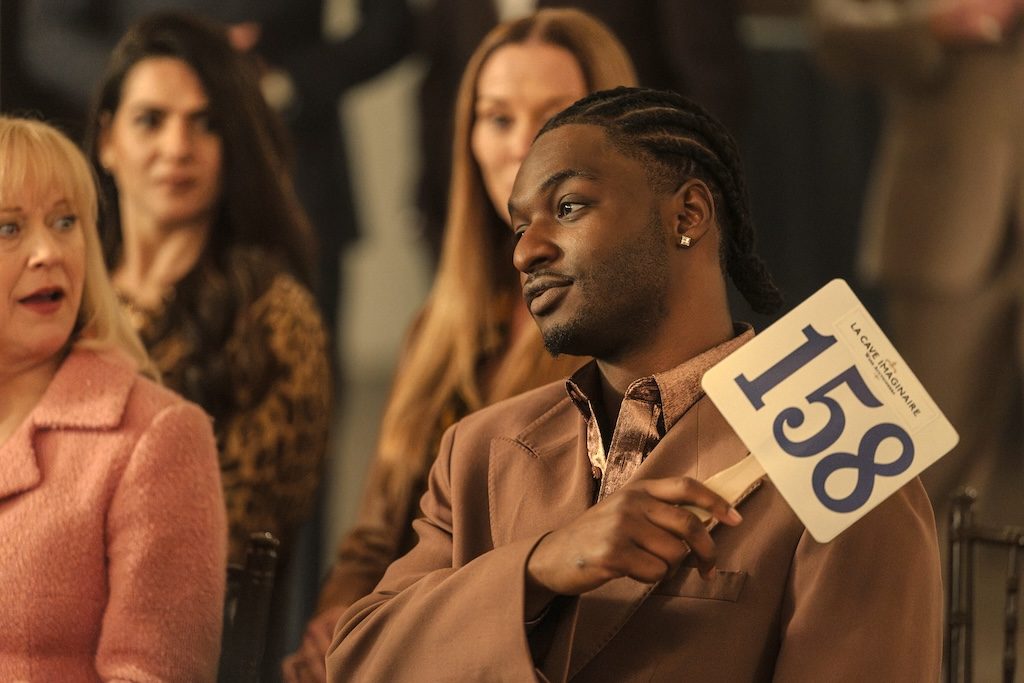
Tyson (Jay Will) Photo by Steve Swisher/ Paramount+
What did Sylvester Stallone bring to his character of Dwight Manfredi?
I think that there’s a deep spiritual aspect to Dwight that came with Stallone.
The idea of exploring, and we get into it a little this year, religion, and spirituality. Sly was very interested in this is a guy who’s done a lot of bad things, and yet he’s not all bad. I think that’s probably true of everybody.
Nobody’s all one color, good or bad. Everybody’s got little shades of different things in them. It was really interesting to explore that with Dwight.
Sly was definitely interested in the deeper aspects of this guy, and the idea that he’s searching and he’s looking for something deeper. He’s much more nuanced of a gangster in that way. He can be kind, he can be ruthless, but he’s also wise in a lot of ways.
A lot of that came from early conversations with Sly. He wanted Dwight to have some humanity.
The events of Season Four would make anybody start questioning what’s happening here. Am I being punished, is this random horrible things that happened to me, or is this divine retribution? He’s looking everywhere for answers.
I go back to the search for a deeper meaning to all of it. The bigger question about life, why do things happen to us, how much of what we do matters in terms of how the universe gives back or takes away from us?
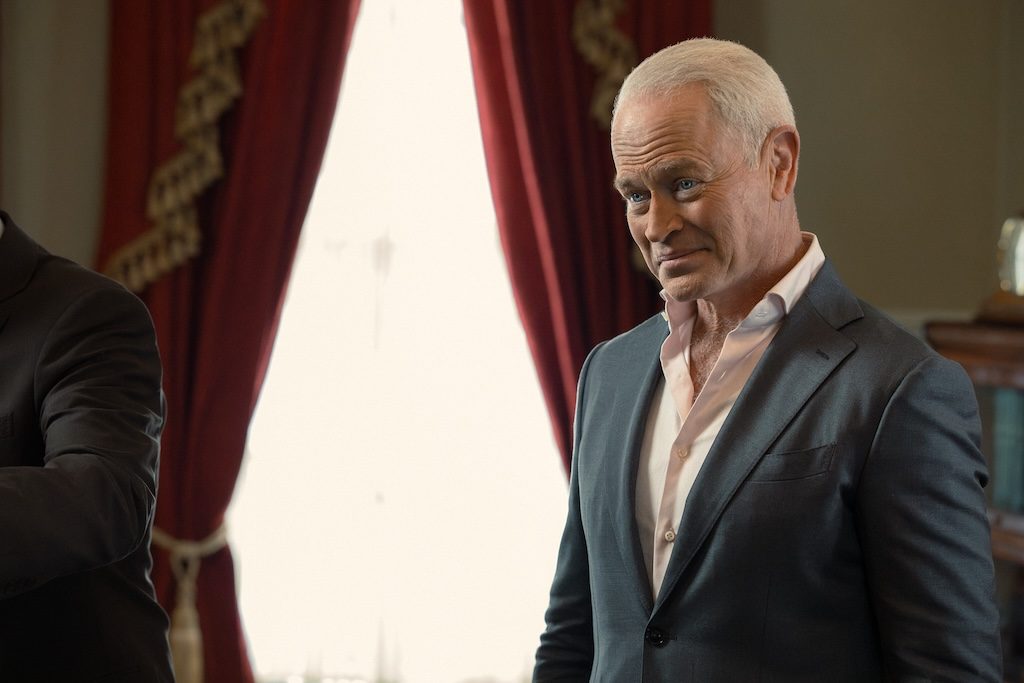
Cal Thresher (Neal McDonough) Photo by Steve Swisher/ Paramount+
What where some challenges you faced in the writers’ room?
I would say if things kept going as well for Dwight, Season Four would be Dwight retiring to a beach in the Bahamas, and drinking champagne because everything’s wonderful. So right there was the challenge. We gotta completely mess this guy up, take things away from him now because it’s going too well.
What does that look like? What’s the worst thing that can happen? He loses the person closest to him. What are the ramifications of that? As it turned out, it dovetailed with the governor, because she was working with him a little bit. Now he’s got that guy out of the picture.
Who comes in? What is he or she like? This is now an adversary who he’s unlike anything he’s seen before. He’s gone up against criminals and gangsters before. He knows exactly how to handle those people. But this is somebody he can’t just shoot and bury. This is somebody who’s a straight arrow, at least on the surface, who is hellbent on bringing him down.
And even his usual tactic of reaching out to the State Governor who might be able to help him isn’t working. He’s on his own.
What does this look like from episode to episode? And then, charting out the bigger arc of the season. Where does it go? And where does it end up?
But generally, I like to have a roadmap. I start saying, where are we going to end up?
If I was going to drive from Los Angeles to New York, I’m going to get there eventually. But where are we stopping along the way? We’re going to stop in Vegas. We’re going to stop in Chicago, then Philadelphia, then we get to New York.
Those different cities being story points along the way. Once I have the major beats of where we’re going to be in each episode, then it’s a question of how do we get there. It’s just a continual asking each other. What about this? What if this happens?
Related: What Make Gangster Films & TV Shows Work?
How does Dwight perceive, conceptualize actual family versus work family?
I don’t think he makes a distinction.
This is true in real life too, I think found families are often closer to us sometimes than our actual blood relatives. I think he probably considers some of these people in Tulsa as close to him, if not more than his own actual family. These are people who’ve literally taken bullets for him, that would put their life on the line for him.
I think it is very true of people in his business, and it’s probably true of soldiers, cops and people who put their life on the line in their work. The people who are around you are often very much closer to you.
You’re putting your lives in their hands, you know, so that’s a much closer relationship there.
Is there a moment in this season of Tulsa King that really captures the essence of Dwight Manfredi?
The scene with Dwayne and Bodhi this season was really powerful.
It’s when Bodhi is trying to get him to open up, be emotional, and feel the pain of Margaret’s loss. And Dwight’s response is, “Why would I do that? I don’t want to feel it.” He’s built this wall around himself by necessity of not allowing emotion to seep in. That’s how he survived 25 years in prison.
Even if you remember early on, he told his daughter to stop coming to visit him in prison. He couldn’t deal with the pain of that. He’s a guy who’s learned how to insulate himself from emotion, love and everything else.
When he says that to Bodhi, he’s really stating his life philosophy, which is really sad. Bodhi then hits him with this emotional left hook of saying that the same thing happened to him.
It comes out of nowhere. It’s such a powerful moment between these two. It says so much about Dwight, who he is and how he gets through the day.