
Steve Cox and Matt Walker on ‘Shaun the Sheep: The Beast of Mossy Bottom’ — Aardman’s Wild New Halloween Feature

Shaun the Sheep is back, and this time a strange and hairy beast is lurking around Mossy Bottom Farm.
Shaun the Sheep: The Beast of Mossy Bottom is Aardman Animations’ latest stop-motion adventure, following the lovable, mischievous, woolly ringleader and his flock as they investigate a mysterious creature terrorizing their beloved countryside home.
Blending Aardman’s signature wordless humor, jaw-dropping hand-crafted stop motion animation, and a healthy dose of rural British charm, the film promises to delight fans of all ages while delivering the kind of heartfelt storytelling that has made the Shaun the Sheep franchise a globally beloved institution for over two decades.
Based on a screenplay by Mark Burton and Giles Pilbrow, directors Steve Cox and Matt Walker spoke with Creative Screenwriting Magazine about their collaboration on their scarily hilarious Halloween movie.
What are some of the considerations in making a horror film with claymation, where people are more inclined to giggle rather than cover their eyes?
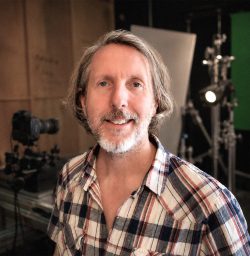
Steven Cox
Steve: It was something we were really conscious of when we first decided to do a Halloween film. Our audiences range from 4-year-olds up to 94-year-olds. We don’t want to alienate anybody in our audience.
We had to be careful with our horror film and Halloween films that exist already. We could dive into them and pick any tropes out, but we needed to make sure that when they came into our film, we always ended with a gag, or we always softened the impact to make sure that it was user-friendly for all our audiences.
For example, we had a home invasion scene where the farmer’s trying to break into the house. That could be really scary. And it was originally when we had the sheep flock inside cowering, and this monster coming around the outside of the house.
We decided to flip the point of view from the flock to the farmer so that you see the flock scared, but in the next moment you see the bumbling farmer treading on a rake or struggling with a door handle.
We found that as long as we add jokes and we jump the point of view occasionally, we can keep our audience from being too terrified.
Matt: I think that was the key to it was that juxtaposition and undercutting the scares with comedy.
We were both fans of horror films and we really wanted to draw on these different tropes, but we also needed to find that balance and not making it too scary.
Related: Chicken Run: Dawn Of The Nugget Karey Kirkpatrick & John O’Farrell
Discuss how you navigated relativcly dialogue-free storytelling

Matt Walker
Matt: Yeah, it’s a fun challenge. We’ve had a lot of practice with the series and the previous features, but certainly when they made the transition from the series to the first Shaun The Sheep feature, they weren’t sure how well Shaun would work in a feature film when there’s no dialogue, but they really pulled it off.
Once we knew we could do Shaun The Sheep feature films, Farmageddon and now Mossy Bottom, it’s a really good challenge finding how we can tell these emotional stories.
In the television series, we’re just focused on the comedy and the comedy storytelling. But in the features, we want to tell a more nuanced, emotional story. Trying to communicate what the characters are feeling and thinking without dialogue becomes much more difficult. We have amazing animators and they manage to convey so much with the performances they put into the puppets.
The puppets can really challenging to work. For example, Shaun has a solid head and he doesn’t have eyebrows. It’s just eyelids. All of that emotion has to come out of his body language and just how his eyelids and eye movements move.
The farmer’s even more difficult because he doesn’t have eyeballs, just a mouth.
Related: Insights from Craig Mazin on “The Sheep Detectives”
What were some horror movie references you drew upon?
Steve: We delved into Hammer Horror, Universal Monsters and horror films from across the board. The Psycho Gag, was one of our favourites in there.
There’s some tiny little details in the background. For example, our pub is usually the Moon Inn, but we changed it to The Shine Inn. That’s an old Shining joke. It’s still got the moon as well. It’s still relevant to our Shaun world.
Then other things are not necessarily specific to individual films, like a bathroom cabinet jump scare. You shut the cabinet and there’s a reflection of somebody behind you. They’re from general horror films across the board. We wanted to get those feelings in, without necessarily saying this is a reference to a specific film.
We’re also aware that, with a younger audience, I don’t think the five-year-old’s going to know what Psycho is. So we always want to try and make sure those jokes work for the whole audience, even if you don’t know what the film is referencing is.
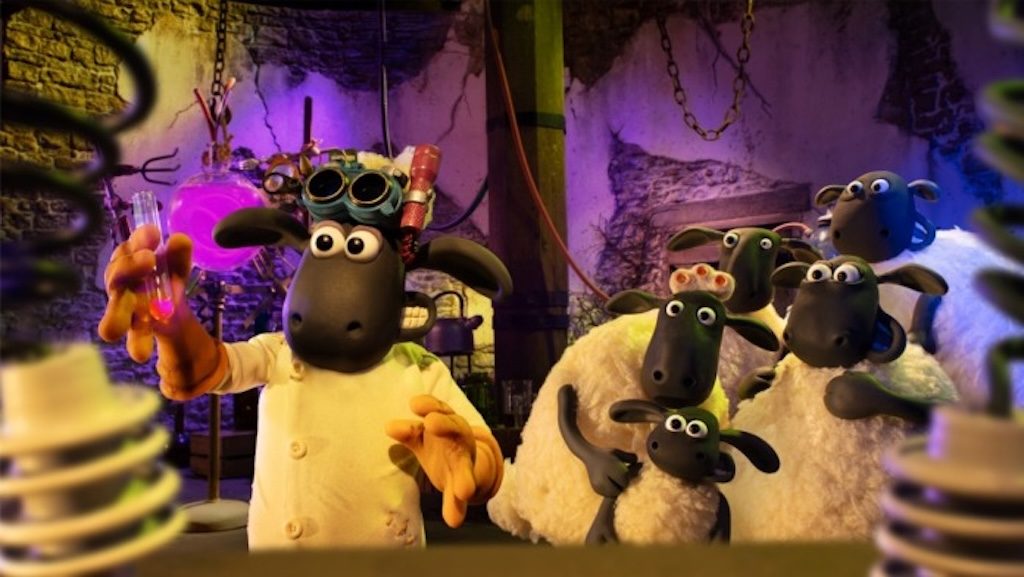
Photo courtesy of Aardman Studios/ GK Kids
Discuss your collaboration with screenwriters Mark Burton and Giles Pilbrow.
Matt: Luckily we have a great relationship with those guys because we’ve both worked with them before. I’ve worked closely with them on The Flight Before Christmas, which was a Shaun the Sheep half hour.
Those guys came with the pitch, the bare bones of the idea that started off with the love story between these guys, the hair growth, and that kernel of the idea. But it was a half hour special. We decided through the process of talking about how it would be much better and it could sustain a full feature length film.
We were lucky enough to be in the very early stages of that. Mark and Giles would go away, they’d write up some ideas, they’d send them back to us, pitch us new ideas, and then we’d spend days, sometimes weeks, in the room with them, bouncing ideas back and forth.
We’d allow our story to just meander and go in different directions to see where it went. Then we’d bring it back and say, ‘No, that’s not going anywhere.’ So we’ll bring it back to a different branch and go off in another way.
We had a few tropes that we wanted to get in there.
We knew that we wanted the beast to be coming from the farm and the hair growth cream. We knew our theme of not wanting to mess with nature. We had some cornerstones, but it was a very collaborative, free-working environment.
The writing process continued throughout the production because initially we were working with Mark and Giles before we started the storyboarding process. But once we’d figured out the film, there were still elements that we were still working out which we’d take into the storyboarding process.
Throughout the storyboarding process and building the animatic and the edit, there’d still be things that we realised weren’t quite working. So that would go back to Mark and Giles. They’d go back to the script and rethink some things, and then we’d feed that back into the edit.
It was a malleable process. Once we got into the production and shooting the film, we had a much more locked animatic. There were still little things we were changing along the way. They always evolved throughout the whole process, where we needed to tweak story elements, where things weren’t quite clear or needed to punch up some gags.
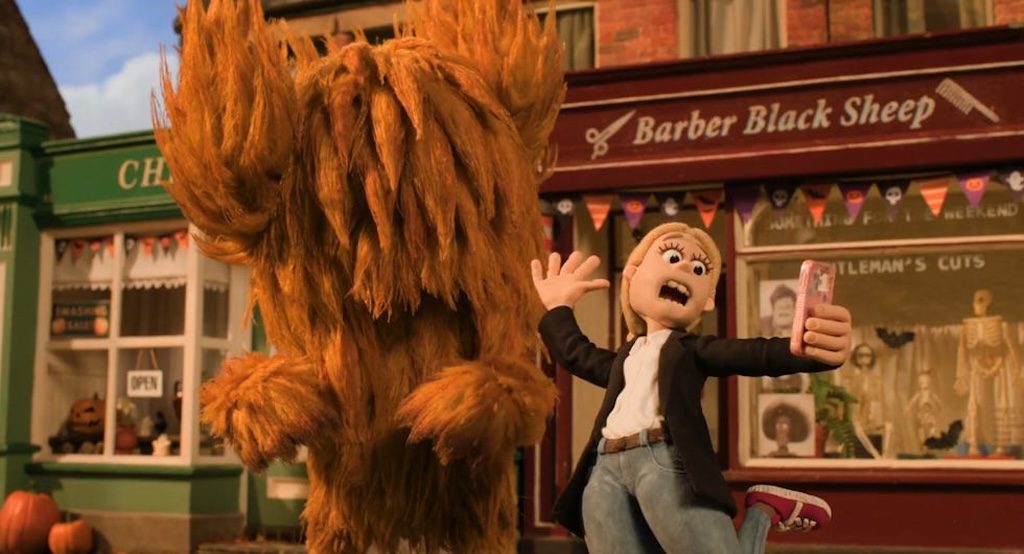
Photo courtesy of Aardamn Studios/ GK Kids
What were the guiding story principles that kept you on track?
Steve: It’s always comedy and character that’s our touchstone for any Aardman Anmation film.
We always want to make sure that we stay true to our characters, so it’s easy then for us to come up with any ideas. We’re lucky enough to have a back catalogue of great films that we can refer to.
We know that Shaun wouldn’t do something, or what Shaun would do in a situation. And often the character would lead us into how to guide the narrative.
But it’s the non-dialogue thing which really throws us up sometimes. You can’t do an easy line of dialogue to get you out of trouble to explain something. You have to find a clever way of explaining it through the actions of the character. That for us is tricky, but it also makes the story more engaging.
We’re finding clever ways of making sure the audience is on board with us and the clarity of that is so important.
Audiences want to know how the farmer is going to resolve his problems. Is he going to get together with the vet? Once you’ve got them hooked on that idea, then the fact that there’s no dialogue means they’re staring at the screen and they’re watching the nuances of the character. I think it makes the audience more engaged with what’s on screen rather than listening out for bits of dialogue and following it that way.
Matt: The characters are the core of anything. I want the characters to dictate the story.
What are the key themes you’re exploring in The Beast of Mossy Bottom?
Matt: I think that with every story we do with Shaun, it’s great putting Shaun into a different genre. We did it with sci-fi in Farmageddon, and now with Halloween for Mossy Bottom.
I feel like the world of Shaun is very elastic. If we need the farm to be by the coast because we want to send them to the docks, we can do that. If we want to introduce aliens into the story, we can do that. But the characters aren’t elastic. We always make sure that the characters stay true to themselves and never deviate from what we know of those characters and how they’d react in a situation.
I think that’s at the core of how we tell our stories and the comedy. We make sure that it always comes from the character. As long as it feels genuine, the story then feels authentic.
Steve: There’s a little bit of obsession from Shaun in the mad scientist thing. He’s the fixer among the family and the flock. He’s always the one who solves the problem. I’ll make sure everyone’s safe. The pumpkins are destroyed. Don’t worry, I’ll sort it out, no problem.
I’ll grow pumpkins in a few days. By accepting that challenge, that’s his obsession. And I have to somehow find a way, without asking for help, and burying my head in this problem.

Join the Discussion!
Related Articles
Browse our Videos for Sale
[woocommerce_products_carousel_all_in_one template="compact.css" all_items="88" show_only="id" products="" ordering="random" categories="115" tags="" show_title="false" show_description="false" allow_shortcodes="false" show_price="false" show_category="false" show_tags="false" show_add_to_cart_button="false" show_more_button="false" show_more_items_button="false" show_featured_image="true" image_source="thumbnail" image_height="100" image_width="100" items_to_show_mobiles="3" items_to_show_tablets="6" items_to_show="6" slide_by="1" margin="0" loop="true" stop_on_hover="true" auto_play="true" auto_play_timeout="1200" auto_play_speed="1600" nav="false" nav_speed="800" dots="false" dots_speed="800" lazy_load="false" mouse_drag="true" mouse_wheel="true" touch_drag="true" easing="linear" auto_height="true"]





You must be logged in to post a comment Login