
Character vs Character Trait: Why Most Scripts Get This Wrong

A memorable character is not built from a list of adjectives. Funny, guarded, ambitious, and reckless may help a writer picture someone on the page, but they do not explain, who they really are, why that person drives the story, or why an audience should keep watching them.
A character trait is an expression of personality, while a character definition is the dramatic engine underneath it
Traits tell us how a person tends to behave. Character tells us what they pursue, what they avoid, what they misunderstand about themselves, and what it will cost them to change. They aren’t interchangeable. although related.
The writer’s job is not to invent every biographical detail. It is to select the pressure points, contradictions, and behavior patterns that make a person impossible to confuse with anyone else in the story.
Character Definition Comes Before Traits
A character definition is the role’s basic dramatic proposition. It includes a want, a need, an operating strategy, and a source of resistance, an obstacle and also a wound which informs their healing process. It displays their wants and needs.
A character can also be defined as an archetype based on their dramatic function – hero, villain, trickster, mentor.
Related: Exploring Female Character Archetypes – The Maiden
Related: Exploring Male Character Archetypes – The Warrior
The want is the concrete objective: win the restaurant’s first Michelin star, preserve a marriage, solve a murder, get a kidnapped child home, secure political power, or win the sporting event. The need is the deeper emotional correction the person may avoid or fear: accept help, surrender control, grieve honestly, stop treating love as a transaction.
Want = what
Need = why
Wound = unresolved wants and needs
A trait, by contrast, is an observable tendency – or pattern. A person may be punctual, sarcastic, flirtatious, meticulous, evasive, or compulsively generous. Those details can color a scene. They cannot, on their own, sustain a feature or a multi-season series because they aren’t the cornerstone of a character.
Consider Carmy Berzatto in The Bear, created by Christopher Storer. His traits are immediately identifiable: technical precision, intensity, verbal economy, a reflexive need to control his environment. But those traits emerge from a deeper definition. Carmy wants to build something culinary excellent and redeem his family’s restaurant. He needs to confront the grief, guilt, and isolation that make excellence feel safer than intimacy.
If Carmy were merely “a perfectionist chef,” the show would flatten quickly. The writing instead asks what perfectionism costs him in relationships, leadership, and self-worth. He only needs to realize it.

Carmy Berzatto (Jeremy Allen White). Photo courtesy of FX Networks.,
Surface Traits vs. Deep Characterization
A common trap for emerging writers is relying on a list of character traits to define a person.
Listing hobbies, favorite music genres, or a quick temper does not automatically create character depth. These exterior markers are merely the paint on the walls; they do not constitute the framing studs of the house.
A character definition requires establishing the core wound, the worldview shaped by that wound, and the protective armor the protagonist wears to survive.
Consider Tony Gilroy’s work on the Disney+ series Andor. Cassian Andor’s initial surface traits — cynical, guarded, evasive — are symptoms of his foundational trauma as a displaced orphaned child soldier.
Gilroy avoids treating these traits as mere window dressing. Instead, every defensive action Cassian takes directly stems from his deeply-ingrained survival philosophy.

Cassian Andor (Diego Luna) Photo courtesy of Disney
For Past Lives , written and directed by Celine Song, Nora, who has built her adult identity around forward motion and emotional self-possession, must confront an unresolved version of herself when her childhood love reconnects with her in New York to give her closure.
That definition contains more screenplay fuel than “Nora is smart, reserved, and nostalgic.” Those are useful traits, but they are not the movie’s driver.

Nora Moon (Greta Lee) Photo courtesy of A24 films.
Surface Traits Are Character Evidence, Not the Engine
Surface traits are the audience’s first introduction to a character. They often appear in dialogue rhythm, wardrobe, posture, habits, work style, or social behavior. Viewers read responses and behavioral choices.
Traits become generic when they do not point to a deeper fear, desire, or worldview – or unique character signifier. Anyone can be short-tempered, but not everyone has the same reasons for being so.
In The Holdovers, Paul Hunham’s pedantry, social abrasiveness, and tendency to correct people are not simply comic eccentricities. Writer David Hemingson uses them as scaffolding. Paul’s fixation on standards protects him from confronting his own disappointments and loneliness. When the story puts him in proximity to Angus and Mary, those external attributes begin to reveal a more vulnerable internal life.

Paul Hunham (Paul Giamatti) Photo courtesy of Focus Features
Internal vs. External Character Traits
External traits are visible and repeatable patterns:
– A detective who organizes evidence with almost religious precision
– A politician who avoids direct answers
– A teenager who turns every emotional question into a joke
– A restaurateur who compulsively fixes broken equipment herself
Internal traits are the emotional and ideological forces beneath those actions:
– A terror of chaos
– A belief that directness invites humiliation
– A fear that sincerity gives others power
– A conviction that reliance on others leads to abandonment
The critical craft move is to connect the two. If a person is “funny,” what is humor doing for them? Is it seduction, dominance, self-protection, misdirection, or genuine generosity? If a person is “cold,” is that coldness contempt—or an expensive form of restraint?
In Beef, creator Lee Sung Jin gives Amy Lau and Danny Cho volatile behavior that is easy to describe: both are proud, reactive, status-conscious, and capable of escalating a petty insult into major catastrophe. The series becomes richer because it keeps excavating the separate emotional logic underneath their conduct. Amy’s self-presentation as a successful, composed entrepreneur conceals exhaustion and rage. Danny’s performance of toughness masks shame, precarity, and a desperate need to feel consequential.

Amy Lau (Ali Wong) and Danny Cho (Steven Yeun). Photo courtesy of Netflix
Build a Complex Character Through Contradiction
A complex character is not necessarily likable, morally gray, or burdened with a tragic past. Complexity comes from layered, competing truths that create unpredictable, but psychologically coherent choices.
Contradiction is the writer’s most efficient tool because it highlights a character trait in contrast to opposing ones.
In Anatomy of a Fall, written by Justine Triet and Arthur Harari, Sandra Voyter is articulate, controlled, and formidable under scrutiny. She is also emotionally opaque in ways that invite interpretation. The film’s power does not depend on supplying a tidy answer to who Sandra “really” is. It depends on allowing multiple plausible versions of her to co-exist: devoted parent, ambitious artist, difficult spouse, unreliable witness, possible victim, possible perpetrator.
That is not ambiguity for its own sake. Each messy version is grounded in behavior, testimony, and the unstable perspectives of the people around her.
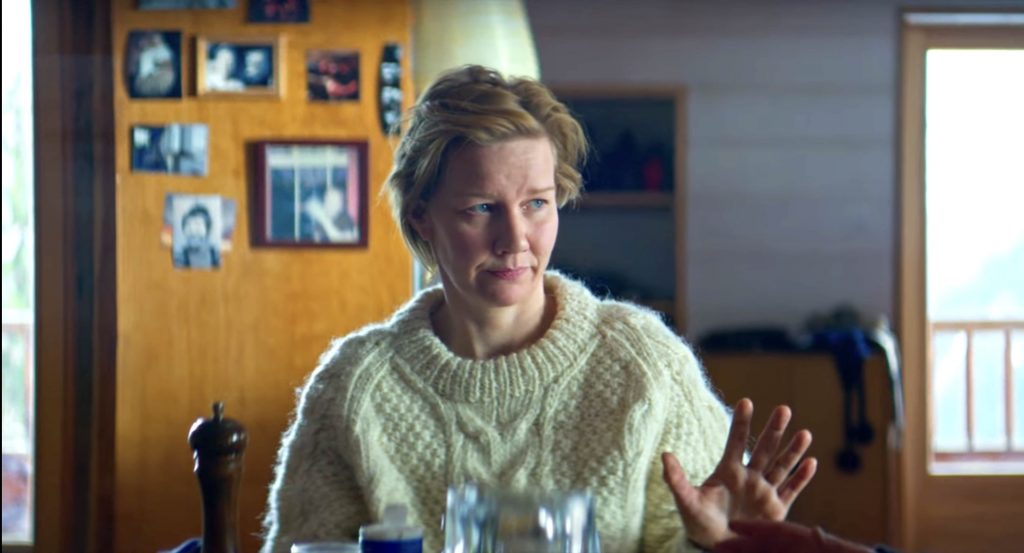
Sandra Voyter (Sandra Huller). Photo courtesy of La Pacte
Make Character Contradictions Active
A contradiction should create a scene problem, not sit passively in a character bible. Activate them.
Weak contradiction:
– She is confident, but insecure.
Active contradiction:
– She can command a courtroom, but she cannot admit to her son that she does not know what happened.
Weak contradiction:
– He loves his family, but is selfish.
Active contradiction:
– He will sacrifice his career to protect his brother, then resent the brother for needing protection.
The latter formulations generate decisions under pressure. They also give actors playable reversals.
The Last of Us developed for television by Craig Mazin and Neil Druckmann, builds Joel’s arc around a contradiction that is central. He is capable of fierce care, but his version of protection is inseparable from control. The series does not frame that as a simple heroic virtue. It makes his love dangerous because it can override Ellie’s agency and ferocity.
That is layered characterization: a virtue and a flaw sharing the same foundation.
Use Wants and Needs to Round Out Flat Characters
Flat characters are often not underwritten because they lack traits. They are underwritten because their behavior has no evolving relationship to the plot.
A flat best friend may be “loyal and funny.” A flat antagonist may be “ruthless and brilliant.” A flat romantic interest may be “free-spirited.” These labels describe character traits that have not yet become people.
To round out the role, identify what that person wants in scenes where the protagonist is absent. Then identify what they are unwilling to lose in pursuit of it.
In Bottoms, written by Emma Seligman and Rachel Sennott, the central duo’s scheme to start a fight club is powered by a recognizable adolescent want: status, sex, and escape from invisibility. But the comedy lands because PJ and Josie do not want exactly the same thing in the same way. PJ’s confidence is a performance built on grandiose self-mythology; Josie’s apparent timidity contains its own capacity for manipulation and desire.
The characters do not simply occupy “the bold one” and “the shy one” slots. The film keeps finding the gap between their self-image and their behavior.
Ask Four Questions Before Adding More Backstory
When a supporting role feels thin, resist the urge to invent childhood trauma immediately. First ask:
1. What do they want from the protagonist that they cannot ask for directly?
2. What status do they believe they deserve?
3. What choice would expose the gap between their self-image and reality?
4. What do they do well that becomes destructive under stress?
In The White Lotus Season 2, creator Mike White builds Daphne Sullivan through precisely this kind of dramatic specificity. On the surface, she is cheerful, breezy, fashion-conscious, and seemingly unbothered by her husband Cameron’s conduct. Those traits could easily produce a caricature of a wealthy, oblivious spouse.
Instead, Daphne’s emotional intelligence and survival tactics gradually complicate the audience’s assumptions. She may be performing naïveté, but she is not naïve. Her capacity to adapt is both a strength and a disturbing accommodation to the life she has chosen.
Avoid Stereotypes by Writing Specific Social Logic
Stereotypes reduce people to prepackaged cultural meaning, based mainly on expectation. Caricatures propagate one trait until it becomes the entire role.
The solution is not to remove recognizable details of class, profession, gender, race, age, or region. It is to make those details interact with individual desire and social context. Add a surprise and an insight into their logic process.
A wealthy character should not merely be entitled. What does money allow them to deny? What form of insecurity does wealth fail to solve? A working-class role should not exist solely to provide grit, nobility, or blunt wisdom. What is their private standard of success, and how might it differ from the story’s assumption about them?
Succession remains a useful case study in avoiding broad shorthand. Jesse Armstrong’s Roy siblings are all privileged, damaged, and hungry for Logan Roy’s approval and announcement as heirs. Yet their similarities do not erase their distinctions.
Kendall turns pain into performance and strategy. Shiv treats emotional distance as intellectual superiority. Roman converts humiliation into comedy and sexualized provocation. Connor seeks legitimacy through grandiose self-invention. The writers do not give each sibling a single defining adjective; they give each a different relationship to power, shame, and paternal love.
Replace Labels With Scene Behavior
Instead of writing:
> Mara is a strong female CEO.
Write the behavior:
> Mara lets a board member finish a condescending speech, thanks him for his concern, then removes his division’s funding before he reaches the elevator.
Then go further. What does that action cost Mara? Does she enjoy the power, regret the cruelty, or fear that any softness will be read as weakness? The answer is where the role begins to gain dimensionality.
Specificity also means allowing characters to be wrong about themselves. In All of Us Strangers, written and directed by Andrew Haigh, Adam’s isolation is not treated as a static sadness trait. The film examines the stories he has built around intimacy, memory, family, and self-protection. His emotional life unfolds through what he permits himself to imagine—and what he cannot bear to risk in the present.
What Professional Screenwriters Are Doing Now
Recent films and series have leaned into characters who are defined by pressure, contradiction, and social role rather than a list of personality markers. They are neither hero nor villain, but exist in the moral gray area.
That includes protagonists who are difficult to like, but impossible to simplify.
It also includes ensemble writing where every major figure has an agenda, a wound, and a competing version of the truth. The result is a story world that feels lived-in rather than designed to demonstrate a theme.
Before you assign another trait, define the emotional engine.
Ask what the character wants, what they need, what they fear, and what contradiction keeps them from becoming simple. Then make every visible quality serve that deeper logic. That is how a character moves from description to drama — and how a script builds people worth following.

Join the Discussion!



Browse our Videos for Sale
[woocommerce_products_carousel_all_in_one template="compact.css" all_items="88" show_only="id" products="" ordering="random" categories="115" tags="" show_title="false" show_description="false" allow_shortcodes="false" show_price="false" show_category="false" show_tags="false" show_add_to_cart_button="false" show_more_button="false" show_more_items_button="false" show_featured_image="true" image_source="thumbnail" image_height="100" image_width="100" items_to_show_mobiles="3" items_to_show_tablets="6" items_to_show="6" slide_by="1" margin="0" loop="true" stop_on_hover="true" auto_play="true" auto_play_timeout="1200" auto_play_speed="1600" nav="false" nav_speed="800" dots="false" dots_speed="800" lazy_load="false" mouse_drag="true" mouse_wheel="true" touch_drag="true" easing="linear" auto_height="true"]







You must be logged in to post a comment Login