
Character Introduction Tips for Screenplay Writers

The first time a character appears on screen, the audience learns who they are. Not through exposition. Not through backstory delivered in dialogue. Through action. Through what they do when nobody’s watching. Or when everyone’s watching. Your character introduction sets the foundation for everything that follows, and how you describe that moment determines whether readers — agents, sctors, producers, and directors trust your vision or dismiss it.
A strong character introduction doesn’t require elaborate description. It requires specificity. The difference between a forgettable character and a memorable one often hinges on whether the writer chose one vivid, telling detail instead of listing surface traits.
The first entrance matters more than the backstory. Audiences are introduced to a character where they’re at, not where they’ve been. Writers can’t front load an introduction with excessive exposition they don’t need to know yet.
Related: “Character is Story.” Richard Walter on Screenwriting.
The Power of Active Introduction
A character introduction is most potent when the character is doing something. Not thinking. Not waiting.
The strongest character introductions often feel unremarkable at first glance. They show a person engaged in the texture of their daily grind, and within that mundane moment, the character’s essence emerges. It’s in the ‘how’ more than the ‘what’ they do.
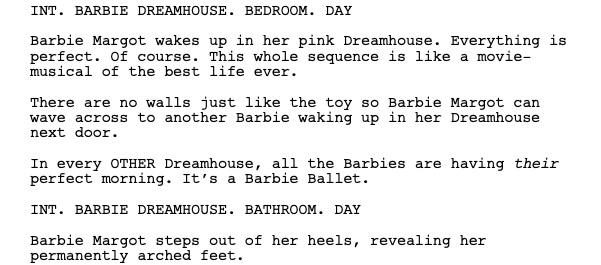
Greta Gerwig’s introduction of Barbie (2023) makes the point. Barbie wakes in her perfect pink bedroom, flawlessly coiffed, perfectly posed, and immediately breaks character. She’s anxious. She’s self-aware enough to know something is wrong. The introduction doesn’t tell you Barbie is in crisis; it shows you through a single action: she checks her feet, and they’re imperfect. That one physical detail contains the entire thematic conflict – and curiosity.
The point is that the writers don’t write a psychology report. They show Barbie getting up in the morning.
Related: Write Worlds And Characters Actors Want To Play
Introduction During High Stakes
An alternative approach is to introduce a character when they’re already in the middle of something. When stakes exist. When they’re making decisions.
James Gunn’s Guardians of the Galaxy Vol. 3 (2023) reintroduces Rocket by showing him coordinating a dangerous rescue mission. He’s giving orders. He’s cautious. He’s protective of his crew. Gunn doesn’t pause the action to explain Rocket’s character. The introduction is the action itself.
This approach proves especially effective for ensemble casts or when reintroducing an established character. There’s no time for setup. The audience enters the character’s world mid-stream and grasps who they are by watching them *function under pressure*.
Similarly, Denis Villeneuve’s introduction of Paul Atreides in Dune: Part Two (2024) occurs not in quiet reflection, but in the middle of his rebellion. He’s leading fighters. He’s making impossible choices. That introduction — the quality of his decision-making—tells you more than exposition ever could.

Related: The Many Faces Of Supporting Characters

Paul Atreides (Timothee Chalamet)
Character Description: The Art of Restraint
This is where many screenwriters fail. They write too much inconsequential detail. They describe hair color, clothing, age, and a paragraph of personality traits which don’t inform the story. Professional screenwriters describe one thing, and they choose that one thing deliberately to define their character.
Look at Aaron Sorkin’s character descriptions. In The Trial of the Chicago 7 (2020), he introduces Tom Hayden with minimal physical detail: a man in his late twenties, idealistic, articulate.
But then Sorkin adds one detail: “He’s wearing a shirt and tie, but he’s rolled up his sleeves.” That single gesture — rolled-up sleeves — communicates working-class solidarity and readiness for action more effectively than a paragraph of exposition.
The detail should illuminate character, not just fill space.
Emerald Fennell’s introduction of Cassie in Promising Young Woman (2020) uses constraint strategically. Cassie appears fashionable, young, beautiful, and then Fennell reveals she works at a coffee shop and lives at home. The introduction doesn’t reveal her trauma or her vengeance. It shows her moving through a life that doesn’t match what she appears to be. One detail — she leaves the coffee shop and goes home to her childhood bedroom — carries the entire character weight upon which the story is built.

Cassie (Carey Mulligan)
Related: Write Better Characters: How Types of Truth Drive Motivation
What Not to Describe
The amateur move is to write exhaustive physical description. “She has auburn hair, green eyes, a slight scar on her left cheekbone, and walks with a limp.” This reads like a police report. It’s passive. It tells the reader nothing about character – except for the limp. It may be important to the character’s backstory.
Professional screenwriters avoid this. Instead, describe how a character moves through space. Describe what they choose to do. Describe the contradiction between what they appear to be and what they’re actually doing.
Related: 5 Character Revealing Scenes To Enhance Your Screenplay
Specific Description vs. Generic Character Descriptions
Generic: An attractive woman in her thirties.
Specific: She’s in her thirties, wearing someone else’s coat, checking her reflection in a store window like she’s not sure who’s looking back.
The second example describes appearance minimally, but establishes psychology through action and detail. The coat isn’t hers. (It may be shown by being the wrong size). She’s uncertain. She’s displaced. That’s character introduction with precision.
Not all character introductions happen on page one. Secondary characters deserve introductions calibrated to their dramatic function and the narrative’s needs. Even one time characters need a moment in the spotlight in their limited screen time.
Related: What Makes A Character Memorable?
Major Characters: Establishing Complexity
Your protagonist’s introduction should also contain contradiction or internal tension. Not external action-movie conflict, but something that suggests this character has depth and stakes that will unfold.
In Glass Onion: A Knives Out Mystery (2022), Rian Johnson reintroduces Benoit Blanc by showing him doing something mundane — playing with a puzzle box during a video call. The introduction establishes that Blanc is intellectually restless even in downtime. That detail becomes the entire thematic foundation for the film. One action. One revealing detail.
Your protagonist’s introduction should generate curiosity. Not mystery for its own sake, but a sense that this character is worth paying attention to. Something about how they move, think, or act should intrigue. Blanc is acutely observant and analytical, but also playful.

Benoit Blanc (Daniel Craig)
Related: How Ethics & Morality Shape Characters (Part 1)
Supporting Characters: Functional Introduction
Supporting characters can be introduced more economically since they generally have a narrower dramatic function. They don’t need psychological complexity on first appearance; they need clarity and purpose. What’s their function? What’s their relationship to the protagonist?
In Killers of the Flower Moon (2023), Martin Scorsese introduces multiple characters playing corrupt officials, oil barons, and con men. Each introduction is quick and efficient. An agent arrives and immediately establishes authority through how he moves and speaks. A businessman appears and his greed is evident in how he calculates. No wasted description. Pure function.
Related: How Screenwriters Should Approach Character Arcs & Growth
Ensemble Casts: Strategic Differentiation
When you have multiple characters entering the narrative simultaneously, introduce them doing different things. This helps the audience differentiate.
In The Brutalist (2023), Brady Corbet introduces a refugee family arriving at a house. Rather than introducing them as a unit, Corbet staggers their introductions: the father surveys the property with suspicion, the mother touches the walls gently, the daughter looks lost. Same scene. Same moment. But each introduction is distinct.
Related: Do Characters Have To Be Likable? (Part 1)
Movement as Psychological Indicator
In Poor Things (2023), Yorgos Lanthimos introduces Bella moving in a way that’s not quite human. She’s stiff. She’s curious. She’s innocent but physically other. That movement — deliberate, unnatural — becomes her character introduction. You don’t need backstory. You see her, and you understand there’s something fundamentally unusual about her existence.


Bella Baxter (Emma Stone)
Related: Writing Appealing Character Descriptions
Stillness as Presence
Not all strong physical introductions involve movement. Sometimes the most powerful character introduction is a character who is still while everyone around them moves.
In Anatomy of a Fall (2023), Justine Triet introduces Sandra, the protagonist, sitting in a legal proceeding. She’s not animated. She’s not reactive. She’s watching. Listening. Absorbing. That stillness, that reserve, becomes her defining characteristic. Triet doesn’t describe Sandra psychologically; she lets Sandra’s physical composure introduce her. Silence becomes character.
Related: 7 Scenes That Reveal The Inner Layers Of Your Character
What They Choose to Say (and What They Don’t)
Sometimes the most powerful dialogue introduction is silence or restraint. What a character doesn’t say can be just as revealing as what they do say.
In Aftersun (2022), Charlotte Wells introduces the father character largely through his reluctance to speak. He doesn’t explain himself. He doesn’t over-share. The introduction isn’t what he says — it’s how withholding he is. That restraint becomes his defining characteristic throughout the narrative.
Related: 3 Ways Character Surprises Enhance Your Screenplay
Contradiction & Contrast in Movement
The most interesting character introductions contain contradiction. The character is doing one thing but their body language suggests something else.
In The Whale (2022), Darren Aronofsky introduces Charlie playing video games in darkness. He’s isolated. He’s avoidant. And then. in a single moment, he cries. That contradiction between avoidance and vulnerability becomes his character introduction. The audience immediately understands he’s someone fracturing internally.

Charlie (Brendan Fraser)
Related: How to Write Authentic LGBTQ+ Characters That Everyone Relates To
Dialogue and Voice as Introduction
Strong character introductions often hinge on dialogue that’s distinctive to that specific character. Not all characters in your script should have the same speech pattern or cadence.
In American Fiction (2023), Cord Jefferson introduces multiple characters in a publishing world, and each one speaks in a register particular to their class, education, and agenda. The white literary editor speaks differently than the Black novelist protagonist. The agent speaks differently than the author. The dialogue itself introduces the character because each person sounds like themselves, not like the writer.
Related: Writing Morally Gray Characters (Part 1)
Subtext Beneath the Words
In The Iron Claw (2023), Sean Durkin introduces the Von Erich wrestling dynasty through dialogue that’s ostensibly about wrestling but actually about family pressure, toxic masculinity, and control. The introduction isn’t what’s explicitly said; it’s what the dialogue reveals about the family dynamic beneath the surface. Words can lie; subtext cannot.
Related: How Television Showrunners and Stars Build Complex Characters
Introducing Characters in Ensemble Scenes
When multiple characters appear simultaneously, the introduction becomes a choreography problem. How do you establish individual character when everyone is entering at once?
Introduce them doing different things within the same moment or sequence.
In Oppenheimer (2023), Christopher Nolan introduces the Manhattan Project team by showing them in a single room but engaging in different modes of behavior. One is calculating, one is idealistic, one is cautious. Nolan doesn’t describe them; he arranges them so their introduction emerges from their contrasting responses to the same situation.
Related: “A Study Of Masculine Identities” Daredevil And Kingpin Reunite In ‘Daredevil: Born Again’
Using Space to Reveal Character Hierarchy
Where a character stands or moves in a room communicates character and power dynamics. A character who stays at the periphery is different from one who moves to the center. A character who speaks over others is different from one who waits to be acknowledged.
In The Iron Claw, the Von Erich brothers are often introduced in group scenes, but Durkin staggers their prominence. One brother dominates, one seeks approval, one is quiet. Their spatial relationship to each other introduces their character dynamics without requiring exposition or awkward explanation.
The First Impression vs. Later Revelation
A strong character introduction establishes who a character appears to be. The best scripts create space for that appearance to deepen, complicate, or even reverse as the narrative unfolds.
Related: Writing Memorable Script Openings (Part 1)
The Reliable Introduction
Some character introductions reveal exactly who the character is, and the narrative deepens that character without contradicting the introduction. This is the most common approach for supporting characters and straightforward protagonists.
An honest cop introduced as honest; a vain actor introduced as vain; a skeptic introduced as skeptical. The introduction is reliable. The character develops and becomes more complex, but doesn’t fundamentally change their core nature.
Related: More Than The Protagonist: The Six Main Character Types
The Incomplete Introduction
The more sophisticated approach: introduce a character in a way that’s true but incomplete. The audience sees one side of the character, and the narrative reveals other sides.
In Poor Things, Bella is introduced as innocent, naive, childlike. She is those things. But the narrative reveals she’s also calculating, ambitious, and aware of her own power in ways that contradict our initial reading. The introduction isn’t false; it’s incomplete. The character surprises us by revealing dimensions that were always there.
In Killers of the Flower Moon, Ernest Burkhart is introduced as a war hero, charming, seemingly good-natured. He is those things. But the narrative reveals he’s also capable of monumental cruelty and complicity in genocide. The introduction is honest; the character is simply more complex and more morally compromised than he first appears.
Related: Dating Your Character
The Deceptive Introduction
The riskiest approach: introduce a character in a way that’s deliberately misleading. The character is not what they appear to be. This requires caution. If handled poorly, it feels like the writer is cheating the audience. If handled well, the recontextualization of the introduction becomes a powerful dramatic moment that reframes everything the audience thought they understood.
In Promising Young Woman, Cassie appears to be directionless and victimized. That introduction is true. But the recontextualization, discovering her actual plan, her agency, her intentionality makes the original introduction land differently on second viewing. The audience didn’t miss it; they misinterpreted it, which was precisely the point.
Related: What Are Friends For? The Reflection Character
Character Introduction: Make Every Entrance Count
The first appearance of a major character is one of the most consequential beats in a script. Before plot mechanics take over, readers are deciding whether this is a person worth following. A strong character introduction gives them an immediate sense of essence: how someone moves through the world, what they value, what they hide, and what pressure they are likely to create.
It does not require an explosive entrance. A protagonist can be folding laundry, covering a bar shift, arguing with a parking meter, or sitting silently in a car. The test is whether the moment reveals a dramatic point of view rather than merely filling in biographical data.
The first page is not the place to deliver a character breakdown. It is the place to create a relationship between reader and character.
Consider the difference between these two introductions:
> NORA, 34, attractive, intelligent, and guarded, enters the office.
And:
> NORA, 34, makes the receptionist repeat the name of the company’s CEO. She already knows it. She wants him to know she knows.
The second version does not explain Nora’s childhood, occupation, or emotional wound. It gives an actor behavior to play and gives the reader a question: Why does she need control before the meeting has even begun? That is the essential job of an entrance. Create a clear initial impression of the character while leaving room for the story to complicate it.
Related: How To Use Cognitive Bias To Layer Your Characters
Give the Reader Something Playable
Professional readers want to imagine the movie. Actors want an entrance that suggests physical behavior, rhythm, and inner life. Producers want to know what makes a role distinct in a crowded marketplace.
“Funny,” “tough,” “troubled,” and “brilliant” are conclusions. They are not dramatic material.
A better approach is to write the evidence that allows readers to reach the conclusion themselves. A “tough” detective may not flinch at a grisly crime scene, but that is familiar shorthand. What if she quietly straightens a victim’s coat before the body is photographed? What if she identifies the murderer’s brand of cologne while everyone else focuses on the blood?
Specific action creates character more efficiently than a label.
The entrance should also indicate what kind of story the audience has entered. In a workplace comedy, a character’s first move may expose social insecurity. In a thriller, it may establish surveillance, paranoia, or professional competence. In a family drama, a mundane task can reveal a long-buried power dynamic.
Related: Why You Should Play Closer Attention To Your Characters
Character Description Should Be Brief but Loaded
A character description is not a novelistic portrait. The screenplay is a blueprint for a visual medium, and the reader needs only enough information to see the person and understand their immediate energy.
That does not mean stripping every introduction down to age and name. It means choosing details that do narrative work.
In May December (2023), screenwriter Samy Burch introduces Elizabeth Berry through her professional purpose: she is an actor arriving to research a role based on Gracie Atherton-Yoo. Her presence is shaped by observation. Elizabeth watches people closely, gathers behavioral fragments, and maintains an unsettling degree of composure. The character’s ambition and extraction process are embedded in the way she enters Gracie’s world.
A more generic version might call Elizabeth “beautiful, poised, and ambitious.” Burch’s approach, as realized in the film, makes those qualities active and morally complicated.

Elizabeth Moore (Natalie Portman) & Gracie Atherton (Julianne Moore)
Related: Creating Believable Characters
Choose Details That Reveal Social Position
The most useful visual details tend to indicate status, self-presentation, or conflict.
A character’s clothes may suggest money, but they can also reveal aspiration, denial, grief, or professional camouflage. A clean suit in a grimy warehouse says something different from a clean suit at a political fundraiser. A cracked phone, a carefully packed lunch, an expensive watch with a broken clasp, or an ill-timed smile can all carry story information.
In The Holdovers (2023), written by David Hemingson, Paul Hunham is defined early by his place within Barton Academy. He has authority over the students but little social grace or institutional affection. His manner, rigid expectations, and apparent joylessness establish him as a difficult man before the film begins to reveal the loneliness beneath that posture.
The script does not need a paragraph explaining that Paul is embittered by a life of disappointments. His behavior toward the boys, the school, and himself points in that direction.
Related: To Every Character Their Moment
Use Competence, Failure, or Compromise
Most effective first scenes build around one of three engines:
Competence: The person is good at something, and the audience sees how they operate. In Mission: Impossible – Dead Reckoning Part One (2023), Ethan Hunt’s competence is not an abstract characteristic. The film frames him through mission-driven action, improvisation, and an ability to work under escalating pressure.
Failure: The person makes a mistake that reveals a limitation. In The Holdovers, Angus Tully’s behavior identifies an intelligent teenager whose self-protective hostility is already costing him connection.
Compromise: The person makes a questionable choice for understandable reasons. In Anatomy of a Fall (2023), written by Justine Triet and Arthur Harari, Sandra Voyter initially appears controlled and articulate in an interview situation. The scene creates uncertainty around her without forcing the audience toward a simplistic judgment.
All three approaches give a character an immediate dramatic charge.
Related: “Character is Story.” Richard Walter on Screenwriting
Match the Entrance to the Screenplay’s Genre
An introduction has to belong to the tonal world of the piece. The same conduct can play as comedy, menace, tragedy, or romance depending on how the story frames it.
A woman arriving late to a dinner party can be a screwball-comedy disruption, an ominous thriller development, or a social-drama power play. The dialogue around her, the details in the room, and the reactions of the other guests establish the register.
In Greta Gerwig’s Barbie (2023), stereotypical Barbie arrives as the unquestioned epicenter of Barbieland. Her entrance is built around her exalted status in a bright, controlled world where every day is apparently perfect. The comedy depends on the certainty of that status, and on the fact that the movie will soon dismantle it.
Todd Field’s Tár (2022) uses the opposite approach. Lydia Tár first arrives through institutional prestige: a formal public interview that catalogs her professional achievements. The scene makes power visible. It also shows Lydia’s command of language, her relationship to admiration, and the elaborate public image that will become central to the film’s drama.
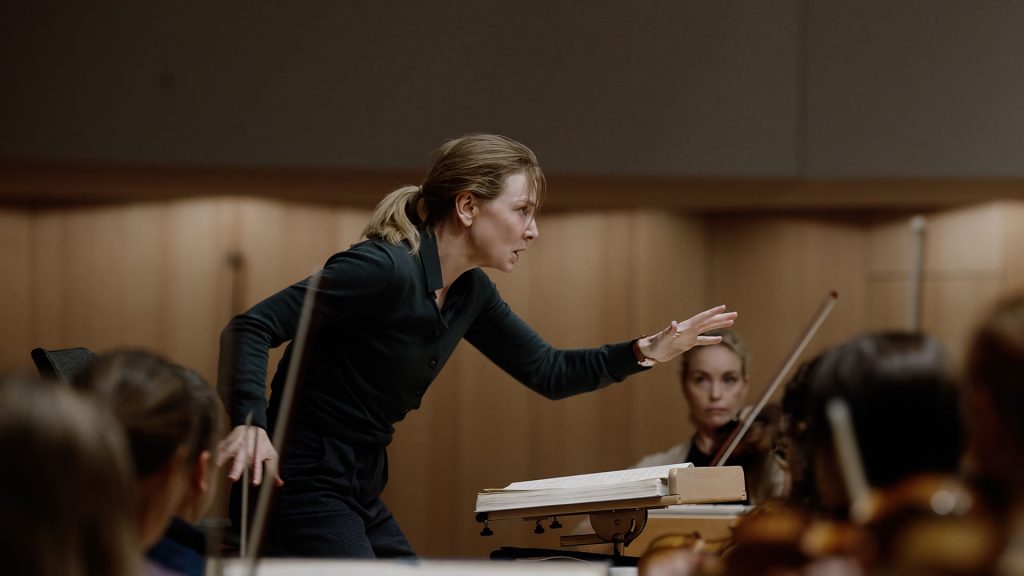
Lydia Tar (Cate Blanchett)
Distinguish a Detail From a Gimmick
A gimmick is an unusual trait that does not affect the story. A detail becomes character when it reveals a pattern of behavior, exposes a need, or creates conflict.
For example:
> LENA wears red gloves.
This may be visually distinctive, but it is inert.
> LENA removes her red gloves before touching anything she wants.
Now the gloves suggest control, appetite, fear of contamination, or ritual. The story has somewhere to go with them.
The more conspicuous a detail is, the more it must pay off. If a protagonist enters carrying a locked briefcase, that briefcase should shape the scene or create a question the audience expects the story to answer.
A useful revision test is simple: remove the detail. If the reader’s understanding of the person remains unchanged, the detail may be decoration.

Join the Discussion!



Browse our Videos for Sale
[woocommerce_products_carousel_all_in_one template="compact.css" all_items="88" show_only="id" products="" ordering="random" categories="115" tags="" show_title="false" show_description="false" allow_shortcodes="false" show_price="false" show_category="false" show_tags="false" show_add_to_cart_button="false" show_more_button="false" show_more_items_button="false" show_featured_image="true" image_source="thumbnail" image_height="100" image_width="100" items_to_show_mobiles="3" items_to_show_tablets="6" items_to_show="6" slide_by="1" margin="0" loop="true" stop_on_hover="true" auto_play="true" auto_play_timeout="1200" auto_play_speed="1600" nav="false" nav_speed="800" dots="false" dots_speed="800" lazy_load="false" mouse_drag="true" mouse_wheel="true" touch_drag="true" easing="linear" auto_height="true"]







You must be logged in to post a comment Login