
Star Trek: 60 Years of Boldly Going Where No Viewer Has Gone Before

On September 8, 1966, a television show premiered on NBC that would forever change the landscape of science fiction and popular culture. Star Trek, the brainchild of visionary writer and producer Gene Roddenberry, debuted with its first episode, The Man Trap, introducing audiences to the starship USS Enterprise and its intergalactic crew.
Few could have predicted that this modestly budgeted television series, which would ultimately be cancelled after just three seasons, would grow into one of the most beloved and enduring franchises in entertainment history. Eugene’s son, also named Eugene, heads Roddenberry Entertainment which continues to produce new iterations of Star Trek to captivate audiences old and new.
Now, six decades later, the world is celebrating an anthropologic milestone that speaks to something far deeper than mere nostalgia.
Star Trek: A Vision Ahead of Its Time
What made Star Trek so revolutionary in 1966 was not its low-budget special effects or its space adventure storylines — it was its audacious optimism about humanity’s future despite every reason to despair. A belief in a brighter tomorrow.
Roddenberry deliberately crafted a universe where humanity had evolved beyond war, poverty, and prejudice. At a time when the United States was torn apart by the Civil Rights Movement, the Vietnam War, and Cold War anxiety, Star Trek dared to present a future where people of all races, nationalities, and even species worked together as equals toward a common purpose. A viable alternative. They celebrated these differences rather than scorn them.
The original series featured one of television’s most diverse casts ever assembled before DEI was a thing. Lieutenant Uhura, portrayed by Nichelle Nichols, was one of the first Black women in a position of authority on American television — not a servant, not a stereotype, but a respected officer on the bridge of a starship. Hikaru Sulu, played by George Takei, represented Asian Americans at a time when such representation was virtually non-existent on screen. Japanese Americans were treated far worse.
Pavel Chekov brought a Russian character into heroic prominence during the height of Cold War tensions. And at the center of it all stood Mr. Spock, a half-human, half-Vulcan science officer who embodied the struggle between logic and emotion — a metaphor that resonated deeply with anyone who had ever felt like an outsider trying to understand his human tribe.
Related: Kirsten Beyer On Co-Creating ‘Star Trek: Picard’
Why It Endures
The genius of Star Trek has always been its ability to use the possibilities of science fiction to explore the most pressing issues of the human condition. It tackled racism, imperialism, war, artificial intelligence, gender identity, and moral relativism. By setting these stories in the distant future, Roddenberry gave audiences permission to examine uncomfortable truths from a safe distance, and then carry those lessons back into their everyday lives.
Most importantly, it never chooses sides. It doesn’t pontificate. Its underlying backbone is one of tolerances and co-existance.
But beyond its social commentary, Star Trek endures because it offers something increasingly rare in modern storytelling — hope. In a film and television landscape often dominated by dystopian futures and opposing narratives to boost viewership, the Star Trek universe remains a beacon of possibility. We will always disagree. We will always face obstacles. The question is how we handle them. We must find a solution because we are all humans.
Star Trek insists that humanity is capable of better, that our curiosity is greater than our fear, and that our capacity for compassion can overcome our impulse toward destruction. That message was radical in 1966, and it remains just as powerful — and perhaps just as radical — today.
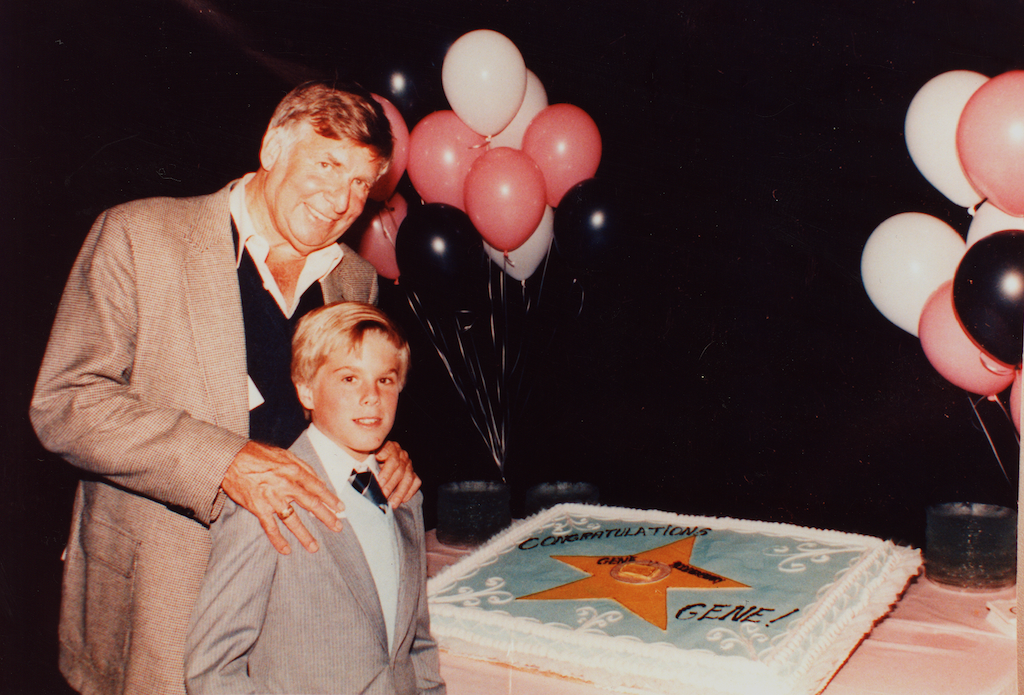
Gene Roddenberry & Eugene “Rod” Roddenberry. Photo by Roddenberry Entertainment
A 60th Year Legacy Honored in Hollywood
The reach of Star Trek’s cultural impact is perhaps best measured not just in its countless spin-off series and films, but in the genuine emotional connection it has forged with generations of fans around the world. That connection was powerfully on display when Eugene “Rod” Roddenberry, son of the franchise’s creator, delivered a heartfelt speech commemorating the restoration of the Star Trek star on the Hollywood Walk of Fame in Los Angeles, California.
Standing in the place where his father’s legacy is etched into the sidewalk of one of the world’s most famous streets, Rod Roddenberry carried forward a torch that Gene Roddenberry first lit sixty years ago — a reminder that the vision of a better, brighter future is not just the stuff of science fiction, but an inheritance and legacy worth protecting and passing on.
As Star Trek marks its 60th anniversary, it does so not as a relic of the past, but as a living, breathing, evolving cultural institution that continues to inspire scientists, activists, artists, and dreamers. From the halls of NASA, where astronauts have cited the series as their inspiration, to the classrooms where the next generation of explorers is just beginning to look up at the stars, Gene Roddenberry’s dream lives on.
Surrounded by over 50 Trekkie writers (from over 200 in total) and a bunch of funs, Trevor Roth (COO Of Roddenberry) and Rod Roddenberry spoke.
Related: Akiva Goldsman on ‘Star Trek: Picard’
Star Trek: A Writer’s Entreprise
Trevor Roth commenced proceedings.
It starts with a page. A storyteller and a blank canvas.
It always begins with the writer. Not just because they can write, but because writers have ideas.
And ideas are boundable. And in the right hands, those ideas can be powerfully conveyed. One of my favorite stories about Gene came from the late, great Star Trek writer, Michael Piller.
He told us the story of when he was a young, hungry writer on The Next Generation. He asked Gene if he could pitch him an episode one day during lunch. Gene, as he did so many times, graciously accepted, and Michael launched his pitch. I don’t recall exactly the story Michael told, but when finished, he waited.
He sat there and he waited for Gene to respond. Gene looked at him and said, ‘What’s it about?’ Michael, misunderstanding the whole thing, launches back into the episode’s story. Well, the Enterprise goes here and there, and Gene stopped him.
And he repeated, ‘No. What’s it about?’ It was an a-ha moment for Michael. It provides our North Star. It sets the bar for everything that we do.
But it also reminds us that there are writers, and there are Star Trek writers. Star Trek writers don’t just have to be good. They have to go further than any writer has gone before.
Star Trek writers have the added mandate to make sure that they’re saying something about something. They have to write stories that have meaning. It starts with a page, because that’s the only place it really can start.
Like Gene, our writers are facing the blank page, not only with the determination to fill it, but to fill it with words that convey ideas, substance, and meaning.
Gene started his love of books as a child. That’s how he traveled. He wasn’t able to get out of bed or move around a lot, so he traveled through books in his imagination. And it just continued throughout his entire life.
Related: Alex Kurtzman Interview: From ‘Star Trek’ to ‘Sleepy Hollow’
Rod was here 41 years ago, in 1985. Now it’s his turn to address the audience.
The star was first given to my father. It was one of the first stars in Hollywood to be given to a writer. It wasn’t given to a performer, not a producer, but to a writer.
Almost every story idea in this industry that has ever been created started with a writer. Every franchise, every character, every quote, every line, came from a writer.
I remember a while back interviewing Bob Justin in his documentary, he said something that stuck about my father.
He said my father was a better philosopher than he was a writer. And looking back, that makes a lot of sense. One of my clearest memories of my father was seeing him lying in bed. He was always in bed reading. He wasn’t writing. Every night, I came in to say good night, and that’s what he was doing.
It was usually a non-fiction book, something about metaphysics, or a biography on a world leader. He read books about the heroes of our past and the villains. He wanted to understand humanity.
I never asked him why he was reading, but it was always something that I clearly remember. It’s made a lot more sense, now that I’ve been involved in the Star Trek universe. What my father wrote was less about the scene and more about humanity.
It wasn’t about what was happening to the characters. It was more about the ideas and the people. When he got the star here in 1985, he talked about people. He talked about humanity. He said, ‘We’re in a childlike development now. We’re young. We’re making mistakes. We’re arguing. We’re doing dumb things.’
But old children do go through that too. We will come out on the other side. And he would end it with, ‘Yes, and then we’re going to be something special.’
This was the kind of thinking my father did. There’s one thing I want to mention about Michael Piller. When he told his story about what it was like working for my father.
I know he said it was a pain in the ass for most writers because my father didn’t want conflict between his main characters.
We were a better species in that future. It was outside of the ship. It was the aliens who needed our help. Not always. There were some far more advanced than us, but those were the fun stories.
But Michael said this experience challenged him. It brought better stories, and in the end, it made better writers. So that’s the thing about storytelling. It’s part of who we are.
Before there was TV, movies, Hollywood… it all started with someone painting on a cave wall. They were sharing what they saw. And today, whether a story is true or entirely imagined, it’s always about something.
Writers lay the foundation. Everything the rest of us do in this industry, the directing, the effects, the producing, all of it gets built on top of something somebody else wrote. And when a writer is lucky, their ideas and their vision make it all the way in front of an audience.
And that audience walks away with a perspective they might never have had had. They might have seen it or experienced it any other way. I would argue that’s one of the most important things we do.
Star Trek is the proof that when it’s done right, storytelling can help shape the world. Since 1966, we’ve had countless superb writers on Star Trek. Each one has given it their own fresh perspective while at the same time honoring its core values.
The audience tuned in for the spaceships, aliens, and adventure, but they stayed for what got said.
Who counts as a person? What does war cost us? What might we be if we were a little less afraid of each other? The plot got them in the door, but the ideas are what they took home and what they still have.
Six years of Star Trek doesn’t just belong to my father. It belongs to the writers who kept showing up and putting important ideas into it. Fiction has always been one of the safest places to tell the truth, and we could use a lot more of that these days.
There’s still a lot of fear, division, and misinformation, and I don’t think we can lecture our way out of it. However, I think we all know there is one thing we can do. We can “tell” our way out of it. We need to keep showing what’s on the upside of the doom and gloom.
Let’s keep creating stories that make people want to hear a different point of view that’s not their own. Stories that explain, not just something is the way it is, but why it is that way. Stories that show things that are different are actually interesting instead of frightening.
Being exposed to new ideas does not obligate you to accept them, but it can elevate your thinking. And while I know how this sounds, I do truly mean this with all my heart. When we end up boldly going anywhere worth going, it’ll be because someone wrote it first and made it look possible.
To my father, and to all the writers who have kept Star Trek alive for 60 years, and all the upcoming writers that will keep it alive for the next 60, thank you.

Join the Discussion!



Browse our Videos for Sale
[woocommerce_products_carousel_all_in_one template="compact.css" all_items="88" show_only="id" products="" ordering="random" categories="115" tags="" show_title="false" show_description="false" allow_shortcodes="false" show_price="false" show_category="false" show_tags="false" show_add_to_cart_button="false" show_more_button="false" show_more_items_button="false" show_featured_image="true" image_source="thumbnail" image_height="100" image_width="100" items_to_show_mobiles="3" items_to_show_tablets="6" items_to_show="6" slide_by="1" margin="0" loop="true" stop_on_hover="true" auto_play="true" auto_play_timeout="1200" auto_play_speed="1600" nav="false" nav_speed="800" dots="false" dots_speed="800" lazy_load="false" mouse_drag="true" mouse_wheel="true" touch_drag="true" easing="linear" auto_height="true"]







You must be logged in to post a comment Login