
Inside ‘Coyote vs. Acme’: Saving Looney Tunes and Surviving Hollywood’s Brutal Shelving Crisis

Few films in recent Hollywood history have endured a journey as tumultuous — or as ironically appropriate — as Coyote vs. Acme.
Directed by Dave Green and co-written by Samy Burch, the hybrid live-action/ animation film follows Wile E. Coyote as he finally reaches his breaking point with the perpetual failures of defective and often dangerous ACME Corporation products. He’s not gonna take it anymore.
Hell bent on sueing the mega-manufacturer of all things cheap and ludicrous, Wile E. hires a down-on-his-luck human lawyer (Will Forte as Kevin Avery) to take on ACME’s smug corporate legal team (led by John Cena as Buddy Crane), leading to an absurd courtroom showdown that honors the timeless anarchy of Chuck Jones’ original Looney Tunes cartoons while injecting fresh, meta-commentary into corporate accountability.
The key argument is whether cartoons can sue corporations in a class action lawsuit. Legal precedent had been set that corporations can be people.
The movie’s real-world drama quickly overshadowed its premise. In November 2023, Warner Bros. Discovery shocked the entertainment industry by shelving the completed, well-tested, highly-anticipated film for a $30 million tax write-down (to offset Barbie’s mega profits), sparking outrage from filmmakers, fans, and industry unions alike.
What followed was an unprecedented grassroots campaign, leaks, and an eventual studio reversal allowing the filmmakers to shop the movie to Ketchup Entertainment in order to release it. They reportedly paid $50 million for the privilege.
But let’s not allow the behind the scenes shenanigans to eclipse a Wile E. and Goliath story of an average Joe (or Wile E.) pitting his wits against a soulless corporation who insisted that Wile E. Coyote’s injuries were self-sustained due to user errors, rather than taking responsibility for its faulty novelty products.
Wile E. Coyote Never Gives Up
Coyote vs. Acme is a movie about a hero who always keeps going, no matter what obstacles are thrown in his path. Or how many times he has cheated death.
It is a story that began in print, back in 1990. Its source was the satirical article, published in The New Yorker and written by acclaimed humorist Ian Frazier, who imagined the legal briefings of a case brought by one Wile E. Coyote against the ACME Corporation.
A suit alleging corporate malfeasance and liability, born of the string of disastrous products, everything from ACME’s patented Rocket Sleds to Spring-Powered Shoes, that had caused Wile E. Coyote no end of “personal injury, loss of business income, and mental suffering.” You have to admit, he had a pretty convincing case.
Wile E. catches an advertisement for an ambulance-chasing lawyer Kevin Avery (Will Forte) who yelps, “‘There’s always someone to blame!” Realizing that all his faulty products used to catch the Roadrunner are all manufactured by ACME, he hatches a plan to track down Avery and sue ACME.
More: Samy Burch and Dave Green Talk ‘Coyote vs. Acme’
Kevin Avery vs Buddy Crane
“Kevin is, a lazy lawyer, who is only ever looking for the cheapest, fastest way out of things,” laughs producer Chris deFaria. “This is a guy, whose office is in a strip mall, and who will take the lowest ever case and settle it immediately – while eating French fries.”
Kevin Avery, Attorney At Law, has his own sad story. He previously made a momental mistake in a bigger case and retreated to practising strip mall law.
“He has represented cartoon characters for about 10 years when we meet him,” says Dave Green. So Wile E. is in good legal hands.
“Handling cases involving cartoons who have been flattened by a piano or splatted by a bus, Kevin will take the first offer the opposing side offers in compensation and kids himself that he’s proud of that.”
Wait a minute! Kevin is an underdog that takes on the cases that courts want settled quickly to clear its docket. Has he really gotten the best deal for his clients? But a cartoon who’s had his hand blown off by an ACME dynamite stick will be fine the next day anyway. A win’s a win!
Although Kevin Avery imbues the skeezy qualities of Jimmy McGill or Saul Goodman, he does what he can for his clients while nursing his spiritual wounds.
John Cena’s Buddy Crane is a suited up corporate shill protecting the interests of his ACME overlords. After all, they can’t be held legally responsible for Kevin Avery’s client’s failings. Crane is an an uncompromising, uncaring barrister – suave and scary, wrapped up in a conceited smile.
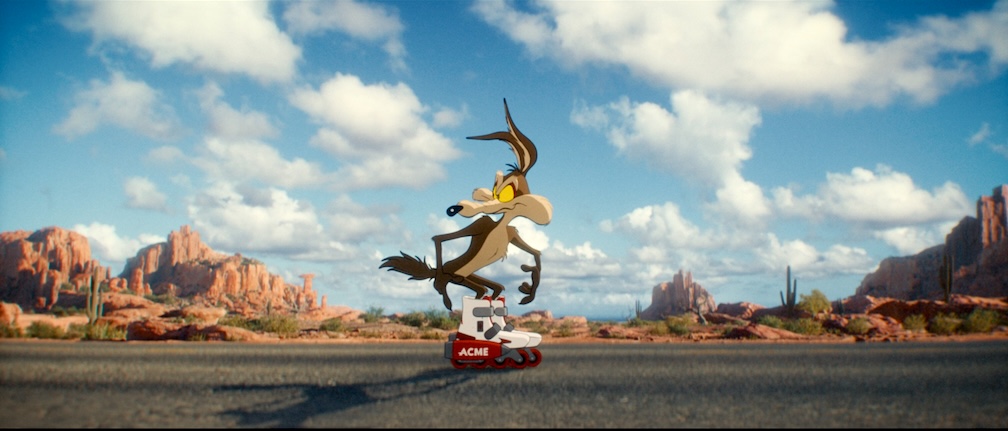
Still from Coyote vs Acme. Photo courtesy of Ketchup Entertainment
Director Dave Green’s Take On Wile E. Coyote
When he was first created – in 1949 – by animator Chuck Jones and writer Michael Maltese, Wile E. Coyote was famously based on a line in a book by Mark Twain – his semi-autobiographical slice of travel literature from 1872 titled Roughing It, that described the desert coyote as a “long, slim, sick, and sorry-looking skeleton” always looking for its next meal.
Dave Green was given a wide canvas to paint his version of Wile E. He toyed with the idea of a true crime documentary. He looked at defining courtroom dramas, thrillers and procedurals to craft his story. He referenced Michael Clayton, The Verdict, and A Few Good Men.
But one movie really captured Green’s imagination – Michael Mann’s The Insider starring Russell Crowe as research chemist Jeffrey Wigand makes the brave decision to turn whistleblower on the tobacco industry.
What if we put Wile E. into the world of The Insider?
This was Green’s take on Coyote vs Acme. Audiences can share Jeffrey Wigand’s anger at Big Tobacco and the ensuing injustice. Perhaps a scrawny coyote near psychological collapse suing a corrupt corporation over faulty pogo sticks shared a parallel thematic track?
Recruiting Screenwriter Samy Burch
Dave Green invited Samy to Warner Bros to spitball ideas for the movie with producer Chris DeFaria. It was more of a “bake off” – the WGA frowned upon practice where multiple writers are invited to pitch their take on a project without pay.
Following an intense “battle of the pitches,” Burch emerged as the victor.
As the screenwriter remembers, “We put about a hundred cards on the wall, working out the conspiracy, the legal case, the character arcs, but also establishing a tone that mixed the straight-faced comedy of Ian Frazier’s article and an emotional core that hopefully would take the audience off guard.”
For deFaria, “The first thing we did – Dave, Samy and I – even before we really knew each other’s take on the story, was to grab a stack of Post-Its and write down adjectives that we wanted the audience to feel when watching the movie – specifically about Coyote. And since he never speaks in our film, we then had to imagine scenes that could deliver what was on those cards. It was kind of backwards, but it worked.”
But the ones that stood out then and ring so true in the final movie, producer Chris deFaria says, were these:
Surprise, Heart and Smart/ Silly
Producer Chris deFaria ran on the principle that, “We all believe that we’re Road Runner, but deep down inside, we know we are actually Wile E. Coyote.” This is how the movie will capture the hearts of audiences. Morevoer, Wile E. being silent is more than a metaphorical element to the movie.
The Enduring Nature of Looney Tunes
The key reason of the evergreen durability of Looney Tunes is the subversive, chaotic, and iconoclastic nature of its characters. But there’s something about Wile E. Coyote, the struggling silent movie star on the verge of starvation, that people respond to.
“It’s easy to write this coyote off as a fanatical freak, but Wile E. is the most positive character in all of Looney Tunes. He wakes up every morning, sets the table for Road Runner stew, and goes out. And every day he fails, comes home, and puts away those things on the table. But he never wavers. The next day he gets up and does it all over,” the producer adds.
“Wile E. Coyote has his flaws. He’s foolhardy, has an ego, is prideful, and devious. But the thing that is so admirable about him is that he’s so persistent,” says director Dave Green. “In the tradition of Charlie Chaplin or Buster Keaton, Wile E. Coyote is one of the best silent film actors of all time.”

Join the Discussion!
Related Articles
 Samy Burch and Dave Green Talk ‘Coyote vs. Acme’ About The Most Consequential Court Case in Decades
- “Mirror Mirror On The Wall. Who Is The Fairest Of Them All?” ‘Snow White’ Returns In A Live Action All Singing, All Dancing Disney Extravaganza
- Study Great Screenwriters, But Hone Your Original Writing Voice



Browse our Videos for Sale
[woocommerce_products_carousel_all_in_one template="compact.css" all_items="88" show_only="id" products="" ordering="random" categories="115" tags="" show_title="false" show_description="false" allow_shortcodes="false" show_price="false" show_category="false" show_tags="false" show_add_to_cart_button="false" show_more_button="false" show_more_items_button="false" show_featured_image="true" image_source="thumbnail" image_height="100" image_width="100" items_to_show_mobiles="3" items_to_show_tablets="6" items_to_show="6" slide_by="1" margin="0" loop="true" stop_on_hover="true" auto_play="true" auto_play_timeout="1200" auto_play_speed="1600" nav="false" nav_speed="800" dots="false" dots_speed="800" lazy_load="false" mouse_drag="true" mouse_wheel="true" touch_drag="true" easing="linear" auto_height="true"]






You must be logged in to post a comment Login