
How Damian McCarthy Creates Layered Horror in “Hokum”: A Masterclass in Atmospheric Filmmaking for Writers

After Damian McCarthy directed Oddity and Caveat, he cemented his place in moody, unsettling, atmospheric cinema. He continues his style in Hokum. Irritable novelist Ohm Bauman (Adam Scott) visits The Bilberry Woods Hotel in rural Ireland (where his parents honeymooned) to scatter their ashes and finish writing his book. There are creepy waiters who play dumb, an alleged witch, a creepy host in rabbit suit reminiscent of Donnie Darko, and psychological taunting through careful drip-feeding of exposition.
Ohm Bauman – The Prickly Protagonist as Conduit for Dual Horror
At the heart of Hokum is Adam Scott’s Ohm Bauman, an American author struggling with profound self-loathing deeply rooted in childhood trauma and shame. Ohm is simultaneously vulnerable to the hotel’s supernatural threats and complicit in generating his own psychological torment.
McCarthy’s genius lies in making Ohm deeply unlikeable at the film’s outset. He’s abrasive, dismissive, rude to the hotel staff, and radiates contempt for the very people who might otherwise help him escape. Rather than positioning Bauman as potentially alienating, his standoffish demeanor invites curiosity into his character. He’s more than a temporamental writer battling writers’ block with alcohol.
In order to provoke his unstable, menacing headspace, there’s a presence in the hotel. Internal or external remains to be seen. It could be his guilt gnawing at his conscience, or are subconsciously manifesting into reality? He’s forced to deal with unexamined emotions and self-resentment before he finds peace.
Ohm’s backstory is delivered in bite-sized nuggets through fragmented memories, visions, and the bartender Fiona’s (Florence Ordesh) observations, who might provide insight into what is triggering his outbursts.

Damian McCarthy. Photo courtesy of NEON
Atmospheric Constraint: Using Confined Space as a Character
The Bilberry Woods Hotel isn’t merely a setting; it’s a strait jacket that functions as a character that traps Ohm in both physical and psychological confinement. The film deliberately creates “dark and damp atmospheric design” that is “essential to the film’s most chilling moments.” McCarthy understands a principle that “enclosed spaces amplify claustrophobia, and claustrophobia amplifies fear.”
The hotel operates as a layered labyrinth. There’s the public space — the lobby with its retro call bells, and the bar where Ohm hears tales of the haunted honeymoon suite where he stays.
There’s the second layer — the guest corridors and Ohm’s room, where private horror can unfold without witnesses. And crucially, there’s the third layer: “the basement, accessed via dumbwaiter elevator, where the film’s most visceral horrors materialize.”
In the basement, “Bauman encounters all manner of strange things, including what seem to be witches.”
McCarthy uses these architectural elements creatively. The film “finds a way to make elevators creatively central to the plot.” When Ohm enters an elevator, he’s in a confined box traveling vertically. The spatial constraint mirrors his psychological prison cell.
Constraint breeds intensity. When you force a character into increasingly smaller spaces — whether literal rooms or metaphorical corners — the tension tightens proportionally.
The Witch as Manifestation of Unconscious, Unresolved Guilt
The haunting, lurching presence in Hokum takes the form of a witch — a figure drawn from Irish folklore and fairy tale tradition to punish naughty children. McCarthy explained his approach by noting: “It was about a character who something happened to him as a child, and it kind of seems to be that that’s where his life stopped with these things that happened to him when he was so young. So, I like the idea that by the time he has to finally confront it. It’s a witch that makes it happen. It’s kind of like she’s still chasing that little boy in him.”
The film visualizes this through disturbing imagery. There’s a dead body in a rabbit suit — grotesque and unexplained — and echoes of this in childhood television footage. Ohm remembers: a terrifying TV host with bulging eyes and rabbit ears. These weird moments that are never or only slightly explained hit harder because they’re left to the audience’s imagination.
Visions, Flashbacks, and the Interface Between Conscious and Unconscious
McCarthy employs a sophisticated technique for representing the boundary between what Ohm knows consciously and what his unconscious mind is desperately trying to communicate: fragmented visions, flash-cuts, and premonitions that feel like real memories, but might be prophecy. They’re fractured, unsettling, narratively unclear.
At the film’s opening, Ohm glimpses the ghost of his mother at home before he leaves for Ireland. This premonition leads him to The Bilberry Woods Hotel, where his parents honeymooned. The vision suggests something genuinely supernatural may be operating, but it also represents Ohm’s guilt — his mother’s presence as accusation, his need to perform a ritual (scattering ashes) that he hopes will grant him absolution.
Throughout the film, disturbing imagery pokes into Ohm’s waking consciousness. These moments operate like the language of dreams or the intrusions of the repressed unconscious. They’re not explained through exposition; they’re experienced through dissonance. This creates a specific kind of dread: the audience, like Ohm, doesn’t fully understand what’s happening, and that uncertainty is far more terrifying than clear exposition would be.
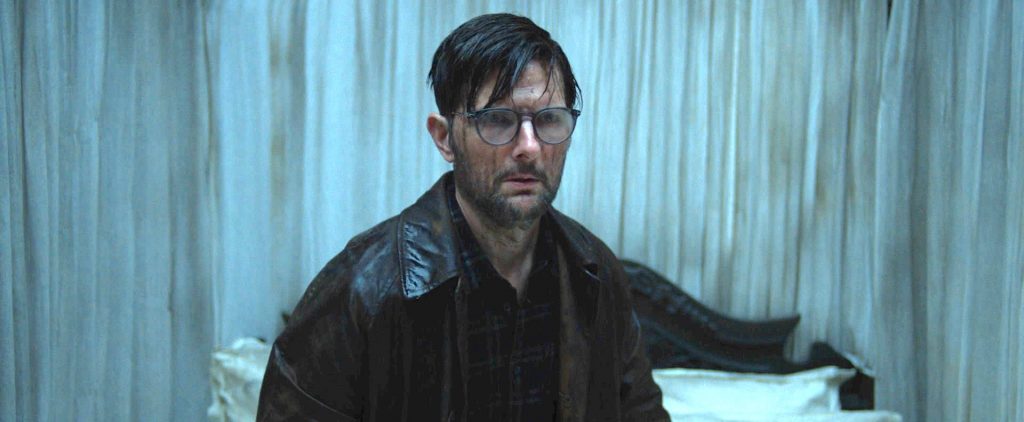
Ohm Bauman (Adam Scott) Photo courtesy of NEON.
Tension Through Restraint: The Sparing Use of Jump Scares
Interestingly, while Hokum does deploy jump scares as delayed reveals. The horror is built from the the accumulation of small shocks and mood.
McCarthy understands that the anticipation of horror is often more effective than horror itself. He builds silence. He allows scenes to linger. He makes characters move through dark spaces slowly and meditatively, letting the audience’s imagination shade in the gaps.
Jump scares, then, function as punctuation — moments where the accumulated tension finally ruptures.
The Basement as a Liminal Space of Final Reckoning
The basement of The Bilberry Woods Hotel functions as more than a dungeon — it’s the threshold between the conscious and unconscious, between Ohm’s public performance and his private disintegration. “There’s this scene where Ohm travels to the basement and is listening to a recording that Fiona made.”
The dumbwaiter — a small mechanical lift used to transport objects between floors — becomes a vehicle for descent into literal and psychological depths. The basement contains evidence of the hotel’s dark history, remnants of the witch’s presence, and ultimately, the truth about what happened to Ohm in his childhood. It’s where external horror and internal horror collide.
Liminal spaces such as basements, attics, hallways, thresholds are naturally psychological spaces where rules feel suspended and anything seems possible. They are in a purgatorial space that feels between worlds. This both mirrors and amplifies the internal state of a character facing what they’ve been avoiding.
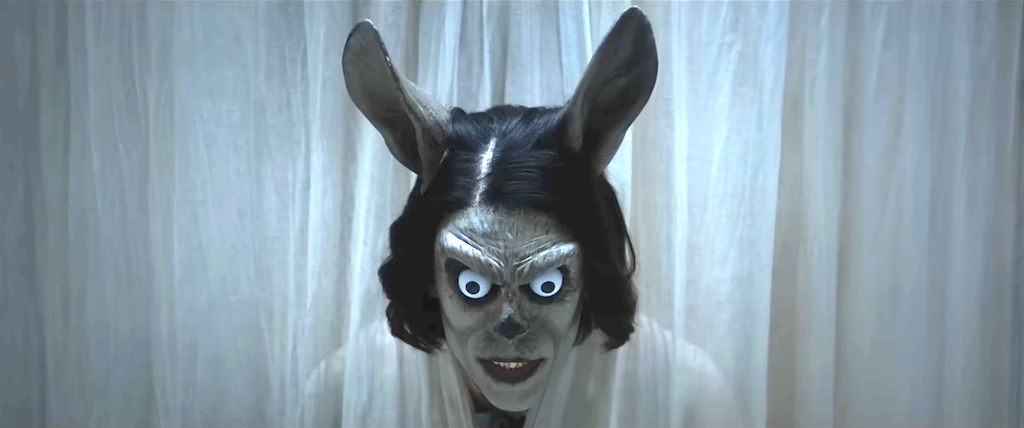
Photo courtesy of NEON
The Mystery: Blending the Supernatural with the Real
Hokum is not strictly a supernatural horror film as there are elements of actual villains out to harm Ohm and Fiona. This adds another dimension to the folkloric witch and supernatural presences. This uncertain gray zone further ingratiates the audiences as they play whodunnit and deduce reality from imagination.
In Hokum, the haunted house is really a haunted mind, and watching that mind confront what it’s been fleeing is horror in its truest form.

Join the Discussion!


Browse our Videos for Sale
[woocommerce_products_carousel_all_in_one template="compact.css" all_items="88" show_only="id" products="" ordering="random" categories="115" tags="" show_title="false" show_description="false" allow_shortcodes="false" show_price="false" show_category="false" show_tags="false" show_add_to_cart_button="false" show_more_button="false" show_more_items_button="false" show_featured_image="true" image_source="thumbnail" image_height="100" image_width="100" items_to_show_mobiles="3" items_to_show_tablets="6" items_to_show="6" slide_by="1" margin="0" loop="true" stop_on_hover="true" auto_play="true" auto_play_timeout="1200" auto_play_speed="1600" nav="false" nav_speed="800" dots="false" dots_speed="800" lazy_load="false" mouse_drag="true" mouse_wheel="true" touch_drag="true" easing="linear" auto_height="true"]






You must be logged in to post a comment Login