
How Olivia Wilde Made A24’s ‘The Invite’: Inside Her Creative Process

The Invite is A24’s dark comedy movie from Olivia Wilde, who directs and stars as Angela alongside Seth Rogen, Penélope Cruz, and Edward Norton. The screenplay was written by Will McCormack and Rashida Jones. It is a remake of Cesc Gay’s 2020 Spanish film, Sentimental (released internationally as The People Upstairs, which in turn was based on Gay’s 2016 play, Los Vecinos De Arriba).
The story follows a married couple whose prickly relationship is shaken when they invite their free-spirited upstairs neighbors over for a dinner party.
Built around awkward social tension, jealousy, and temptation, The Invite turns a simple four-hander, dinner-party setup into a sharp, uncomfortable, and very adult comedy in this highly-entertaining film.
One should always be in love. That is the reason one should never marry – Oscar Wilde
Wilde’s witty quote sets the tone for Joe and Angela’s marriage which is already on thin ice. Should they try to repair or dissolve it? Their enigmatic neighbors help them probe the question by inviting them to an exclusive swingers party.
The Invite is hilariously touching both in its intriguing premise and its inexorable emotional honesty. What is love anyway? What is intimacy? What is sex? How do these concepts exist in a marriage?

Will McCormack & Rashida Jones
Setting The Scene For The Invite
The Invite begins when vulnerable and uneasy Angela (Olivia Wilde) asks the free spirits from upstairs, Hawk (Edward Norton) and Piña (Penélope Cruz), over for dinner, much to the chagrin of her exhausted, frustrated husband Joe (Seth Rogen) who has forgotten. And wouldn’t you know it, Joe has forgotten the wine and its too late to get some.
This serves as an irritant to a brittle marriage on the verge of divorce. Don’t expect an explosive argument to end it all. The resentment is built on years of accumulated resentment and unmet needs as Joe and Angela service their marriage more than themselves. They’re not deeply unhappy, but they’re not satisfied either. They cruise along without rocking the matrimonial boat too much.
Piña and Hawk are minutes away from arriving. They overhear Joe and Angela arguing and delay their arrival.
Joe insists that Angela never told him about the get-together, and when he urges her to reschedule, she refuses. With their daughter away at a sleepover, and their infrequent visitors they proceed with the gathering as they search for a wine substitute.
This ‘impromptu’ gathering is more than a chance for Angela to meet her neighbors and infuse some neighborly energy to their charming apartment. She wants to show off their recent renovations to their historic San Francisco apartment and also to apologize for the construction noise.
Joe isn’t a billionaire tech bro showing off his real estate portfolio. He’s a modestly paid music teacher. The apartment belongs to his parents.
Hawk and Piña have subtly avoided socializing with Angela and Joe, but they eventually accept the invitation in good neighborly faith. They will even have a chance to see what their neighbors have done with the place.
Aside from being a friendly neighbor, Angela also wants to tactfully bring up the sensitive issue of Piña and Hawk’s frequent love making at noise levels higher than their construction noise.
Now that everyone’s motivations are stated, the story can begin in earnest as the buttoned down couple interact with the unbuttoned one.
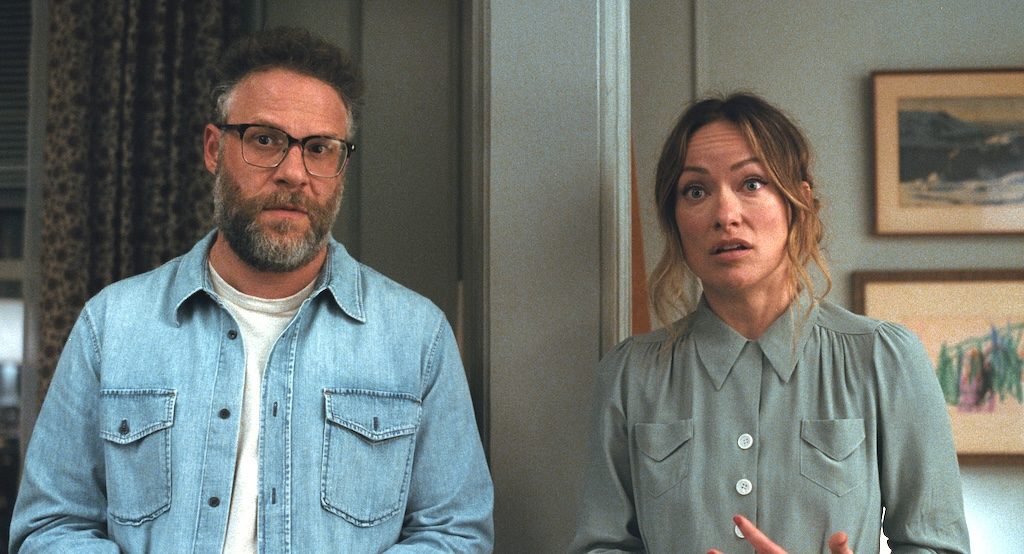
Joe (Seth Rogen) & Angela (Olivia Wilde) Photo courtesy of A24
Hawk and Piña arrive
Aside from the lack of wine and the guests’ constant clock watching, Angela breezes as a hostess as she waits for her moment to pounce with her concerns.
The guests, however, are all too happy to frankly discuss their intimate lives, suggesting that Joe and Angela might benefit from a similarly liberated approach to carnal pleasures. Maybe they could even begin to do so tonight?
Angela and Joe are squeamish, but open to suggestions. They can’t really confess to being uptight. And they’re looking for a spark. So, why not?
The inviting premise isn’t as bawdy as the title suggests. It’s a springboard into soul searching and defining the parameters and communication skills necessary for a successful relationship rather than naked sweaty acrobatics.
Adapting The Invite For an American Audience
Although the theater production had previously been adapted for Italian and Korean audiences — underlining the universal nature of the themes it explores and their cross-cultural relevance — McCormack and Jones were keen to tell the story through an American lens. “It’s such a rare occasion where you have all this great source material — a great play and a movie that’s so rich and so specific culturally,” Jones says. “The structure was so solid and the themes were so relevant, that it was easy for us to plug in and then stretch in areas that were of interest to us.”
Early drafts of the project pinged their way to Wilde’s inbox several years ago with an eye for her to act in. When she was later approached with an offer to direct the film, she jumped at the chance.
“I thought, at this point in my life, this film is exactly the conversation I want to be having. I think that’s what it takes for you to direct a film,” says Wilde, who carefully read McCormack and Jones’ screenplay several times after revisiting Sentimental. “I found myself wrestling with the themes of the original film as though I were in a relationship with it. It became this intense obsession, coming to me at a time when I realized I had so much to say through my own work.”

Hawk (Edward Norton) & Pińa (Penelope Cruz) Photo courtsey of A24 Films
From Booksmart to The Invite
Having established herself as a talented actress, Olivia Wilde also proved herself to be an equally gifted director in the award-winning Booksmart, starring Kaitlyn Dever and Beanie Feldstein as over-achieving high-school seniors who decide to break all the rules in one epic night of partying before graduation.
In a sharp detour, Wilde’s second feature was Don’t Worry Darling, a tense and unnerving thriller starring Florence Pugh as a 1950s housewife who finds herself trapped in a suburban place far darker than it seems.
Olivia Wilde has proven she can navigate the massive swings of the emotional and mood pendulum. She’s equally adept at wide tonal spectra and genre. With The Invite, she contricted herself into a contained story and focused on character gymnastics.
She wasn’t going to remake Sentimental although it’s always a touchstone in her creative process. She turned to the films of director Mike Nichols, especially The Graduate and his adaptation of Who’s Afraid Of Virginia Woolf? for inspiration. Both were largely filmed indoors in closed spaces and honed in on deep character exploration without the distractions of too many supporing characters.
Wilde was most interested in orchestrating the push and pull that emerges among the unlikely quartet over the course of one uncomfortable, unconventional evening inside Angela and Joe’s apartment in The Invite. It wasn’t about who controlled the narrative or who was morally superior. It isn’t even about comparing marriages and deciding which you prefer. The movie excavates the communications (or lack of) in close relationships without being didactic or judgmental. Even Piña and Hawk have a full-blown argument. There is no perfect marriage and couples always fight. The point of The Invite is to encourage audiences to explore the notion of stating relationship expectations and navigating conflict
Wilde says. “This film was a chance to say, ‘If the thing that interests me most is relationship dynamics, what if I just make a film where there’s nothing else but that?’ The thing that interests me most about directing is human relationships, and telling stories about relationships.” Her mission is that simple.
Workshops – Preparing The Actors for their Roles
From the outset, it was clear that The Invite wasn’t going to be filmed with a series of takes, retakes, and reshoots. The actors needed to prepare for naturalistic acting of extended scenes without constant interruptions during production.
For the workshops, writers McCormack and Jones sat with the director and cast around a table, crouched over their laptops with the script beside them.
In raucous creative sessions, the group shared revealing personal anecdotes, ad-libbed pointed barbs, and memorable one-liners; all while gut-checking every decision the characters made. Each character should behave authentically.
“We went through this period of sharing openly, and in doing that, you get into a comfort zone with each other to do some stuff that’s got some taboos and is a little risqué,” recalls Norton.
“It was a very important part of this film; the fact that we were able to gather for eight days around a table with the writers. They were so generous and open to hear our ideas and to bring things into our characters,” adds Cruz.
For McCormack and Jones, the process was unlike anything they had experienced before, and found themselves making script revisions daily to reflect the conversations that were happening around the table. “The very first rewrite for this iteration of the movie started with that workshop,” Jones reveals.
“Our job was to take in all this blue sky energy and then ensure that the scaffolding of the story remained intact and could bear the weight of all these big, fun ideas. It was a very propulsive, iterative process and it was great to hear directly from the actors.”
“We were incorporating these brilliant, sometimes astonishing ideas from the cast and weaving them into the script in a way that was really interactive — to have that time with them, to hear things come to life, to volley ideas back and forth was totally thrilling,” continues McCormack.
Recruiting A Psychotherapist
Olivia Wilde decided to delve even deeper into her characters. She recruited renowned psychotherapist and New York Times bestselling author Esther Perel known for such books as Mating in Captivity: Unlocking Erotic Intelligence to serve as a consultant on The Invite.
“I admire the empathy that Esther brings to the conversation about relationships and I love her focus on personal responsibility in terms of one’s own happiness — the idea that we have agency within a relationship,” states Wilde. “We can express what we want without fear or guilt.”
“She was much more than a consultant on this film. She was an oracle.”
Cruz was also grateful to have the opportunity to speak to Perel to gain insights that helped shape her approach to playing therapist Piña. “I was a big fan of Esther’s work and then when I realized that we had the possibility to talk to her, it was very exciting,” Cruz declares. “My profession gives me the opportunity to meet incredible people. I feel so lucky that I was able to call her anytime I had a doubt or when we were working on the script. It was very important to have her input.”

Join the Discussion!



Browse our Videos for Sale
[woocommerce_products_carousel_all_in_one template="compact.css" all_items="88" show_only="id" products="" ordering="random" categories="115" tags="" show_title="false" show_description="false" allow_shortcodes="false" show_price="false" show_category="false" show_tags="false" show_add_to_cart_button="false" show_more_button="false" show_more_items_button="false" show_featured_image="true" image_source="thumbnail" image_height="100" image_width="100" items_to_show_mobiles="3" items_to_show_tablets="6" items_to_show="6" slide_by="1" margin="0" loop="true" stop_on_hover="true" auto_play="true" auto_play_timeout="1200" auto_play_speed="1600" nav="false" nav_speed="800" dots="false" dots_speed="800" lazy_load="false" mouse_drag="true" mouse_wheel="true" touch_drag="true" easing="linear" auto_height="true"]







You must be logged in to post a comment Login