
Interview: “Nemesis” Creator Courtney A. Kemp on Her New Netflix Crime Drama Series

Courtney A. Kemp is the visionary behind STARZ’s crime hit Power-verse franchise, creating multiple spin-off series including Power Book II: Ghost, Power Book III: Raising Kanan, Power Book IV: Influence, and Power Book V: Force. Now, she returns with her hot crime drama Nemesis on Netflix.
Nemesis. co-created alongside work and life partner Tani Marole, this edge-of-your-seat, Los Angeles-set, cat-and-mouse crime drama is a tense psychological battle of morals, loyalty, and self-preservation.
The show centers on a brilliant, relentless LAPD detective Isaiah Stiles (Matthew Law) who becomes fiercely obsessed with bringing down Coltrane Wilder (Y’lan Noel) the mastermind behind a string of exceptionally daring burglaries starting at a Halloween Ball. Courtney shares her intention for Nemesis.
How did you create enough distance between Nemesis and Power to ensure it was distinct from the Power-verse?
I co-created this with Tani Marole. Tani and I together are very different from me writing alone. Tani is a lot of momentum, pace and action. While I always did action, it was slower. I would take time to carjack that guy and drive over him for example. Tani loves explosions. He loves running gun. The pacing is faster.
Netflix is a global platform, which is very different from Starz. At Starz, we were a big fish in a little pond. You have to make a big splash in order to make any kind of waves. Nemesis had to have a bigger voice. Power had a lot more time per episode, 58 minutes 30 seconds, to get into really deep character moments.
I was also a very different woman when I started Power. I was 35 years old and I had a two-year-old son. When I started Nemesis, I was 46 years old with a teenager and been through a divorce.
As you age, you change profoundly as a writer and as a person.
Related: How Courtney Kemp Created The Power-verse

Courtney A. Kemp
How did you Pitch Nemesis to Netflix?
This show is much more about marriage than other shows I’ve done. Other shows I’ve done have been about individuals. This is really about these two marriages – with wives Ebony Wilder (Cleopatra Coleman) and Candace Stiles (Gabrielle Dennis).
The hook was definitely that Nemesis is a more mature, fully realized version of a cops and robbers story, because these are men. They are men with familiy responsibilities.
I’m going to the theme of maturity. Also, Tani and I are engaged. We’re a couple making a show. So it’s going to come from those couples arguments.
Discuss the relationships between wives Ebony and Candace.
My female characters are never just the woman. I always got angry as a young woman watching action stuff with the women who never did anything, they never said anything, and they were just there. That’s one of the things I really loved about Ocean’s Eleven; there aren’t many women in it except for Julia Roberts. I liked that because we could focus on her character.
Who are the women who would marry these guys in Nemesis? Why would they be in these relationships?
One of the things that was really important, especially in the Black community, at my age, because I’m 49, is you’re supposed to check off these boxes. You have your job, you have your spouse, you have the kids. You’re supposed to do these things in this order. These are characters who are still doing that stuff, but they just are also kind of wackadoo.
The other thing is I wanted the unattached woman, Charlie (Sophina Brown), Ebony’s sister, to be the driving force of a lot of the stuff that’s happening. I wanted to show how women who are unattached, have the freedom to create in their own way and build their own system.
Related: Liz Sarnoff Adapts the ‘Scarpetta’ crime novels into a series
How did you innovate the cops and robbers TV show genre?
I like that it’s just cops and robbers. I like that it serves exactly what you’re looking for. I didn’t go out of my way to make something completely new. I’m sure you could see a million different film and television references in Nemesis.
I wanted to elevate the genre in terms of character, but not in terms of the genre. This is a cop and a robber show. They’re chasing each other around LA.
These are men you haven’t seen before, and some of their extended relationships are not relationships that you see. In the usual cops and robbers shows, you don’t spend a lot of time with their families. Everybody’s parents are present in Nemesis. Everyone’s kids are present. Everyone’s family is present.
The intergenerational trauma is very present. Those are the things that I would say are different or new, but I’m not taking us out of a great car chase.
How does Los Angeles serve Nemesis both as a location and as a character?
We had to fight to film here, but Netflix would have preferred at first that we go to Atlanta.
For a million reasons, I decided we’re not doing that, but it did hamper our budget. There were considerations you had to make. I’ve been spoiled.
We made Power in New York for New York. We made Power Book IV: Force in Chicago for Chicago. You really lose the essence of a place when you’re not shooting there. I used to say that New York was a huge character in Power because wherever you point the camera, New York is happening in the background. LA is like that for Nemesis.
Wherever you point the camera, LA is happening in the background. The light here, the people, and all the feelings of it are real.
We’re trying to show the Los Angeles that we haven’t really seen as much of. I always give credit to Issa Rae for Insecure because she showed a lot of Black LA. I’m also trying to show black LA.
Moving the cameras down there, having a black and brown crew from LA, are really important.
Related: Showrunner Brad Inglesby creates tension in ‘Task’
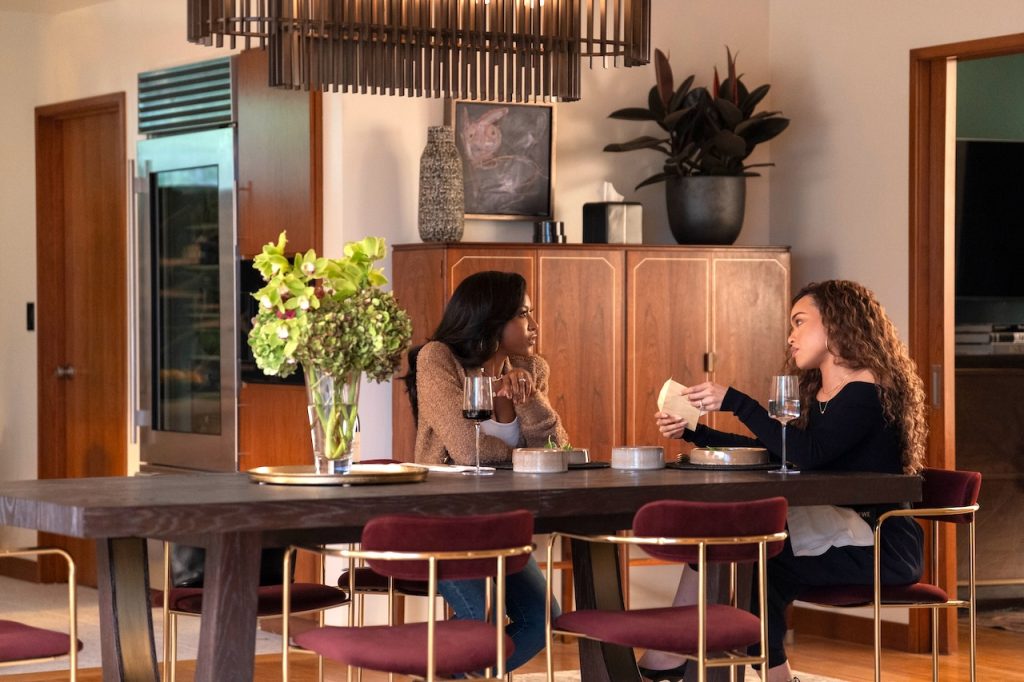
Gabrielle Dennis as Candace Stiles and Cleopatra Coleman as Ebony Wilder. Photo by Saeed Adyani/ Netflix
How do you shape the “Nemesis” characters?
I’m always striving for a universal question or a universal idea with any show. We always asked what is a nemesis? It’s the person who takes you down while you’re trying to take them down.
We always were looking for an equal and opposite reaction. What does if Isaiah Stiles moves this way and Coltrane Wilder moves that way? Then necessarily Stiles moves the other way? How do we set up the dominoes of it?
I can compare it to a lot of different things like the Tetris and Jenga games. What are the pieces that we keep pulling until it falls apart? How are they resting on each other? There is no parallel storytelling. It’s all interconnected, as opposed to being separate.
What were some of the challenges in writing the show?
Definitely writing with another person, having to co-create, and not have the last word. That was challenging after eight years of Power. From a writing perspective, it’s making sure that each line of dialogue is authentic.
If you cover the character name, you should know who said that dialogue. Each line of dialogue pops in its own way and specifically tells you who the character is.
If you think about the scenes where they’re just the crew – Coltrane, Deon (Quincy Isaiah), Stro (Tre Hale) and Choi (Leilani Nichol), they each need to have their own distinct point of view in those scenes or those scenes will die. It can’t be Coltrane against everybody. You see that Stro is kind of a peacekeeper, in a really supportive way, but then also take Coltrane aside and be like, ‘Man, you’re messing up.’
Deon is out for himself all the time, always making the joke. You see Choi is about the business of getting it done.
Candace’s mother, says to her at one point, ‘You know, he’s [Isaiah] not thinking about you, right? And in that same scene, she says, ‘Whatever happened to Malik (Jeff Pierre)?’ Later on, when Malik and Candace are talking, Malik says, ‘You know, Isaiah’s not even thinking about you.’ She’s already heard this from someone else who has her own narrative. She also heard it from her mom. That is something that’s really interesting about Candace. She wonders, ‘Did I pick the wrong guy? How is this my fault? What did I do wrong?’
You want to make sure that you’re always talking about theme and you’re always keeping a character’s either insecurities or point of view right in front of the audience. The audience should be constantly seeing how that character is not only perceived by themselves, but by the other characters in order to shore up that characterization.
Related: David E. Kelley explains writing crime drama in ‘Presumed Innocent’
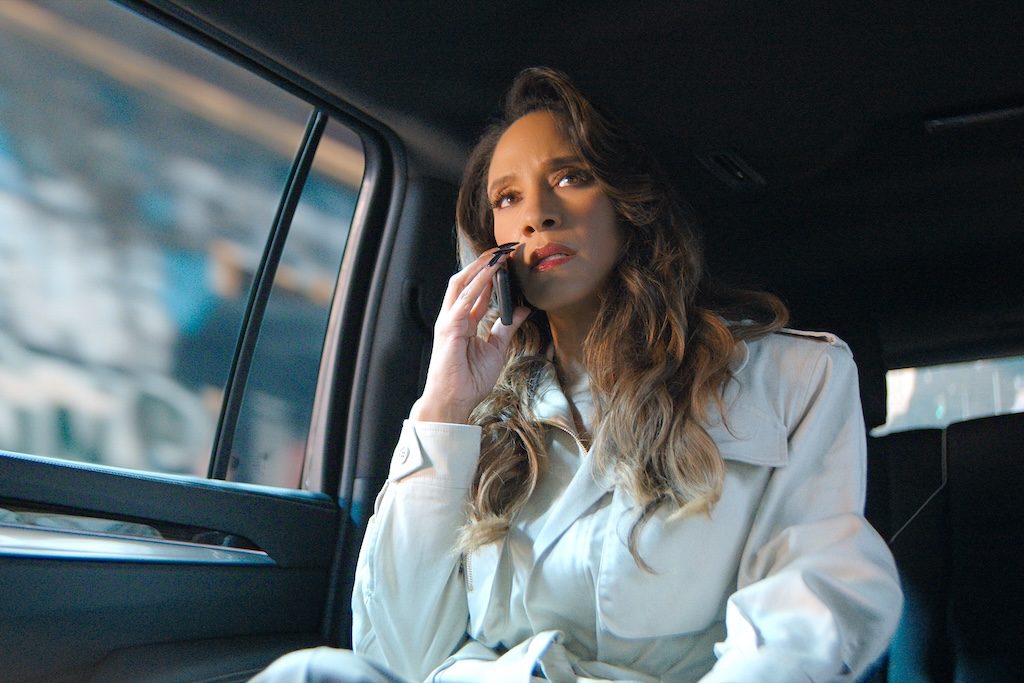
Sophina Brown as Charlie. Photo courtesy of Netflix
Take us inside your writers’ room.
The most important thing is that we’re having a good time while we’re breaking it so that the audience is having a good time while they’re watching it. We always keep a lot of levity, no matter how dark the show is. It should always be funny too. It doesn’t mean there aren’t hard moments.
I also work a lot with the same people. A lot of writers do this. I promote. So what happens is, a lot of times people will start out as an assistant, and then they get promoted through the ranks under me. So our number two on Nemesis, Gabriela Uribe, was my assistant the first year on Power. That’s how long she’s been working her way up.
She’s really well-versed in, ‘What do you say here? What do you do here? What are the reversals?’ I worked with producer John Eisendrath. He ran The Blacklist. Before that he had created a show on ESPN called Playmakers. He was always talking about reversals.
He was always talking about when you go into a scene, how is the situation different when you leave the scene? That’s something that always stayed with me. We always talk about how has the story been pushed forward in a surprising way when you get out of the scene.
How did you want to end the series?
We definitely wanted the show to end with a question and not with an answer.
We definitely wanted this season to end with Coltrane Wilder getting away. We felt like Isaiah Stiles had made enough mistakes where we needed Isaiah to understand how he had created such a huge mess. But we also wanted Coltrane to have an uncertainty.
We definitely wanted the consequences of Isaiah’s actions to be very present.
Quality feedback on your television script helps you make it more market ready.

Join the Discussion!
Related Articles



Browse our Videos for Sale
[woocommerce_products_carousel_all_in_one template="compact.css" all_items="88" show_only="id" products="" ordering="random" categories="115" tags="" show_title="false" show_description="false" allow_shortcodes="false" show_price="false" show_category="false" show_tags="false" show_add_to_cart_button="false" show_more_button="false" show_more_items_button="false" show_featured_image="true" image_source="thumbnail" image_height="100" image_width="100" items_to_show_mobiles="3" items_to_show_tablets="6" items_to_show="6" slide_by="1" margin="0" loop="true" stop_on_hover="true" auto_play="true" auto_play_timeout="1200" auto_play_speed="1600" nav="false" nav_speed="800" dots="false" dots_speed="800" lazy_load="false" mouse_drag="true" mouse_wheel="true" touch_drag="true" easing="linear" auto_height="true"]






You must be logged in to post a comment Login