
Jeremy Robbins Reaches The APEX — Charlize Theron, Taron Egerton & the Story Behind the Australian Set Sci‑Fi Thriller

Apex: The uppermost point; The highest level or degree that is attained.
Jeremy Robbins (The Spiderwick Chronicles, The Purge) makes his feature debut as the screenwriter of the survival action thriller film APEX starring Charlize Theron as Sasha and Taron Edgerton as Ben. Based on an entirely original idea, the film follows a grieving woman testing her limits in the Australian wilderness when she is ensnared in a deadly game with a ruthless apex predator – at the top of the food chain.
APEX serves as a masterclass in sleek, minimalist dramatic storytelling underpinned by heart-pounding, non-stop action in this visceral story of physical and emotional survival. Jeremy shares his thoughts with us on his creative process.
What were the guiding parameters of your story?
Both watching and reading while growing up, I love stories of survival. I love thrillers from the 70s and the action movies from the 90s. I really wanted to write the kind of movie that I wanted to watch. APEX started on spec. No one was asking for it.
I set out to strip away as many of the elements as I could. I wanted to think about the barest essentials of a dramatic story. I always saw this as man versus woman versus nature story, and tried to figure out all the different combinations that I could write with a very stripped down setting, minimal dialogue, and really think about how to tell character and emotion through behavior and action. That was part of the challenge that was baked in from the beginning.
How did you get your spec script out there and generate interest?
There was a really long road to getting the movie to the place that it is now. I started writing this during year one of the pandemic on spec.
I didn’t tell my agents or managers that I was going to write it. I just turned in a story that I was excited to see. We had producers who came on board, Ian Bryce and Will McCants. We tried to put various versions together – different directors, different financiers, it kind of had a path. But none of those quite clicked into place. I was still really happy and really proud of the script.
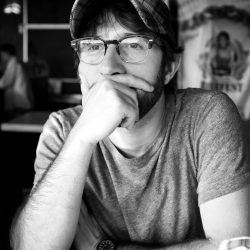
Jeremy Robbins
It kept giving me a reason to write new drafts and continue to push the story forward, and continue to learn about the characters. Then I thought it was one of those scripts that might not see the light of day, but I was still so proud of it as a great writing sample. And then, as luck sometimes has it, the right person saw it at the right time. It was what they were looking for. Peter Chernin came aboard. It was the kind of movie they were looking to bring to Netflix.
From there, I got to do a rewrite with Netflix’s and with Chernin’s input. I’d had enough distance from the script, so I really understood what I was writing. I came to it with a perspective that’s rare to get when you’re writing draft after draft. I had almost a year away from it while I was working on other things and came with this kind of momentum.
That’s really when this iteration of the story took off. After that rewrite, Charlize Theron and Taron Egerton and Baltasar Kormákur, the director, came aboard. Suddenly we were taking a script that I had written for the Pacific Northwest and the Southwest of the United States to Australia.
It was all these wonderful things that didn’t seem on the horizon. And suddenly, it was on a rocket ship to production in less than a year.
What films do you compare APEX to?
Deliverance was a big one. My agents and managers described it as 127 hours meets Silence of the Lambs. You get a sense of this propulsive action movie, but also a serial killer story. Other reference points for me were The Edge, A River Wild, Into Thin Air, and Everest – the seminal survival thrillers that I’ve loved since I was a kid.
What makes Ben such a compelling character?
One of the great things about the collaboration process is what Taron Egerton brought to the role that was different than what was on the page. As soon as he came aboard, he really saw Ben as almost a stunted child; this Peter Pan kind of boy, who’s lost and struggling and acting out. He’s also this feral wild beast. Taron brought that combination of energies to Ben.
Ben is an example of what man can become when he’s faced with extenuating circumstances. I was really interested in the combination that I could make with those three elements – man, woman and nature. Sometimes it’s man and nature versus woman, and sometimes it’s woman and nature versus man.
One of the things I love about the story is that there’s a part where it’s man and woman versus nature. They have to team up and work together. I was trying to think of all of the different dramatic combinations that I could put together that would keep the story feeling fresh from sequence to sequence.
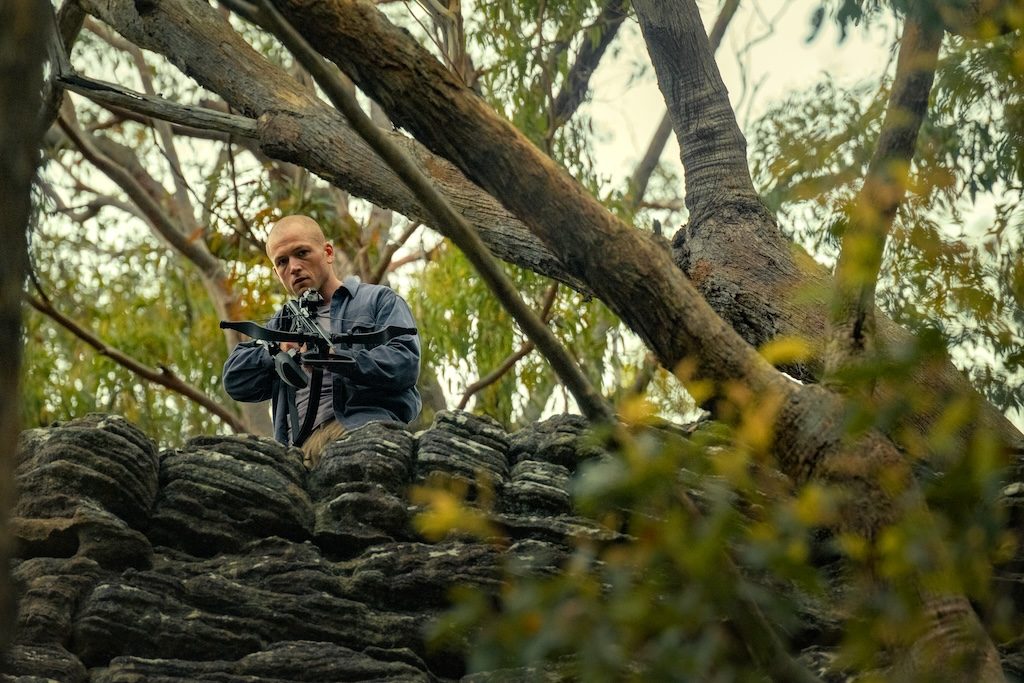
Ben (Taron Egerton) Photo by Kane Skennar/ Netflix
How would you describe Sasha’s character?
That first sequence in the movie is doing a lot of things. It’s setting up this woman who is pushing her limits and trying to find her place in the world. I think there are so many beautiful things the mountains represent spiritually, metaphorically, physically, and mentally.
Her now-deceased partner Tommy (Eric Bana) is saying, “If you’re not careful, if you don’t have a certain mindfulness and an awareness, you can push the limit into a place that’s really dark and dangerous.” Ben is the extreme example of that. He’s that philosophy taken to the max.
Sasha has to confront that. She has to experience that primal animalistic instinct, and then she has to find a way to bring herself out of that.
Charlize has to find the cracks in Ben’s armor in the same way she’s finding the cracks in the mountain to climb. What’s so special about the cat and mouse psychological games that Charlize and Taron are playing, is her ability to climb and find a route that seems impossible. Ben seems like he’s completely in control. He knows everything. The rules are his.
She has to find a way to turn the tables on him. She’s using the same skills as climbing a mountain to figure out, how do to press this guy’s buttons. How do I figure out a way to survive and use his weaknesses against him?
Ben is the example of what Tommy is trying to explain to Sasha in the beginning, but she’s just not ready to understand. She has to go down this path and confront that darkness, find that line for herself, and decide what she’s going to do about it. Do I really want to go that direction, or do I want to make a little pivot? Do I want to zig instead of zag? She has to decide how she’s going to pull herself out of this and find catharsis in a different way.
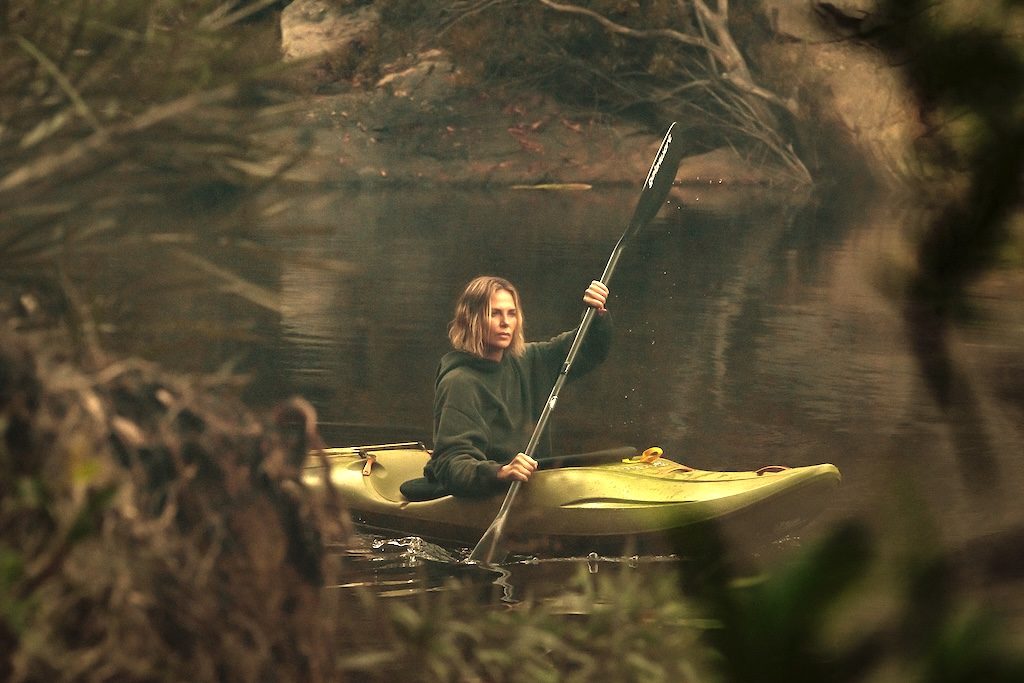
Sash (Charlize Theron) Photo by Kane Skennar/ Netflix
Descibe how Ben and Sasha interact.
Ben’s not sure if this is the right way to live, but to him, he’s using every part of the animal. He sees a purity in using everything – this ultimate hunter’s mentality of respecting your prey by leaving nothing to waste. I think there’s something beautiful and also twisted in that philosophy.
Ben doesn’t see himself as the villain. He sees himself as the hero of his own story. And for him, this is catharsis. This is therapeutic. This is enlightenment. And for everybody else watching it, it’s completely depraved, really demented, really scary, really terrifying.
But none of that registers to him. This is an expression of something deeper and darker that is his therapy as best as he can articulate it. He’s wrestling with it. He’s looking for an answer. And this is maybe the best one that he’s found, but he’s also not ready to die for those beliefs. He is much more like a wounded child who is crying for help, who wants to escape and live to see another day.
That is where Sasha starts to find the ability to take some control back. Ben just wants absolute control to make himself feel safe although he’s never really under threat. It’s never a case of survival for him. He knows he’s always got the upper hand.
How are Ben and Sasha similar?
There’s a kinship between Sasha and Ben in not quite knowing where they fit in in the world; not feeling comfortable in a traditional societal construct.
I started writing this during the the pandemic and you’re watching what isolation is doing to people on this huge scale. I was so struck by the fragility of life and the profound beauty of that. I was drawn to that kind of survival story for the reasons of tapping into the resilience and hope.
For those two characters, nature is their refuge. They are more comfortable away from people, on their own, in nature, because it’s quieter. The solitude can be very peaceful, even if they’re doing really dangerous things. It’s very harmonious. It’s enlightenment.
It’s interesting when you take two people who are much more comfortable on their own and throw them together. What does that do to the dynamic when they are forced into a survival situation? It’s fascinating tethering them together and figuring out how do they move as one.
That was part of the structural exercise that I knew would be a main part of the story.
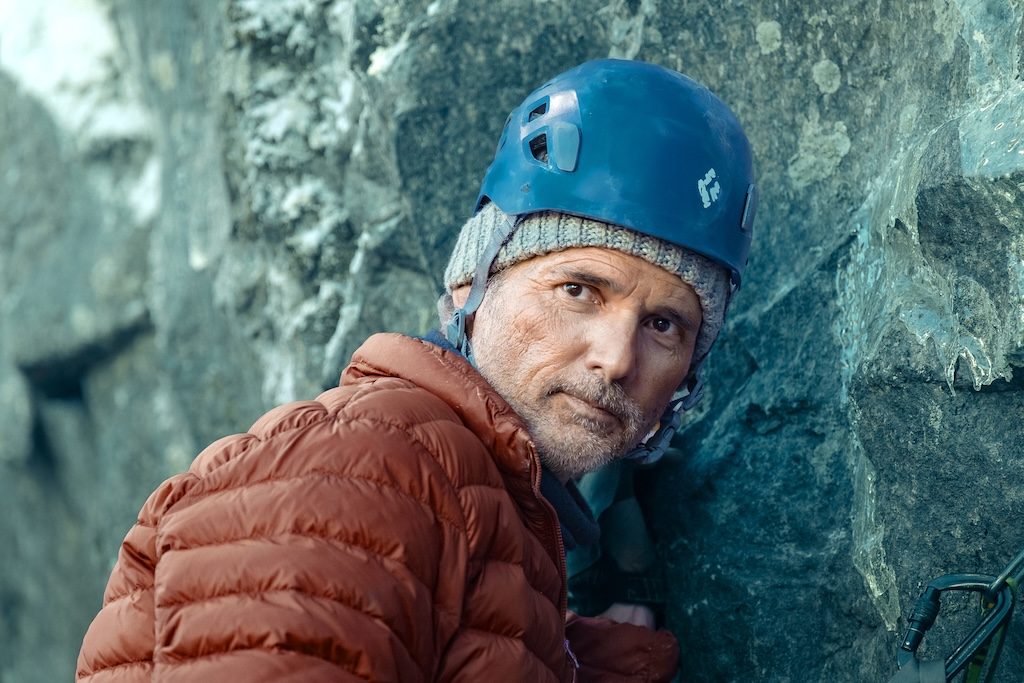
Tommy (Eric Bana) Photo by Kane Skennar/ Netflix
How did you navigate minimalist dialogue?
The truth is through writing many, many, many drafts on my own. Trial and error. Then it’s really about trusting the actors, trusting Baltasar. I feel like the story was in such good hands that I gave them the template.
Then I watched them find the places where they wanted more dialogue or less dialogue. Before Charlize was involved, she was just a character’s name on a page. When she came aboard, you realize that speech that I wrote, she can convey in a look. She can convey that with two lines of dialogue. And that’s better than any speech I could have possibly written.
It’s just a revision process. It’s trusting the collaborators. It’s just basically saying, “Here’s the blueprint.”
I can’t wait to see what you guys are going to do with it. And then it’s about finding where does the audience need to know something and where is it okay to not have the answer. I think the same is true with the edit – finding the places to give the audience enough of an understanding without it feeling like exposition for the sake of exposition.
Is there a scene which speaks the most to you?
The first one that comes to mind is when Sasha finally makes it to the apex of that mountain. She’s by herself. She has triumphed. She laughs. She cries.
There’s such a release and catharsis of emotion and energy. I think Charlize’s performance in that moment is the most beautiful thing that I’ve seen in the whole movie. I find that it’s such a release because it ties back to the beginning.
She’s able to do this thing finally that she couldn’t do before. She’s fighting for her life. She’s sad and happy. There’s triumph and tragedy all wrapped up together. She’s now so aware of her surroundings in a way that feels different. She’s aware of her emotions. She’s aware of her place in the world.
To me, that’s the one that feels like that was the whole point of the movie was to get her, not just to this place physically, but emotionally, mentally and spiritually. She is at her apex. What happens after that remains to be seen.
But right in that moment, that is as close to a catharsis she has experienced in her life.

Join the Discussion!



Browse our Videos for Sale
[woocommerce_products_carousel_all_in_one template="compact.css" all_items="88" show_only="id" products="" ordering="random" categories="115" tags="" show_title="false" show_description="false" allow_shortcodes="false" show_price="false" show_category="false" show_tags="false" show_add_to_cart_button="false" show_more_button="false" show_more_items_button="false" show_featured_image="true" image_source="thumbnail" image_height="100" image_width="100" items_to_show_mobiles="3" items_to_show_tablets="6" items_to_show="6" slide_by="1" margin="0" loop="true" stop_on_hover="true" auto_play="true" auto_play_timeout="1200" auto_play_speed="1600" nav="false" nav_speed="800" dots="false" dots_speed="800" lazy_load="false" mouse_drag="true" mouse_wheel="true" touch_drag="true" easing="linear" auto_height="true"]






You must be logged in to post a comment Login