
Navigating Truth and Power: Nora Garrett on Writing Her Spec Script “After The Hunt”

When Nora Garrett sat down to write what would become After The Hunt, she wasn’t trying to chronicle her own life as a Hollywood assistant for the screen. Instead, she was chasing something more elusive and nuanced: the nature of self-deception, the shifting boundaries of institutional power, shame, privilege, and the complexity of moral reckoning. In fact, her completed screenplay bears little resemblance to her actual life experiences.
The result, brought to the screen by visionary director Luca Guadagnino (Bones and All, Challengers), is a film that probes the distinction between public persona and private shame, set against the rarefied, debating lecture halls of a university philosophy department.
Garrett excavates the power dynamics she witnessed in Hollywood, coupled with a larger fascination with cancel culture and the punitive nature of public shaming, helped her form the backbone of After The Hunt as she repeatedly wondered, “Do we deserve to be punished for the worst thing we’ve ever done for the rest of our lives?” Should we speak up or just live with our guilt?
In a candid interview with Creative Screenwriting Magazine, Garrett (one of Variety’s 10 screenwriters to watch in 2024) opened up about the genesis of the film, the intricacies of its provocative central themes, and the collaborative process that shaped its final form.
The Significance of the Title: Between Truth and Pretense
The title, After The Hunt, derives from a quote by Otto von Bismarck: “People never lie so much as before an election, during a war, or after the hunt.”
For Garrett, this encapsulates the tension between the curated self one presents to the world and the self that exists in private. “It’s the difference between the public and private persona,” she explains. “It’s the self that we present to the world, the self that we perhaps doggedly wish was our true self, and the self that we have contained within ourselves that perhaps is more true.”
Nora Garrett
This dichotomy — of surface and depth, appearance and reality — runs throughout the film, shaping the story’s characters and the choices they make. Although the title might conjure images of literal pursuits, Garrett jokes, “No, but I did take archery once as a child.” The real hunt, she suggests, is for one’s true self amid layers of pretense.
From Hollywood Assistant to Working Hollywood Screenwriter: The Evolution of the Story
While Garrett’s early career as a Hollywood assistant informed the power dynamics in her script, After The Hunt is set in academia, a world she calls “a very codified power structure — a caste system.” With tenured professors at the top in seemingly unassailable positions and students at the bottom who worship them, the academic setting provides fertile ground for exploring blurred moral and practical lines of ambition, because people want to move upwards into a limited number of positions.
“There’s not as clear of a moral framework or HR structure as when you’re working in corporate America,” Garrett notes. “I wanted the film to take place in a world in which these power structures feel so real to the people involved in them, but you zoom out, even a little bit, and most people don’t care about tenure.”
Crafting the Narrative: Building a Thematic Jigsaw
Garrett likens the screenwriting process to assembling a sprawling jigsaw puzzle — one where the pieces are scattered and the overall picture only emerges over time. For her, the first draft is always “fast and loose and messy,” but she knew from the outset that the central character triangle — Professor Alma (Julia Roberts), Hank Gibson (Andrew Garfield), and Maggie Resnick (Ayo Ederibi) — would anchor the story. This dynamic remained constant throughout the entire development process.
“Finish a first draft,” Garrett advises other screenwriters. “That is the hardest thing. Going from zero to one is always much harder than having a completed entity and being able to go back in, shape it, take things out, put things back in.”
“Everything begins with setting,” Garrett states, “and setting is attached to the current social political moment. I don’t believe that art exists in a vacuum.” In After The Hunt, the academic environment is both backdrop and battleground, a place where ideas about power, integrity, and survival are constantly in flux while they are vigorously debated.
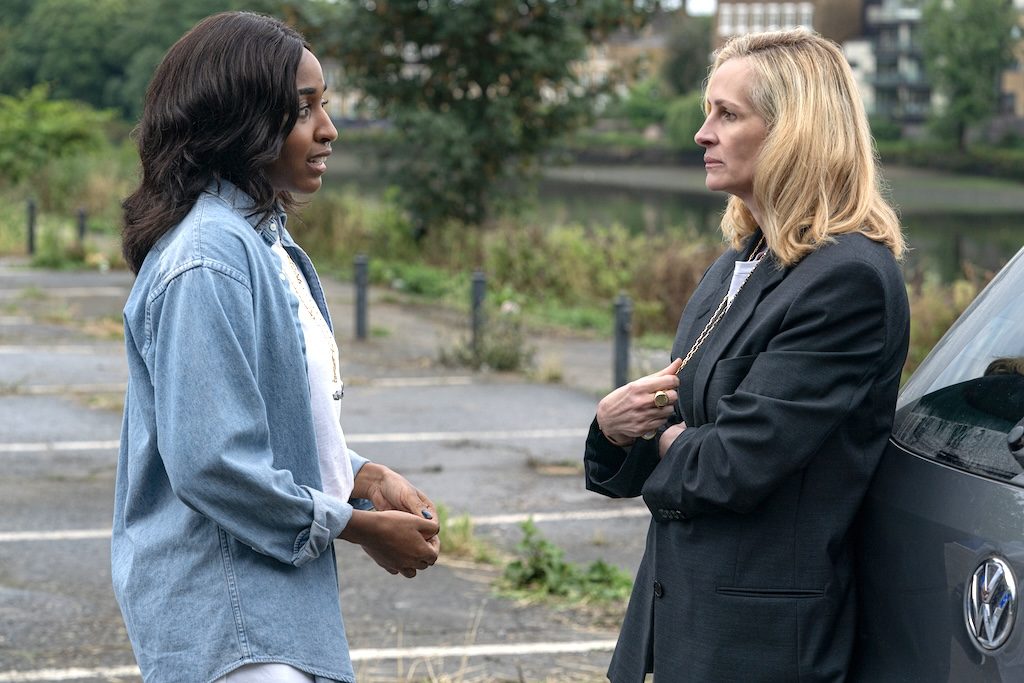
Maggie (Ayo Edebiri & Alma (Julia Roberts) Photo courtesy of Yannis Drakoulidis/ Amazon MGM Studios
Themes of Shame, Morality, and Self-Deception
At the heart of After The Hunt lies an exploration of shame and self-forgiveness. Garrett draws from this philosophy to frame the story’s moral conflicts: “The central crux of philosophy is the moral quandary of how best to live, how best to survive being human.”
The film’s characters, all steeped in deep philosophical discourse, struggle with the gap between what they believe and how they behave. Garrett was particularly inspired by an episode of This American Life podcast called Liars which suggests that the most successful people are often those most adept at deceiving themselves as well as others. Her film asks, “How long can one continue to do that until it starts coming out sideways?”
For Alma, the protagonist, the conflict is between her outward persona as a lecturer and a hidden, private shame which she must ultimately confront and resolve.
Cerebral vs. Emotional: Making Philosophical Concepts Cinematic
One of the biggest challenges Garrett faced was balancing the cerebral with the emotional. “In academia, it’s such a life of the mind… all in the head,” she says. “Having opinions about morality, having thoughts about how to live a moral life are all well and good, but what happens if what you preach cannot be practiced when it comes to your own life?”
Garrett and Guadagnino worked to avoid making the film inaccessible to general audiences, poking fun at academic jargon while ensuring that high-minded debates always had emotional stakes. “People speaking these ideas, and then you see them in their private behavior and the conflict between those two things — that’s the drama.”
Luca Guadagnino’s Influence: Embracing Ambiguity
When director Luca Guadagnino joined the project, he brought a unique vision — one that embraced ambiguity rather than answers. The story must rest in the grey area. “He was adamant that we didn’t provide any sort of ‘this is right, this is wrong’ in terms of the ending message,” Garrett recalls. Instead, the film invites audiences to bring their own opinions, to sit in discomfort and ambiguity, and to examine their own responses.
Guadagnino also helped expand the film’s generational dynamics, ensuring that it didn’t position one cohort as strictly progressive or regressive. “We are all a product of the world in which we were born into,” Garrett says, “and dismantling those are very hard, even when confronted with different evidence.”
Most importantly, Guadagnino’s approach focused the film on the slipperiness of power — how it’s gained, maintained, wielded, abused, and the unseen costs that come with it.
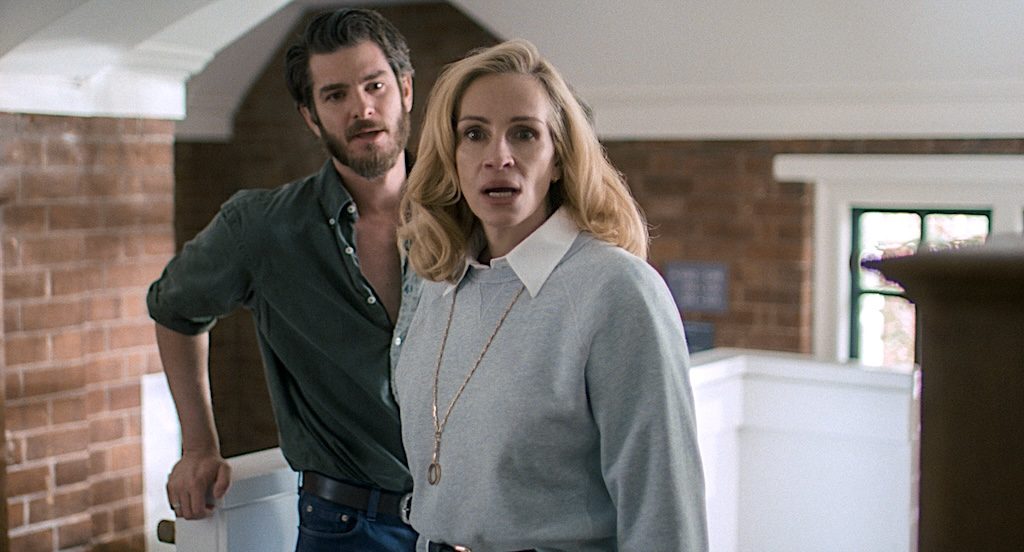
Hank (Andrew Garfield) and Alma (Julia Roberts). Photo courtesy of Amazon MGM Studios
Character Study: Hank, Alma, and Maggie
While much of the narrative centers on Alma and Maggie, Hank Gibson’s character — played with aplomb by Andrew Garfield — offers a study in opaqueness. Hank leaves a party with Maggie, but we don’t ever see what transpired beyond each other’s contradictory testimonies.
Originally written as a more clear-cut villain, Hank became a more complex and nebulous figure in subsequent drafts. “Andrew has a very specific idea of what happened that night, as does Ayo,” Garrett notes, “but I think those feelings are brought to life in the film and you can really feel it when you watch it.”
This refusal to provide definitive answers extends to Alma’s character arc as well. A pragmatist and a realist, Alma’s career in a male-dominated field has taught her to survive by negelcting and even suppressing parts of herself. Maggie, representing a younger, more idealistic generation, challenges that approach, insisting on living with integrity and authenticity, even at personal cost.
After The Hunt doesn’t just dissect individual psychology; it examines the evolution of social mores across generations. Garrett contrasts Alma’s complicit acceptance of “the way things are” with Maggie’s refusal to accept outdated norms. “Even if we don’t succeed, we’re starting the conversation and that’s a win in and of itself.” In stark contrast to Alma, Maggie refuses to live her life in a manner antithetical to herself.
Most importantly, the film suggests that we’re all a product of the world we’re born into.
At the film’s conclusion, Garrett resists definitive statements about Alma’s fate. “Where Alma is at the end of the film is something that is going to be dictated by the audience’s reaction to her whole process throughout the film and to how much they can empathize, sympathize, or project themselves into her shoes,” Nora invites.
Conclusion: A Mirror to Our Moral Dilemmas
Ultimately, After The Hunt is less “who’s telling the truth?” than a mirror, reflecting the ways we navigate shame, power, and the stories we repeat to ourselves until we believe them. In bringing Garrett’s nuanced script to the screen, Guadagnino has crafted a film that bypasses tidy moral resolutions, asking its audience to grapple with ambiguity and discomfort and to find their own truth after the hunt for it.
📣 Your story deserves to be heard. Let’s make sure it’s unforgettable.
Submit your script today and take the next bold step toward screenwriting success.

Join the Discussion!



Browse our Videos for Sale
[woocommerce_products_carousel_all_in_one template="compact.css" all_items="88" show_only="id" products="" ordering="random" categories="115" tags="" show_title="false" show_description="false" allow_shortcodes="false" show_price="false" show_category="false" show_tags="false" show_add_to_cart_button="false" show_more_button="false" show_more_items_button="false" show_featured_image="true" image_source="thumbnail" image_height="100" image_width="100" items_to_show_mobiles="3" items_to_show_tablets="6" items_to_show="6" slide_by="1" margin="0" loop="true" stop_on_hover="true" auto_play="true" auto_play_timeout="1200" auto_play_speed="1600" nav="false" nav_speed="800" dots="false" dots_speed="800" lazy_load="false" mouse_drag="true" mouse_wheel="true" touch_drag="true" easing="linear" auto_height="true"]







You must be logged in to post a comment Login