
Showrunner Erica Messer on Crafting the BAU’s Unholy Partnership with Elias Voit in “Criminal Minds: Evolution” Season 19

Premiering on CBS in 2005, Criminal Minds has cemented its legacy as one of the most resilient and influential psychological procedurals in television history. Created by Jeff Davis, the dark drama follows the elite profilers of the FBI’s Behavioral Analysis Unit (BAU) as they use psychology and behavioral science to hunt the nation’s most twisted UnSubs (unknown subjects).
Over its historic two-decade plus run, the show has survived network cancellations, high-profile cast shifts, and a major streaming evolution; after concluding its original 15-season broadcast run in 2020, it was revived on Paramount+ as Criminal Minds: Evolution, bringing the franchise to a milestone 19th season and securing a renewal for Season 20.
The massive global success of the flagship series naturally paved the way for short-lived spinoffs like Criminal Minds: Suspect Behavior (2011) starring Forest Whitaker, the international thriller Criminal Minds: Beyond Borders (2016) led by Gary Sinise, and a highly popular South Korean television adaptation.
Showrunner Erica Messer, who has worked on Criminal Minds since its inception, shared her insights about the longevity and popularity of the series.
 Erica Messer[/caption]
Compare the broadcast and he streaming vcrsions of Criminal Minds?
I was on the support staff for Party of Five. And then from Party of Five, there was Alias, which had so much action and great character stuff. And then The O.C., which was way more soapy, but also very character driven. By the time I got to Criminal Minds, a huge part of telling a procedural show is you don’t really get to go home very often.
Home is the office. You want that place where you feel safe, where you’re with your colleagues who become your friends. And sometimes, you have disagreements with them. It’s all the stuff that would happen at home, but you have to have it in the workplace. I feel in the early days of the show, we had 42 minutes to tell those stories, both the scary story of the episode and our character arcs in the episode. It forces you to become a very efficient storyteller.
You don’t get an hour to create this world and tell these stories like in streaming. That’s something I was always jealous of with shows like The Sopranos, where you’re getting an hour of story time and you feel like you know everything about them. You’re at home, you’re at work, you’re in therapy with them. You’re hearing everything.
The rules of a broadcast show and then a streaming show, was how do we build that bridge between the thing that everybody liked. Criminal Minds was a huge streaming hit when it was a broadcast show. So now, how do we take what everybody loves from the broadcast show and expand it to be longer storytelling? We didn’t change the mystery. The procedural elements of the show are the same.
We added the character arcs. It is a character driven procedural on the team side, the hero side, and the villain side. There’s not just a scary guy in an alley. You’re going to find out what makes him tick and you’re going to learn his origin.
I think that’s what makes us a little different from from a lot of other procedurals. And I think it’s one of the reasons that people are watching so long.
What is the typical Episode structure of Criminal Minds: Evolution?
We do a teaser and four acts.
Sometimes we want to start our teaser on a personal story because that’s going to be the biggest arc in the episode or the time in the season that we really need that. In the majority of our shows, the teaser is like a scary movie. Often the cast is not our main cast is not even in that teaser.
And then sometimes when we get into act one, if it’s night in the teaser, it’s day in act one.
And now the team is, drinking their coffee and having a good time because they don’t know there’s something bad just happened. The audience knows. The team catches up and finds out. It’s the snowball effect of what’s happening. So by the end of act one, it’s probably worse than what happened at the end of the teaser.
And then in act two, we’re delivering the profile at some point, but then something happens at the end of act two. That makes us realize in act three, there was something we missed. And then act three is usually the “now we’re onto the right guy.”
There’s a chase. That’s really bare bones. That is the procedure that works. That’s the expectation that the audience has.
So we stick to that quite often. And then especially those of us who have been here a long time, we get itchy when we have to write in that way. So then we want to tell stories that are a little bit different.
I’m doing the premiere for Season 20 right now, and there’s no dead body. It’s kind of fun to challenge things that way.
How do you balance the Serialized and the Series components of the show?
I think so much of it is when we first started the show, the nature of TV in 2005 was procedural heavy. You’re going to introduce a case and you’re going to solve it by the end, But the thing that would keep building every week would be who these characters are to one another and in those relationships. One of the things that is kind of a go-to.
In the first few seasons, team members get challenged, whether they’re abducted, or they’ve had a loss in their life or something like that. That allows the rest of the team to gather around and support them. Then you start to see this workplace group of people as a family and you’re more invested.
Mandy Patinkin left in the beginning of Season 3. We had to figure out creatively what that meant. It allowed us to write to that feeling of what it means when somebody that you work with is no longer there.
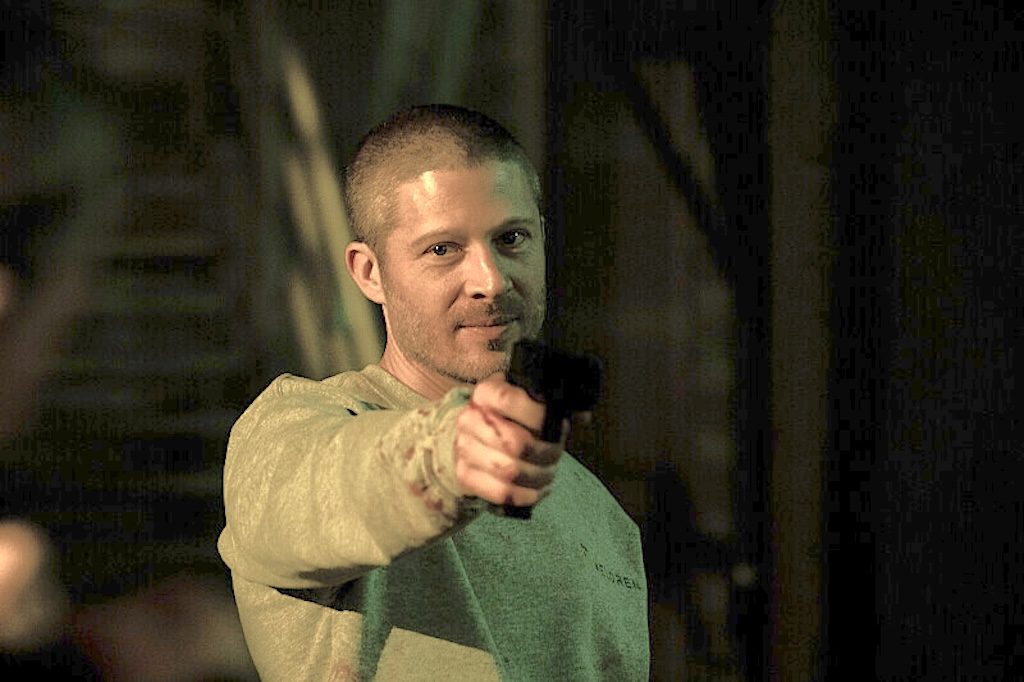
Elias Voit (Zach Gilford) Photo by Michael Yarish/ Paramount+
Season 18 ended with a chilling cliffhanger with Elias Voit. How did that inform your approach to Season 19?
Going back to the new title of the show, it’s not just the evolution of a serial killer, it’s the evolution of a team who’s been fighting serial killers.
We just kept challenging them every season with something that we hadn’t seen them deal with for more than maybe an episode. So now, there are 30 episodes with Elias Voit (Zach Gilford). We jumped ahead a whole year story-wise, and that allowed our character journeys to have room to breathe. But also, what does it look like now for Elias Voit? This killer who was in the shadows for so long now has a podcast named after him.
What does that do to a team who really wants nothing to do with this guy, but they are doing the due diligence of the BAU, which is to interview serial killers. Tara Lewis (Aisha Tyler) has taken that on. What other stories could we tell in that space? What happens when serial killers get fans?
Some fans are enamored with him and want to marry him. But others want to emulate and usually outdo them in some way. We really wanted to explore that this season.
We wanted to make sure we’ve said everything we wanted to say about what this journey is within the team’s exploration into a criminal mind. We’ve really explored this character in every which way. We made him the worst of the worst.
We made him a husband and a father, and then a husband and father who lost everything, who then doesn’t even remember he was a bad guy. And then you feel sorry for this guy. But how can I feel sorry for him when you do that through the characters who are very aware that the world is not black and white?
There’s a lot of gray. Penelope Garcia (Kirsten Vangsness) feels for this guy. She can’t really turn that off, even though she knows he’s done horrible things. This is a human who now has to live with the consequences of what he’s done. It is just a more conflicted view than we’ve ever been able to give our team before. And that excited us. It’s like Donnie Brasco.

Join the Discussion!



Browse our Videos for Sale
[woocommerce_products_carousel_all_in_one template="compact.css" all_items="88" show_only="id" products="" ordering="random" categories="115" tags="" show_title="false" show_description="false" allow_shortcodes="false" show_price="false" show_category="false" show_tags="false" show_add_to_cart_button="false" show_more_button="false" show_more_items_button="false" show_featured_image="true" image_source="thumbnail" image_height="100" image_width="100" items_to_show_mobiles="3" items_to_show_tablets="6" items_to_show="6" slide_by="1" margin="0" loop="true" stop_on_hover="true" auto_play="true" auto_play_timeout="1200" auto_play_speed="1600" nav="false" nav_speed="800" dots="false" dots_speed="800" lazy_load="false" mouse_drag="true" mouse_wheel="true" touch_drag="true" easing="linear" auto_height="true"]







You must be logged in to post a comment Login