
“Spider-Man: Brand New Day”: Screenwriters Chris McKenna and Erik Sommers on Peter Parker’s Lonely New Chapter

Spider-Man: Brand New Day (Spider-Man 4 in the modern series of the franchise) marks the next major stage in Peter Parker’s (Tom Holland) MCU journey. Following the reality-altering events of Spider-Man: No Way Home where all memories of Peter Parker are erased, Peter is entering a new chapter defined by sacrifice, isolation, and the challenge of rebuilding his life as both Peter Parker and Spider-Man.
Peter is living alone in New York five years after Doctor Stephen Strange erased his identity from the world via a spell that unleashes the multiverse. He is fighting crime anonymously while his powers diminish following DNA changes.
Peter also re-meets his girlfriend Mary Jane “MJ” Watson (Zendaya) and his best friend Ned Leeds (Jacob Batalon) without revealing his true identity.
The screenplay was written by Chris McKenna and Erik Sommers, the writing team behind the modern Spider-Man trilogy. Their previous collaborations include Spider-Man: Homecoming, Spider-Man: Far From Home, and Spider-Man: No Way Home.
In this interview with Creative Screenwriting Magazine, McKenna and Sommers discuss the creative direction of Spider-Man: Brand New Day, Peter Parker’s maturation and emotional evolution, and the challenge of moving the character forward after one of the MCU’s most consequential endings.
Discuss the significance of the title Spider-Man: Brand New Day
Erik: Well, obviously, this is a new start for Peter.
We ended the last movie in a place where nobody knows who he is. He’s forgotten. On top of that, we’re starting this movie after some time has passed. He’s in that period of life that we all go through where we’ve moved out of home. We’ve gone off to college, or the military, or a job, or whatever it may be. It’s a totally new kind of life.
You’re expected to be more of a grown up now. Things are complicated in a way that they never were. It really is a new start. It’s a whole new chapter. The creative team was looking for a name that would capture that.
Ultimately, the name Brand New Day was just too appealing. We knew we didn’t want to keep going with the usage of the word “home” in the titles. That was a trilogy that we were done with.
Coming up with a name for your movie is hard. It’s like coming up with a name for your kid. You sit around, you put a lot of thought into it, you overthink it, you underthink it, and you go around and around. Ultimately, the creative team decided that Brand New Day is fitting.
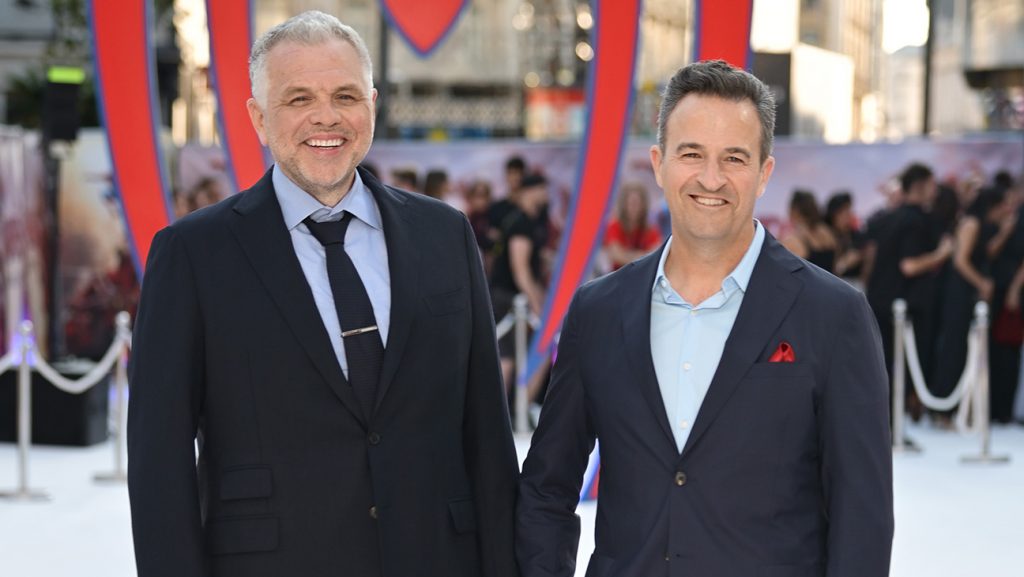
Chris McKenna and Erik Sommers. Photo by Eamonn M. McCormack/ Getty Images.
Related: Chris McKenna & Erik Sommers Talk “Spider-Man: Far From Home”
Chris: Obviously, there was the famous 2008 comic based on The Amazing Spider-Man that had that title. That dealt with the erasure of Peter’s past and his marriage to Mary Jane.
But I think for us, we didn’t have to carry that baggage. There were similarities in terms of only certain things being erased. But as the story unfolded, there wasn’t a complete reset in a lot of ways.
It was a continuation of Peter Parker’s story and the saga that was going on. Much of the movie, metaphorically, is about closing a chapter in his book, and him having a really hard time doing that. I think Brand New Day is meaningful for the beginning of the movie, but also the ending of the movie.
I think by the end, Peter’s gotten through what he needed to get through, so he could actually have a brand new day and move forward.
Related: No Cookie-Cutter One-Liners – Spider-Man: Homecoming
Much of Peter Parker’s emotional struggles lie in his balancing his identity with Spider-Man. Discuss his headspace now that Peter Parker is forgotten and he’s only a superhero.
Chris: We inherited the end of No Way Home, where the identity of Peter Parker was erased. Everyone that knew him suddenly forgot him.
It really was the metaphorical death of Peter Parker. He was forced, or he allowed himself, to embrace only one element of his identity. Without Peter Parker, he throws himself into Spider-Man. He has no life outside of it. He denies his human side in a noble way.
Coming off of the tragic ending of No Way Home, in terms of what happened to Mary Jane, he knows that people he loves are endangered. He knew, looking at the scar on her in Brand New Day, knowing what they had gone through, what they had almost died doing, he couldn’t endanger his loved ones anymore.
But psychologically, it’s really about thinking you can compartmentalize things in your life. It’s almost like a Freudian way of saying, this is bad, this is good, and I’m going to deny the bad parts, and I’m only going to do the good parts.
And then, you have the Jungian, the shadow self. That’s the idea that there are elements of ourselves, of our personalities, that don’t necessarily fit into good and bad, when he goes to Bruce Banner (Mark Ruffalo).
If Peter can just suppress the bad things, then he can have his life be ordered in the way he wants it. But you can’t control those things, or you shouldn’t be able to control them. Those things are essential to your essence and they have to be integrated.
Brand New Day is a story of integration. How do you integrate these parts of your personality, these angry parts, these sad parts, these grieving parts, and get to a place where you’re making yourself whole without chopping off part of yourself? Peter’s being dragged by his metamorphosis and he hates it. He’s trying to stop the change, but then ultimately has to embrace it.
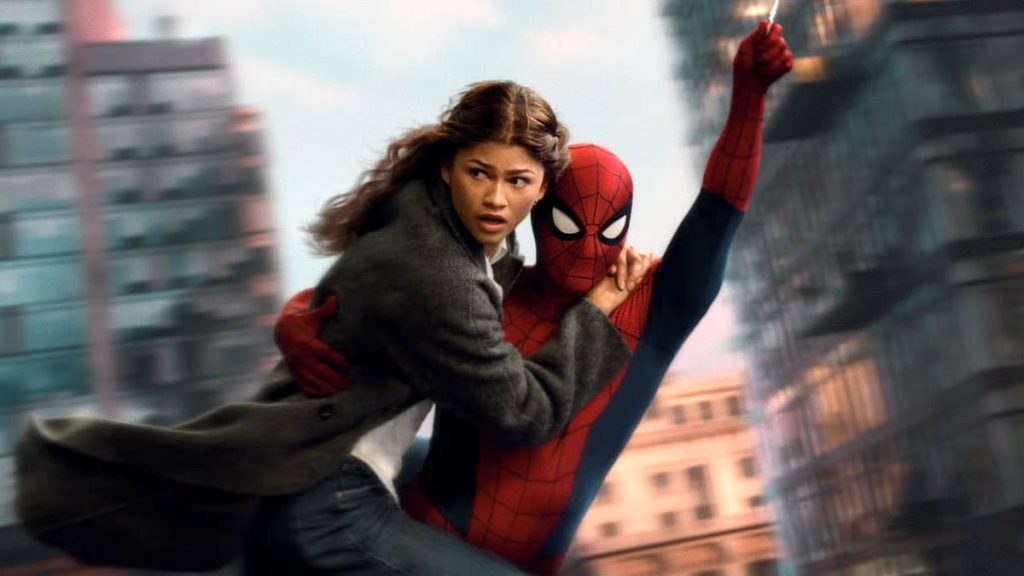
MJ (Zendaya) and Spider-Man (Tom Holland) Photo courtesy of Sony Pictures
Related: Tracking The MCU Mythology Of “Captain America: Brave New World”
How rigid is your creative writing process in Spider-Man: Brand New Day?
Erik: If you’re talking structurally, then certainly there are certain benchmarks that we’re all used to seeing in films, especially a film where you’ve got an adventure, a hero and a villain.
There are certain benchmarks that you’re accustomed to seeing and writing. The challenge is to keep focused on what’s the best story for this person. In the process, there are so many ideas being thrown around. Sometimes it’s everyone falling in love with a certain action sequence, a perfect midpoint, or beat at the end of act two. And then all is lost.
You have to constantly remind yourself, ‘I can’t fall in love with that. We just need to keep thinking about this story.’
Once we’re sure what story we’re telling and what emotional beats we’re hitting, then we can start to land on plot elements, hitting those benchmarks and figuring out where that awesome action sequence would go.
Is there a place for it at all or do we have to say goodbye to it?
It’s really about trying to keep your eye on that ball of this emotional story and making sure you’ve got that as locked in as you can before you start thinking about any of those other elements.
Chris: When I first started getting into screenwriting, I read William Goldman’s Adventures in the Screen Trade and he had a chapter on structure. I didn’t get it. He told me to get it because structure is everything.
I’m like, ‘What are you talking about? No, it’s dialogue. It’s these scenes. It’s these characters.’
It took me a while until it finally hit. After beating my head against the wall on my umpteenth script, I suddenly understood structure. It is the rhythms of our human experience.
It’s the hero myth, the beginning, middle and end, the Goldilocks of it all, why those resonate with us.
Once you start thinking about structure in screenwriting, you have the tools because you can be so cast adrift without them.
It’s one thing to know where to play, and another, how to play. Once you start planting those important flags, it really gives you landmarks in the script to be heading towards. If you don’t know what those things are because you don’t like to get hemmed in, knowing where those landmarks should be can be great when you are really lost.
I know we have to get to this midpoint where things will pivot, but we haven’t found out that great pivot point yet. I know we need a real great low point here and we haven’t figured out what that is.
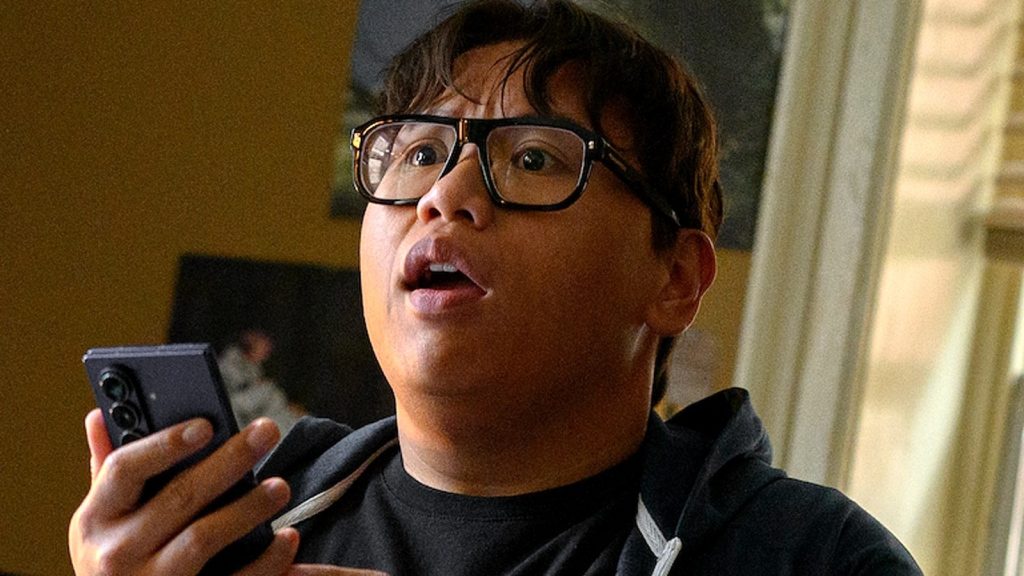
Ned Leeds (Jacob Batalon) Photo courtesy of Sony Pictures
Part of Peter Parker’s internal journey is figuring out the cost of being Spider-Man. How does this take its toll on him?
Chris: He reacted in the extreme.
It was for noble purposes, cutting out human relationships from his life.
That was always a balance in the screenplay because we didn’t want him to be too close to anyone. He has a persona where he can go out and do things, but his own life is empty, lonely and isolated.
Erik: I think in the plainest sense, Peter has given up so much of his humanity that the spider side of him is starting to fill that vacuum. And thus, we see the transformation. Peter always has this struggle between his Spider-Man and his Peter Parker self.
And this was a way to show how difficult it was, especially in this stage of his life. He reaches a place where he has to learn that he can’t suppress his spider side and that he can’t use an inhibiting device of his own making to suppress these symptoms.
He needs to embrace both sides of himself. He needs to go through rather than around. Only then can you reach a catharsis where he can once again find a balance between Peter Parker and Spider-Man.
Related: Beyond Worlds: How to Write a Mind-Bending Multiverse Movie
Discuss how Aunt May still shapes Peter Parker?
Erik: One of the great revelations that the creative team had was realizing that Jean Grey (Sadie Sink) and Peter Parker both acquired powers when they were teenagers. Peter was bitten by a spider. Jean Grey was a mutant and her power started to manifest during her teenage years.
They received completely opposite reactions from their loved ones completely opposite reactions. Jean was rejected, abandoned and cast out into the world to fend for herself. Peter was the exact opposite and comforted and supported by his Aunt May, even in spirit.

Join the Discussion!



Browse our Videos for Sale
[woocommerce_products_carousel_all_in_one template="compact.css" all_items="88" show_only="id" products="" ordering="random" categories="115" tags="" show_title="false" show_description="false" allow_shortcodes="false" show_price="false" show_category="false" show_tags="false" show_add_to_cart_button="false" show_more_button="false" show_more_items_button="false" show_featured_image="true" image_source="thumbnail" image_height="100" image_width="100" items_to_show_mobiles="3" items_to_show_tablets="6" items_to_show="6" slide_by="1" margin="0" loop="true" stop_on_hover="true" auto_play="true" auto_play_timeout="1200" auto_play_speed="1600" nav="false" nav_speed="800" dots="false" dots_speed="800" lazy_load="false" mouse_drag="true" mouse_wheel="true" touch_drag="true" easing="linear" auto_height="true"]







You must be logged in to post a comment Login