
‘Stuart Fails to Save the Universe’: The Big Bang Theory Spinoff That Gets Expansion Right

The spinoff of The Big Bang Theory on HBO Max, Stuart Fails to Save the Universe, has a tricky needle to thread; expand one of network television’s most recognizable sitcom worlds without merely recreating its apartment-set rhythms, romantic pairings, and scientific punchlines.
It represents a tonal and structural shift from origin stories toward character-led genre experimentation. It’s migrated from multi-cam to single-cam comedy. Its altered aesthetics have also altered its thematic nucleus.
Created by Chuck Lorre, Bill Prady, and Zak Penn, the series places Kevin Sussman’s Stuart Bloom at the center of a multiverse story after he apparently damages a device built by Sheldon (Jim Parsons) and Leonard (Johnny Galecki). Stuart, Denise (Lauren Lapkus), Bert (Brian Posehn), and Barry Kripke (John Ross Bowie) must repair it, and reality itself, before ‘the universe’ collapses. No pressure.
That engine of Stuart is not simply more The Big Bang Theory. It cannot be Big Bang 2.0. Otherwise it will surely fail. It is a test case in what a spinoff TV series should do: inherit a world, then find a new dramatic engine that is sufficiently distinct from the original to be autonomous. At the same time, it tosses in enough references to pay homage to the source.
What is a spinoff TV series supposed to do?
A spinoff takes a character, relationship, location, institution, or premise from an existing show and makes it the organizing principle of a new one. A spinoff has the freedom to explore characters, situations, or nuances that don’t naturally fit into the original.
A supporting character cannot just be shoe-horned into a spinoff because audiences recognize them. They need to generate and sustain story at a series level. Stuart, the unlucky comic book store owner, has his chance to save the world. Will he bumble over the finish line?
That distinction separates a viable expansion from a branded remake. It can’t be the same show with a new wrapper.
Successful spinoffs use references to the original show to reward long-term viewers without alienating newcomers. The Big Bang Theory spinoff strategy treats the original show’s history as “lore” rather than “plot.”
Frasier (the original) remains the textbook example of writing a spinoff. Kelsey Grammer’s Dr. Frasier Crane was already a beloved Cheers character, but the new series did not transplant the bar’s ensemble dynamics to Seattle. Creators David Angell, Peter Casey, and David Lee rebuilt Frasier around a different family structure, a new workplace, and a more sophisticated comic arena: status anxiety, high culture, sibling rivalry, and parent-child friction.
Frasier transformed Cheers’ resident psychiatrist into the lead of a sophisticated family comedy about ego and emotional repression.
The remake of Frasier was the next chapter in the Dr. Crane’s snobbish life rather than an overhaul.
Likewise, Better Call Saul did not make Saul Goodman into Walter White 2. Vince Gilligan and Peter Gould shifted the dramatic question from “How far will a decent man fall?” to “Why does an intelligent, morally flexible lawyer choose a life of crime?” It serves more as an origin story of an iconic character – and his transformation from Jimmy McGill to a shoddy lawyer for shady people. Despite the departures from the source, they were close to home.
A Big Bang Theory spinoff has to make a similar choice. It cannot rely on particle physics, comic-book references, science nerds (one of whom gets the blonde chick) and a Sheldon cameo to relive the old show’s effect.

Bert Kibbler (Brian Posehn) Photo by Colin Remas Brown/ HBO Max
The series engine matters more than Stuart’s familiar face
Stuart was effective on The Big Bang Theory because he occupied a specific comic station. He was the sad-eyed proprietor of a failing comic shop; a man whose neediness and precarious finances made the core group look comparatively functional. He was the bridge between nerdom and fandom; united by social anxiety.
Notably, he is not a physicist. He is an outsider far removed from the genius-verse. The tone is warmer, less competitive, and more vulnerable.
That is an endearing supporting-character function. It is not automatically a protagonist role. Stuart was never the guy who lived down the hall or worked in adjacent lab. He was never a guest in Big Bang. He occupied his own space and therefore not interchangeable with other guest characters. In fact, the core cast regularly visited his turf.
For Stuart Fails to Save the Universe to work, Stuart needs agency rather than just ongoing misfortune. He can’t simply be a loser that audiences laugh at. He has to have potential to succeed to keep audiences invested. If not in this universe, then perhaps another one.
The multiverse premise gives him that option to lead. A man accustomed to being the overlooked bystander now has to make consequential decisions in an existential crisis. The stakes couldn’t be higher. His inadequacy becomes the source of story, not simply a punchline delivered at his expense. He drives the story rather than the other way around.
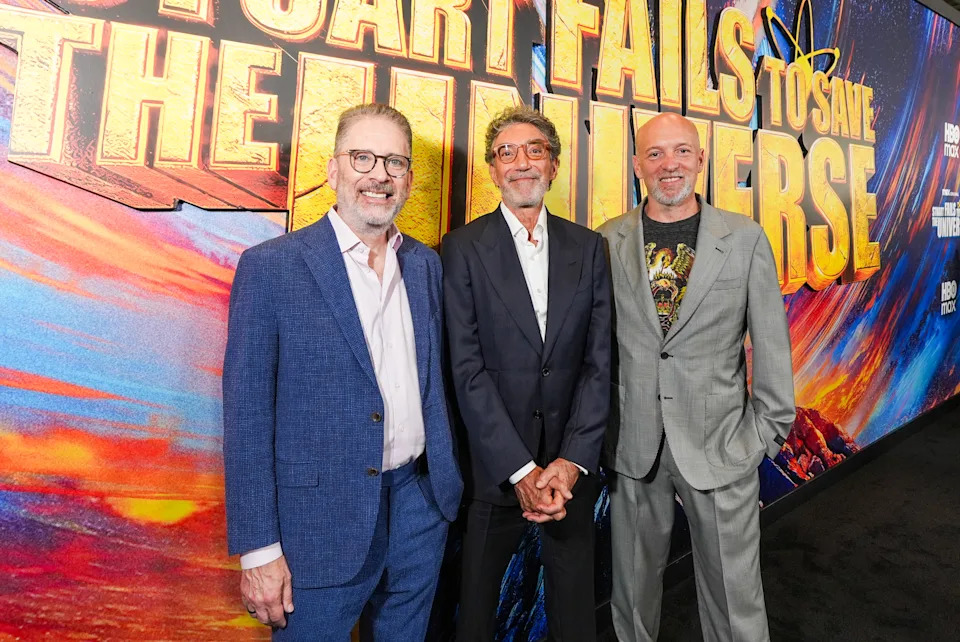
Bill Prady, Chuck Lorre and Zak Penn. Photo by Presley Ann/ Getty Images for HBO
Why the spinoff of The Big Bang Theory needed a genre shift
The premise for Stuart Fails to Save the Universe is a smart formal departure from the source material. It’s more than the kids go to college or open a chain of comic book cafes. It had to be a schism rather than moving to a neighboorhood adjacent to Pasadena.
The look, feel, and scope of the show is loud and pronounced with only faint strains of familiarity.
It moves from a multicamera-adjacent, relationship-driven sitcom tradition into science-fiction adventure territory, using the franchise’s existing love of comics, physics, fandom, and genre storytelling as a neat bridge.
That familiarity is crucial. A spinoff needs enough continuity to feel earned, but enough difference from the source to justify its existence.
The multiverse is not automatically a creative solution. It can be a license for empty nostalgia, alternate versions, and callback-heavy plotting. Not to mention, endless cameos or Comic-Con appearances. But in the right hands, it creates an engine capable of generating multiple episode stories: broken timelines, altered character histories, unexpected worlds, impossible moral choices, and escalating consequences.
All are in service to the show’s title. Stuart’s nerd factor is less of a hindrance. He “claims” Denise as his beloved as he asserts his confidence.
Zak Penn’s involvement is notable here. Penn’s credits include Ready Player One, The Avengers, and X2, projects that understand the workings of franchise-scale genre mechanics. He is more of a big-picture overseer of worlds than deciding on what Kripke or Denise do next.
The best version of this premise uses the multiverse as a character driver. Stuart should not merely encounter random, bizarre realities. Each reality should expose a fear, flaw, or fantasy he has avoided in the ordinary world.
Even the forced reality of everyone being nice to each other has thematic roots beneath its comic premise.
Furthermore, Stuart can’t simply press a “hyperspace” button to escape to another random universe if things get too uncomfortable in his current one. The time/ space device needs quirks and bugs as Stuart figures it (and his life) out.
The genre spectacle must alter the emotional stakes, not tease them. The multiverse can’t be a stylistic CGI gimmick to make the show look cool.
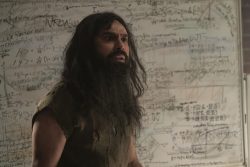
Raj Koothrappali (Kunal Nayyar) Photo by Colin Remas Brown/ HBO Max
Stuart, Denise, Bert, and Barry are a new ensemble
The central cast choice is arguably the show’s strongest decision. Rather than pulling Leonard, Penny, Sheldon, Amy (Mayim Bialik) or Bernadette (Melissa Rauch) back into weekly lead roles, or even cameos, the series elevates characters who have not already exhausted the franchise’s architecture.
Stuart has an established point of view: he is insecure, empathetic, observant, and usually one bad month away from disaster. Denise offers a sharper counterweight. She is not merely “Stuart’s girlfriend”; she is grounded, direct, and more emotionally capable of identifying the self-defeating habits he rationalizes.
Bert and Barry add a useful contrast in comic energy. They bounce off and nourish each other. Geology will reclaim its place as a major science and
“Bawwy” might eventually learn to pronounce his Rs.
Bert is fundamentally sincere. His social awkwardness tends to be open rather than purposed to generate laughs. Barry, by contrast, turns resentment into performance. Kripke has always worked because his pettiness has the confidence of a man who mistakenly believes he is the smartest person in the room.
That combination can create a different ensemble grammar from the original series. The core The Big Bang Theory group was often built around intellectual one-upmanship, romantic (im) maturation, and the friction between insular friends and the wider world.
This quartet has a more unstable alignment to send the universe into a range of potentialities: a reluctant hero, his pragmatic partner, a loyal optimist, and an abrasive wildcard. A strong writers’ room can use that instability structurally.
Stuart and Denise can carry the emotional spine. Bert can provide empathy and unexpected competence. Barry can create complications that are not forced because his jealousy, vanity, and competitiveness make him predictably unpredictable.
The writing challenge is to ensure that every character has a distinct problem-solving method and way of analyzing their environment. If all four simply react to the next multiverse complication, the show becomes plot delivery. If their clashing methods actively create the complications, it becomes comedy.

Lord Barry Kripke (Kevin Sussman)
Legacy cast should be story leverage, not life support
The term “spinoff” carries different weight in 2024 than it did when Young Sheldon debuted in 2017. That show was a prequel, mining nostalgia and character origin mythology.
Stuart Fails to Save the Universe operates as a lateral expansion — same universe, new stakes, deliberately minor characters from the parent show elevated to leads.
The series’ premise is explicitly connected to inventions by Sheldon Cooper and Leonard Hofstadter, and HBO Max has indicated that familiar faces from the original world may appear either physically or in spirit.
Guest appearances work when they change the protagonist’s immediate objective or expose an unresolved tension. They fail when they exist solely to trigger applause and ratings.
Young Sheldon understood this balance unusually well. Although Jim Parsons narrated as adult Sheldon, the show did not depend on recurring appearances from The Big Bang Theory cast. It built its own emotional ecosystem around the Cooper family, 1980s East Texas culture, Mary and George’s marriage (a spinoff of a spinoff show), Meemaw’s independence, and the excitement of knowing where Sheldon’s childhood eventually leads.
That autonomy allowed Young Sheldon to become more than a prequel. It became a family comedy-drama with a different tone, pacing, and emotional timbre from its parent series. Notably, the thread linking the two always lingered in the background.
Young Sheldon leveraged Jim Parsons’ voice narration and Iain Armitage’s uncanny performance as Young Sheldon to justify its existence as “the Sheldon origin story.”
The Big Bang Theory itself spawned multiple failed spinoff pilots. What separated the winner from the rejects wasn’t superior craft alone — it was thematic clarity. Young Sheldon asked: “What made this brilliant, impossible man?” *Stuart* asks: “What about the people on the margins of genius?” This dabbles into themes of greatness – destiny or delusion.
The later series Georgie & Mandy’s First Marriage faced a related challenge: can a character who worked within the Cooper ensemble anchor a new domestic comedy? Its answer depends on whether Georgie and Mandy’s marriage, parenthood, finances, and extended-family pressures create fresh repeatable conflict— not whether viewers remember Medford.
For Stuart Fails to Save the Universe, Sheldon, Leonard, Penny, Amy, Raj, Howard, or Bernadette might appear only when the story gains a complication that the new ensemble cannot provide. Or even a well-placed bottle episode.
Stuart Fails to Save the Universe takes a harder stance on cameos. They are not guest appearcances to reignite a nostalgic flame. The original Big Bang cast appears minimally, and when they do, it’s not as saviors or narrative anchors. Kaley Cuomo is vicious and violent; a far cry from the sweet Penny we know.
This judicious restraint matters because legacy casting creates what we might call “gravitational distortion.” The audience’s attachment to established characters becomes a irritable weight that crushes the new show’s voice.
Younger viewers don’t know Stuart Bloom as Kevin Sussman; they’re encountering him as the protagonist of his own narrative. Older viewers need to accept the tonal shift. That’s only possible if the show isn’t constantly reassuring them that the original is still the center of gravity.
These three shows illustrate a spectrum of spinoff strategies:
– Character‑focused prequel (Young Sheldon).
– Peripheral‑character continuation (Georgie & Mandy).
– Side‑character genre pivot (Stuart).
References to Big Bang Theory are not story: the spinoff versus ripoff test
A spinoff becomes a ripoff or knockoff when it loosely copies the surface features of an earlier success without understanding the underlying dramatic design.
That usually looks like this: familiar catchphrases, repeated sets, archetypes reconfigured as substitutes (perhaps a gender role switch), callbacks mistaken for jokes, and plots that reset because the new series has no independent emotional thesis.
Writers developing an extension of existing IP should ask a harder set of questions:
What can this show do that the original could not?
The answer cannot be “show more adventures with characters audiences already know.” It needs to identify a new storytelling territory unexplored in the original format.
The Big Bang Theory could make superhero mythology, scientific theory, and fandom part of its social comedy. Stuart Fails to Save the Universe can literalize those imaginative spaces. That is a genuine formal distinction.
What is the protagonist’s recurring wound?
Stuart’s likely wound is not simply low self-esteem. That is too broad and reductive to sustain a season. The more useful question is whether he believes he is fundamentally a supporting player in other people’s lives. And whether he has the capacity to save the universe despite the show’s title.
A multiverse narrative can repeatedly challenge that belief. Every crisis asks Stuart whether he will retreat into passivity, defer to someone “more qualified,” or accept responsibility before he feels ready.
That is a series-sized internal conflict. Can he get out of his own way and take charge?
What does the new show risk losing?
The parent series’ comfort is often the first thing a spinoff must sacrifice. The original’s group chemistry, familiar rhythms, and recognizable locations may be precisely what made it popular. Yet repeating them can make the new series feel like a diminished imitation.
What writers can take from Stuart’s multiverse gambit
The most encouraging aspect of Stuart Fails to Save the Universe is that it treats the supporting character’s limitation as the premise’s fuel. Stuart is not the obvious person to save anything. That is why he is dramatically useful and interesting.
The project also recognizes a basic franchise truth: audiences will follow a world into a new genre if the transition honors and expands the source material’s emotional logic.
A comic-book-store owner, a geologist, and a Caltech physicist caught in a multiversal emergency is not a random pivot for The Big Bang Theory universe. It is an expansion of interests that were always present in the background – not a quantum leap.
The final point is the commercial and creative test. A franchise audience may open the door and generate ‘new show’ buzz, but a series survives because viewers understand what they are returning for each week.
If Stuart Fails to Save the Universe can make Stuart Bloom’s anxious, underdog perspective essential rather than incidental, it will have done what the best spinoffs do: prove that a familiar universe still contains a story its original series could not tell.

Join the Discussion!

Browse our Videos for Sale
[woocommerce_products_carousel_all_in_one template="compact.css" all_items="88" show_only="id" products="" ordering="random" categories="115" tags="" show_title="false" show_description="false" allow_shortcodes="false" show_price="false" show_category="false" show_tags="false" show_add_to_cart_button="false" show_more_button="false" show_more_items_button="false" show_featured_image="true" image_source="thumbnail" image_height="100" image_width="100" items_to_show_mobiles="3" items_to_show_tablets="6" items_to_show="6" slide_by="1" margin="0" loop="true" stop_on_hover="true" auto_play="true" auto_play_timeout="1200" auto_play_speed="1600" nav="false" nav_speed="800" dots="false" dots_speed="800" lazy_load="false" mouse_drag="true" mouse_wheel="true" touch_drag="true" easing="linear" auto_height="true"]







You must be logged in to post a comment Login