
Teddy Schwarzman on Producing “Train Dreams”: The Challenges of Getting the Film Made and How He Broke Into Hollywood

- Interview: Lars Knudsen on Launching “Bugonia”, Indie Film Producing, and Working with Ari Aster
- Jerry Bruckheimer on “F1: The Movie,” Working with Brad Pitt, and Breaking into the Movie Business
- Guillermo del Toro’s “Frankenstein”: The Journey of Creation
- How Producer Pippa Harris Overcame the Challenges of Making “Hamnet” — And How She Launched Her Film Career
- Eli Bush on Producing “Marty Supreme”: From Columbia Economics to Period Filmmaking in New York — Challenges & Insights for Producers
- Sara Murphy on Producing “One Battle After Another”: Challenges, Beginnings, and Behind-the-Scenes Insights
- Andrea Berentson-Ottmar on Overcoming the Challenges of Producing “Sentimental Value” and Breaking into Film
- Teddy Schwarzman on Producing “Train Dreams”: The Challenges of Getting the Film Made and How He Broke Into Hollywood
- Sev Ohanian on Producing “Sinners”, Working With Ryan Coogler, and How He Got His Start in Hollywood 🎬
- Producer Miri Yoon Reveals the Challenges of Making “Weapons” and Shares Her Journey to Success in Film Production
Train Dreams is a poignant adaptation of the novella by Denis Johnson, telling the sparse and deeply internalized story of Robert Grainier, a railroad laborer in the early 20th-century American Pacific North West. His quiet life is marked by profound love and devastating loss amid the rapid industrialization of the frontier which has left him uncertain. The film stars Joel Edgerton in the lead role, alongside Felicity Jones in this meditative portrait of solitude, resilience, and the passage of time and timelessness.
Producer Teddy Schwarzman discusses the key challenges in getting such a lyrical film made.
Reflecting on Train Dreams, the biggest challenge for Teddy was adapting such a subtle, contemplative novella into a compelling film. The story spans seventy years in the life of a logger, and nothing truly extraordinary happens to him — he leads a life that is, in many ways, entirely ordinary. In the process, Grainier goes through what we all experience in love and friendship, loss, pain, grief and healing, Also, the audiences hopefully experience the panoply of emotions that goes into what makes life special.
Tackling an adaptation like this felt incredibly daring. Teddy often said to his fellow producers, Marissa McMahon, Ashley Schlaifer, and Will Janowitz, who preceded him on the project, that embarking on a film with a logline, “A logger’s life over seventy years” was a bold move. The pitch was terrible. There was the concept of what this movie could be. There was no cast. There are no sweeping battles or world-shaking events — just the quiet accumulation of moments and memories.
Marissa, in particular, deserves credit for optioning the book and being willing to take on a story about one man’s unremarkable journey through time. Yet,in that ordinariness, lies the challenge: how do you convey the full spectrum of emotions that makes life meaningful, and do so in a way that feels cinematic and resonant?
Her producing team partnered with Clint Bentley and Greg Kwedar in adapting the screenplay for Sing Sing. Just as the team captured lightning in a bottle with the humanity of Sing Sing, they believed there was a way to bring similar depth and universality to this.
Once the producers committed to the project, the next major hurdle was the budget. Making a period film is always expensive, and they set their sights on a $7.25 million budget — a number Teddy is still not exactly sure how they landed on. From there, the questions multiplied: How do they get our actors to work for scale/ freee? How do they maximize their resources? The director of photography wanted to shoot in a 4:3 TV aspect ratio, which meant they’d have a visually striking epic — but in a much smaller frame than Teddy had imagined. On top of that, they decided to shoot exclusively with natural light, which limited them to a certain number of shooting hours each day. That made scheduling a constant challenge.
Mounting the production was, in itself, a significant feat. They faced numerous setbacks during pre-production. Teddy remembers all of the producers signing off on the budget during the first day of production, only to have their line producer say, “By the way, we’ve exhausted our contingency and are already over budget.” Suddenly, they had to restructure every single department. They cut back on set dressing, scaled down the production design, and swapped out certain elements — like some trees for more accessible options. Teddy was confident the audience would never notice these changes, but every small decision weighed heavily.
They had to ensure that they were still capturing Clint Bentley’s vision with the resources they had. This led to some difficult conversations about possibly removing some major set pieces. Teddy thought about what their “action sequences” actually were: a log rolling down a hill, a man climbing a tree with a belt. These were the small moments that carried weight in the story. They couldn’t eliminate them. Each choice was made under these constraints was about creating a world that felt larger than just one man or one family — a world the audience could get lost in, that felt organic to the Pacific Northwest, and allowed viewers to experience an intimate journey that might resonate in unexpected ways.
During the Sundance screening, the entire production team crossed their fingers and said,”We hope people feel this.”
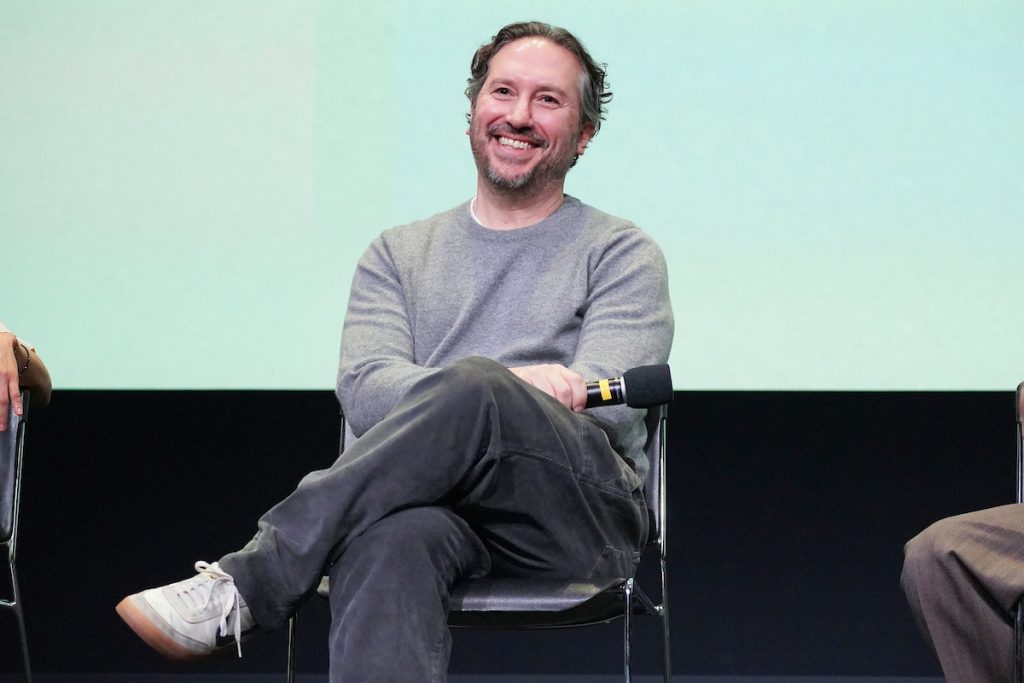
Teddy Schwarzman. Photo by Jordan Strauss
Getting Started in the Film Business
As a child, Teddy’s parents would drop him off at the movie theater, and he’d spend the entire day there — sometimes hiding in the bathroom between screenings so he could watch as many movies as possible with one ticket. He also had a weak immune system and was often home sick. During those times, he’d rent every Stephen King or Jerry Bruckheimer movie he could find, immersing himself in stories of all kinds. From an early age, he developed an obsession with narrative — how stories are told, and how they make us feel.
Academically, Teddy struggled. Through elementary school and college, He realized he was a terrible student at pretty much everything except story — whether in English or film classes. After graduating in finance, he ended up working at a bank, which he found incredibly boring. He was not only a poor student, but also a lackluster employee.
Then 9/11 happened, and it put everything in perspective. Teddy realized life was short and that he needed to figure out what he truly wanted to do. He devised a twenty-year plan: go to law school, study sports and entertainment law, build up his skills, become a corporate attorney, work at a large law firm, then move in-house at a major company like Time Warner, and eventually become general counsel. His hope was that, by impressing someone with his creative ideas, he could make the leap to the creative side of filmmaking.
Three years into that plan, he found himself practicing law — and realized his whole strategy rested on chance. He quit and started asking anyone how to get onto the creative side of film. Someone offered him a job as a producer’s assistant on a film Don Roos was directing, starring Natalie Portman. Teddy thought, “Producer’s assistant — that’s exactly what I want to do.” Of course, he quickly learned this actually meant being a production assistant. His job was to guard a crane in Central Park, often in freezing temperatures. His family, who remembered him as a lawyer just weeks earlier, visited the set and took photos of him bundled up from the cold.
Despite his humble start, Teddy knew he wanted to commit to this path. He eventually found work where he learned the ins and outs of independent filmmaking and production finance. He read every script he could get his hands on, honed his taste, learned about deal structuring from their legal team, and ultimately started his own production company.
Looking back, his journey into film was anything but straightforward. It was shaped by a willingness to start at the bottom, to make mistakes, and to keep learning. It took risk, resilience, and a deep love of storytelling — but every step, even the challenging ones, made Teddy a better producer.

Join the Discussion!



Browse our Videos for Sale
[woocommerce_products_carousel_all_in_one template="compact.css" all_items="88" show_only="id" products="" ordering="random" categories="115" tags="" show_title="false" show_description="false" allow_shortcodes="false" show_price="false" show_category="false" show_tags="false" show_add_to_cart_button="false" show_more_button="false" show_more_items_button="false" show_featured_image="true" image_source="thumbnail" image_height="100" image_width="100" items_to_show_mobiles="3" items_to_show_tablets="6" items_to_show="6" slide_by="1" margin="0" loop="true" stop_on_hover="true" auto_play="true" auto_play_timeout="1200" auto_play_speed="1600" nav="false" nav_speed="800" dots="false" dots_speed="800" lazy_load="false" mouse_drag="true" mouse_wheel="true" touch_drag="true" easing="linear" auto_height="true"]





You must be logged in to post a comment Login