
How Bruce Miller Adapted Margaret Atwood’s Novel “The Testaments” for TV

The Testaments, Margaret Atwood’s 2019 sequel novel set 15 years after The Handmaid’s Tale in a marriage prepartory school is adapted for television.
Created and showrun by Bruce Miller, the series reframes the Gilead story through the eyes of Agnes (Chase Infiniti), and Daisy (Lucy Halliday), while Aunt Lydia (Ann Dowd) remains central to the plot.
The series follows young teens Agnes, dutiful and pious, and Daisy, a new arrival and convert from beyond Gilead’s borders. As they navigate the gilded halls of Aunt Lydia’s elite preparatory school for future wives, a place where obedience is instilled brutally and always with divine justification, their bond becomes the catalyst that will upend their past and forge their future.
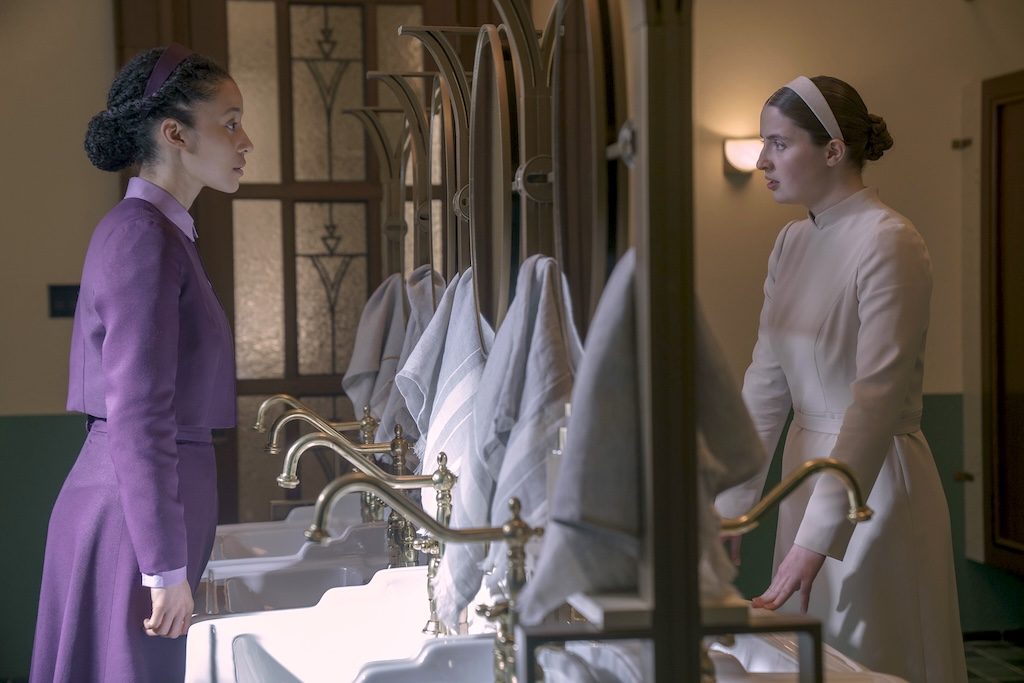
Agness (Chase Infiniti) and Daisy (Lucy Halliday) Photo by Disney/ Steve Wilkie
The series also stars Mabel Li, Amy Seimetz, Brad Alexander, Rowan Blanchard, Mattea Conforti, Zarrin Darnell-Martin, Eva Foote, Isolde Ardies, Shechinah Mpumlwana, Birva Pandya and Kira Guloien.
The dystopian drama television adaptation compresses timelines and alters some character ages and relationships, but preserves the novel’s core themes of resistance, surveillance, and female agency.
Writing Margaret Atwood’s Gilead’s Sequel
At the end of The Handmaid’s Tale 6 seasons, Gilead’s power had been seriously undermined. The Testaments picks up in the aftermath and explores how the regime endures and how a new generation might dismantle it. The series centers on Agnes (Hannah Bankole in Handmaid’s continuity) discovering her true identity and on Daisy’s undercover role with the Mayday resistance — plotlines that directly extend unresolved arcs from June Osborne’s (Elisabeth Moss) fight to free her children.
Bruce Miller intentionally kept June and other Handmaid’s-era figures in the orbit of the new story to provide emotional continuity while letting younger protagonists drive the coming‑of‑age and insurgent elements.
The showrunner spoke with Creative Screenwriting Magazine about The Testaments. He firstly points out that the title is deliberately plural to indicate that the story is told from multiple points of view – in this case Agnes and Daisy’s.
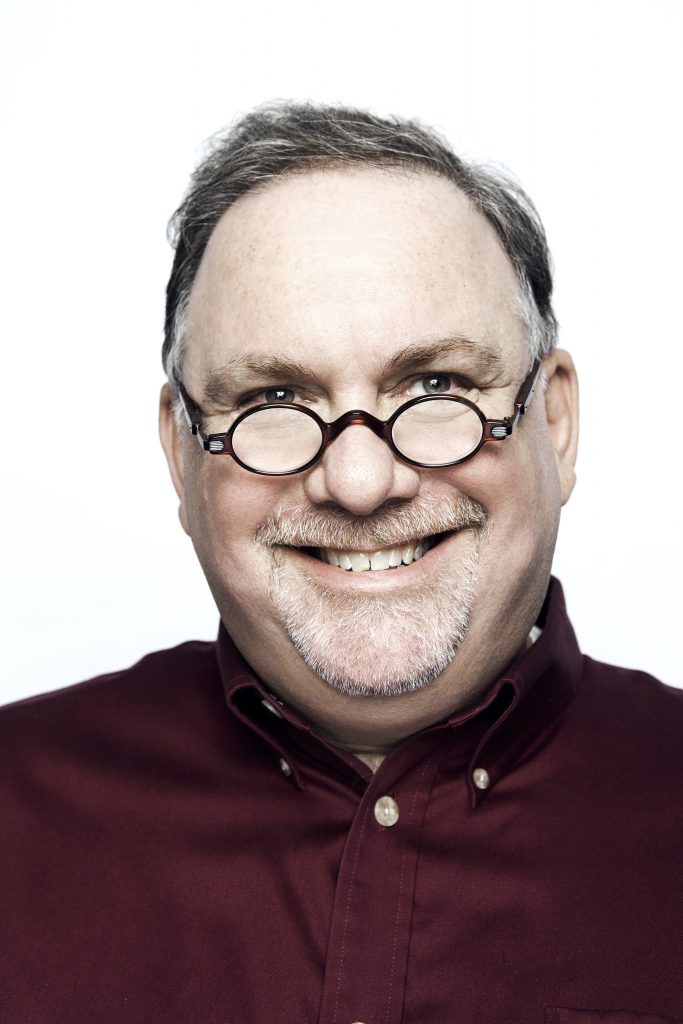
Related: Showrunner Bruce Miller Discusses ‘The Handmaid’s Tale’
The series is set 3 – 4 years after The Handmaid’s Tale show ended. Agnes lives with her parents in Maryland, outside of Annapolis. The themes of mother/child bonds, sacrifice, freedom, and humanity are common to both series to keep them connected.
Although Margaret Atwood wrote the novel, she was involved in the adaptation to a television series. Before the process began, Miller approached Atwood regarding the changes that he thought needed to be made in order for the series to narratively work.
Differences in adapting The Handmaid’s Tale and The Testaments
When Miller adapted The Handmaid’s Tale, he was simply adapting Atwood’s 1985 novel for television. The subsequent seasons all sprang from that book and season in terms of their natural character development.
“With The Testaments, I was trying to write a sequel to The Handmaid’s Tale television series while also adapting the sequel to the novel. It was a little tricky,” Miller recalls.
Bringing old and new Gilead characters to life
“All the characters in the Testaments are so rich it’s a privilege to get to help bring them to life. For Daisy, I really wanted to explore the idea of bravery,” Miller notes.
“The theme of sisterhood runs heavily through the novel and in the show. Daisy certainly learns lessons about sisterhood all along the way. For Agnes, the theme of awakening was at the fore a lot of the time.”
“And for the characters of Agnes and Hannah (Jordan Blake), I had been thinking about them for a dozen years while making The Handmaid’s Tale.”
“Hannah was so central to June and her story. I wanted to know everything about Agnes and her life. Aunt Lydia, who was such a Titanic character and terrifying in The Handmaid’s Tale, transformed through that story. She comes into The Testaments as an enigma, but I don’t think that’s new for Aunt Lydia. Ann Dowd plays her with such depth. She has always been a bit of an enigma with deep resources of cunning and intelligence that are startling sometimes,” the showrunner continues.
Writing Dark Subject Matter
“Gilead can be a difficult world, but so can ours. The Testaments is engaging because it’s about Hope. It takes place in a difficult sometimes terrible place but as long as the characters have hope, the material isn’t so dark,” Miller states.
Bruce Miller finds writing challenging, no matter what kind of story he’s trying to tell. Specifically, for The Testaments, the showrunner had to articulate the various points of view living in this oppressive misogynistic society.
Furthermore, Bruce isn’t a young women and can’t directly draw from his personal life experiences to write these characters. This is where he leans into the help from the other writers and the cast members to vicariously develop the characters in a complex and considered way. This is a key part of being a writer.
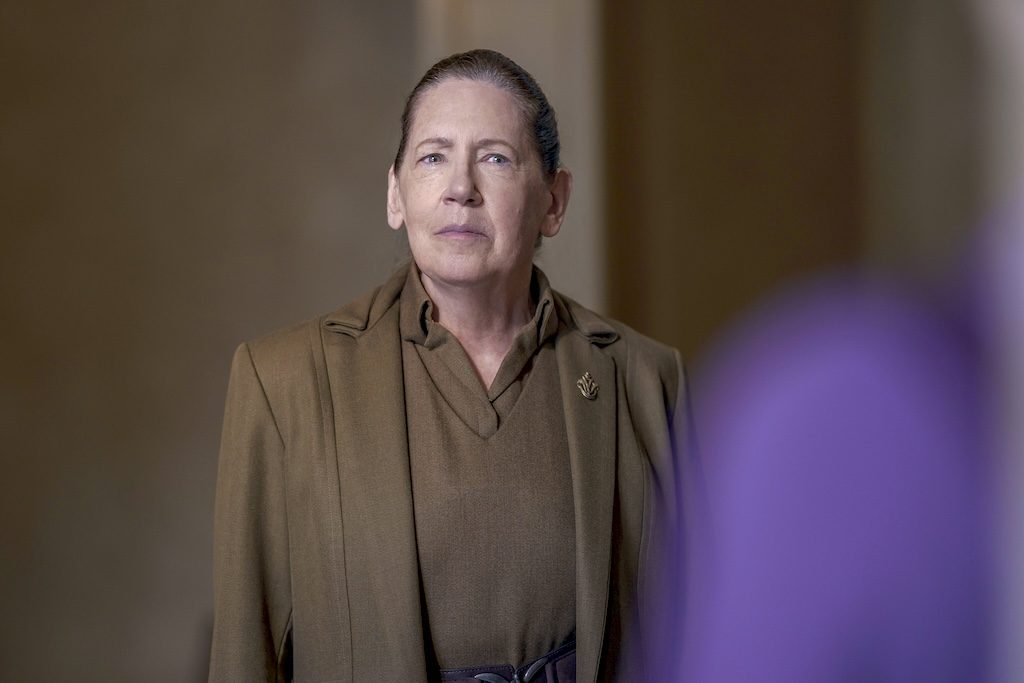
Aunt Lydia (Ann Dowd) Photo by Disney/ Russ Martin)
Related: Kira Snyder On ‘The Handmaid’s Tale’
Writing Daisy’s dialogue was of particular interest to Bruce.
“Daisy was interesting to write because the difference between her voice back in Canada, her voice in Gilead, and her voice in voiceover were so different from each other,” he mentions.
“For Agnes. It was just a pleasure and a privilege to try to bring Hannah’s voice to life. Like so many Handmaid’s fans it was important to me to start to hear this young woman who we have been thinking about for so many years.” The Testaments novel features Hannah Bankole – the biological daughter of June Osborne and Luke Bankole (O-T Fagbenle). She was taken away by a Commander and his wife and renamed Agnes.
The Testaments and The Handmaid’s Tale are both an indictment of the dire state of the current world. Both stories represent a chilling insight into a familiar fictitious world set in the past, but played out before our eyes.
Despite the oppressive cloud that hangs in the air, Bruce Miller believes in the adage, “The way out is through.”
“Look around, like Agnes does – what do you want to change?”

Join the Discussion!
Browse our Videos for Sale
[woocommerce_products_carousel_all_in_one template="compact.css" all_items="88" show_only="id" products="" ordering="random" categories="115" tags="" show_title="false" show_description="false" allow_shortcodes="false" show_price="false" show_category="false" show_tags="false" show_add_to_cart_button="false" show_more_button="false" show_more_items_button="false" show_featured_image="true" image_source="thumbnail" image_height="100" image_width="100" items_to_show_mobiles="3" items_to_show_tablets="6" items_to_show="6" slide_by="1" margin="0" loop="true" stop_on_hover="true" auto_play="true" auto_play_timeout="1200" auto_play_speed="1600" nav="false" nav_speed="800" dots="false" dots_speed="800" lazy_load="false" mouse_drag="true" mouse_wheel="true" touch_drag="true" easing="linear" auto_height="true"]




You must be logged in to post a comment Login