
Train Dreams: How Clint Bentley Transformed Denis Johnson’s Pulitzer-Nominated Novella into Cinematic Poetry

In the vast, quiet landscape of early 20th-century American logging, stories often go untold. Denis Johnson’s ethereal novella Train Dreams is one such story – a tender exploration of Robert Grainier’s life as an itereant logger that seemed to exist in the liminal spaces between nostalgia, myth, and harsh reality.
When filmmaker Clint Bentley (Sing Sing) first encountered the novella, he wasn’t immediately struck by its cinematic potential. It was just another contender for the Pulitzer Prize. But something about Johnson’s work lingered and endured. Bentley shares: “I fell in love with it immediately. Then I fell in love with Johnson’s writing and read everything. That was before I became a filmmaker.”
Director/Co-Writer Clint Bentley and actors Joel Edgerton (who plays Robert Grainier) and William H. Macy (who portrays Arn Peeples) discuss bringing this delightful story to the screen.
The Unexpected Journey to Adaptation
Years would pass before the novella would eventually find its way to the screen. The producers had secured the book’s rights and were searching for the right filmmaker to inject life into Johnson’s dreamy and meditative narrative.
Their protracted search led them to Bentley’s film Jockey, which premiered at Sundance in 2021. Something in his directorial approach – a delicate handling of interior landscapes, and a willingness to let gentle space and silence unfold the story struck a chord. Bentley finally reconsidered his position on Train Dreams. Maybe the novella had cinematic legs after all.
“It seemed like it had cinematic potential to it. It felt beautiful. The story of Robert Grainier really spoke to me. Even though it was about a man in the early 20th century, it was speaking to me in my life, I felt like he would speak to others as well,” Bentley recalls.
Finding the Quiet Humanity in Train Dreams
Joel Edgerton was drawn to the project long before he was approached. He had previously read Johnson’s novella independently, finding unexpected parallels to his own life as an actor. “Acting, while not the same as a lumberjack, is similar in that you’re away from home a lot. It’s very peripatetic. You’re in different places at all different times,” Edgerton muses.
“There’s something profound about a character who experiences so much, yet speaks so little,” Edgerton explains. “Robert Grainier isn’t performing his emotions; he’s living them. As an actor, that’s incredibly compelling.”
Edgerton confesses to his love of playing people that he’s not. In real life, he admits to being quite locquacious. That’s acting.
He continues: “I have two young kids. And I’m a husband. And I’m in love. So, there’s aspects of Robert that I really connect with. There’s the going away from home and asking yourself what it means to try and connect the economic part of your life with the connecting with your family, and how you reconcile those things.”
William H. Macy, who plays a supporting role, brought his own unique perspective. He’s an older character and shares his venerable wisdom. A woodworker in his personal life, he understands the complex relationship between humans and the natural world that Johnson’s novella explores.
“There’s something sacred about trees,” Macy reflects. “In this film, we’re not just telling a story about logging. We’re exploring humanity’s complex relationship with nature.”
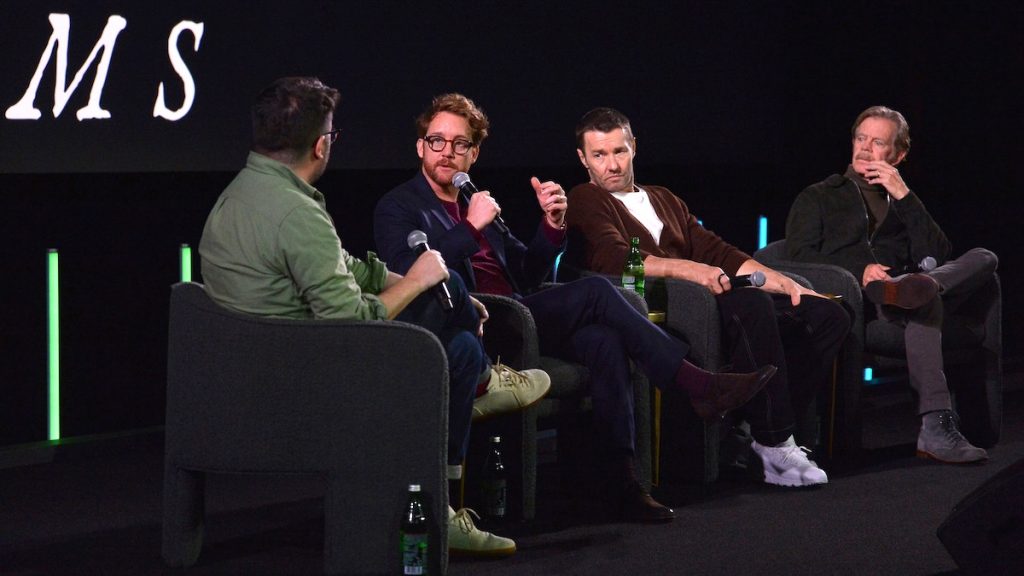
Clint Bentley, Joel Edgerton & William H. Macy
The Voice of the Landscape: Will Patton’s Narration
Central to the film’s internalized emotional architecture was the voiceover, performed by Will Patton. Bentley wanted to preserve Denis Johnson’s distinctive narrative voice – that lyrical flow of scenes that transforms a simple life story into something transcendent and effective.
Bentley continues: “Denis Johnson has this indefinable quality. The voiceover allows us to maintain the book’s lyrical nature while creating something distinctly cinematic. It allows us to enter Robert’s internal world without betraying the character’s fundamental quietness.”
Macy chimes in: “I find that whenever anybody walks into a forest, especially an old forest, you lower your voice, you have a tendency to talk quietly and even to whisper.”
“Even though Robert’s got eighteen feelings running within him, it was helpful to help the audience get inside that character through voiceover,” shares Edgerton. “I think there’s been a part of me that’s been afraid of really connecting on a personal level and showing people some of my own feelings, as if they’re not really worth it.”
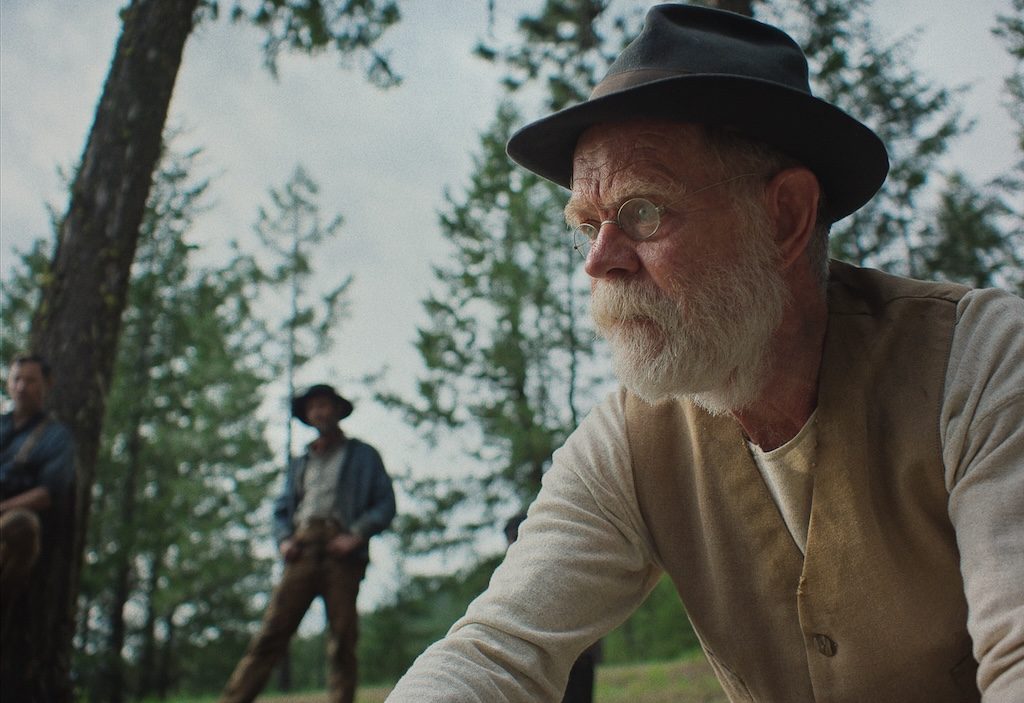
Arn Peeples (William H. Macy) Photo courtesy of BBP Train Dreams. LLC.
Themes of Loss, Connection, and Transformation
Thematically, Train Dreams is about more than logging or early 20th-century Americana. It’s a meditation on human resilience, on how we construct meaning in a world that often seems cruel and indifferent.
Edgerton views the film as a deeply personal exploration. “It’s about reconciling economic survival with emotional connection,” he notes. “How do we maintain our humanity while meeting the practical demands of existence?”
What sets Train Dreams apart is its commitment to quiet narrative minimalism. Many scenes are devoid of dialogue. Its storytelling restraint allows audiences to drift with the thematic subtleties of the film. Known for his ability to transform physically in previous roles, Joel Edgerton disappears into the character’s interiority. Every micro-expression, every subtle shift, every non-verbal gesture molds Grainier’s tale.
“I’ve spent years doing costume dramas and transformative roles,” Edgerton reflects. “But this felt different. This was about being present, about trusting that the camera would see something authentic if I just… existed.”
William H. Macy, a veteran of layered character work, appreciated the film’s philosophical undercurrents. His character Arn Peeples serves as a kind of narrative Greek chorus, offering wisdom that feels both ancient and immediate.
“There’s something profound about how we relate to nature,” Macy observes. “As someone who’s planted hundreds of trees in my lifetime, the idea of cutting down a 200-year-old tree is unsettling – it robs your soul of something.”
The film’s technical approach was as deliberate as its pulse. Shooting in natural light, often around actual campfires, created an immersive environment that blurred lines between performance and real life.
Bentley describes their filming methodology as an “iterative process of discovery”. Scenes were meticulously planned, but remained open to spontaneity and ad-libbing. The art department even reconstructed trees for certain logging sequences, a meta-commentary on environmental transformation.
Edgerton sees the film as part of a larger conversation. “It’s about ordinary people,” he states. “The kind of stories we often overlook. But these are the narratives that truly define us.” He sees this as the film’s most powerful element. “We’re not just telling one man’s story,” he says. “We’re exploring how individual lives intersect with larger historical narratives.”
Bentley was deeply moved by Denis Johnson’s original novella, but he wasn’t interested in a literal translation. Instead, he sought to capture the novella’s vibrant soul – its ability to find profound meaning in seemingly mundane everyday experiences.

Join the Discussion!
Related Articles
 Teddy Schwarzman on Producing “Train Dreams”: The Challenges of Getting the Film Made and How He Broke Into Hollywood
- How Filmmakers Greg Kwedar and Clint Bentley Approached The Rehabilitation Through The Arts Program In “Sing Sing”
- “None Of This Is Real. It’s Both A Dream & A Nightmare” Thomas Wright On ‘The Stranger’



Browse our Videos for Sale
[woocommerce_products_carousel_all_in_one template="compact.css" all_items="88" show_only="id" products="" ordering="random" categories="115" tags="" show_title="false" show_description="false" allow_shortcodes="false" show_price="false" show_category="false" show_tags="false" show_add_to_cart_button="false" show_more_button="false" show_more_items_button="false" show_featured_image="true" image_source="thumbnail" image_height="100" image_width="100" items_to_show_mobiles="3" items_to_show_tablets="6" items_to_show="6" slide_by="1" margin="0" loop="true" stop_on_hover="true" auto_play="true" auto_play_timeout="1200" auto_play_speed="1600" nav="false" nav_speed="800" dots="false" dots_speed="800" lazy_load="false" mouse_drag="true" mouse_wheel="true" touch_drag="true" easing="linear" auto_height="true"]







You must be logged in to post a comment Login