
“Hijacking The Attention Economy” Daniel Goldhaber & Isa Mazzei on ‘Faces Of Death’

This interview contains mild spoilers.
Faces Of Death is one of the original video nasties in the 70s. Widespread censorship and banning the film by John Alan Schwartz for overly-graphic depictions of human deaths ensured Faces Of Death remained an underground cult favorite. Decades later, the film is reimagined for a modern audience by Shudder. The grainy Super 8 footage and under the counter, well-played VHS videocassettes have been replaced with online videos on the Kino platform. However, the spirit of the original film and our fascination with the macabre remains alive. And of course, the underlying question of whether the footage is real or fake.
The new version of Faces Of Death makes several references to the original film and tracks Arthur (Dacre Montgomery) who re-enacts the murders for his online videos in search of clicks and notoriety. He is merely following market forces and giving consumers what they want. On his heels, is Margot (Barbie Ferreira) a jaded content moderator, who’s convinced that these videos may not be elaborately staged stunts, but rather, gruesome acts of violence playing in real time.
Director/ co-writer, Daniel Goldhaber & co-writer/ producer Isa Mazzei (Cam, How To Blow Up A Pipeline) spoke with Creative Screenwriting Magazine) about injecting new interest into the film while adding a modern flair to it.
How did you navigate the controversy surrounding the original Faces Of Death while imagining your version of it?
Isa: When we first got it from Legendary Pictures, we had not seen the original movie. We’re both 34, so the first thing we did was watch it. From there, we recognized we had already seen parts of it before.
I’m thinking of the “monkey moment,” and a few other familiar kinds of clips that I had seen online but pulled out of context. I never realized they all came from the same source. We realized that as much as we hadn’t originally engaged with it when Faces Of Death first came out, it was still a part of the cultural lore that we grew up with online.
Do you consider your version of Faces Of Death a remake, a re-imagining, a reinterpretation, or an homage?
Daniel: I think of it as a mixed media film. Personally, I think of it as a movie that’s about Faces Of Death. It’s about something that exists in our world. I don’t think of it as having much more of a connection to the original film.
If it was a remake or a re-imagining, it would need to exist as a fake object, as something that was purporting to be something it’s not, which is not really what our movie is doing. Our movie is a slasher film about a someone who has been motivated by Faces Of Death to hijack the attention economy. I’ll just call it an homage or an honoring, kind of like Seven.
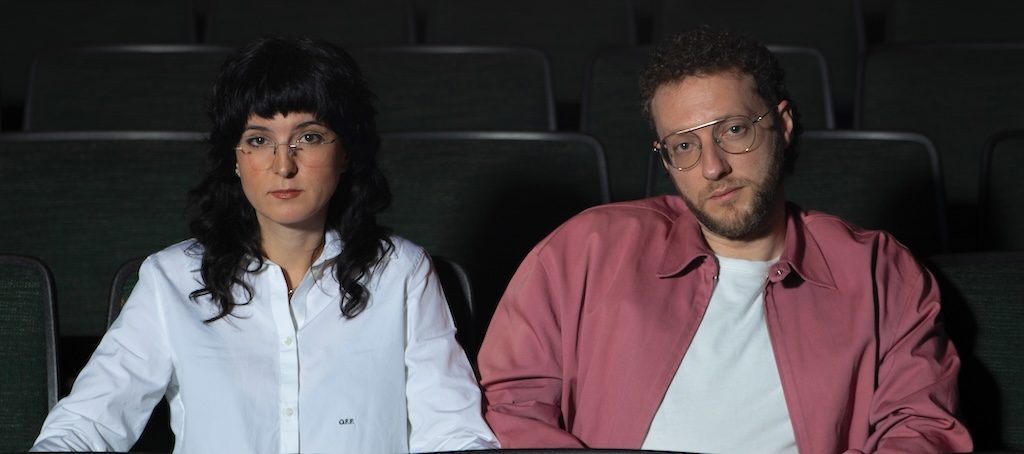
Isa Mazzei & Daniel Goldhaber, Photo by Jason Lester
How did you approach contemporizing video cassettes to online culture?
Daniel: From the beginning, there was a recognition that Faces Of Death used to exist on VHS tape. It was something that was incredibly difficult to find, something that was banned, something that was a video nasty and caused a moral panic.
We treated it as the most dangerous images on the planet are now served to people on a daily basis on their phones. This was something that Isa and I had initially encountered in a very decentralized way on the internet. The entire movie conceptually grew out of that.
Where is Faces Of Death today and how do we tell a story about it?
I think that the idea of sitting in a world of content moderation felt very exciting because there’s so much about the way the internet works that is invisible. That’s part of what’s so alienating about it. There is literal labor that goes into running this thing that appears to be this infinite service that we’re all able to tap into.
From a standpoint of creating characters, I think the idea that we start with a janitor of the internet was a fun place to begin.
Aside from the original film, did you turn to other popular culture for inspiration?
Isa: We looked into more traditional films. There was a big reference to Silence of the Lambs and Clarice Starling. I think her relationship to the killer is something that I was really inspired by – to bring into Margot and her relationship to the killer and her feeling of knowing something and wanting to uncover it for yourself. Also, this recognition that Clarice recognizes that she’s met her match in this killer. I think Margot and Arthur have the same dynamic.
Bringing the internet into this is what our work focuses on. Our first film Cam was heavily about the internet as well.
We want to make sure that the parts of this film about the internet feel really authentic and true. We’ve all had the experience of cyber stalking, trying to find some information online and bringing that into Margot’s experience where it’s like, “I go to Reddit.” So Margot’s gonna go to Reddit too.
Arthur doesn’t seem to have a huge traumatic backstory to explain his actions. How did you create his character?
Daniel: What I find very interesting about Arthur, and the way that people read Arthur is, where he lives. Look at his house.
He gives a story to the cops about his parents dying tragically recently. There’s a lot of the aesthetic in this suburban nothingness. His house is a like a giant McMansion that’s seemingly made out of plastic, in this neighborhood of people that don’t really speak to each other. Arthur is somebody who’s looking to connect in that sort of isolated environment. And the only real way that he’s able to connect, is by committing acts of extreme violence and having people pay attention to him on the internet.
We all want to connect with each other in a world that’s an attention economy. So the more attention you have, the more value you have. And a great way to generate lots of attention is by committing acts of violence.
It’s a big part of the psychological reality of living in America these days. We wanted to evoke that without being overly didactic or explicit about it. Arthur could really be everyone, especially isolated teens. Clicks and views are their lifeblood.
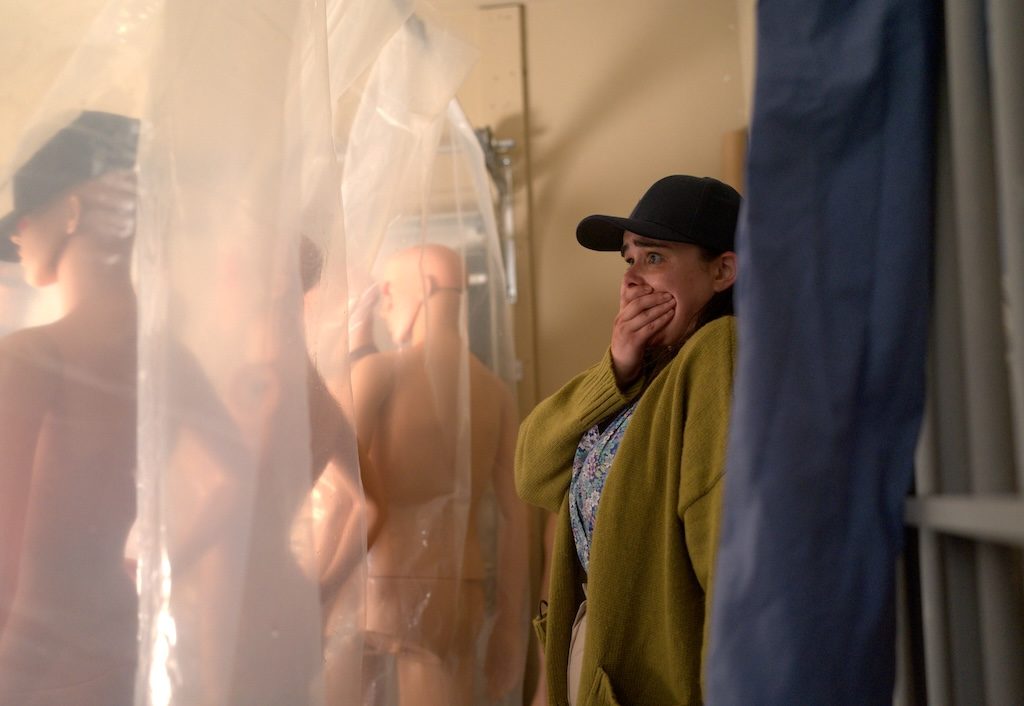
Margot (Barbie Ferreira) Photo courtesy of IFC/ Shudder
Tell us more about Margot and her motivations.
Daniel: Part of what we were thinking about in developing protagonists for this movie, is that if you have a normal content moderator who comes across this piece of content. They’re probably going to either do as their boss says – leave it up – or flag it and then move on with their day. They’re not going to disappear down a rabbit hole of trying to figure out who’s behind it and stop them.
It was important that our protagonist felt like they had like an especially significant personal stake in wanting to clean the internet and in really believing that, “I’m gonna get a job as a content moderator. I’m gonna really do my best to keep bad stuff off the internet.” That’s how I’m going to make up for this thing I did with my sister where I pressured her into filming that train video. She didn’t wanna do it, and she died. And then Margot posted it and this is how she’s gonna make up for that.
There was a real genuine reason for our protagonist to act when faced with the structural brick wall of the institution, the lack of assistance. So she feels that she has to take matters into her own hands, confront Arthur and track him down herself.
Why are audiences attracted to extremely violent videos?
Isa: It almost feels self-protective. I remember seeking out videos like this in high school or middle school when everyone was talking about them. I had a fascination with them while also being horrified by them.
It’s like when you’re in your bed at night, and you’re scared of monsters when you’re a little kid, and you think, “Oh, well, if my eyes are open, if I’m looking at it, then it can’t hurt me. If I turn on the lights, it can’t hurt me.” I think it’s similar to that where you feel that if you look away, it’s almost more dangerous than confronting it by staring it in the face.
It’s almost ritualistic how we engage in this kind of repetitive behavior of consuming video violence, as if knowing about it, as if witnessing it, will somehow protect us or protect those we love.
Where there any scenes that you felt might alienate the audience?
Isa: Not in the writing process, but in discussing with Daniel how to incorporate actual videos that exist out in the world. A huge point of discussion for us was whether to to include real videos of violence and death or not.
Ultimately, we decided to do it. That came out of conversations with the filmmakers of the original as well – while a lot of it is staged, there are also real deaths. It would feel disingenuous or cute to not include that in our film when I know I can open Instagram and see a dead body right now.
Procuring that content to put in the film was something I think legitimately traumatized me. I had a research assistant, and I think we had moments where we would look at each other and ask “Are we gonna need therapy after this? Because we looked at a lot of snuff.”
What are you saying about the morality of these online video platforms?
Isa: We want people to think about who’s actually benefiting from us being fed these images on our phones, on social media all day, constantly. It’s not us.
When we watch these violent images, these videos, when we interact with them, when we see them on our feed, when we repost them, are we actually helping?
What are we doing by engaging in that act? I think that by decontextualizing these things we see every day and putting them in a movie theater, we hope that kind of recontextualization will cause people to reevaluate these assumptions about social media and whether it needs to be this way.
Did you do much research on how algorithms work?
Daniel: I’ve actually had more difficulty getting things off of my feed than getting them. It also doesn’t take a ton of research in the sense that like everyone is very aware of the algorithm.
It’s very easy to observe it happening in real time. An act of mass violence happens and then we very quickly trace back the message boards to that person who committed it. In many ways, we felt like we were just reflecting a media ecosystem in which we were already a part of, not really something that we had to go looking for.
What is the broader theme you’re exploring in Faces Of Death?
Isa: I think it’s about how our attention has been taken from us. It’s been hijacked. I don’t think anyone wants what the algorithm offers. I don’t think we asked for this. We asked for social media.
We grew up with the coming of the internet. I remember the internet used to have such a hopeful promise. It was a place of sharing knowledge. It was a place of connection. It was a place where I found my earliest friends. And I think somewhere along the line, it became this horrible thing that can suck you in and steal your attention for hours and give you whatever it to make you feel the type of way that it wants you to feel.
That’s on the tech companies. They know that if I’m angry, if I’m upset, if I’m depressed, I’m going to keep scrolling. There’s an interesting study that shows that we actually don’t get dopamine from scrolling. What we get is a decrease in cortisol. Scrolling will calm us for a minute, but then it spikes when we stop. So we’re hooked.

Join the Discussion!



Browse our Videos for Sale
[woocommerce_products_carousel_all_in_one template="compact.css" all_items="88" show_only="id" products="" ordering="random" categories="115" tags="" show_title="false" show_description="false" allow_shortcodes="false" show_price="false" show_category="false" show_tags="false" show_add_to_cart_button="false" show_more_button="false" show_more_items_button="false" show_featured_image="true" image_source="thumbnail" image_height="100" image_width="100" items_to_show_mobiles="3" items_to_show_tablets="6" items_to_show="6" slide_by="1" margin="0" loop="true" stop_on_hover="true" auto_play="true" auto_play_timeout="1200" auto_play_speed="1600" nav="false" nav_speed="800" dots="false" dots_speed="800" lazy_load="false" mouse_drag="true" mouse_wheel="true" touch_drag="true" easing="linear" auto_height="true"]







You must be logged in to post a comment Login