
Jeremy Slater on “Mortal Kombat 2”: Inside the Screenwriter’s Vision for the Sequel

Jeremy Slater (Godzilla X Kong: The New Empire, Moon Knight) returns to write the next chapter of Mortal Kombat with Ed Boon and John Tobias. The first Mortal Kombat film was released in 1995 and its sequel Mortal Kombat: Annihilation in 1997. The franchise went into hiatus and rebooted in 2021. Now, its sequel Mortal Kombat II is released, once again directed by Simon McQuoid.
Slater crafts an expanded Kombat multiverse in his densely-layered screenplay. The fan favorite champions – now joined by Johnny Cage (Karl Urban) are pitted against one another in the ultimate tournament battle to defeat the dark rule of Shao Kahn (Martyn Ford) that threatens the existence of the Earthrealm and its defenders.
The screenwriter grew up in the age of big 90s blockbuster movies including Speed, Jurassic Park and The Matrix, which informed his tastes.
“I love those kind of movies, and I feel that Hollywood has forgotten how to make them. We get a lot of IP shovelware, but we don’t get a lot of material that is primarily designed to just take the audience on a great ride and have them exit the theater with a big smile on their faces,” Slater comments.
His mission was to combine his creative sensibilities with an existing IP like Mortal Kombat to create the type of film he would have enjoyed watching during his teenage years.
To IP or not to IP
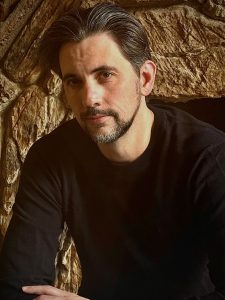
Jeremy Slater. Photo by Melissa Russell
Slater isn’t sure that he could pitch Mortal Kombat if it was a new original idea.
“It would be impossible. I don’t know if Christopher Nolan could do it. If he walks in and says, ‘It’s a movie about a karate tournament for the fate of the universe, and the participants are a bunch of ninjas, wizards, cyborgs and movie stars,’ you would laugh him out of the room,” Slater imagines.
Fortunately, the Mortal Kombat film franchise has been around for over 30 years, it’s made billions of dollars, and it has millions of fans all over the globe. So, it’s a reasonably safe bet for film studios. Slater observes the excitement of that built-in fanbase who’ll drive ticket sales with advance purchases and cosplay at screenings.
Jeremy Slater doesn’t view Mortal Kombat as simply a video game to movie adaptation. He laments that n-oone makes dark, R-rated, martial arts, fantasy movies anymore. Part of the joy of Mortal Kombat II is that this ignored genre is that it can be made under the protective studio banner.
Balancing Being Faithful To Video Games With Film Narrative
Traditionally, video games aren’t known for deep character exploration. Slater has his own opinions on cardboard cut out characters.
“There are two schools of thought when it comes to adaptations, whether it’s video games, comic books, any genre IP. There’s the literalists, and there’s the adaptationists.”
“It’s the difference between Zack Snyder’s and Damon Lindelof’s Watchmen. Snyder’s version is faithful to the comic to the point of recreating comic book panels, while Lindelof used the iconography and characters to tell a story audiences haven’t heard before. ‘We’re going to tell you a story that hopefully gives you the same feelings you had when you experienced the original.'”
Slater opts for the latter in Mortal Kombat II in trying to duplicate that sense of character discovery.
“If I’m watching something and it’s too faithful, I stop engaging with it on an emotional level as a viewer.” He starts waiting for expected references or shots straight out of the video game and compares the two, rather than enjoying each version in its own right.
He approaches his storytelling in a similar way to Marvel and DC Comics. “We’re going to take these characters and stories, use the elements that make sense, but we’re not going to be beholden to it to the point where you’re just recreating a scene in live action.”
“The casual audience is baffled and left on the outside, and the hardcore fans say, ‘It was good, but I’ve seen it before.’ So you have to have some element of surprise,” he adds.
Jeremy Slater is also cognizant of “playing in someone else’s sandbox.” Writers must be respectful of the source material. There is always room for personal creativity, but you can’t change the basic story for the sake of it.
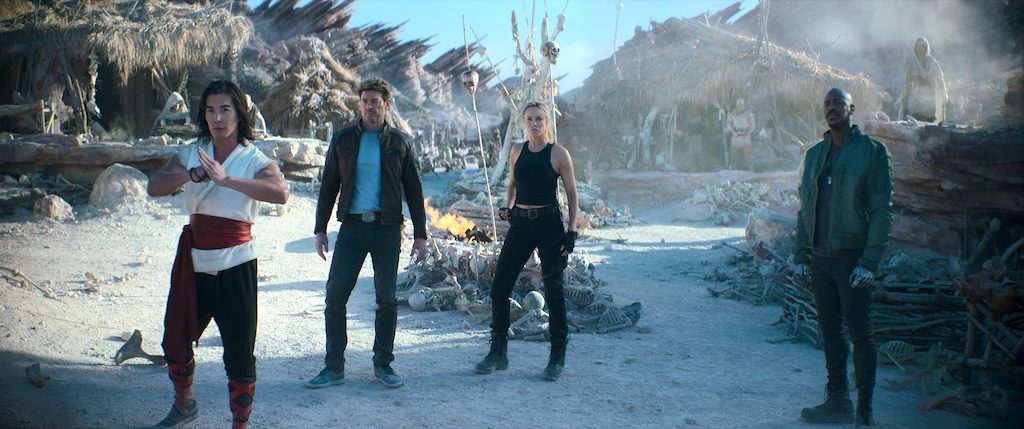
Liu Kang (Ludi Lin), Johnny Cage (Karl Urban), Sonya Blade (Jessica McNamee) and Jax (Mehcad Brooks) Photo courtesy of Warner Bros. Pictures
Writing Mortal Kombat II
A group of writers are typically issued with a comprehensive brief from actors, producers, directors, cast, and executives on how to shape a film like Mortal Kombat. Slater considers himself to be relatively unique. “I got to write the brief.”
The creative process began with a roundtable discussion where the studio calls in around half a dozen writers or directors they have a relationship with, and ask for their take on the material. Sometimes, they have a screenplay or outline only, a problematic script that needs punching up, or an almost finished movie that needs some additional photography.
Other times, it’s a “blue sky” roundtable where the studio wants to make the film, but hasn’t started working on the story. This was the case for Mortal Kombat II. Warner Bros. wanted to make a sequel and invited broad pitches, including from Jeremy Slater. The screenwriter is a big advocate of pitches, even if they are rejected. They indicate that he has thought about the story and contributed to the finished film in some way.
He approached his studio pitch to Warner Bros. as follows: “You promised Johnny Cage is coming and we have to do justice to that. We can’t have him fulfill the same role he did in the 1995 movie where he just stands in the background and says funny things every now and then. He has to be a main character.”
“The other one is that the tournament is coming. We can’t delay this anymore. This is what the fans want to see. That means we need to really engage with this. I also came in and said my personal problem with martial arts tournament movies is that they’re all peaks and valleys.” The action must be constant.
There’s a big fight and then the characters wait for the next fight to begin. Slater believes this approach trains the audience to disengage with the film until the next fight. Slater prefers to “hit the gas” on the movie from the start.
That said, audiences can become action fatigued if the film is a series of non-stop fight sequences. His solution to this was to pitch a B-story line that weaves in between the big martial arts tournament. The characters are developed with a side objective based on something they need.
“Let’s say the only way you guys can win is if you do X, Y, and Z. That way, there’s always an additional objective and a goal, even in between the fight sequences. When the round table was over, they asked me to write the first draft. It was the easiest yes I’ve ever said in my life,” Slater recalls.
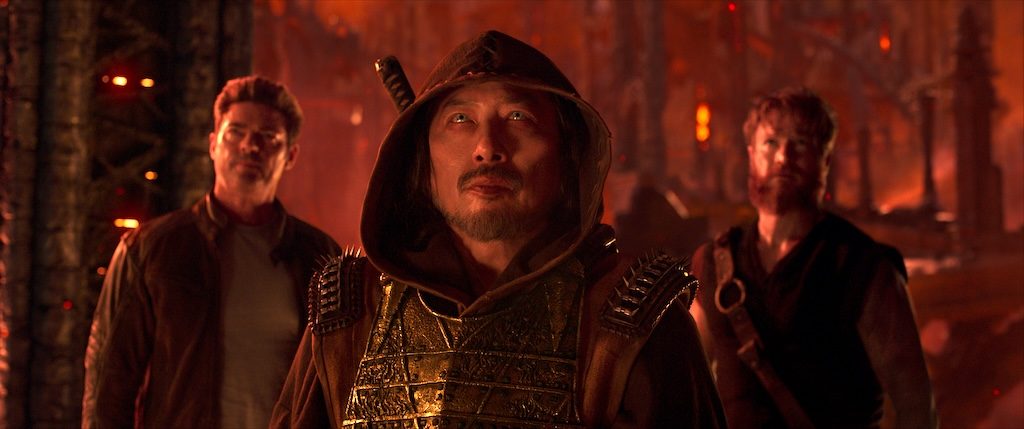
Johnny Cage (Karl Urban), Scorpion (Hiroyuki Sanada) and Kano (Josh Lawson) Photo courtesy of New Line Cinema/ Warner Bros. Pictures
Playing Mortal Kombat II For Laughs
Mortal Kombat relies on quips, references, and comedic interludes much like its predecessor. Comedy is part of its DNA.
“Josh Lawson, who plays Kano, and Karl Urban, who plays Johnny Cage, were our two improv superstars where it doesn’t matter how funny the dialogue you write for them is. They’re going to give you five more versions off the top of their heads. And sometimes their lines were better than mine,” Slater says.
“To find the right balance, you need a little bit of winking for the audience. That’s something that was missing a little bit in the first movie. They were struggling with trying to figure out the right tone and how much will the audience go along with it.”
“In the first movie, everyone felt, was probably a little too grounded in the real world. It was a little too self-serious. And for this one, we need to give the audience permission to laugh at the absurdity of this crazy scenario these characters find themselves in. That’s why it’s so helpful having someone like Johnny Cage enter the movie as a newbie who knows nothing about it. This mirrors what the audience should be feeling in that moment.”
“It’s really a balancing act because you can take that too far, and then it becomes Deadpool. That’s a different beast where nothing really matters. Everything is sort of a gag. We’re never going to have a moment of real sincerity because we’re always going to undercut it with a joke. I didn’t want Mortl Kombat II movie to be that, especially with Kitana’s (Adeline Rudolph) storyline in trying to get revenge for her family.”
“It’s very emotional. It’s very grounded in loss and tragedy. We didn’t want to be constantly undercutting that with gags and winks. Finding that balance where we could have some levity, we could acknowledge that it’s okay to have fun, but never tipping our hands so that it felt like the whole thing is silly.”
“Once it becomes silly, you’re telling the audience it doesn’t matter and they no longer care. You always strike that tone of where’s the line. We can walk right up to it, but never step across it. The line is basically a cliff’s edge, and for Cage and Kitana, that’s what they’re like in real life.”
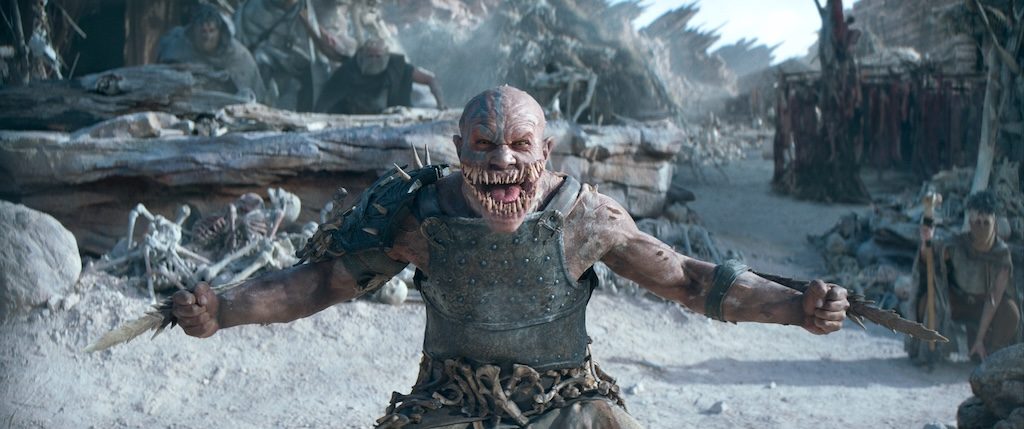
Baraka (C.J. Bloomfield) Photo courtesy of New Line Cinema’s/ Warner Bros. Pictures
Mythology and Lore
“Part of the joy of Mortal Kombat is that you’re not restricted to one genre. If you’re doing a John Wick movie, John is going from nightclub to nightclub and he’s shooting gangsters with guns. You can have different gags and different weapons, but the same thing is happening in every sequence.”
“Mortal Kombat has such a deep roster of characters, locations, and powers that you can have wildly different fights in the same movie that still feel fairly cohesive. We have some stuff that takes place in the real world in a very grounded state – in the parking garage of Comic-Con, and we also have two characters battling over an acid pit full of spikes and slime and a stage that’s hovering with a big blue spinning portal in the background,” Slater adds.
“You can really blend classic Hong Kong martial art movies with 80s fantasy, almost ‘Beastmaster Krulls’ type stuff. When you start talking about the Tarkatan village where Johnny fights Baraka (CJ Bloomfield), with grounded fights in our world, including battles between Bi-Han (Joe Hazlim) and Hanzo (Hiroyuki Sanada), which is just like a classic Samurai duel that just happens to take place in hell.” This was Slater’s favorite sequence to write.
“But there are different scenes that normally would never coexist in the same space. I think part of what makes Mortal Kombat so much fun to write, and part of why the fans love it, is that it does have that breadth.”
Some people were concerned whether the humor in these scenes would play well with the audiences. But the screenwriter insisted they would. Johnny Cage needed a trial by fire with life and death stakes. This sequence tracked highest with test audiences indicating that his persistance paid off.
The screenwriter still took viewer concerns about overload on board. The humor was never at the expense of the characters and Cage never made fun of Baraka. “He’s not ridiculous. He just doesn’t necessarily understand our language and our customs and doesn’t really care about social niceties at all.”

Join the Discussion!



Browse our Videos for Sale
[woocommerce_products_carousel_all_in_one template="compact.css" all_items="88" show_only="id" products="" ordering="random" categories="115" tags="" show_title="false" show_description="false" allow_shortcodes="false" show_price="false" show_category="false" show_tags="false" show_add_to_cart_button="false" show_more_button="false" show_more_items_button="false" show_featured_image="true" image_source="thumbnail" image_height="100" image_width="100" items_to_show_mobiles="3" items_to_show_tablets="6" items_to_show="6" slide_by="1" margin="0" loop="true" stop_on_hover="true" auto_play="true" auto_play_timeout="1200" auto_play_speed="1600" nav="false" nav_speed="800" dots="false" dots_speed="800" lazy_load="false" mouse_drag="true" mouse_wheel="true" touch_drag="true" easing="linear" auto_height="true"]







You must be logged in to post a comment Login