
Chamber Films vs Contained Movies and the Craft of Writing Stories Under Pressure

Some of cinema’s most unforgettable films are built on a paradox: the smaller and focused the world, the greater the dramatic possibilities.
Some of the most economical screenplays ever produced are also among the most psychologically sophisticated and layered. Understanding chamber films alongside the enduring appeal of contained movies reveals why restriction and minimalist filmmaking has become one of cinema’s most effective storytelling tools. If screenwriters focus on constantly changing locations, elaborate action and spectacle, and the screenplay has nowhere to hide.
While audiences often use the terms interchangeably, chamber films and contained movies are not the same thing. They overlap frequently, particularly in independent filmmaking, but each represents a distinct storytelling approach.
Understanding where they diverge and converge — and why films like The Whale, Locke, Buried, Conclave, 10 Cloverfield Lane, Heretic, Phone Booth, Circle, Knock at the Cabin, Knives Out, and Mass succeed — offers valuable lessons for screenwriters.
Chamber Films vs. Contained Movies Explained
The distinction begins with the source of dramatic tension.
A chamber film is defined by concentrated psychological conflict, while a contained film is defined by concentrated physical space.
A chamber film prioritizes interpersonal conflict. The term derives from the theatrical tradition of chamber plays — small-scale dramas built around a limited cast, restricted settings, and psychological rather than physical action on a stage. The camera becomes an observer of human behavior rather than a participant.
A contained film, by contrast, is defined primarily by production constraints. The story unfolds in one location — or a very small number of related locations. Although many contained films are thrillers, the format can include horror, science fiction, drama, comedy, or romance. A romcom set entirely in an elevator that is stuck between two floors is a contained film.
Many contained thrillers may partially function as chamber pieces because the confined environment intensifies relationships. Many films contain the DNA of both and are acutely aware how to parse them.
The Whale remains largely confined to Charlie’s (Brendan Fraser) apartment, yet its emotional engine is family reconciliation with his daughter Ellie (Sadie Sink) rather than external danger. Buried takes place almost entirely inside a coffin, making survival itself the narrative objective. One examines emotional imprisonment; the other literal confinement.

Paul Conroy (Ryan Reynolds) in Buried. Photo courtesy of Lionsgate
Prison dramas frequently employ the same chamber principles. The Experiment, A Prophet, and Hunger create dramatic intensity through systems of confinement where authority, identity and survival become inseparable. The walls matter less than the psychological torture they impose.
Courtroom films operate similarly. Anatomy of a Fall, A Few Good Men and The Caine Mutiny Court-Martial derive suspense, not from movement, but from progressing argument, testimony and incremental revelatory bombshells that continually recalibrate what the audience believes.
The common denominator is pressure and space. Chamber films compress space and intensify pressure, so that character becomes plot.
A contained film is more defined by where the story happens. A chamber film is defined by how dramatic pressure is generated. One is primarily a production model. The other is a storytelling model.
Many of these definitions are academic semantics. The most reductive way to separate the two, is whether a film could have been adapted from a play. However, this definition of chamber cinema is becoming decreasingly relevant to modern cinema.
Chamber Play Adaptation Film: Why Theatre Continues to Influence Cinema
Many successful chamber films originate as stage plays, making the chamber play adaptation film an enduring category within prestige or awards cinema.
These stories demonstrate that cinematic adaptation is not about “opening up” the play with unnecessary exterior scenes. Instead, filmmakers use framing and performance to create cinematic intimacy and a deep insight into the human psyche.
The screenplay remains driven by dramatic confrontation rather than visual expansion.
Contained films = production constraint (one location, limited locations, manageable budget)
Chamber films = dramatic constraint (psychological pressure, competing objectives, no escape from conflict)

Charlie (Breandan Fraser) in The Whale. Photo courtesy of Focus Features
Screenwriting Advice for Chamber Films
Write for Dialogue, Not Action
Chamber films live and die by dialogue. Every line should reveal character, advance the emotional narrative, or create subtext. If you have a beautiful action sequence in mind, you might not be writing a chamber film. If you can remove 80% of the physical actions and still have a complete story, it’s probably chamber material.
Exploit Escalation, Not Movement
Since characters can’t flee, escalation must be emotional and psychological. Each scene should raise the temperature: mistrust grows, secrets emerge, pretense cracks, threat and violence becomes inevitable (or friendship deepens—depending on your story).
Structure should follow a pressure-cooker model: initial civility → small cracks → major revelations → climactic confrontation
Develop Subtext Ruthlessly
With nowhere to go physically, subtext becomes your visual language. What characters don’t say, where they stand, what they won’t look at — these become crucial. Directorial choices will carry meaning.
Keep Your Cast Tiny
Aim for 2-5 main characters. More than that, and you diffuse focus. In a chamber film, every character must be essential to the psychological dynamic. There aren’t supporting characters.
Limit Your Locations
Ideally one room, or a few connected rooms. This isn’t about budget limitations — it’s about psychological intensity. The space should feel like a character itself. – like a secluded cabin.
Chamber Films Are Psychological Pressure Cookers
A chamber film is less about geography than dramatic concentration. While many unfold in a single room or building, the defining feature is sustained psychological conflict between a small group of characters whose competing objectives cannot be escaped.
The setting functions as a pressure vessel. Every conversation tightens the screws and expands possibilities. Every revelation shifts power. Every silence carries meaning because there is nowhere else for the story to go.
This is why courtroom dramas, prison dramas, military command stories and interrogation films often feel like chamber cinema even when they occupy more than one room. Their dramatic world is deliberately sealed off from the outside to shine a spotlight on them. The conflict becomes increasingly internal.
A Chamber Film Asks Deeper Character Questions
The central dramatic question is emotionally and psychologically intense.
- Can these people reconcile or at least reach an impasse?
- What truths remain hidden? What are revealed?
- Which relationships will survive confrontation?
A Contained Thriller Asks Survival Questions
The primary dramatic question is external.
- Can the protagonist escape?
- Who can be trusted?
- What is really happening?

Mr. Reed (Hugh Grant) in Heretic. Photo courtesy of A24 Films
How Chamber and Contained Films Differ
Chamber films prioritize character revelation. The confined space is metaphorical —it forces characters to confront each other and themselves. Conflict is primarily psychological and interpersonal. Think of it as “people trapped by their relationships.”
Contained films prioritize plot momentum. The confined space is functional — it creates obstacles, raises stakes, and forces characters to act. Conflict can be external (escape, survive, solve the mystery). Think of it as “people trapped by circumstance.”
Chamber: What will these people say to each other?
Contained: What will these people do to survive/ escape/ solve this

Stu Shepahrd )Colin Farrell) in Phone Booth. Photo courtesy of Fox 2000 Pictures
Why Limited Location Cinematography Creates Better Drama
The phrase “limited location cinematography” often sounds like a budgeting decision. In reality, it becomes a storytelling discipline.
When writers remove geographical variety, every remaining storytelling tool must become sharper. Characters cannot leave an uncomfortable conversation simply because the next scene moves elsewhere. Writers cannot distract audiences with travel montages, large action sequences, or visual spectacle.
Instead, conflict evolves internally and strategically.
Steven Knight’s Locke demonstrates this beautifully. The entire film unfolds inside one moving car. Visually, almost nothing changes. Dramatically, everything does. Every phone call dismantles another aspect of Ivan Locke’s carefully constructed life until the confined physical space becomes secondary to his emotional collapse.
Similarly, Mass, written and directed by Fran Kranz, spends nearly its entire runtime inside a church meeting room where two families confront the aftermath of a school shooting. There are no flashbacks, no courtroom scenes, and virtually no visual spectacle.
Pressure is contemporary example of the contained survival thriller, Pressure traps its characters in an extreme war environment where technical problems quickly become psychological ones. Like Buried or Frozen, the physical predicament supplies the premise, but the screenplay succeeds because escalating stress exposes flaws in leadership, trust and decision-making. The environment isn’t simply an obstacle — it becomes an engine for character revelation.
This economy of storytelling demands extraordinary discipline from the writer. Every scene must alter the emotional balance. Every revelation must change the audience’s understanding. Every interruption must increase pressure rather than merely extend runtime.
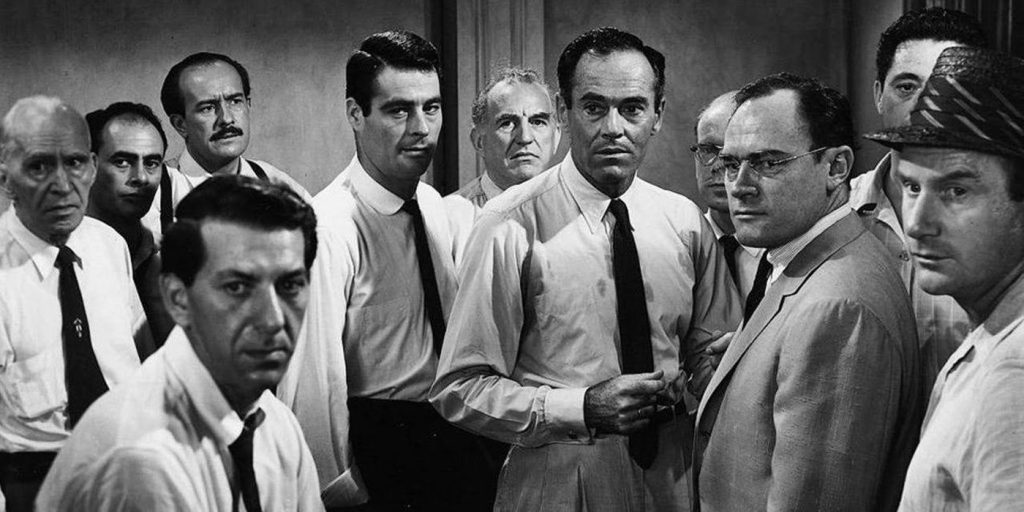
12 Angry Men. Photo courtesy of United Artists.
The Best Single-Room Movies Use Escalation
The best single-room movies rarely feel static because they continually change the emotional temperature and character dynamics inside the same physical environment.
Consider 12 Angry Men.
The jury room never changes, yet alliances constantly shift. New evidence reframes previous assumptions. Individual prejudices surface. The room becomes psychologically larger because the screenplay continually redefines the conflict.
The same principle drives The Hateful Eight.
Most of Quentin Tarantino’s western unfolds inside Minnie’s Haberdashery. The setting remains fixed while suspicion escalates through shifting loyalties, hidden identities, and carefully delayed information.
Rodrigo Cortés’ Buried takes this concept to an extreme.
Ryan Reynolds spends the film inside a coffin, yet the screenplay introduces new complications through phone conversations, environmental changes, dwindling resources, and difficult choices to expand the story scope. The confined location never limits narrative momentum because the dramatic circumstances continue evolving.
Dialogue-Driven Films Demand Invisible Structure
Many writers mistake dialogue-heavy scripts for conversations.
Professional screenplays understand that dialogue (or lack of) is action and character revelation. The finest dialogue-driven films use speech to negotiate status, conceal intentions, manipulate opponents, or reveal uncomfortable truths.
Aaron Sorkin’s scripts frequently demonstrate this principle, but chamber cinema depends upon it even more because dialogue often replaces physical action. Notice how The Father repeatedly destabilizes the audience through contradictory conversations. Or Social Network baffles viewers through cannon fire dialogue.
Observe how Conclave, adapted from Robert Harris’s novel by Peter Straughan, transforms confidential discussions into political warfare. Although the film moves between a handful of Vatican interiors rather than literally one room, its tightly controlled environment and emphasis on competing agendas place it firmly within the chamber tradition. Every exchange changes the strategic landscape. Nothing exists simply to provide exposition or visual opulence.
Come and Go is a theatrical adaptation of Samuel Beckett’s work. It explores three women in conversation. It’s for experimental theater enthusiasts.
Why Writers Keep Mistaking a Contained Film for a Chamber Film
Many contained scripts fail because the writer assumes the location is the concept.
It isn’t.
A cabin, submarine, jury room or prison cell isn’t inherently dramatic. The location only becomes compelling when it forces incompatible objectives into prolonged collision.
Take Phone Booth. The phone booth isn’t interesting because it’s small; it’s interesting because leaving means immediate death.
Locke isn’t compelling because Ivan Locke is driving. It’s compelling because every phone call forces him to choose between competing responsibilities he can no longer postpone.
Likewise, Conclave isn’t about cardinals trapped inside the Vatican. It’s about ambitious men who cannot leave until one of them becomes pope. The location should function as a dramatic amplifier. If the story would play exactly the same in twenty different locations, it probably isn’t truly contained.

Conclave. Photo courtesy of Focus Features.
Is Your Story Really a Chamber Film?
Before committing to the format, writers should ask several questions.
Could the story remain compelling if the characters never left the primary location? Does confinement increase conflict? If moving the characters elsewhere would make the story easier, the restriction is working.
Would removing expensive action sequences actually strengthen the relationships? Every sequence should deepen pressure rather than simply repeat it.
Does every major scene permanently alter the emotional balance? Are the characters carrying the tension? If the suspense disappears once the concept is explained, the screenplay probably depends too heavily on its premise.
Can the conflict escalate through information, psychology, or moral choice rather than geography?
Would this still be compelling as a stage play? Not because it should become one, but because it tests whether the dramatic engine is rooted in character rather than spectacle.
If moving characters to additional locations merely disguises structural weaknesses, the screenplay may actually benefit from becoming more contained. Likewise, if the concept depends primarily upon spectacle or scale, forcing it into a chamber format may weaken the premise. The location should intensify the story rather than simply reduce the budget.
Why Chamber Stories Remain a Screenwriter’s Proving Ground
Chamber films expose craft with stark clarity. Problems can’t usually be fixed in post-production.
There are fewer distractions.
Dialogue must work impeccably. There can’t be any flabby or superfluous dialogue.
Character objectives must remain active and constantly evolve.
Conflict must escalate without relying on explosions, chase scenes, or constant visual novelty.
Screenwriting Advice for Contained Films
Establish Clear Stakes and Ask Questions Immediately
Why can’t they leave? Why can’t they call for help? Why can’t they solve this easily? Your premise must answer these questions fast.
10 Cloverfield Lane— She wakes up in a bunker. Captor says the outside is toxic. Leaving = death
Use Space as an Obstacle
The location should create meaningful problems with dire consequences. A haunted house is interesting only if the layout matters — if certain rooms are dangerous, if characters must traverse threats to reach goals.
Build Momentum Through Discovery
Contained films often work best with a mystery structure: information slowly reveals why the characters are trapped, what they must do, what the true danger is, as well as carefully constructed character reveals.
Allow for Kinetic Variety
Unlike chamber films, contained films can include action, chases, physical conflict. Use the space creatively. Don’t Breathe uses a dark house brilliantly because the blind man’s advantage in darkness creates visual storytelling opportunities for both.
Give Characters Goals Beyond Escape
Survival is a base-level goal. What’s the secondary goal? It is a deeper exploration of the “why?” Rescue someone else? Uncover truth? Protect a secret? This deepens the narrative beyond pure containment.
How to Know If Your Story Is Right for These Genres
Choose Chamber Film if:
- Your story is fundamentally about what people reveal about themselves when cornered or under pressure
- You have compelling characters with deep internal conflicts that dialogue can explore
- Your story works in real-time or compressed time (a single night, afternoon, etc.)
- Tension comes from interpersonal dynamics, not external threat
- You have an original perspective on human nature, morality, or relationships
- Your premise is simple: “What happens when these specific people meet?”
- You’re interested in ambiguity, subtext, and what’s unsaid
Examples of chamber-ready premises:
– An aging director holds auditions with a young actor, and power dynamics shift unexpectedly
– Two estranged siblings reunite at a parent’s funeral and must reconcile 30 years of resentment
– A therapist realizes one of her colleagues is a patient’s abuser
Choose Contained Film if:
- Your story has a clear external problem that must be solved
- Characters must overcome obstacles or survive a threat to succeed
- You have an exciting, high-concept premise that audiences want to experience
- The location is integral to the plot (not just a backdrop)
- You want to build suspense, dread, or excitement through circumstantial pressure
- The story has a clear ending condition (escape, rescue, discovery, survival)
- Multiple characters drive different subplots within the same space
Examples of contained-ready premises:
– A woman is trapped in a sinking car and must escape before it drowns
– Strangers wake up in a locked room with a bomb and one hour to defuse it
– A family must survive a home invasion by an enemy they can’t identify
Final Words
For writers looking to develop that discipline, receiving professional script coverage before submitting widely can identify whether the tension truly builds scene by scene or whether repetition has crept into the confined setting. Similarly, screenplay contests often reward scripts that demonstrate exceptional command of character, structure, and dialogue — qualities that outstanding chamber and contained films depend upon.
A well-executed contained screenplay gives readers nowhere to hide from strong craft, making expert feedback and competitive evaluation logical next steps before approaching agents, managers, or producers.
Whether you’re writing an intimate family drama or a high-concept survival thriller, chamber and contained storytelling remain among the clearest demonstrations that screenwriting is not measured by the size of its canvas, but by the precision with which conflict unfolds.

Join the Discussion!



Browse our Videos for Sale
[woocommerce_products_carousel_all_in_one template="compact.css" all_items="88" show_only="id" products="" ordering="random" categories="115" tags="" show_title="false" show_description="false" allow_shortcodes="false" show_price="false" show_category="false" show_tags="false" show_add_to_cart_button="false" show_more_button="false" show_more_items_button="false" show_featured_image="true" image_source="thumbnail" image_height="100" image_width="100" items_to_show_mobiles="3" items_to_show_tablets="6" items_to_show="6" slide_by="1" margin="0" loop="true" stop_on_hover="true" auto_play="true" auto_play_timeout="1200" auto_play_speed="1600" nav="false" nav_speed="800" dots="false" dots_speed="800" lazy_load="false" mouse_drag="true" mouse_wheel="true" touch_drag="true" easing="linear" auto_height="true"]







You must be logged in to post a comment Login