
Frankenstein: Discussion with Guillermo del Toro and Actors Jacob Elordi, Oscar Isaac, Mia Goth

Guillermo del Toro’s ambitious adaptation of Mary Shelley’s Frankenstein is a rich exploration of creation and humanity, starring Oscar Isaac as the titular Baron Victor Frankenstein, Mia Goth as Elizabeth and Claire, and Jacob Elordi as the Creature. Del Toro transforms Shelley’s classic novel into a gothic science fiction epic that probes into the psychological and moral complexity of its characters. Known for finding humanity in monstrous beings, the director crafts a haunting reimagining the classic horror tale. Mary Shelley’s novel has stood the test of time because it’s about so many things, but primarily the question of whether, just because we can’t do something, should we?
On finally bringing Frankenstein to the screen, Del Toro muses, “Sometimes you lose so much of your life working on a movie. You miss things with your children, with your family, with your friends. And sometimes it feels like you’re building a cathedral. And other times it feels like you’re building a 7-Eleven. Frankenstein is a sacred place, a majestic place.”
Jacob Elordi on Collaboration and His Role
Working under Guillermo was a transformative experience. I think we can all agree that the set that he makes is so inclusive, collaborative and joyful. It was very unexpected that he would be this free. I think it allowed all of us to be free.
He has this infectious enthusiasm that permeated the set. I remember one day distinctly. It was my first day of shooting, and I found myself on a vast frozen lake, being pulled by trained dogs. There was Guillermo, passionately shouting, “grim determination!” as he directed me. That was his first direction of the day, and it perfectly encapsulated his approach — full of passion and energy. Every day felt a bit like a wild adventure.
Guillermo has this wonderful way of making everyone feel included, fostering an atmosphere of joy and creativity. It’s inspiring to work in such a collaborative context, where all ideas are welcome, and laughter is a constant presence.
I’ll never forget my first fitting with Kate Hawley. It wasn’t the typical, quiet affair filled with measuring tapes and hushed conversations. Instead, Guillermo and Kate turned it into a lively gathering. At one point, even Oscar’s family joined the fittings. It felt like a celebration of creativity rather than just a technical process, and it set a positive tone for the rest of the production.
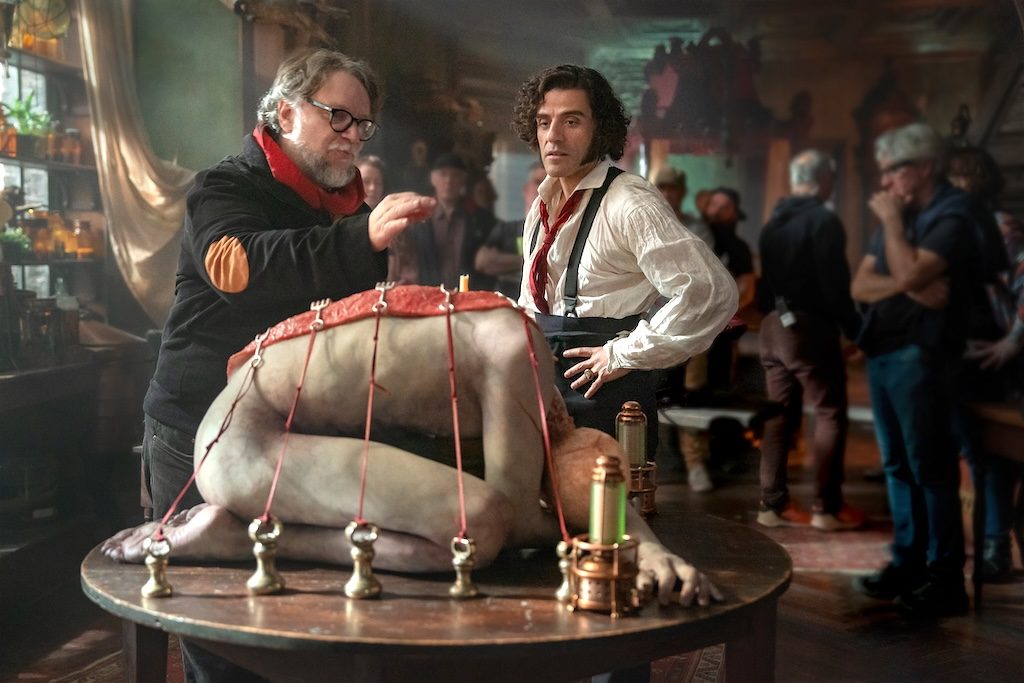
Director Guillermo del Toro, the Creature (Jacob Elordi) and Victor Frankenstein (Oscar Issac) Photo by Ken Woroner/ Netflix
Oscar Isaac on Exploring The Themes In Frankenstein
The novel poses profound questions about morality, the extent of scientific pursuit, and the ethical implications of creation of life througth death. Guillermo’s adaptation aims to address these complexities, particularly the nuances of fatherhood and the emotional ramifications of parental rejection and neglect. Victor Frankenstein is deeply flawed by his misguided ambition.
Victor was emotionally abused by his father, and he in turn, is perpetuating that cycle. How could anyone ever look at something so innocent and do such wickedness? And then move into that place of trying to rationalize it. It’s not only blindness, but there’s something that becomes this philosophy of cruelty. It moves into this Marquis de Sade kind of nihilism of how perfect the act of cruelty is.
It’s this running away that happens, running away from his responsibility, running away from himself, not wanting to look at those things. And then, I think the more relatable thing is just when patience dries up. There’s this uncontrollable urge to push away your child or to denigrate them.
Preparing for Victor was both daunting and enriching. When we first met before production, we discussed the intricate psychology of the character. Victor operates in a moral gray area; he’s not a villain for the sake of being evil, but a product of his environment and life experiences.
The character embodies a tragic flaw — an obsessive ambition that blinds him to the repercussions of his actions. Throughout the story, we see Victor grapple with guilt and regret as he abandons his Creation. His inability to confront his responsibilities results in a tragic cycle of pain, examining the themes of estrangement that Guillermo is known to explore in his films.
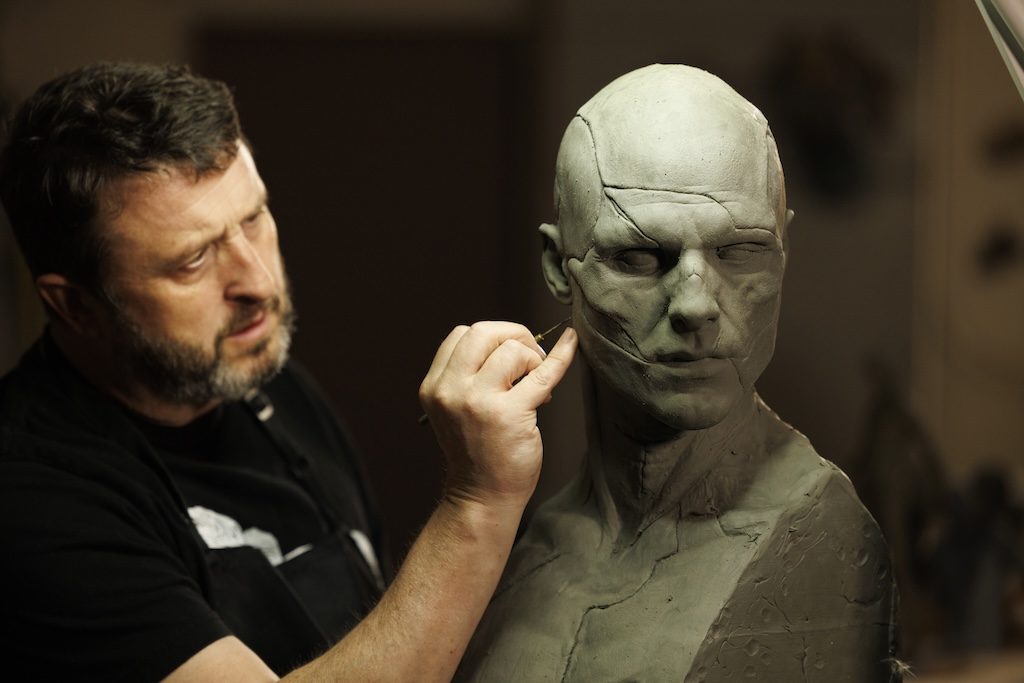
Prosthetic Makeup Effects Dept. Head Mike Hill creating The Creature. Photo by John P. Johnson/ Netflix
The Nature of Creation: Jacob on the Creature’s Perspective
The Creature begins its life as a blank slate. That was something Guillermo talked about. He said he needs to be nothing before he’s even a baby. There is this moment of nothingness before in the early stages, you’ve found a feeling or a physicality. The Creature is not burdened by consciousness at that point. It hasn’t learned cruelty. It hasn’t learned kindness.
It’s an abandoned child searching for parental comfort. One of the most poignant themes in Frankenstein is the exploration of family dynamics and the impact of deep emotional wounds across generations.
Portraying the Creature presented unique challenges, primarily because I wanted to convey a range of emotions without relying on words. For much of the early part of the film, the Creature is innocent, experiencing the world for the first time. I approached the role by tapping into primal instincts and emotions — fear, confusion, love, and desperation.
Guillermo emphasized not overplaying any specific emotion. Instead, he encouraged me to embody the rawness and vulnerability inherent in the character. The moments where the Creature cries out “Victor, Victor!” are filled with a longing. They encapsulate a childlike desire for connection, even in the face of rejection.
Oscar and Jacob on the Collaborative Experience of Creation
The collaborative atmosphere influence Jacob’s performance as the creature? I felt that everyone’s thoughts and contributions were valued, which led to spontaneous moments of inspiration. Oscar and I would discuss our scenes in-depth, finding nuances that added layers to our performances. I cherished those conversations; they created a sense of collective ownership over our characters.
Oscar completely agrees. Establishing that trust among the cast and crew was essential. We shared experiences, fears, and aspirations, and those conversations enhanced the depth of our work. It made each scene feel more impactful, knowing that we were all invested in these characters’ journeys.
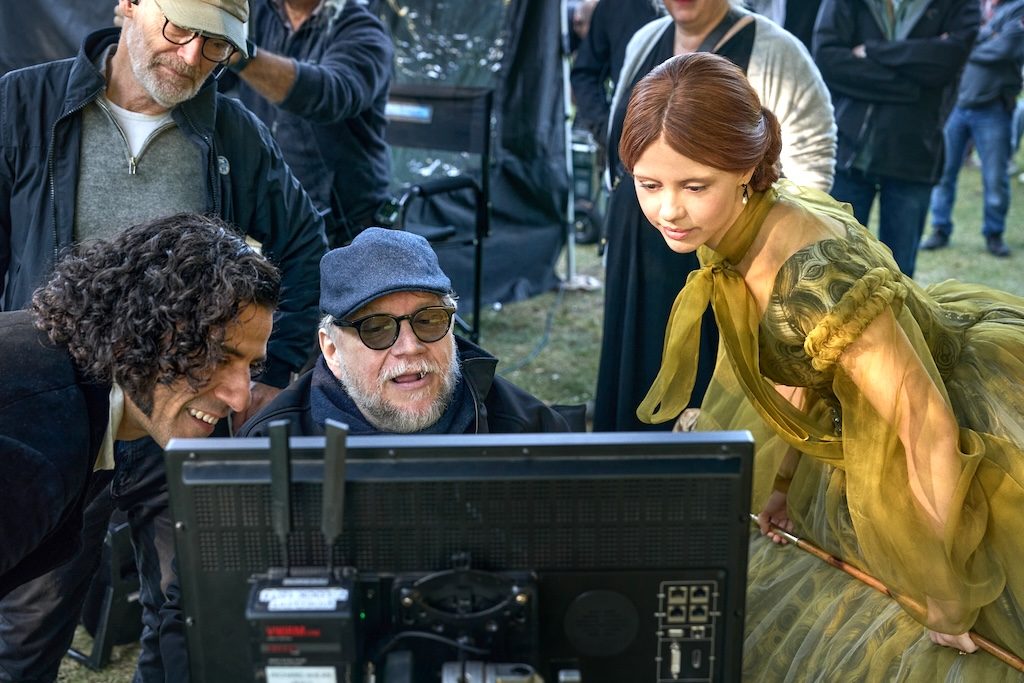
Victor Frankenstein (Oscar Issac), Guillermo del Toro and Elizabeth (Mia Goth) Photo by Ken Woroner/ Netflix
Mia on Playing Both Victor’s Love Interest and His Mother
Mia plays Elizabeth, Victor’s fiancée and his mother Claire, by design.
I did a lot of work to eventually realize that I had to let all of that and just get really quiet. And in those moments, in that space, kind of where you open your eyes after a meditation – that’s where Elizabeth exists. She’s this calm. She was like a smoke to me where I’d have her for a moment and then she’d be off again.
Elizabeth was a creature in her own way. She’s kind of fluttering in and out with these moments in the movie. It was pretty tricky. playing the mother and the love interest. It speaks to Victor and, I guess, men to an extent. It’s kind of a Freudian concept, isn’t it? He’s fallen for his mother.
Confronting The Ethical and Moral Questions in Frankenstein
Elordi explains that the Creature’s existence raises critical questions about the responsibility that comes with creation. He grapples with the existential crisis of being alive yet feeling utterly alone. The Creature represents anyone who has ever felt alienated due to circumstances beyond their control.
Isaac concurs that Victor’s journey reinforces the idea that with great power comes great responsibility. His decision to create life without considering the emotional ramifications ultimately leads to tragic outcomes. This is a theme that Guillermo carefully examines in the film. It challenges viewers to reflect on their own societal obligations, especially toward the vulnerable.
In conclusion, Guillermo del Toro said how difficult it is making a movie of this scale. “You climb Mount Everest with people you can huddle with at night and say it’s worth it!”
[More: Guillermo del Toro’s Frankenstein]

Join the Discussion!



Browse our Videos for Sale
[woocommerce_products_carousel_all_in_one template="compact.css" all_items="88" show_only="id" products="" ordering="random" categories="115" tags="" show_title="false" show_description="false" allow_shortcodes="false" show_price="false" show_category="false" show_tags="false" show_add_to_cart_button="false" show_more_button="false" show_more_items_button="false" show_featured_image="true" image_source="thumbnail" image_height="100" image_width="100" items_to_show_mobiles="3" items_to_show_tablets="6" items_to_show="6" slide_by="1" margin="0" loop="true" stop_on_hover="true" auto_play="true" auto_play_timeout="1200" auto_play_speed="1600" nav="false" nav_speed="800" dots="false" dots_speed="800" lazy_load="false" mouse_drag="true" mouse_wheel="true" touch_drag="true" easing="linear" auto_height="true"]






You must be logged in to post a comment Login