
Guillermo del Toro’s Frankenstein: Monsters, Humanity, and Honoring Mary Shelley’s Gothic Horror Work

And thus the heart will break, yet brokenly live on – Lord Byron
Guillermo del Toro stands as one of the most imaginative and respected storytellers in modern cinema, a director who brings monsters to life with stunning visuals and undeniable pathos. Now, he is turning his singular vision toward what he calls “the story of my life:” Mary Shelley’s Frankenstein; or, the Modern Prometheus.
Del Toro’s quest for finding meaning in monsters began after watching James Whale’s Frankenstein films from the 1930s for the first time. Mary Shelley’s masterpiece is filled with questions that ignited Guillermo’s soul:, tender, savage, doomed human questions that only monsters can answer.
Published anonymously on January 1, 1818, the first edition of Mary Shelley’s novel Frankenstein unveils the tragic saga of Victor Frankenstein, a man driven by both personal hubris and scientific curiosity to play God. The gifted scientist bestows life on a nameless Creature made from scavenged body parts, then turns away from his creation in horror, leaving him to wander alone in the world. Rejected by everybody as a ghastly abhorration, the lonely Creature turns violent, determined that his maker should suffer.
For del Toro, Frankenstein is far more than a simple horror story. It is an exploration of the boundaries of science, the pain of isolation, and the universal longing for love and belonging. “Monsters are metaphors,” del Toro has said repeatedly. “They show us who we are, what we fear, and what we hope for.” In Frankenstein, he finds a story where it takes a monster to explain what it means to be human. The story is further underpinned by the existential question: Who is the monster and who is the human?
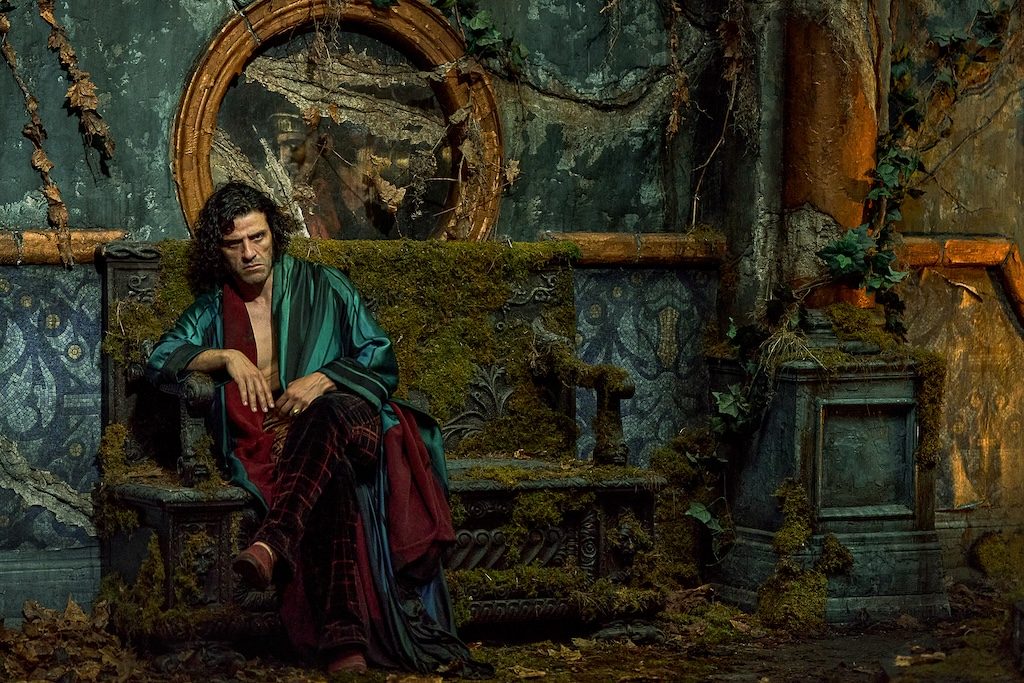
Victor Frankenstein (Oscar Isaac) Photo by Ken Woroner/ Netflix
A Lifelong Dream: Del Toro’s Personal Frankenstein
Del Toro’s fascination with Frankenstein began in childhood. “Frankenstein is the most important book of my life,” he has stated in numerous interviews. At seven years old, he read Mary Shelley’s text and was captivated by the tragic fate of Victor Frankenstein and his abandoned creation. For del Toro, the Creature (portrayed by the mesmerizing Jacob Elordi) was not merely a monster, but a sympathetic figure — an outsider, misunderstood and rejected, yearning for love and acceptance.
This sense of kinship has only grown with time. “I see myself in the monster. I see everyone in the monster.” This empathy for the marginalized and misunderstood — those who exist on the fringes of society — has been a defining theme in del Toro’s body of work, from Cronos and The Devil’s Backbone to Pan’s Labyrinth and the Oscar-winning The Shape of Water.
Del Toro’s journey with Frankenstein has been decades-long, marked by numerous setbacks and perseverance. Hollywood’s reluctance to revisit such a well-trodden story, especially with the level of ambition and nuance del Toro demanded, meant that for years the project lingered in development limbo. “There have been so many Frankenstein films,” del Toro acknowledges. “But I wanted to make something that honored Shelley and also spoke to our times.”
“This is a supernatural thing, and that’s me. That’s why I don’t fit in. When I lost my father and I lost my mother, and I really had to wonder about who I am because you become nobody’s child,” the filmmaker muses. This was his entry into the Creature.
The Long Road to Frankenstein
Del Toro’s script for Frankenstein has undergone countless drafts, refined over years spent obsessing over Shelley’s text and the philosophical questions at its heart. “I didn’t want to make Frankenstein again just because I could,” he explains. “I wanted to make it because I needed to.”
The breakthrough came when Netflix, fresh from the success of del Toro’s Oscar-winning Pinocchio, offered him the creative freedom and resources to realize his vision without compromise.
This freedom has also allowed del Toro to restore elements often lost in adaptation: the Creature’s education, his philosophical struggles, and his understandable request for a companion. “Shelley’s Frankenstein is not just a horror story. It’s a story about loneliness, creation, and the consequences of playing God,” del Toro emphasizes.
“A lot of the dialogue [in the film] is entirely original, but it has the patois and the rhythms of Mary Shelley. When English is your second language, you are trained very acutely to the melody and the rhythms of a language. I tried to make the dialogue be like that without sounding archaic,” Del Toro adds.
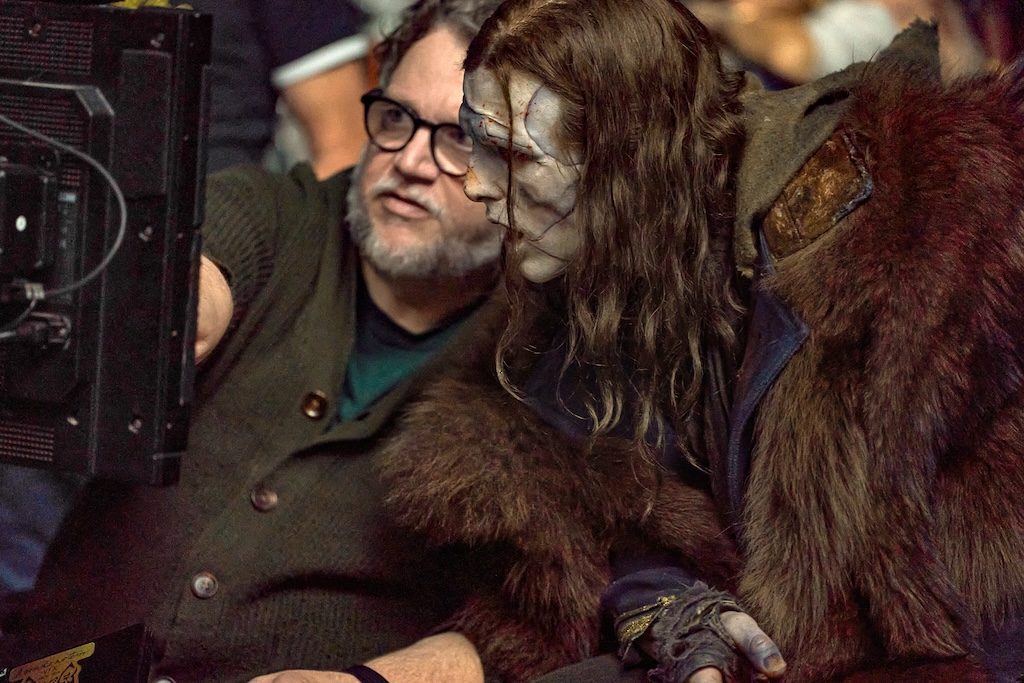
Writer/Director Guillermo del Toro and The Creature (Jacob Elordi) Photo by Ken Woroner/ Netflix
Victor Frankenstein: The Rock Star Scientist
At the center of Shelley’s novel is Victor Frankenstein (portrayed by Oscar Isaac) — a brilliant, tormented scientist haunted by unchecked ambition and remorse. Del Toro’s adaptation explores Victor’s menacing psyche with intense depth. “Victor Frankenstein is like a rock star — brilliant, reckless, and ultimately tragic,” del Toro explains, noting the character’s boldness and vulnerability and his grizzly fall from grace. He exudes punk rock energy.
“Victor is driven by grief and hubris,” Isaac says, following the death of the character’s mother as a boy. “He wants to conquer death, but in doing so, he creates something he cannot control.” Del Toro’s script gives Victor a rich complexity and conflicted moral ambiguity rarely seen in previous adaptations. Victor is as sympathetic as he is flawed — a man whose manic quest for greatness leads to his own destruction.
The film delves into Victor’s motivations, exploring his scientific curiosity, his fear of loss, and his inability to accept the limits of human power. Del Toro is fascinated by Victor’s duality: a man who becomes both creator and destroyer.
“Like all tyrants, Victor believes himself to be a victim.” He’s oblivious to the damage and heartache he’s caused. “Everybody in the movie has a failing and a lack. They all need love. I think it’s a very tender movie. For me, it’s a melodrama and a drama. I don’t see it in terms of a horror movie,” Guillermo iterates.
“There’s a beautiful circularity to it, this idea of fathers and sons and how trauma gets passed on, how good and evil are two sides of the same coin, and they’re constantly flipping back and forth, how words don’t necessarily get us closer to the truth,” Isaac says.
Jacob Elordi: Bringing the Creature to Life
“Jacob has this combination of strength and vulnerability that’s essential for the Creature,” del Toro continues. “He’s not just a monster — he’s a lost soul, desperate for connection.” Elordi has spoken about the challenge and honor of embodying such an iconic figure. “The Creature is poetry and pain. He’s innocent but feared, full of longing, but condemned to solitude.”
Elordi drew from a wide range of influences to shape his incarnation of the character. At del Toro’s suggestion, the actor familiarized himself with the slow, theatrical, sometimes surreal movements of the avant-garde Japanese dance form known as Butoh, to develop the Creature’s physicality. He also used books given to him by the filmmaker to consider how it might feel to be a newborn in the world, frightened of unfamiliar noises and sensations and desperate for encouragement and guidance.
In del Toro’s adaptation, the Creature is not a mute brute, but a being of intelligence, sensitivity, and eloquence. The update restores the philosophical and emotional richness of Shelley’s original character. “He is a character with profound emotional depth,” del Toro notes. “He learns, he questions, he suffers. He is more human than the humans around him.”
Faithful to Shelley, Yet Fiercely Original
Del Toro’s Frankenstein is rooted in a deep respect for the source material. He aims to faithfully adapt the structure, themes, and emotional resonance of Shelley’s novel, restoring scenes and philosophical debates often omitted from earlier versions.
Del Toro also places a unique emphasis on the Creature’s perspective, restoring his intelligence, eloquence, and moral complexity. “I want the audience to feel for the Creature, to understand his pain and his wonder,” del Toro says. “He is not a villain, but a victim.”
“Adapting is like marrying a widow. You have to respect the memory of her late husband, but on Saturdays, you’ve got to get some action.”
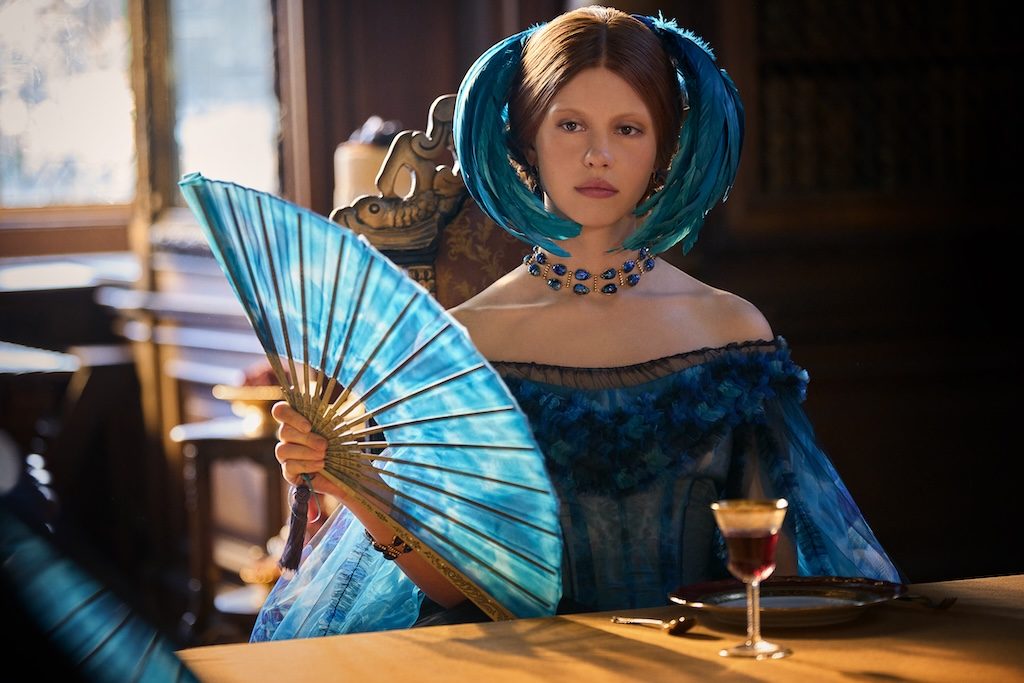
Elizabeth (Mia Goth) Photo by Ken Woroner/ Netflix
The Artistic Vision: Monsters as Mirrors to Humanity
Monsters have always occupied a central place in del Toro’s cinematic universe. To him, they are not merely objects of fear but mirrors reflecting our deepest anxieties and desires. In Frankenstein, this theme is front and center. “Monsters are metaphors,” del Toro reiterates. “They show us who we are, what we fear, and what we hope for.”
The Creature’s design, draws closely from Shelley’s descriptions —tall, striking, assembled from many bodies, yet possessing a soul. Del Toro’s Creature evokes both terror and pity, inviting the audience to see themselves in his suffering and search for meaning.
Del Toro’s films have always explored the idea that the monstrous and the human are two sides of the same coin. In Frankenstein, this duality is expressed not only through the Creature but through Victor, who ironically becomes monstrous in his obsession and isolation. The film subtly asks: Who is the real monster — the creation, or the creator?
Conclusion: The Enduring Power of Frankenstein
Del Toro, for his part, remains humble about the challenge ahead. “I’m just a custodian of this story,” he said. “I want to honor Shelley, and I want to honor the monster in all of us.”
Frankenstein endures in all its iterations because it asks timeless questions: What does it mean to be human? Can we escape the consequences of our actions? Is there hope for the outcast?
As del Toro himself puts it, “The story of Frankenstein is the story of all of us. We are all searching for acceptance, all capable of creating beauty and destruction.”

Join the Discussion!



Browse our Videos for Sale
[woocommerce_products_carousel_all_in_one template="compact.css" all_items="88" show_only="id" products="" ordering="random" categories="115" tags="" show_title="false" show_description="false" allow_shortcodes="false" show_price="false" show_category="false" show_tags="false" show_add_to_cart_button="false" show_more_button="false" show_more_items_button="false" show_featured_image="true" image_source="thumbnail" image_height="100" image_width="100" items_to_show_mobiles="3" items_to_show_tablets="6" items_to_show="6" slide_by="1" margin="0" loop="true" stop_on_hover="true" auto_play="true" auto_play_timeout="1200" auto_play_speed="1600" nav="false" nav_speed="800" dots="false" dots_speed="800" lazy_load="false" mouse_drag="true" mouse_wheel="true" touch_drag="true" easing="linear" auto_height="true"]







You must be logged in to post a comment Login