
Matthew Shear on “Fantasy Life”: Creating the SXSW Audience Award-Winning Rom-Com/ Dramedy

A law school dropout Sam (Matthew Shear) with anxiety takes on a job as a manny to his psychiatrist’s (Judd Hirsch) daughter Dianne’s (Amanda Peet) three boisterous girls who ask way too many awkward questions. This might sound like the setup to a New York romantic comedy.
Dianne’s marriage to musician David (Alessandro Nivola) is strained because he’s also doing much of the parenting. Dianne’s acting career has stalled and David is about to embark on a world tour. And they need a nanny. Sam to the rescue.
Actor and filmmaker Matthew Shear sees the chemistry between Sam and Dianne as more nuanced than a romcom.
There are certainly elements of romance and comedy in Fantasy Life, but Shear describes his film Fantasy Life as more of a dramedy.
Sam, and the kids’ mom (whom he pines for), both have chronic mood and anxiety disorders. Are these shared experiences the basis for a stable romance?
Shear drew on his history with depression and anxiety as honestly as possible in crafting these characters. He was especially eager to challenge many prevailing mental health narratives associated with such conditions; namely hyper-tragic stories tackling suicide or hospitalization. The filmmaker sought to find drama in the more personal, everyday comic aspects of living with a mental illness. While Sam is loosely based on Shear, Dianne’s struggles are very different from Sam’s. She has millenial and maternal burnout. However, they both share a spark of chemistry through shared isolation that revealed a funny, awkward and useful refuge for them both.
Matthew Shear spoke with Creative Screenwriting Magazine about tapping into his personal challenges to create his film.
What is the significance of the title Fantasy Life?
The title has some irony because these characters are confronting a kind of fantasy existence and finding the reality on the other side of it. You’ve got an unemployed law school dropout who ends up kind of embedding himself in a fantasy family and stands in for the mother of the family’s husband. Amanda Peet’s character is a languishing actress who wants to have a career that she doesn’t have.
Fantasy Life has a distinctive New York tone. Can you elaborate on that?
I think that New York has a population that is generally inside its head. It can be knocked out of its head by either a romantic situation or some kind of comic or dramatic scenario. That’s probably why Fantasy Life lends itself to a romantic comedy as it creates a drama for someone to go outside themselves.
Can you describe Sam’s character?
I’m an actor. So that was a connecting point. From there, Sam did take on the character of a number of different people in my life, including some family members. Fromt there, it started to take its own shape.
I had a very clear sense of the character and didn’t always need to belabour my performance or try and perfect it because I already had a good instinct for it. I think it hindered me sometimes because I couldn’t always see outside of that perspective.
I drew from my history and some aspect of my personal anxieties and neuroses to develop Sam. Sam takes that from me, but he really goes to town with it.
It was important to me to tell a story that had mental health elements in it in a way that felt normal and not overly dramatic. I didn’t want to make Girl Interrupted or The Joker or something that took it too seriously. I made a point of weaving it into regular life and having moments of humor, compassion, and absurdity.
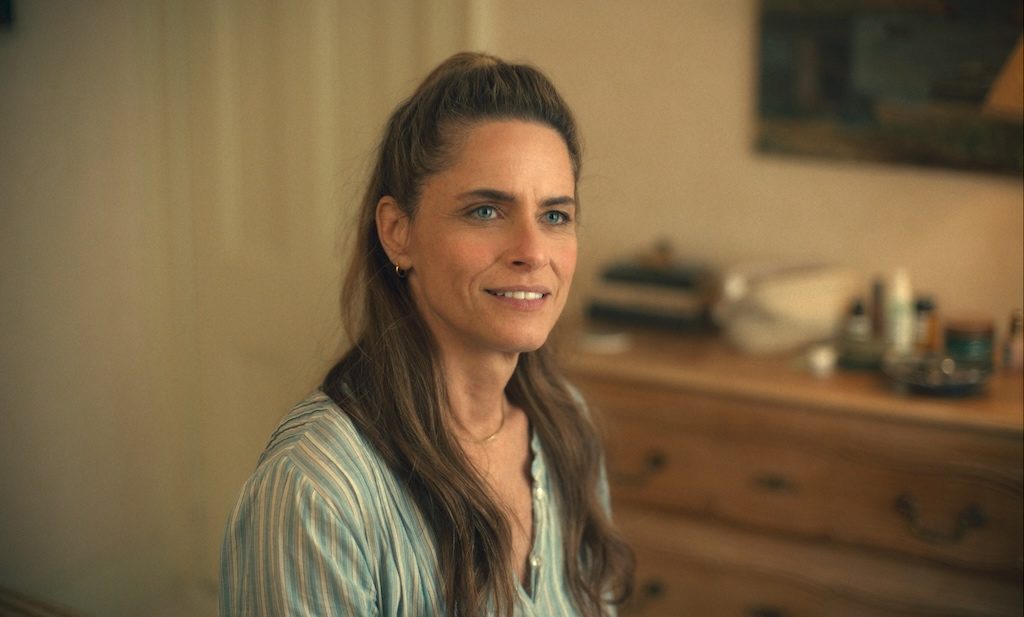
Dianne (Amanda Peet) Photo courtesy of Greenwich Entertainment
How did you build Dianne’s character?
The character came out of the writing process in that I had written this first section of the film where you learn about Sam and how he becomes his psychiatrist’s granddaughters’ babysitter, and their father. And you have a whole experience with them. Then you’re left asking, “Who the hell is the mother? Is there a mother?” That was a question for me while writing.
How did you cast the movie?
I brought on a casting director early in the process through my own connection to one as an actor. He was willing to help me. His name is Doug Aibel and he is very experienced.
He helped me get the script to actors’ agents. The process started to accelerate when Amanda Peet signed on. I wrote her a personal letter about why I thought she was really good for the role and why I’m a huge fan of hers. It was kind of like a Hollywood dream scenario where one of the producers knew her manager’s assistant, who used to work for this person’s assistant, who finally got it on the desk of Amanda Peet’s manager.

David (Alessandro Nivola) & Sam (Matthew Shear) Photo courtesy of of Greeenwich Entertainment
Describe Sam and Dianne’s relationship.
That’s part of the reason it has some force because you’re really seeing them as a couple although they’re really not. There’s clearly a rapport and some sort of bond, but, is it romantic?
It’s doesn’t seem to be exactly, but it has some relationship to romance. They’re really on their own journeys and you get to see them witness each other independently dealing with their own lives. I think that style of character development lets you go with Dianne at the end and do a deeper dive into what’s going on with her.
Sam ends up in a relatively stable place; the kind of place after something chaotic has happened in your life.
Six or eight months later, you’ve completely gotten past a heartbreak or something, but you’re back in your life. It seems to me that it was useful to him to have gone through that whole experience to evolve as a person. He’s in a humble place living with his parents.
He’s not where he wants to be, but he seems to handle the whole situation of seeing Dianne and communicating with her fairly well.
How did you advance Fantasy Life from script to screen?
The final version of the screenplay after feedback took about four or five years.
The first moment where I felt like I was onto something was after I’d written the scene with Sam and his psychiatrist. Sam was in the office waiting room talking to his wife and the conceit of him going to babysit. This became the basis for the screenplay.
After I was ready to send out the script, I gave it to my acting agent. I’d never had a lit agent before. We just sent it around and it didn’t gain much traction. I wasn’t attaching myself as a director at the time. I was looking for a director and only hoping to act in it. I met with various producers and production companies and nothing really was sticking. That was definitely a year or two. Then I met someone who became one of my producers. He couldn’t do it at the time, but later he left his job and called me. That was kind of how we started to get going on the film.

Join the Discussion!



Browse our Videos for Sale
[woocommerce_products_carousel_all_in_one template="compact.css" all_items="88" show_only="id" products="" ordering="random" categories="115" tags="" show_title="false" show_description="false" allow_shortcodes="false" show_price="false" show_category="false" show_tags="false" show_add_to_cart_button="false" show_more_button="false" show_more_items_button="false" show_featured_image="true" image_source="thumbnail" image_height="100" image_width="100" items_to_show_mobiles="3" items_to_show_tablets="6" items_to_show="6" slide_by="1" margin="0" loop="true" stop_on_hover="true" auto_play="true" auto_play_timeout="1200" auto_play_speed="1600" nav="false" nav_speed="800" dots="false" dots_speed="800" lazy_load="false" mouse_drag="true" mouse_wheel="true" touch_drag="true" easing="linear" auto_height="true"]







You must be logged in to post a comment Login