
Simran Baidwan on Writing The Pitt’s Revolutionary Healthcare Drama & Breaking Barriers for South Asian Writers

The Pitt, the Emmy-winning HBO Max medical drama, has redefined what a contemporary medical procedural can be beyond the ‘case of the week’ format.
Created by R. Scott Gemmill and executive produced by John Wells and Noah Wyle, the series captures an unflinching portrait of modern American medicine by following Dr. Michael “Robby” Robinavitch’s 15-hour emergency room shift — with each episode representing one real hour.
Simran Baidwan, the Emmy-winning EP and writer on both seasons of The Pitt spoke with Creative Screenwriting Magazine about the show.
Simran Baidwan’s Career Pivot from the Courtroom To The Pitt
Part of The Pitt‘s success is executive producer and writer Simran Baidwan, who made an extraordinary career pivot from criminal prosecution to television storytelling. After spending four years as a prosecutor Baidwan took a significant pay cut to start as a Hollywood assistant, eventually establishing herself as a writer on acclaimed series including The Good Doctor, Royal Pains, and Manifest.
With The Pitt, Baidwan became the first South Asian woman to win an Emmy in the Outstanding Drama Series category, cementing her status as both a trailblazer and a defining creative voice. The show’s resonance stems from Baidwan and Gemmill’s commitment to layered, socially aware storytelling that centers authentic representation — not as tokenism, but as the given. By exploring interconnected salient themes of immigration, workplace bias, healthcare inequity, and medical debt, without preaching.
Simran shared her thoughts with Creative Screenwriting Magazine on her career trajectory and making a hit medical show.
Related: “Never Start With The Medicine” Joe Sachs On‘The Pitt’
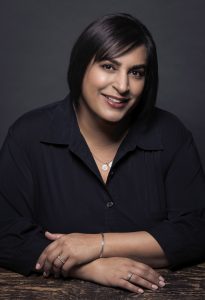
Simran Baidwan. Photo by Jilly Wendell
Discuss your transition from criminal law into television writing.
Some might argue law is also a creative field.
I did realize in hindsight is that there was so much structure in legal writing, especially when I was a criminal trial attorney. Much of what you do in trial is trying to capture the jury’s attention very quickly.
If you don’t engage them in the first two to three minutes, they’re thinking about what they’re going to cook for dinner or they’re looking out the window. So there’s a bit of performance involved. You want to get the most engaging information out first, hook them, and then hopefully have them along for the ride.
That’s really not that different than television writing. You want to make sure you hook them in the teaser.
Discuss your initial conversations with Scott Gemmell, John Wells, and Noah Wyle about The Pitt.
My initial meeting with Erin Jontow, who was the president of John Wells’s team, was developing a half-hour comedy. In the midst of our conversations, she said, ‘Your resume speaks more to drama.’ She suggested that if I was open to staffing, to let her know.
There was only one meeting for The Pitt, but it was just with Scott and Noah. I walked in and I had very little information. There was no script, there was no logline for the show. My team, just cryptically said, ‘We think it’s a medical show.’
When I went in, they did have the formation of it being set in Pittsburgh. It was going to be 15 hours, so one day in ER per episode.
They knew about Dr. Robbie’s (Noah Wyle) character and a few other main characters like Dana Evans (Katherine LaNasa). But as far as the medical stories and big arching storylines, they did not have that. We had a very candid conversation because I had worked on medical shows before and they wanted to know what things worked and what things didn’t work.
It was just such a wonderful conversation about the state of the world, the state of healthcare, and the things we could try to put together. I think my candor in talking about things that I saw, I liked or I didn’t like, or that I felt were missing, really resonated with them.
Two weeks later, they said, ‘Come join our merry band.’
Related: Eric Ledgin on NBC’s Workplace Comedy “St. Denis Medical”
What is the story engine of The Pitt?
I really think of it as the characters first.
Who are these people? Where are they? What brings us to their lives today?
The core of what we’re doing is leaning into the POV of our doctors, our healthcare workers, and everybody who’s in this environment. They are seeing all of the world’s ills coming into their front door. They see people in ER probably during the worst days of their lives.
How is ER who are dealing with that influx of humanity? How are these interactions reflective of their own lives, both personal and professional?
How do you break stories?
The Pitt isn’t afraid to tackle current hot button social issues in addition to medical ones.
Scott has created a wonderful environment where we have a safe space where we can pitch anything that is of interest to us. There might be things that we are reading about or happen to us in our personal lives. These so-called hot topics are grounded in reality.
We’re hearing real life stories from healthcare workers and we want to incorporate them into this show. Frankly, I think it would be irresponsible not to. When you’re talking about immigration, climate change, mental health, and death doulas, those aren’t political issues, they’re humanitarian ones.
We ended up talking about immigration and vaccination. We shot these things before all the things went down in Minneapolis. We’d already shot the vaccination story before the big measles outbreak happened. We were paying attention and listening to our colleagues in the healthcare industry.
In addition to that, there are issues like black maternal health and elder care that are really important to us.
We had seen so many facets of death where people are not prepared. I thought, ‘Wouldn’t it be nice to show someone who has some agency and be able to dictate the best that they can, the parameters of their death and what’s going to happen when they die, and make it something that is not so scary?’
How do you handle all sides of sensitive topics?
We are very fortunate that we have a writers’ room where we look each other in the eye and understand that nobody wants to be lectured to. We don’t want to be telling a story with a finger wag. Our whole goal is to present the topic as it appears, as we see it in real life. We are fictional, but also reflective of what it means in society.
There are people from different cultural and socioeconomic views in the room with differing ideas about how they feel about these topics. So, I think it’s also healthy for us to have that discourse in a way that is compassionate and not hysterical or yelling. How do we have these conversations where we can actually sit down and listen to each other? If we can do that through the medium of film and TV, that opens the broaderscope of conversations.
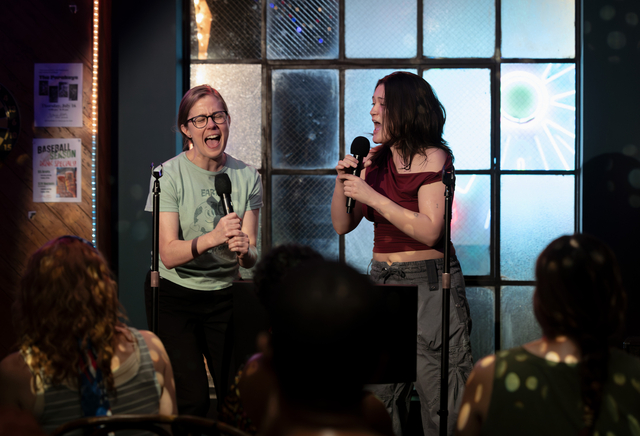
Dr. Melissa King (Taylor Deardon) & Dr. Trinity Santos (Isa Briones) Photo by Photograph by Warrick Page/ HBO Max
How do you balance the tone over the 15 hour time frame in each episode?
It’s very much about rhythm and flow. It’s a little bit like jazz. You’re playing in this arena – you are heavy here, and then we’re going to mellow it out there. That happens with storylines as well. We have very heavy stories with death and abuse, and then you can have really silly, funny stories about somebody getting pooped on. There’s the levity. There’s the balance. It’s a little bit of orchestration.
As far as the actual geographical mechanics, we have these giant boards in our room, which are maps of the actual floor plans of our stages.
Nina Ruscio, who is our production designer, brilliantly helped construct that before we even began writing, so we could see what the rhythm and flow of these spaces was going to be like.
We know that I’m going to handle these patients. What room am I going to put them in? So, when Robbie crosses off in the background, I can hang into Langdon (Patrick Ball) going into this room, and vice versa. We play with the space as much as we play with the story. It does feel very fluid and very active.
Related: Justin Spitzer and Eric Ledgin Discuss “St Denis Medical”
How did you break Season 2 of The Pitt?
We had a ten month break. It was really important for us when we started going into the room for Season 2 to think about what these characters did during those ten months off. What happened in their lives after this very shocking day with a devastating mass casualty that hits the hospital at the end of Season 1? For a lot of them, it was their first day ever in this department, and some were very green med students.
What is the aftermath? What are they like in their personal and professional lives? So much of that doesn’t necessarily come out on screen, but it really helps us to understand and build the layers of that character underneath.
I said to Scott Gemmell, ‘It would be great if we’d leave this little thread. What if we came back on Langdon’s first day after going to rehab? Let’s leave this little hanging chad about not tying up everything so neatly with Mel (Taylor Deardon) and this measles kit. What if it comes back and she gets sued?’ They were there in case we wanted to use them.
Once we realized we’re going to place Season 2 on Langdon’s first day back, it was really easy for us to figure out what are those interactions going to be. Seeing Santos (Isa Briones) and Garcia (Alexandra Metz) after they had a little flirtation. What happened with them? What’s going on with Javadi (Shabana Azeez) and her parents?
We don’t really tease out and see in completion until the end of Season 2 with, that farmer’s wife who Whitaker (Gerren Howell) really bonded with after her husband was severely burned. We have this wonderful brainstorming session in our blue sky room and talk about the hopes and dreams and what happened, what we might be able to bring to fruition, or we might just drop a little Easter egg.
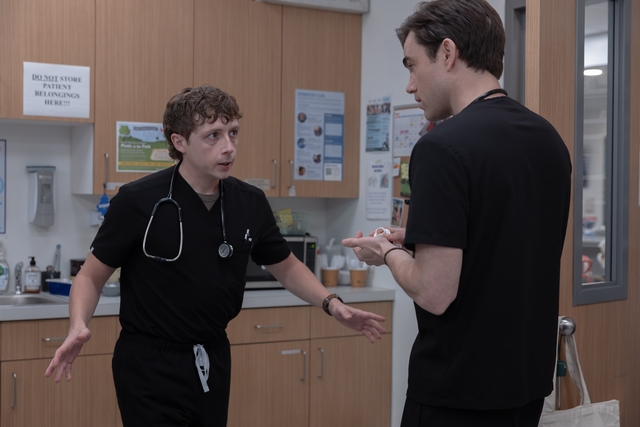
Dr. Dennis Whitaker (Gerran Howell) & Dr. Frank Langdon (Patrick Ball) Photo by Warrick Page/ HBO Max
As a woman of Punjabi immigrant parents, how do handle diversity in the writers’ room?
I think this is a testament to Scott. He could have filled the room with all of his friends.
Instead, he filled them with a brand new slate of writers, other than Noah Wiley and Joe Sachs, who he had previously worked with. The majority of the room is diverse. There are LGBTIQ writers. There’s so many of us from different backgrounds.
I think that that speaks volumes to wanting to incorporate different points of view – culturally, socio-economically and societally.
It was really important when I was first meeting with him that I’m just going to say what I have to say. I said, ‘I defy you to go into any hospital in America. I don’t care if it’s in Western Kentucky, or if it’s some tiny town in Texas, you will find a South Asian doctor.’ I was also advocating for Filipino nurses who are everywhere. You can’t tell a story without them.
I was just talking about things that t I felt were an accurate representation of the real world that I hadn’t really seen reflected on television. Scott really took that to heart. He said, ‘Let’s be really conscientious and deliberate about the choices that we are making.’
Can you think of a storyline that most speaks to you?
I’ll give you one example from Season 1, We had this story of an Asian woman and her elderly mother.
For me, as a South Asian woman, it was unheard of. When you had an elder person who was ailing, they lived with you. I lived with grandparents. I lived with aunts and uncles. We would bring a hospital bed in, they would be propped up in the living room, and they were with you until they died.
I would love to tell a story about an Asian family where the daughter is taking care of the mom and she’s living with her. It’s not easy. We talk about caretaker fatigue, and all these other things. Some of the story also delves into the financial burden that it creates, but also the social and emotional responsibility that so many of us in our culture feel to take care of our elders.
What is the most unique aspect of the writers’ room?
I think one of the benefits of our room is that we break every episode together. Very early on, in addition to talking to all the characters, we try to map out as much as we can in advance. What are we going to see in every episode and what the character arcs are going to be?
Where’s the trajectory? Where do we want to see Robbie beginning, middle, and end of Season 2? Where do we want to see Dana, where we want to see McKay (Fiona Dourif) or Santos? We talk about these characters and their interactions.
As we’re breaking the individual episodes, we do that again together. There’s the medical component and what characters we think would be best served in telling that story and how it would be reflective of them. The writer goes off and writes their outline.
When they bring it back, it’s in the safety of our room, We give notes on it before it goes out to any other producers or the studio network. Same thing happens with the drafts. We create this space where we can say, ‘This is working, this isn’t working, this feels like it doesn’t mesh with somebody’s voice.’
There’s one individual writer’s name on the script, but we all take a sense of pride in that all of our names are on this show. We’re only as good as our our weakest link. We want to make sure that we don’t have any weak links and that we help elevate one another to create the most exceptional show that we can. And you also need harmonization.

Join the Discussion!


Browse our Videos for Sale
[woocommerce_products_carousel_all_in_one template="compact.css" all_items="88" show_only="id" products="" ordering="random" categories="115" tags="" show_title="false" show_description="false" allow_shortcodes="false" show_price="false" show_category="false" show_tags="false" show_add_to_cart_button="false" show_more_button="false" show_more_items_button="false" show_featured_image="true" image_source="thumbnail" image_height="100" image_width="100" items_to_show_mobiles="3" items_to_show_tablets="6" items_to_show="6" slide_by="1" margin="0" loop="true" stop_on_hover="true" auto_play="true" auto_play_timeout="1200" auto_play_speed="1600" nav="false" nav_speed="800" dots="false" dots_speed="800" lazy_load="false" mouse_drag="true" mouse_wheel="true" touch_drag="true" easing="linear" auto_height="true"]







You must be logged in to post a comment Login